

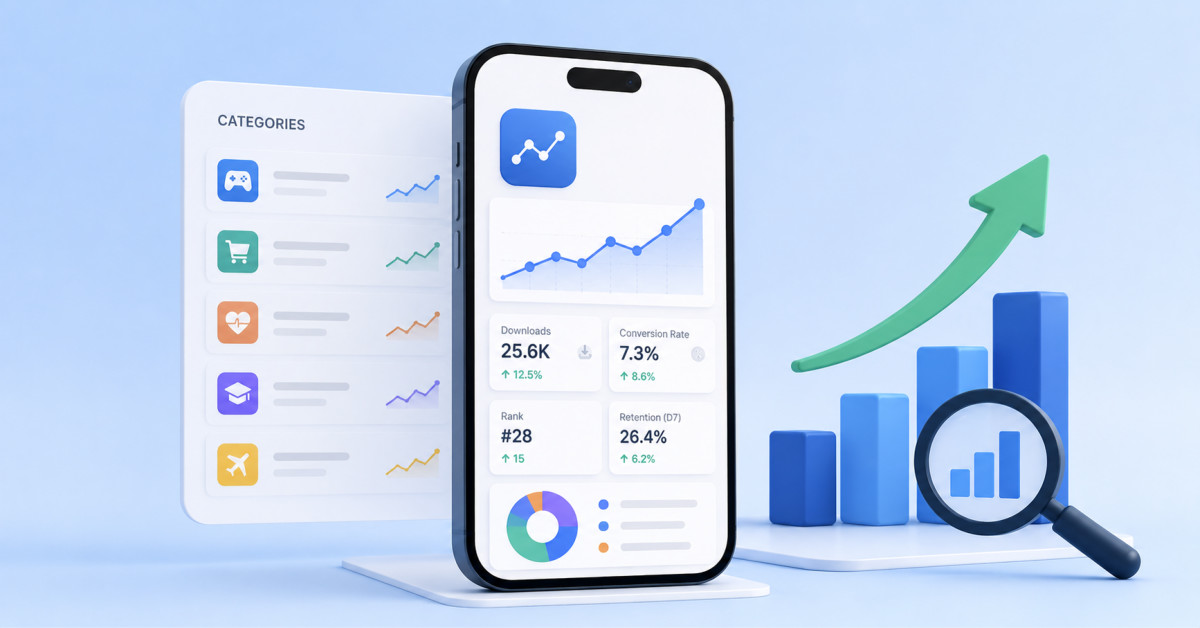
App category benchmarks improve growth planning by showing whether your visibility, rankings, reviews, and market movement are strong or weak relative to the apps competing for the same users. Internal metrics show progress; category context shows what that progress means.
A ranking gain is only meaningful when you know whether your app moved because it improved, because the category shifted, or because one competitor lost ground.
Growing an app without category context is like running a race without knowing who else is on the track. Internal metrics tell a team how their app is performing relative to its own history. Still, they say little about whether that performance is strong, average, or trailing within the actual competitive field. Category benchmarks give teams the external reference points they need to make better planning decisions.
Every app competes within one or more store categories, and those categories have their own dynamics. Leaders shift. New entrants gain visibility quickly. Seasonal patterns cause ranking fluctuations that affect the entire field, not just individual apps. Teams that track only their own numbers risk misreading what those numbers mean. A 20-position ranking improvement means something very different depending on whether the rest of the category moved in the same direction at the same time.
Planning a growth campaign without category data creates blind spots. Before increasing spend, expanding to new markets, or revising metadata, teams benefit from understanding the current state of the category they are entering or defending. Which apps currently dominate? How stable are their positions? Are new competitors gaining ground quickly? Are there segments of the category with less competition? These questions don’t need to be answered with perfect precision, but they do need to be asked — and they require data beyond the team’s own dashboard.
Inside any category, several signals are worth examining. Who are the consistent leaders, and how long have they held top positions? Which apps are gaining visibility quickly, and through what apparent means — keyword targeting, review velocity, ratings improvement? How does ranking distribution look across different countries? Are there subcategories or adjacent query clusters where the competitive set is less established? Are category leaders also dominant in search, or do they rely more on brand and browse? Each of these comparisons helps a team identify where their app fits in the category and where there may be room to grow.
ASOMobile is an app store optimization and market analytics service that provides keyword research, rank monitoring, competitor analysis, category data, and review tracking for both major app stores. Teams can use the platform to explore category leaders, monitor visibility changes among competitors, and track how rankings shift over time. Rather than relying on assumptions about who dominates a category, teams can check the data and form hypotheses based on what is actually happening in the market at a given point.
Category benchmarks are especially useful before major growth decisions. Before scaling paid acquisition, a team can check whether category leaders are stable or whether the top positions are contested — which affects how much effort organic optimization can realistically contribute. Before entering a new market, a team can look at which apps lead in that country and how competitive the ranking environment appears. Before a major metadata revision, comparing competitor descriptions and keyword coverage in the category can inform which directions are most worth testing. These are not decisions that category data makes automatically. They are decisions that category data makes better.
App teams interested in understanding where their app stands within its category can explore market intelligence features at ASOMobile and evaluate which benchmarking capabilities fit their planning process.
Category benchmarks are reference points derived from how other apps in the same store category perform. They include ranking positions, visibility trends, review volume, and competitive activity — giving teams external context for evaluating their own results.
ASOMobile provides data on category leaders, keyword rankings, competitor visibility changes, and market trends across both Google Play and the App Store. Teams can use this data to understand the competitive landscape before and during growth campaigns.
Top chart positions signal strong install velocity or sustained engagement, depending on how each store weights those factors. Understanding which apps hold these positions — and how that changes over time — helps teams calibrate their own growth targets against realistic category standards.
Useful comparisons include: which apps lead consistently versus which fluctuate, how competitive the field is in specific countries, which keyword clusters competitors are targeting, and how recent entrants have gained or lost ground.
Yes. When teams understand the category environment — including competitor stability, market size signals, and ranking movement patterns — they can make better decisions about where to focus optimization effort, which markets to prioritize, and how to interpret their own results in context.




