

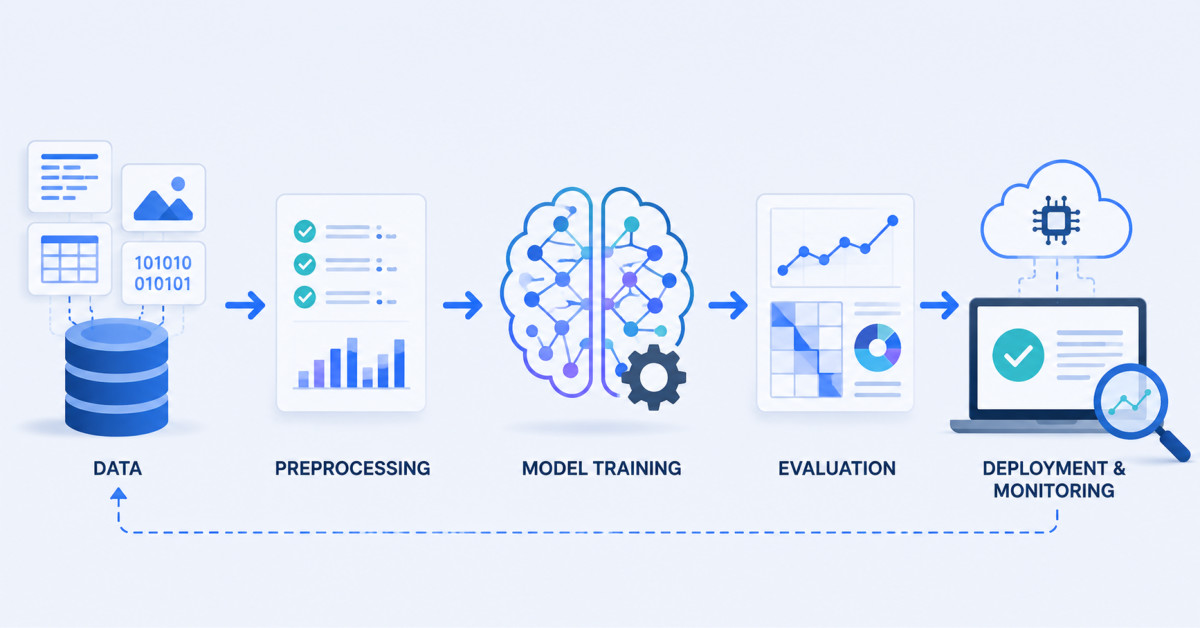
Enterprise machine learning succeeds when a specific business decision, reliable data, production integration, and ongoing model monitoring are designed as one operating system. A highly accurate prototype still fails if data drifts, workflows do not adopt it, or no team owns performance after deployment.
A model does not create business value because it predicts well in a test environment. It creates value when a real workflow can use the prediction, measure the outcome, and respond when the world changes.
Building a machine learning model is only one part of bringing AI into a business. A model that performs well in testing can still fail in production if the underlying data changes, the integration is poorly designed, or nobody’s paying attention to performance after deployment.
Let’s explore how enterprise machine learning systems move from business idea to production deployment, including the processes required to keep models accurate, scalable, and reliable over time.
Machine learning projects that work tend to start with a specific decision the organization wants to improve: predicting customer churn, detecting fraudulent transactions, forecasting product demand, identifying equipment failures before they happen, automating document classification. The business goal determines what data is needed, which metrics matter, and how success gets measured. Projects that start with “we want to use machine learning” and work backward to find a use case tend to produce models that are technically functional and operationally unused.
Raw business data is rarely ready to use. It comes from transaction systems, CRM platforms, ERP software, IoT devices, application logs, and external providers, often in inconsistent formats, with missing values, duplicates, and outdated entries.
Before any model training begins, data engineers and machine learning specialists clean inaccurate records, standardize formats, remove duplicates, handle missing values, and combine data from multiple sources into usable training datasets. This stage is unglamorous and consistently underestimated. A sophisticated algorithm can’t compensate for unreliable input. Most experienced practitioners will say data preparation is where the majority of the actual work goes. The model training part is faster.
Feature engineering transforms raw data into signals a model can interpret. A retail company predicting churn might analyze not just purchase count, but average order value, purchase frequency, time since the last transaction, support interactions, and product categories. These additional signals help the model find patterns connected to future behavior.
In some deep learning systems, models can discover patterns automatically from raw data. But feature engineering remains important in enterprise applications where explainability matters. Regulated industries especially need to understand what inputs the model is actually responding to, not just what predictions it produces.
During training, an algorithm processes historical data and learns the relationships between inputs and expected outcomes. Parameters get adjusted iteratively until the model can generalize, making accurate predictions on data it hasn’t seen before, not just data it trained on. That distinction is where a lot of projects hit their first real problems.
Different problems require different model types. Regression for numerical predictions. Classification for assigning categories. Clustering for identifying groups. Deep learning for complex patterns in text, images, or large unstructured datasets. Machine learning engineers typically compare several approaches before selecting the one that best balances accuracy, speed, cost, and explainability for the specific use case.
A model that performs well on training data isn’t ready for production. Enterprise teams evaluate models on separate datasets representing real-world conditions. The gap between training performance and production performance is where overconfident project timelines tend to collide with reality.
Fraud detection illustrates why accuracy alone is a misleading metric. A model that flags every suspicious transaction might seem to maximize detection, but too many false positives overwhelm the investigation team. The practical question is whether the model improves operational efficiency, not whether it technically catches more fraud in a test environment.
Moving a model into production requires connecting it with existing business applications and making it handle real data reliably. The deployment approach depends on what the use case actually needs.
Real-time predictions, fraud checks during payment processing, product recommendations during browsing, identity verification at registration, require models served through APIs with fast response times. Batch predictions process large datasets at scheduled intervals, suitable for monthly risk assessments, inventory forecasting, or periodic reporting. Embedded predictions operate directly within existing application workflows: a CRM displaying customer risk scores, a manufacturing platform predicting equipment failures.
Choosing the wrong deployment model for the use case creates performance problems that are much easier to avoid than to fix after the fact.
Deployment isn’t the finish line. It’s where maintenance begins. Unlike traditional software, machine learning systems degrade over time because the data they process changes. Customer behavior shifts. Fraud patterns evolve. Market conditions move. Equipment conditions diverge from historical training data.
זה המקום Agiliway comes in. As an AI-augmented software development company, we help enterprises build and maintain production-grade machine learning systems through MLOps: version control for models and datasets, automated testing, deployment pipelines, performance monitoring, retraining schedules, and security management. Organizations that treat deployment as the end of the project tend to find out why it isn’t, usually when predictions have already quietly gotten worse for longer than anyone realized. We help make sure that doesn’t happen, combining MLOps practices, scalable cloud infrastructure, and workflow integration to keep models reliable over time.
ניטור בייצור
Enterprise machine learning requires continuous monitoring. Model performance tracking watches whether predictions remainaccurate over time. A meaningful decline usually signals retraining is needed. Data quality monitoring catches changes in incoming data that affect model behavior: new customer segments, updated product categories, changes in how data gets collected upstream. Operational monitoring covers response time, availability, infrastructure usage, and costs. Catching problems early is considerably cheaper than diagnosing them after users notice.
The technical work is only part of the challenge. Integrating models into existing systems is where many projects stall. A model that works in isolation has to connect with legacy infrastructure, match existing data formats, and produce outputs that downstream processes can actually consume.
Machine learning development creates and evaluates a model, while MLOps operates that model reliably after it is connected to production systems. Development includes problem definition, data preparation, feature engineering, training, and offline evaluation. MLOps adds version control for data and models, automated testing, deployment pipelines, infrastructure management, monitoring, retraining governance, incident response, security, and auditability. A team needs both because a model that performs well in a notebook can still fail when live data changes, an API slows down, an upstream schema shifts, or no one detects performance degradation.
Your company is ready for a machine learning project when it has a specific decision to improve, an accountable business owner, enough representative data, a workflow that can act on the prediction, and a way to measure the outcome. You do not need perfect data or an enterprise-scale AI team to start. You do need a real operational problem, access to relevant historical outcomes, and willingness to change a process when the model proves useful. Start with a narrow use case, establish a baseline, and test whether the prediction improves a measurable business result.
Machine learning models fail in production when live data differs from training data, upstream systems change, business behavior shifts, integration design is weak, users do not adopt the output, or no team monitors accuracy and operational health after launch. A model can also fail through data leakage in testing, unclear success metrics, excessive false positives, insufficient latency, missing fallback procedures, or ungoverned retraining. Prevent these problems by validating real deployment conditions, monitoring data and prediction drift, measuring business outcomes, defining ownership, logging versions, and maintaining a human or rules-based fallback for important decisions.
An enterprise should retrain a machine learning model when monitored performance, data drift, business conditions, or a scheduled review show that the current model no longer meets its approved baseline. Some use cases need frequent retraining because patterns change rapidly, while others remain stable for months. Do not retrain automatically just because new data exists. Each retraining cycle should validate data quality, compare performance with the deployed model, test relevant segments, document changes, and pass approval gates before release. A scheduled review combined with drift and performance alerts is safer than an arbitrary retraining calendar alone.
Ecommerce brands should use real-time predictions when a decision must happen during a live customer interaction, such as fraud screening, recommendations, search ranking, or dynamic support routing. They should use batch predictions for scheduled decisions such as demand forecasting, churn prioritization, customer segmentation, inventory allocation, and campaign planning. Batch systems are usually simpler and less expensive to operate, so they are the right default when an immediate response is not required. Choose the deployment pattern from the decision’s timing, operational workflow, latency tolerance, cost, and fallback requirements rather than from technical preference.




