

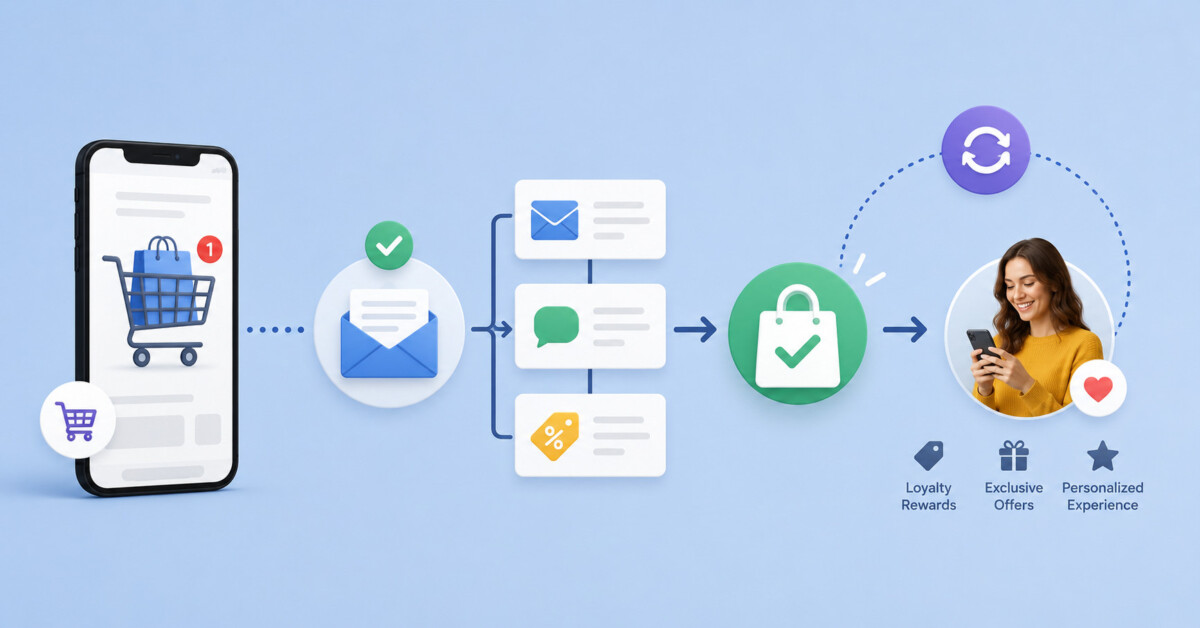
In 2026, ecommerce automation beats more ad spend by systematically recovering abandoned carts, driving second purchases, and capturing silent browsers, turning the same traffic into compounding revenue without increasing acquisition costs.
Traffic is no longer the bottleneck in ecommerce; the brands winning in 2026 are the ones that treat automation as the default path for every cart, customer, and browser after the click.
Every ecommerce founder eventually learns the same expensive lesson: traffic is not the bottleneck. Follow-through is. The average online store loses roughly seven out of ten carts before checkout, and most of those shoppers never hear from the brand again. That is why ecommerce automation has quietly become the highest-leverage investment a store can make in 2026, often outperforming another dollar of ad spend by a wide margin.
This playbook walks through the automation stack that turns one-time browsers into repeat buyers: what to automate first, what the data says about each play, and how to think about the tooling without drowning in subscriptions.
Paid acquisition costs have climbed every year since iOS 14.5 reshaped tracking. When a click costs more, every leak after the click costs more too. Automation attacks the leaks.
Consider the math for a store doing 10,000 sessions a month at a 2 percent conversion rate and a $60 average order. Two hundred orders, $12,000 in revenue. Now recover just 8 percent of abandoned carts and nudge 5 percent of past buyers into a repeat purchase each month. The same traffic now produces roughly $14,500, a 20 percent lift, with no additional ad spend. That delta compounds every month the flows keep running.
Email-only cart recovery is the industry default, and it underperforms. Open rates on recovery emails hover in the 40 percent range, but click-throughs fall off sharply, and the messages compete in a crowded inbox. The stores winning this play in 2026 run recovery as a sequence across channels: an SMS within the first hour, an email a few hours later, and a final incentive touch the next day.
The cart abandonment statistics compiled by Baymard Institute put average abandonment near 70 percent across industries, which means even small recovery-rate improvements move real money. SMS matters here because its read rates dwarf email and its speed matches the shopper’s intent window. A text that arrives while the product is still on the shopper’s mind converts very differently from an email discovered tomorrow morning.
Good recovery flows escalate gently. The first touch is a service message: your cart is saved, here is the link. The second adds social proof or answers a common objection. Only the third introduces an incentive, and only if margin allows. Leading with a discount trains shoppers to abandon on purpose.
Acquisition gets the glory, retention pays the rent. A repeat customer costs nothing to re-acquire, converts at several times the rate of a cold visitor, and lifts lifetime value enough to change what you can afford to pay for ads.
The automation is unglamorous and it works: a post-purchase thank-you that sets delivery expectations, a check-in timed to product usage, a review request when satisfaction peaks, and a replenishment or cross-sell reminder timed to the product’s natural cycle. Coffee reorders in three weeks. Skincare in six. Equipment accessories after a season.
Platform choice shapes how hard this is to run. Stores that manage marketing across separate email, SMS, and review tools spend hours reconciling audiences that an integrated system synchronizes automatically. Teams evaluating consolidated options can compare how store builders with native abandoned-cart SMS workflows handle the whole loop inside one contact database, which removes the integration tax entirely.
Ninety-plus percent of visitors leave without identifying themselves. Every automation above depends on knowing who the shopper is, so capture is the foundation the rest stands on.
Each mechanism feeds the same principle: turn anonymous attention into an addressable relationship before the tab closes.
The typical mid-size store runs five to eight marketing tools: email platform, SMS provider, review manager, chat widget, scheduling, and a CRM gluing it together. Each is individually reasonable. Together they cost hundreds per month and, worse, they fragment customer data at exactly the moment automation needs it unified.
The 2026 trend is consolidation. All-in-one platforms now bundle email, SMS, chat, reviews, and automation behind one contact record, and the pricing math often favors them once a store outgrows two tools. Before renewing your stack, it is worth an hour to research what all-in-one marketing platforms actually cost compared to your current subscription total. The comparison is frequently a five-tool bill against one flat fee, and the unified data model is the quieter, larger win.
Automation reporting drowns teams in open rates. Three numbers actually describe the machine’s health: recovered-cart revenue as a percentage of abandoned value, repeat-purchase rate at 90 days, and revenue per subscriber per month. If those three climb while ad spend stays flat, the machine is working. If they stall, audit the flows before buying more traffic.
A practical cadence: review the three numbers monthly, A/B test one message per flow per month, and resist the urge to add new flows before existing ones are tuned. Most stores need five excellent automations, not twenty mediocre ones.
The reason ecommerce automation rewards patience is that its output compounds. Every new subscriber joins flows that already work. Every improvement to a recovery sequence applies to every future cart. Unlike ad spend, which stops producing the moment you pause it, a tuned automation stack keeps converting while the team sleeps.
Start with cart recovery this week. Add the post-purchase sequence next month. Fix capture the month after. By quarter’s end, the store will be earning revenue from shoppers it used to lose silently, and the founder will wonder why the flows waited this long.





