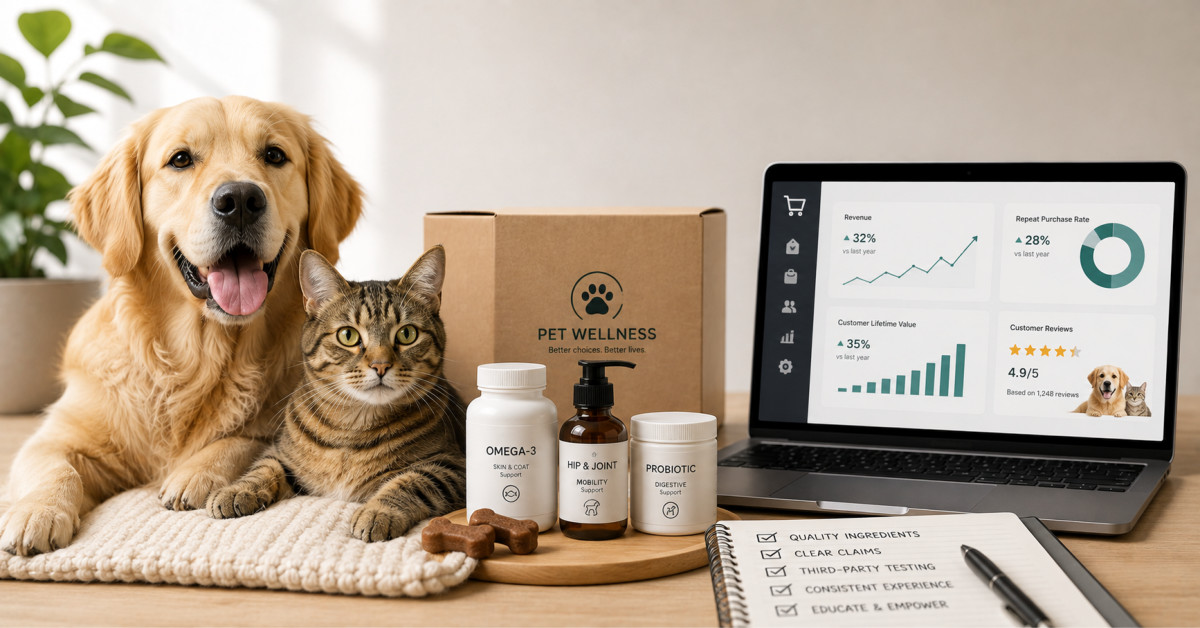
Pet wellness is now a major ecommerce category because it pairs high repeat purchase rates with high research intent. The brands scaling past $2M win on product page evidence and replenishment mechanics rather than creative, because regulation caps what they are legally allowed to claim.
The pet wellness brands that stall are rarely the ones with a weak product. They are the ones whose product page cannot answer the six questions a buyer asks before handing an unregulated supplement to a family member who cannot tell them it hurts.
A founder I spoke with last year was running a $900K joint supplement brand and had spent four months and roughly $18K testing ad creative against a conversion rate that would not move off 1.1%. The creative was fine. The problem was that her product page listed a proprietary blend with no per ingredient amounts, no serving guidance by body weight, and no third party verification of any kind. Buyers were arriving, reading, and leaving to check whether the ingredients were real.
That is the pattern in pet wellness, and it is different from the pattern in apparel or home goods. This is a category where the buyer is purchasing on behalf of someone who cannot report side effects, in a regulatory environment that forbids you from promising the outcome they actually want. The brands that scale are the ones that internalize that constraint early and build the page around evidence instead of persuasion.
If you are running a pet brand somewhere between $250K and $5M, this is the read. What follows is where the category actually is, what the rules actually say, and what to fix first at your stage.
US pet industry expenditures are projected to reach $165 billion in 2026, up from $158 billion in 2025, but roughly 2% of that 4.4% growth is inflation, which puts real category growth closer to 2.4%. That figure comes from the American Pet Products Association 2026 State of the Industry Report, which also found that 95 million US households own at least one pet and that dog ownership expanded from 51% to 53% of households, adding roughly 4 million dog owning homes in a single year.
The headline number is healthy. The composition underneath it is more interesting for an operator. APPA also reported that 22% of pet owners spent less on their pets in 2025 than the prior year, with spending shifting away from discretionary items and toward essential care. Households are not leaving the category. They are getting more selective inside it, which raises the burden of proof on anything that looks optional.
Supplements sit right on that line. Reporting from PetfoodIndustry puts the US pet supplement market somewhere between $4 billion and $5 billion depending on how broadly you define the category, with Lauren DeVestern of L.E.K. Consulting arguing the wider figure is closer to reality once you include topicals and dental chews.
Here is the part most DTC founders get wrong. גרנד הצג מחקר found that offline channels still held 76.5% of pet supplement distribution in 2025, with chewables at 69.8% of format share and hip and joint at 21.6% of application share. Online is the fastest growing channel, not the biggest one. מודיעין מודיעין projects online channels growing at a 12.6% CAGR through 2031 while specialty stores held 42.3% share in 2025.
What that means at your stage: if you are under $500K, you are competing for a growing minority of a category where the default purchase still happens in a store or at a vet clinic. Your job is not to out spend the incumbents. It is to be the option that answers questions the shelf cannot.
In pet supplements, any expressed or implied claim that a product will cure, treat, prevent, or mitigate disease can establish the product as an unapproved new animal drug, which makes the claim itself the legal problem rather than the product. The FDA’s Center for Veterinary Medicine states this directly in its guidance on animal food labeling and pet food claims, and it reviews specific claims such as maintains urinary tract health and hairball control against that standard.
There is a second detail that catches founders coming from the human supplement world. FDA’s published assessment, issued in the Federal Register on April 22, 1996, is that the Dietary Supplement Health and Education Act does not apply to animal food, including pet food. The framework you may have learned selling human nutraceuticals does not transfer. Pet supplements are regulated as animal food, and the claim latitude is narrower.
The practical effect is that your best copywriter will make this worse, not better. Persuasive writing in wellness reaches instinctively for the outcome, and the outcome is exactly what you cannot promise. The discipline is to describe support for normal structure and function, and to let evidence carry the rest.
Operationally, this belongs in Shopify metafields rather than in free text descriptions. A claims metafield per product, populated once and reviewed on a schedule, prevents the slow drift that happens when three different people edit product copy across eighteen months.
When regulation prevents you from claiming the outcome, independent verification becomes your primary persuasion asset, which is why the NASC Quality Seal functions as a conversion tool rather than a compliance artifact. The National Animal Supplement Council was formed in 2001 and now counts roughly 300 members, and its seal requires a documented quality control manual, an adverse event reporting system, labeling that carries the caution statements recommended by FDA’s Center for Veterinary Medicine, random product testing by an independent lab, and annual training.
The seal is not a logo you license. Member companies pass a facility audit and are re audited on a recurring cycle, which is precisely why buyers who have been burned by a proprietary blend treat it as signal. In 2026 the council extended the program to treats, its first major scope expansion in 25 years, addressing a treat market NASC estimates at $12 billion to $14 billion.
Stage matters here more than ambition does. Under $500K, pursuing your own seal is usually premature complexity. The faster path is to manufacture with an NASC preferred supplier and surface that relationship on the page, which gets you most of the trust signal without the audit overhead. Between $500K and $2M, the seal starts paying for itself, particularly if retail or vet channel distribution is anywhere in your 18 month plan.
Verified reviews do adjacent work. A review platform such as Okendo or Judge.me that captures pet size, breed, age, and duration of use produces exactly the attribute rich social proof that substitutes for a claim you cannot make. A generic five star rating does not. The difference between 400 reviews and 400 reviews with structured attributes is the difference between decoration and evidence.
A pet wellness product page converts when it answers six questions inside the first scroll: what is in it, how much of each active ingredient, how often it is given, for what body weight, who verified it, and what happens if it does not work. Miss any one and the buyer opens a second tab, and the second tab is usually a competitor or an AI assistant.
Walk a competitor funnel as a customer rather than as an operator, and the pattern becomes obvious quickly. A shopper who decides to shop with Pup Labs is met with per weight serving guidance, a named veterinary consultant, a subscribe and save discount, a 180 day guarantee, and several thousand on page reviews. Whether or not you rate the formulations, the page architecture is doing the job the copy is not permitted to do. That structure is replicable at any stage, and it costs a theme edit rather than a reformulation.
The elements most brands skip are the boring ones. Serving guidance by body weight, stated as a range rather than a single dose, resolves the most common pre purchase question in the category. Duration is the second. A supplement given for 30 days and abandoned produces a refund and a bad review, so stating plainly that a joint formula needs 60 to 90 days before a fair assessment sets expectations that protect both the customer and your margin.
Storage, format, and warnings round it out. Format is not a detail in this category. A powder that a dog refuses is a returned product regardless of how good the formulation is, which is why chewables hold nearly 70% of format share. If you sell a drop or a powder, the page needs to address administration directly rather than hoping it does not come up.
None of this replaces conversion work. It precedes it. The product page optimization fundamentals around imagery, CTA visibility, and mobile layout still apply, but running an A/B test on button color while your ingredient panel is incomplete is testing the wrong variable.
Subscription is the correct end state for pet supplements because the product is consumed on a fixed rhythm, but switching it on before you know your 90 day repeat purchase rate converts a retention tool into a refund queue. The dosing cycle does the work for you: a 30 serving bottle at one dose per day sets a natural cadence that most categories have to invent.
The prize is real. Traditional ecommerce stores lose roughly 70 to 75% of customers within a year of first purchase, while subscription models running monthly churn in the 4 to 6% range retain them far longer. Our complete guide to subscription ecommerce growth covers the replenishment model in depth, and pet is one of the categories where it maps most cleanly.
The trigger is behavioural, not financial. Illustrative benchmark: if fewer than a quarter of your first time buyers reorder unprompted within 120 days, subscription will amplify a product or expectation problem rather than solve a retention problem. Fix the reorder rate first. I have watched brands at $600K install Recharge, Klaviyo flows, and a loyalty app in the same quarter, then spend the following two quarters untangling which one was responsible for the churn.
When the number says go, match the tool to the stage. Shopify Subscriptions is enough to validate the offer. Recharge is the default once recurring revenue is material. Skio and Stay AI compete on subscriber experience and AI driven churn prevention respectively, and both are worth evaluating above roughly $2M, where a two point churn improvement is a real number rather than a rounding error.
The related trap is portfolio sprawl. A brand adds a joint formula, then a calming chew, then a dental powder, and the subscriber is now paying for three products without a clear reason for each. In pet wellness, more SKUs on subscription usually means more cancellations, not more LTV, because the cancellation decision is made on the total monthly charge rather than product by product.
A meaningful share of pet supplement research now begins as a question typed into an AI assistant rather than a search box, which means your product page is being parsed by a model before it is read by a human. Questions like whether glucosamine is appropriate for a twelve year old Labrador are exactly the kind of high consideration query that assistants answer by pulling from whatever pages they can parse cleanly.
This is where claim discipline pays a second dividend. The plain, specific, unhyped language that keeps you compliant is the same language extraction systems handle best. Vague wellness copy fails the regulator and the model for the same underlying reason: it makes an assertion that cannot be verified against anything concrete.
The practical setup work is documented in our walkthrough on setting up a Shopify knowledge base for agentic commerce, and pet wellness brands have an advantage most categories lack. Your customer service inbox is already full of the exact questions that belong in a product level FAQ: can I give this with my dog’s current medication, what if my dog is on a prescription diet, how long before I should expect to see anything. Pull the top fifteen from Gorgias or your support tool and publish them as question and answer pairs.
One caution that belongs in the same breath. An assistant that recommends your product will also surface the limits of what it can assess, and that is appropriate. A supplement should never be positioned as a substitute for veterinary attention when an animal has ongoing digestive problems, unexplained weight change, persistent itching, or reduced appetite. Saying so plainly on your page costs you nothing and buys the credibility that the rest of the page depends on.
The right first move depends entirely on revenue stage, and applying the wrong stage’s advice is the most expensive mistake available in this category. Under $500K, the whole game is the evidence block. Full ingredient panel with amounts, serving guidance by body weight, duration expectations, and a manufacturer relationship you can point to. That is a weekend of work and it usually moves conversion more than any acquisition change available at that revenue.
Between $500K and $2M, formalize claim review and pursue third party verification. This is also the stage where you decide whether subscription is a retention tool or a bandage, using the 120 day reorder rate as the test. The stack question matters here too, and our stage by stage Shopify tech stack guide covers why the cheap subscription app installed at $200K becomes the expensive migration at $3M.
Above $2M, the work shifts to infrastructure that survives scrutiny. Subscription tooling you could actually migrate off, review data you own rather than rent, claim documentation organized well enough to hand to a retail buyer or an acquirer. Pet wellness is a category where an exit conversation will include a diligence pass on your claims, and the brands that treated compliance as a marketing constraint rather than an operational system are the ones that discover this late.
The category will keep growing. Whether that growth is available to you depends less on the market number and more on whether your page can survive a careful reader who is deciding what to give an animal that trusts them completely.
No. Pet supplements are regulated as animal food rather than as dietary supplements, because FDA’s published assessment is that the Dietary Supplement Health and Education Act does not apply to animal food including pet food. That assessment was issued in the Federal Register in April 1996 and still governs. The practical consequence for a merchant is that the claim latitude you may be used to from the human supplement category does not transfer. FDA’s Center for Veterinary Medicine oversees animal food, and any claim that a product will cure, treat, prevent, or mitigate disease can establish the product as an unapproved new animal drug.
You can make claims that describe support for the normal structure and function of the body, and you cannot make claims that a product treats, cures, prevents, or mitigates a disease. In practice that means supports joint comfort and mobility is acceptable while treats arthritis is not, and supports normal urinary tract function is acceptable while prevents urinary tract infections is not. The line is drawn by intended use rather than by wording alone, so implied claims in reviews, ad copy, and influencer content carry the same exposure as claims on the label itself. Have one person own claim review across every surface.
No, NASC certification is voluntary and no federal or state law requires it, but it functions as the most recognized trust signal in the category. Earning the Quality Seal requires a documented quality control manual, an adverse event reporting system, labeling that carries FDA recommended caution statements, random independent lab testing, and passing a facility audit on a recurring cycle. Below roughly $500K in revenue, manufacturing with an NASC preferred supplier and surfacing that relationship on your page captures most of the trust benefit without the audit overhead. Above $500K, particularly if retail or veterinary distribution is in your plan, the seal starts justifying its cost.
Add subscription once you can see that a meaningful share of first time buyers already reorder without being prompted, which is the signal that the product earns its repeat rather than that billing forces it. As an illustrative benchmark, a reorder rate below roughly 25% within 120 days suggests a product or expectation problem that subscription will amplify rather than fix. When the number supports it, match the tool to your stage: Shopify Subscriptions to validate the offer, Recharge once recurring revenue is material, and platforms like Skio or Stay AI above roughly $2M where churn improvements are worth real money.
The overall US pet industry is projected at $165 billion in 2026, up 4.4% from $158 billion in 2025, though roughly 2% of that is inflation, so real growth sits closer to 2.4%. The supplement segment specifically is estimated at $4 billion to $5 billion in the US depending on category definition. The number that matters for a DTC operator is channel mix rather than total size: offline still held 76.5% of supplement distribution in 2025, while online is the fastest growing channel with projections around a 12.6% compound annual rate through 2031. Online is where growth is, not where volume is.