

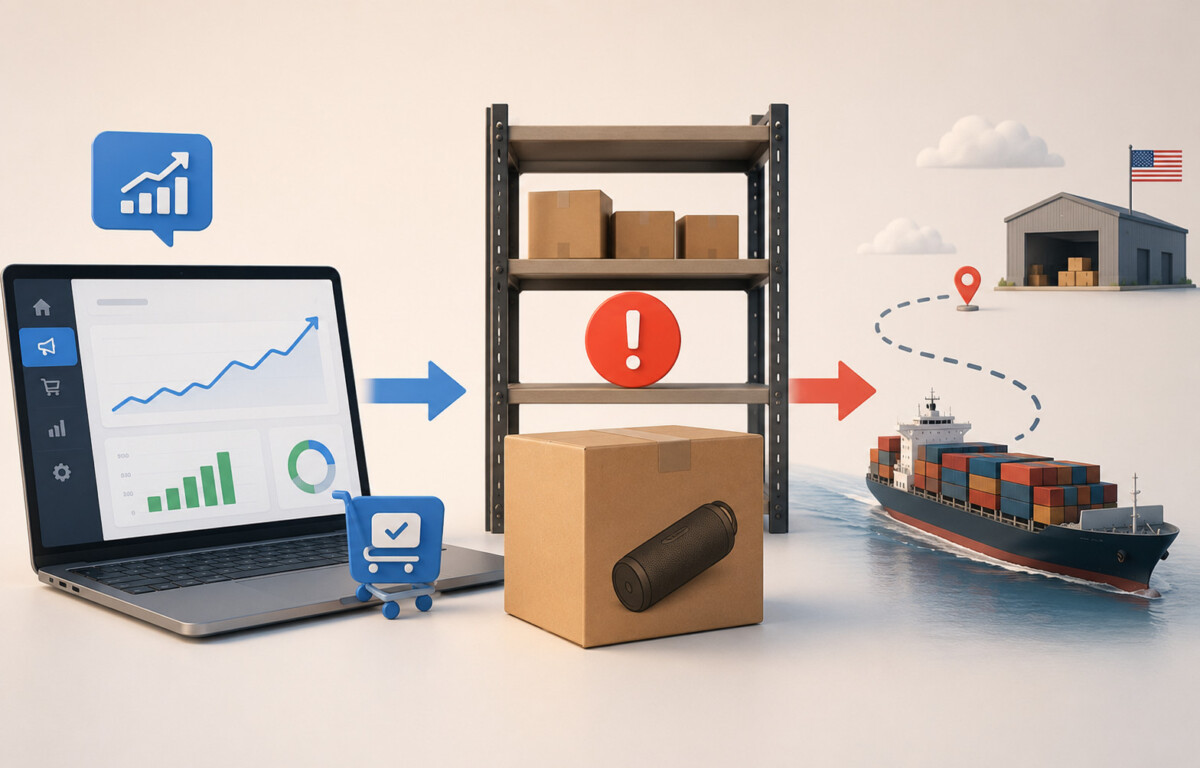
Ecommerce sellers keep ads and inventory in sync by calculating true inventory runway against full replenishment lead times before scaling budgets, then adjusting campaigns and freight choices based on the size and timing of the stock gap.
Strong ad performance is only sustainable when inventory, freight, and restock dates move in step with campaigns, not several weeks behind them.
On Monday morning, a seller opens the advertising dashboard and sees that the weekend went well. Cost per click is stable, conversion is stronger than the previous week, and several new creatives are beginning to generate steady orders.
The team is ready to raise the budget. Then someone checks the inventory page.
The main SKU has only 680 units left.
At the previous sales rate, that stock might last about three weeks. If the advertising budget is increased and daily sales double, it could be gone in little more than ten days.
This is a common problem for cross-border ecommerce sellers. The product is not struggling. It is gaining momentum before the replenishment plan is ready to support it.
The advertising team sees ROAS and conversion rates. The operations team sees remaining units. The supply chain team sees production dates, vessel schedules, customs clearance, and warehouse appointments. When those timelines are not aligned, strong advertising performance can create an inventory problem surprisingly quickly.
ROAS should not be the only number used to decide whether a campaign is ready to scale. Sellers also need to know how many days of inventory remain and whether the next shipment can become sellable before current stock runs out.
החישוב הבסיסי הוא:
Current sellable inventory ÷ average daily sales = days of inventory remaining
For example, a SKU with 900 units left and average sales of 30 units a day has about 30 days of inventory.
That number changes quickly when advertising is scaled. If the expected sales rate rises to 60 units a day, the same 900 units will last only 15 days.
Now assume the next shipment needs 18 days to move from production completion to available warehouse stock. Increasing the advertising budget would create a three-day inventory gap, even if the original forecast looked safe.
A more useful calculation is:
Days of inventory remaining − total replenishment lead time = real safety margin
A result close to zero means the plan has little room for delays. A negative result means the seller is likely to run out before replenishment arrives.
Before raising the budget, calculate inventory runway twice:
Do not wait for a marketplace or inventory system to issue a low-stock warning. By the time the alert appears, the next batch may still be in production or may not yet have a confirmed booking.
Many sellers set reorder points by asking the supplier one question:
“How many days do you need to produce the next batch?”
Production time matters, but it is only one part of the replenishment cycle. Before the goods are sellable again, they may need to pass through several stages:
A supplier may quote 15 days for production, but packaging and labelling could take another three days. Waiting for a shipping booking may add four days. Ocean transit and customs could take several more weeks, followed by a warehouse appointment and receiving period.
The seller may think the replenishment cycle is 15 days when the full timeline is closer to 40 or 45 days.
This is why many inventory gaps are not caused by the vessel itself. Delays often begin earlier, with factory release, incomplete documents, missed cut-off times, or warehouse receiving requirements.
Advertising decisions should change as inventory risk increases. The choice is not limited to “keep scaling” or “pause everything.”
When inventory runway is clearly longer than replenishment lead time, and the next batch has a confirmed production and shipping plan, sellers can continue testing creatives, increasing keyword budgets, and using promotions.
Even at this stage, the team should track projected sales after scaling rather than relying only on the current sell-through rate.
If stock is falling faster than expected but there is no immediate stockout risk, the seller can keep proven campaigns running while reducing less certain tests.
This is the right time to confirm:
High-converting campaigns may still deserve budget. Broad audience tests, experimental creatives, and low-confidence keywords may need to wait.
If inventory runway is shorter than the full replenishment timeline, the business has entered risk-control mode.
The seller may need to pause discounts, reduce broad traffic campaigns, and move part of the budget toward SKUs with healthier stock. Selling through the final units faster does not always help, especially when the remaining inventory has a lower margin or supports an important ranking position.
When the product is close to selling out, the advertising objective changes.
Instead of paying heavily for new customer acquisition, the seller can protect existing demand with a small amount of brand or remarketing spend, collect back-in-stock sign-ups, and recommend suitable alternatives on the product page.
At this stage, buying more cold traffic usually does not create sustainable growth. It simply accelerates the shortage.
Ocean freight, air freight, express shipping, and DDP each solve different problems. The right choice depends on the size of the stock gap, the product margin, and the value of avoiding a stockout.
A small emergency shortage on a high-margin product may justify a limited air or express shipment. A larger and more predictable replenishment order is usually better suited to ocean freight. When timing is tight but full air freight would be too expensive, sellers can split the shipment: send a small urgent batch by air and move the main quantity by sea.
כשמשווים משלוח מסין לארה"ב, sellers should look beyond transit time alone. Booking stability, customs arrangements, DDP scope, final-mile delivery, and warehouse requirements can all affect the real arrival date.
Gorto Freight is one example of a logistics provider that covers ocean, air, express, and door-to-door options for China-to-US shipments. That kind of comparison is useful when sellers need to decide whether they are solving a short-term stock gap or planning the next full replenishment cycle.
Fast freight works best as a rescue tool. If every order depends on emergency air shipping, logistics costs will gradually reduce the profit created by stronger sales.
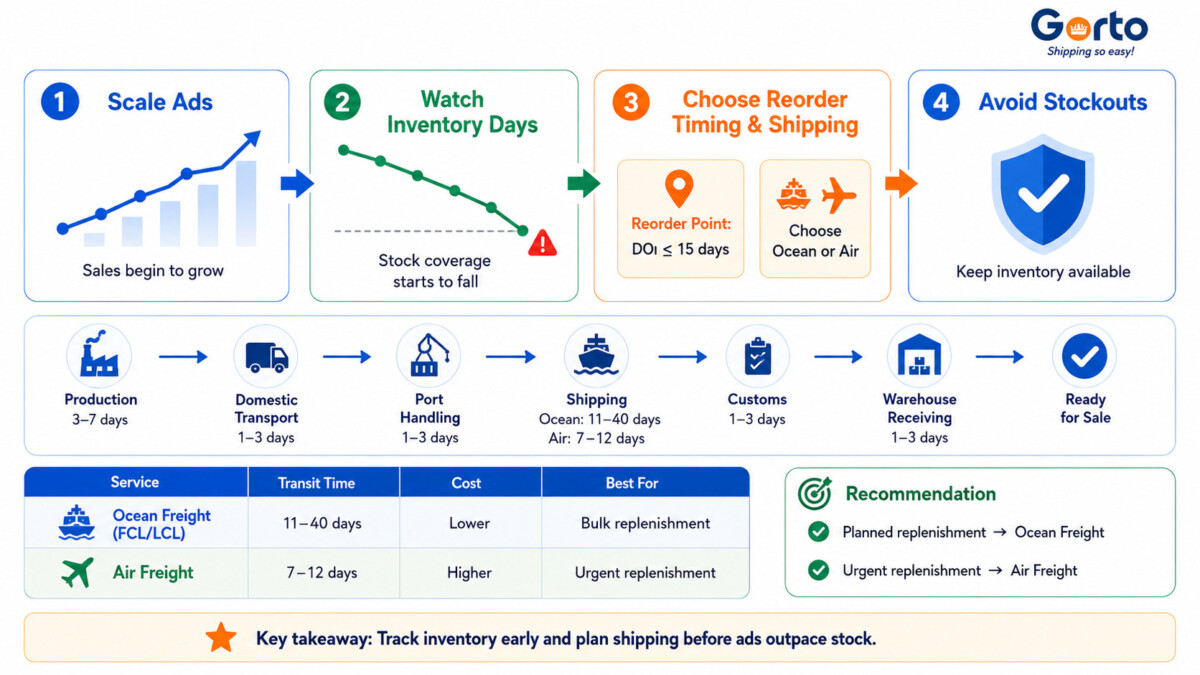
Sellers often use ETA, the estimated arrival date, as though it were the date the product will be back in stock.
In practice, goods may still need to clear customs, be released, move to the destination warehouse, receive a delivery appointment, and complete receiving before they are available for sale.
A more useful replenishment tracker includes several milestones:
A shipment can reach the port on time and still miss the planned restock date. For advertising and customer communication, “available for sale” is the milestone that matters most.
A supplier saying “nearly ready” is not enough to support a public restock promise. A freight forwarder providing an estimated arrival date is also not a guarantee that the warehouse can receive and release the inventory on schedule.
Before announcing a restock date, the supplier, freight forwarder, and warehouse should be working from the same product details, quantities, carton counts, labels, and delivery information.
Teams should review the main documents required for ocean freight shipping, including the commercial invoice, packing list, and bill of lading. Product descriptions, declared values, carton counts, and consignee details should match across the paperwork.
Depending on the shipment, sellers may also need to confirm customs filings, import requirements, battery documentation, or warehouse-specific labels.
A small mismatch can delay customs release, destination handling, or warehouse receiving. Those delays become especially costly when the advertising plan has already been built around a promised restock date.
When the timing is still uncertain, it is safer to collect back-in-stock notifications first and restart promotion once the shipment status is clearer.
Advertising and inventory should not be reviewed together only when a stockout is close.
A simple weekly review can include:
This is especially important when advertising, operations, and logistics are managed by different people. A shared review gives the team time to adjust before the business is forced into emergency decisions.
Before scaling a campaign, the seller should be able to answer five questions:
Advertising determines how quickly demand grows. Replenishment planning determines whether that growth can continue.
For ecommerce businesses sourcing from China and selling into the United States, stable growth depends on more than stronger campaigns. Inventory levels, replenishment cycles, freight choices, and advertising timing need to move together.
A product selling well is worth celebrating. Truly stable growth means the next batch is already moving at the right time, in the right way.





