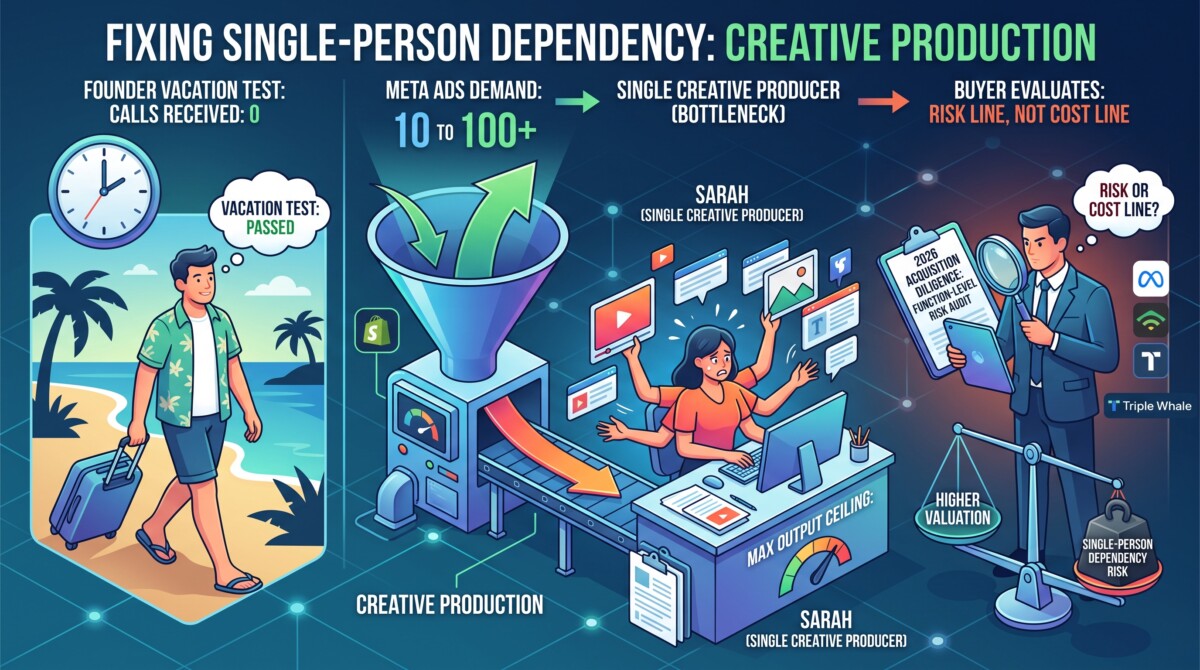
Buyers used to ask whether your Shopify business depends on you. In 2026 they also ask which individual functions depend on one person, because a marketing operation that runs on a single creative producer is now priced as a risk rather than a cost line.
The founder who passes the vacation test and still has one person producing every ad has moved the dependency, not removed it. Buyers have started noticing the difference.
Go away for two weeks and count the phone calls. More than three, and the business still runs on you. That test has been circulating among ecommerce buyers for years, and it is a good one, which is why I put it in the title of the episode where I heard it stated most plainly.
Here is what it does not catch. I have watched founders at $3M and $5M pass that test comfortably, because they hired an ops manager and wrote SOPs and genuinely stepped back from the daily decisions. The calls stopped. And the business still had one person who made every ad, one person who knew how the email flows were built, and one person who could answer a question about inventory forecasting without opening a spreadsheet. The dependency did not disappear. It moved down a level, where it is harder to see and easier to live with.
Buyers have caught up to that. And the reason they have caught up now, specifically, rather than five years ago, is worth understanding before you decide whether any of this applies to you.
Founder risk is the discount a buyer applies for the possibility that the business stops working when you leave, and every acquirer has a version of the same diagnostic. On פרק 482 של הפודקאסט, Bawar Ahmad, co-founder of the acquisition firm אקומה, described his: send the owner away for two weeks and count the calls, and if it takes more than three, the business is still dependent on the founder.
The part of that answer worth writing down is what comes next. Ahmad said that when they ask a seller the question directly, they double whatever number the seller reports. Tell them three, and they assume six. That is not cynicism about you specifically. It is an adjustment applied to a self-reported number that every seller has an incentive to understate, and it means the honest answer you give in a diligence call gets treated as a floor.
Ahmad has closed 72 acquisitions, and Ecomma buys brands in the $100K to $2.5M annual profit band, which is roughly where a Shopify business doing $1M to $10M in revenue lands. So this is a buyer describing the screen he actually applies to businesses at the size most of you are running.
None of this is new. Founder dependency has been the first line on every exit checklist for a decade, and if you have read anything about preparing a business for sale you have seen it. What is new is that clearing it no longer gets you the credit it used to, because buyers now run a second pass underneath it.
The second pass asks which individual functions in your business run on one person, and the answer is now part of how the offer gets built. Ahmad was explicit that Ecomma’s focus during acquisition has shifted toward what he called the agents a business has in place: which ones exist, how they are performing, and what it costs to build them where they are missing. If a business does not have them, his team sets them up after the close, and that build cost is a real number that comes off something.
Strip the word “agents” out of that and the underlying question is older and more durable than the terminology. It is: when this function needs to double its output, does that require doubling a person, or does it require changing a configuration? Buyers have always cared about that. What changed is that for the first time there are functions in a small ecommerce business where the honest answer can be “changing a configuration,” and buyers now check which ones you have.
This matters more at your stage than it does at enterprise scale, and the reason is counterintuitive. A $50M brand with forty people has redundancy by accident. Somebody else can cover. A $4M brand with nine people does not, and each of those nine holds a function outright. That is normally an efficiency story, and at $4M it genuinely is one. It becomes a valuation story the moment somebody is deciding what your business is worth without you in it.
Ahmad’s framing carries an obvious commercial interest, since a firm that builds these systems post-acquisition benefits from finding them absent. I would not run on his word alone, which is why the rest of this piece looks at where the claim holds up independently.
Creative production is the function where single-person dependency becomes visible fastest, because the volume the platform demands has moved and the headcount required to meet it has not. Ahmad’s version of the argument was arithmetic: before AI, ten new creatives a month kept a paid social account performing, and now it takes closer to a hundred for the same effect, because everyone can produce ten.
I would normally treat a number like that as directional, since it came from one operator in conversation rather than from a study. But it holds up against data neither of us produced. Motion’s 2026 analysis of more than 550,000 Meta ads across 6,000 advertisers and roughly $1.3 billion in spend between September 2025 and January 2026 found that only about five percent of ads spend meaningfully above an account’s median, and that the advertisers who surface more winners are not the ones with better instincts, they are the ones running more tests. In the $50K to $200K monthly spend tier, the top quarter of accounts ship around sixteen new creatives a week. The average account in that same tier ships under seven.
The line in that report I would put in front of every founder reading this is the diagnosis, not the benchmark. Motion’s finding is that the constraint on creative volume is usually organizational rather than budgetary, that teams anchor their output to what their production and approval workflow can comfortably support, and that creative strategy is better understood as capacity planning than as optimization.
Capacity planning is a phrase a buyer understands immediately. If your ad account is running at seven creatives a week because one person makes them all and that person can make seven, you do not have a creative problem. You have a capacity ceiling with a name attached to it, and that is exactly the shape of thing an acquirer prices.
A function is genuinely wired to a model when its inputs and outputs move without a person in the middle, which is a much higher bar than someone on your team using ChatGPT to write ad copy faster. That distinction is where most of the self-assessment on this goes wrong, and it is worth being precise about, because a buyer will be.
The unwired version looks like this: your media buyer opens a chat window, describes the product, pastes the output into a design file, exports it, and uploads it. That is a person using a tool. Remove the person and the output goes to zero. The wired version is that your product data, your performance data, and your customer feedback are readable by a model without a human assembling them first, so the question “which three concepts should we produce next” gets answered from your own numbers rather than from one person’s memory of what worked in March.
Ahmad put the end state in one line: companies should be queryable. He meant that an AI system should be able to read the whole business from a database rather than being handed selected pieces of it. That is a genuinely useful test, and it is closer than most founders assume. The tools most Shopify brands already pay for now expose their data this way, and I walked through connecting Klaviyo, Triple Whale, and Fairing in about twenty minutes each in the operator guide to Shopify MCP, including the read-only scoping I would insist on before you connect anything.
Apply the eighteen month filter here, because it separates the durable part from the noise. Ten creatives becoming a hundred is a 2026 number and it will be wrong by 2028. Whether a function can scale its output without adding a person is a question buyers were asking about warehouses in 1985. The tooling is the temporary part. The dependency is the permanent part.
What a buyer finds shows up in the multiple and in the terms, not usually as a line item you get to argue about. Small ecommerce businesses are valued on a multiple of seller’s discretionary earnings rather than revenue, and the ranges published by credible sources genuinely disagree with each other, which tells you something about how much judgment sits inside the number. Frank Kosarek, who acquired around fifty Shopify brands as head of M&A at OpenStore before co-founding BizPort, puts the typical band at two to two and a half times SDE, reaching five times for category leaders. I have covered how SDE is actually constructed, and why team reliance sits alongside channel risk and margin trend as a multiple input, in the מדריך רווח והפסד של Shopify.
Kosarek’s list of what damages a deal is the useful part, and it corroborates Ahmad from a completely separate seat. He names lack of operational structure as a red flag: buyers do not want to walk in and build everything from scratch, they want to see documented processes and clear ownership of marketing functions, and their confidence rises when they can quickly understand how the company distributes work. Two buyers who have never met, one in Dubai and one in Miami, describing the same thing.
The mechanism is not that a buyer pays you extra for having connected your tools. It is that undocumented, single-person functions convert into diligence questions, diligence questions convert into perceived risk, and perceived risk converts into either a lower number or a structure that keeps your money contingent on things you no longer control after closing. Ahmad’s own advice on that second path was blunt: treat the cash at closing as what you are actually being paid.
Fix the function with the highest volume demand and the lowest documentation, which for almost every Shopify brand between $1M and $10M is creative production. Not because it is the most important function you run, but because it is the one where the gap between what the platform now demands and what one person can produce is widest, and it is the only one on the list you can meaningfully change in a quarter without hiring.
The documentation step matters more than the tooling step and costs less. Screen recorded walkthroughs where the person doing the work narrates their reasoning turn one person’s judgment into something the next person can run, which is the specific move I described in the remote hiring playbook, and it converts a fragile dependency into a transferable asset whether or not you ever sell.
One caution, because I have watched this go wrong more often than I have watched it go right. The failure mode at $500K to $2M is not moving too slowly on this. It is connecting seven tools in an afternoon, calling it an AI operation, and never opening six of them again. That is premature complexity wearing a new outfit, and it is the same pattern that has stalled brands in this band for as long as I have been watching them. The version of operational debt that quietly compounds is always the one built on manual workflows and individual dependence, and adding tools on top of it does not remove it.
Ahmad’s estimate is that selling a company properly takes six to twelve months. If an exit is a five-year possibility rather than a live plan, you have room to do one function per year, properly, and arrive with four that are documented and none that are fragile. That is a better use of the next four quarters than anything you could do to the multiple directly.
Buyers screen three things in order: the seller as a person, the business fundamentals, and the brand story, and a failure on the first usually ends the conversation. Within the fundamentals, the checks are profit rather than revenue, stable month to month performance, clean financials with no personal expenses mixed in, positive customer sentiment, and low dependency risk. What has changed recently is that dependency risk is now assessed at the function level rather than only at the founder level. An acquirer will ask which individual functions run on one person, and increasingly whether marketing, support, and forecasting can scale output without adding headcount.
Pick a function and ask what its output would be next month if that person left tomorrow. If the honest answer is close to zero, that is a single point of failure regardless of how well documented your company looks on paper. Run the same test on creative production, customer support, inventory forecasting, and email or SMS. Most brands between $1M and $10M fail at least two. The founder-level version of this test, sending the owner away for two weeks and counting the calls, is a useful starting point but it will not surface function-level dependency, because a business can run smoothly without you and still have four people who are individually irreplaceable.
Using AI tools does not raise your valuation by itself, and no buyer pays a premium for a ChatGPT subscription. What can affect the number is whether a function’s output scales without adding a person, because that removes a cost the buyer would otherwise have to absorb after closing. The distinction a buyer is testing is between someone on your team using an AI tool to work faster, which disappears when that person leaves, and a function whose inputs and outputs move without a human in the middle, which does not. The second one survives a change of ownership. The first one is a person with a habit.
Small ecommerce businesses are valued on a multiple of profit, not revenue, using seller’s discretionary earnings as the base figure. SDE starts from net income and adds back the owner’s salary, benefits, and one-time expenses. Published multiple ranges vary widely by source and by category, which tells you how much judgment sits inside the number, so treat any range you read as a starting point rather than a quote. What consistently moves the multiple within a range is profit consistency, recurring or subscription revenue, documented operating procedures, and low dependency on any single person. Tracking SDE monthly rather than reconstructing it during diligence is the single highest-leverage habit here.
Six to twelve months is the working estimate from buyers for running a sale process properly, but the operational preparation described here runs on a longer clock than that. Documenting a function and removing its single point of failure takes roughly a quarter per function if you are honest about it, so a business with four fragile functions is looking at a year of background work that is best done before a sale is on the calendar rather than during it. The practical reason to start early is that preparation done under deadline pressure tends to show. Buyers are experienced at telling the difference between systems a business actually runs on and systems assembled for diligence.