




Quick Decision Framework
- Who This Is For: Shopify and DTC brand operators doing $50K to $5M per month who are actively investing in content and SEO but have no visibility into whether their brand appears in ChatGPT, Perplexity, Claude, or Google AI Overviews when customers ask buying questions.
- Skip If: You are pre-revenue or still running fewer than 100 orders a month. Get your product and fulfillment dialed in first. Come back when you are ready to compete for brand awareness at scale.
- Key Benefit: A clear, stage-appropriate map of the 15 tools that track and improve your brand’s presence inside AI-generated answers, so you stop flying blind in the channel that is quietly replacing the top of your funnel.
- What You’ll Need: Access to your current SEO stack and analytics setup, a rough sense of your monthly content budget, and clarity on whether you are optimizing for brand awareness, product discovery, or competitive defense.
- Time to Complete: 12 minutes to read. 2 to 4 hours to audit your current stack against this framework and identify the one tool worth testing first.
Your customers are still researching your products. They just stopped clicking. The brands that figure out how to show up in the AI answer itself will own the next decade of DTC growth. The ones still chasing organic rank position 1 are optimizing for a metric that matters less every quarter.
What You’ll Learn
- Why “Answer Inclusion” has replaced click-through rate as the primary visibility metric for DTC brands competing in AI search in 2026.
- How to evaluate LLM monitoring tools across five criteria that actually predict whether a tool will move the needle for your stage and budget.
- What the 15 most relevant tools do differently from one another, and which category of merchant each one is actually built for.
- How Yotpo Reviews and Yotpo Loyalty feed the freshness and structured data signals that make AI models more likely to cite your brand.
- When to move from monitoring into active GEO strategy, and which optimization levers have the highest return at the $100K to $1M monthly revenue range.
Gartner predicted that search engine volume would drop 25% by 2026 due to AI chatbots. That number is no longer a forecast. It is happening in real time, and the brands I talk to every week are feeling it in their traffic reports without being able to name the cause. Customers are still researching. They are still comparing options. They are just doing it inside ChatGPT, Perplexity, and Google’s AI Overviews instead of clicking through to your site. The traffic never arrives. The sale might still happen, but you had no influence over the conversation that led to it.
This is the core problem that LLM monitoring tools are built to solve. Before you can optimize for AI visibility, you have to be able to measure it. Whether you are doing $10K months and just starting to think about brand authority, or running a $2M per month operation with a full marketing team, the question is the same: when someone asks an AI about your category, does your brand show up, and does it show up accurately? If you are not tracking that, you are managing a channel you cannot see. For a deeper look at what SEO looks like in 2026 and why AI citation has become the new scorecard, that context will sharpen how you use this guide.
This guide walks through 15 tools, what they actually do, who they are built for, and how to think about the category as a whole. Yotpo contributed research and perspective to this piece, and their platform comes up naturally in the optimization section because their Reviews and Loyalty products are directly relevant to the freshness signals that AI models weight. That context is noted where it matters.
Understanding the Shift to Generative Search
The fundamental change is not that search got smarter. It is that search stopped being a list of links and became a synthesized answer. For decades, Google retrieved documents and ranked them. Today, models like GPT-4o and Gemini read those documents, extract the relevant entities and facts, and generate a natural language response. Your brand is no longer competing for a click. It is competing to be the primary source the model trusts enough to cite when constructing that answer.
The downstream effect for DTC brands is a split result. Brands cited inside the AI Overview see organic click-through rates increase by up to 35% compared to standard results, because the citation itself signals authority. Brands displaced by the AI Overview face CTR drops exceeding 60% on the same keywords. That is not a marginal difference. That is a structural shift in who captures attention at the top of the funnel, and it is happening across every product category from skincare to supplements to home goods.
The other thing that catches operators off guard is volatility. Traditional SEO rankings were relatively stable. A page that ranked third last Tuesday usually ranked third this Tuesday. LLM outputs are probabilistic. The model predicts the most likely answer given the prompt, which means the same query can return meaningfully different results across runs, across platforms, and across time. Effective monitoring tools account for this by running the same prompt multiple times and averaging the results into a reliable baseline rather than treating any single response as ground truth. If you are building rank tracking strategies built for the AI-first era, that multi-sampling methodology is one of the first things to look for in any tool you evaluate.
The Visibility Gap Every Ecommerce Brand Needs to Understand
The most counterintuitive finding in the AI search landscape is that traditional SEO performance and AI visibility are largely uncorrelated. Research from Authoritas found that 93.7% of links cited in Google AI Overviews come from pages outside the top 10 organic results. Read that again. The page ranking number one for a keyword is not the page being cited in the AI answer for that keyword. LLMs prioritize semantic relevance, structural clarity, and what the industry is calling “information gain” over domain authority alone.
This creates a Visibility Gap. A brand can dominate traditional SEO for its category and be completely absent from the AI answer a customer receives when they ask a buying question. Meanwhile, a challenger brand with a well-structured FAQ page, consistent review content, and clear entity signals on its About page might be cited in every AI Overview for that category. The gap is not about who has the most backlinks. It is about who has the most machine-readable, semantically complete, and freshness-signaling content. That is the problem this entire category of tools exists to surface and close.
How to Evaluate LLM Monitoring Tools
Not every tool in this space is actually built for LLM monitoring. Some are traditional SEO platforms that added AI Overview tracking as a feature. Others are purpose-built for tracking brand mentions across ChatGPT, Claude, Perplexity, and Gemini in real time. The distinction matters because the use cases are different, the data architecture is different, and the price points are very different. Before evaluating any specific tool, get clear on five criteria.
The first is model coverage. A tool that only tracks Google AI Overviews is missing the majority of the AI search surface area. ChatGPT alone handles over 100 million daily queries. Perplexity has become a default research tool for a significant portion of professional buyers. Claude is increasingly embedded in enterprise workflows. A complete monitoring strategy covers all four major platforms: Google AI Overviews, ChatGPT, Perplexity, and Claude.
The second is data collection method. API wrappers are fast and cost-effective but can miss dynamic elements like personalized responses and local variations. Client-side mimicry, which simulates a real browser session, captures the full experience including injected content and local pack variations. For brands in regulated categories or with significant local footprint, the distinction matters.
The third is granularity. Simple presence or absence tracking tells you whether you showed up. Sentiment analysis tells you whether the mention was positive. Citation provenance tells you which specific source URL the AI used to generate the claim. Positioning data tells you whether you were the primary answer or a footnote. The more granular the data, the more actionable the output.
The fourth is enterprise readiness. If you are running a larger operation with multiple stakeholders, SOC 2 Type II compliance, SSO, and API integrations for data warehousing move from nice-to-have to required. Most purpose-built AI monitoring tools are still maturing on this dimension.
The fifth is actionability. Monitoring data that does not connect to a clear optimization workflow is just expensive reporting. The best tools either provide specific content recommendations or integrate with platforms where you can act on what you find.
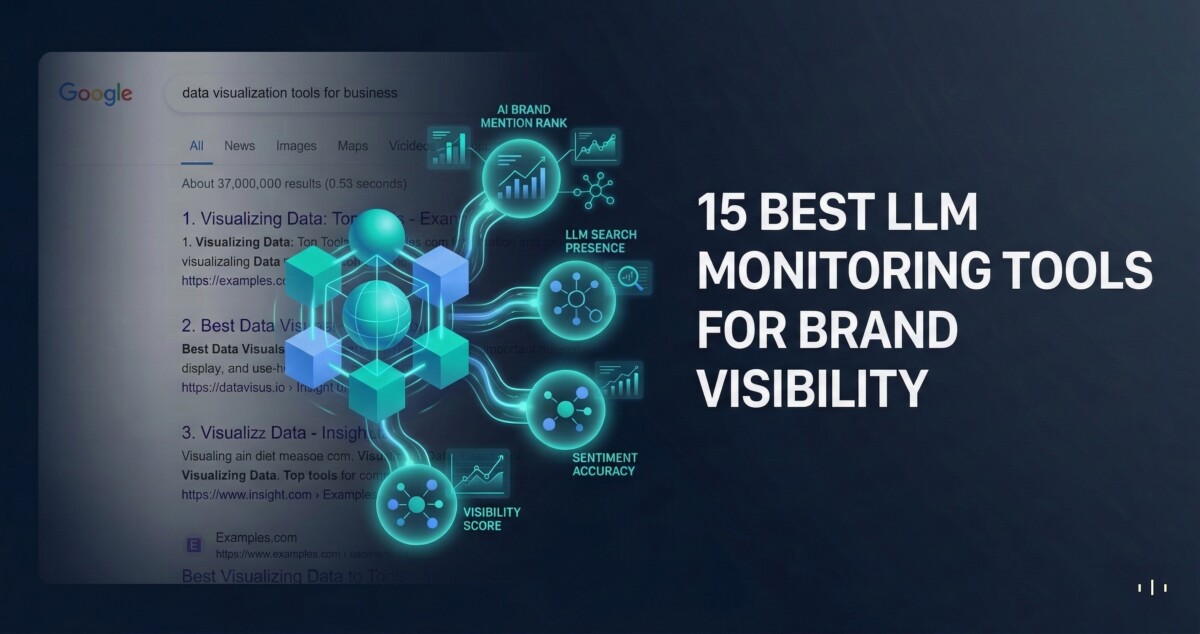
The 15 Best LLM Monitoring Tools for Brand Visibility in 2026
The tools below are grouped by primary utility. The right tool for a $50K per month brand is not the right tool for a $5M per month brand, and the right tool for a content-first team is not the right tool for a technical SEO team. Use these groupings to filter toward what fits your actual situation.
Enterprise Intelligence Platforms
Semrush is the most comprehensive starting point for brands that want unified search intelligence across traditional and AI channels. Its AI Visibility Toolkit tracks AI Overview presence across device types and keyword sets, and its Unified AI Visibility Score distills multi-platform data into a single KPI that works for executive reporting. The platform’s strength is historical data and the ability to correlate AI visibility fluctuations with algorithm update timelines. For teams doing $1M or more per month who already run SEO through Semrush, the AI features are a logical extension rather than a separate tool purchase. The limitation is that Semrush was built for traditional search and retrofitted for AI monitoring. It is not the deepest tool for tracking ChatGPT or Claude specifically.
Profound is built from the ground up for accuracy in AI monitoring. It uses client-side mimicry to simulate real user sessions, which reduces the hallucinated data risk that comes from API-only approaches. Its Citation Provenance Engine identifies the specific source URL an AI used to generate a claim, which is the data point you need to run effective off-page optimization. Profound also carries SOC 2 Type II compliance, which matters for enterprise IT teams. It is best suited for brands in regulated categories, brands with complex reputation management needs, or operators who need to know not just whether they are cited but exactly where the citation is coming from.
BrightEdge is the standard for Fortune 500 marketing teams. Its Generative Parser tracks what it calls the Intent Hierarchy of Google’s AI deployment, helping large brands understand macro trends in how AI Overviews trigger across different industry categories. The Deployment Rate Tracking feature is particularly useful for resource allocation: it shows how often AI Overviews appear for your specific keyword set, so you can prioritize GEO investment where it will actually have impact. For independent DTC brands, BrightEdge is almost certainly over-engineered and overpriced. For brands doing $10M per month or above with dedicated SEO teams, it is worth evaluating.
Conductor focuses on translating AI visibility data into business-level reporting. Its Persona-Based Insights feature tracks visibility changes by user intent classification, distinguishing between early-stage awareness queries and bottom-of-funnel buying queries. The dashboards are built for executive stakeholders who need to see ROI from GEO investments, not raw data. Best for brands with marketing leadership that needs to justify AI optimization spend to a board or investor group.
Mid-Market and Agency Tools
Authoritas applies a data-science approach to AI visibility with particular strength in volatility modeling. Its Branded vs. Unbranded Flow Analysis separates navigational queries (someone searching your brand name) from informational queries (someone searching your category), which helps you understand whether your AI presence is driven by existing brand equity or by content authority. The platform’s Universal SERP architecture tracks the interplay between traditional organic rankings and AI Overviews, making it useful for teams that need to manage both channels simultaneously. Well suited for mid-market brands with in-house SEO teams doing $500K to $3M per month.
SE Ranking offers robust historical AI Overview tracking at a price point accessible to agencies and mid-sized brands. Its SERP Feature History visualization shows the stability of AI placements over time, and its Competitor Intersection report identifies exactly where competitors are triggering AI answers that you are not. For agencies managing multiple DTC clients across different categories, SE Ranking’s multi-client architecture and reporting features make it a practical choice.
Advanced Web Ranking (AWR) is the most accurate tool in this list for localized AI tracking. As AI results become increasingly geo-specific, the ability to see how AI responses vary by city or region becomes a meaningful competitive advantage for brands with brick-and-mortar footprint or strong regional markets. AWR tracks AI Overviews across thousands of specific locations with a precision that most enterprise platforms cannot match. If your brand has physical retail presence or significant regional concentration in your customer base, AWR belongs in your evaluation.
Sistrix provides a clean Visibility Index that now incorporates AI features, with particular depth in European markets where AI deployment regulations and search behavior vary from North American patterns. Its AI Opportunity Keywords filter shows where an AI Overview is present for a keyword but your brand is not yet cited, which is the most direct input for content prioritization. For brands with meaningful European revenue, Sistrix is often the most accurate tool for that specific market.
Agile Optimization Tools
ZipTie.dev is built for teams that need to run rapid experiments and see results quickly. Its AI Success Score is a unified metric that weights visibility against commercial intent, correlating AI presence with potential traffic impact. The platform provides specific structural recommendations for improving citation likelihood in Google AI Overviews. For brands that want to move fast and test content changes against AI visibility outcomes without a large analytics infrastructure, ZipTie.dev is one of the most accessible entry points in this category.
MarketMuse combines AI monitoring with content intelligence in a way that is particularly useful for content-first teams. Its Competitive Content Heatmaps show where your content lacks the depth or semantic richness of the sources currently winning AI citations. The platform’s focus on Information Gain, producing unique data and insights rather than rephrasing what already exists, is directly aligned with what LLMs reward when selecting sources to cite. If your primary growth lever is content production and you want a tool that connects monitoring to editorial workflow, MarketMuse is worth a close look.
Surfer integrates monitoring into the content creation process itself, creating a continuous loop of audit, optimize, and track. Its Auto-Optimization feature provides suggestions based on the current top-performing AI citations, helping content teams structure new pieces to match the formats AI models prefer. Best for brands with high content output volume that want to build GEO signals into the production workflow rather than treating it as a separate audit process.
Specialized and Input-Side Tools
Brand24 monitors the inputs of the AI ecosystem rather than just the outputs. Forums, news sites, and online discussions are part of the training and retrieval corpus that LLMs draw from. Brand24’s Influential Creator Discovery feature identifies specific forum posters and authors whose content is frequently cited by LLMs, enabling targeted outreach to the sources that actually influence AI answers. Its sentiment analysis functions as an early warning system, detecting negative narratives in the places where AI models are learning before those narratives surface in AI outputs.
Botify addresses the technical side of AI visibility: ensuring that AI crawlers can successfully render and read your site’s content. Its Crawler Budget Analysis tracks how search bots interact with JavaScript-heavy pages and identifies Rendering Gaps where critical entity data like pricing and product specifications is technically inaccessible to LLMs. For Shopify brands running complex themes with significant JavaScript, Botify can surface technical issues that are invisible to content-focused monitoring tools but are actively suppressing AI citation rates.
Similarweb is primarily a traffic intelligence platform, but its Outgoing Traffic Analysis makes it relevant for AI monitoring in a specific way. When your target keywords are driving traffic to Reddit, Quora, or niche review sites rather than to your own domain, those third-party platforms are likely the sources AI models are citing for your category. Identifying them is the first step toward improving your presence there, whether through community participation, review acquisition, or digital PR. Useful as a diagnostic tool rather than a primary monitoring platform.
Sprout Social belongs in this list because LLMs increasingly ingest real-time social data through platform API partnerships. Social listening is becoming a proxy for LLM monitoring in the sense that the conversational sentiment about your brand on X and Reddit is part of the corpus that shapes how AI models represent your brand. Sprout’s Sentiment Trends feature tracks the emotional tone of brand mentions across the social web. For brands managing active communities or navigating reputation challenges, social listening and LLM monitoring are now part of the same workflow.
How Reviews and Loyalty Programs Directly Improve AI Visibility
One of the most actionable insights from conversations with brands actively working on GEO is the role that user-generated content plays in AI citation rates. Static product pages signal to AI models that a brand is not actively engaged with its customers. A consistent stream of verified reviews provides a constant influx of fresh, semantically rich content in the natural language that customers actually use when asking buying questions. The phrasing in a genuine review, “this holds up after 200 washes” or “runs small, order up a size,” is often closer to the exact phrasing of an AI prompt than anything a brand’s marketing team would write.
This is where Yotpo Reviews creates a direct connection to AI visibility. Yotpo generates a continuous stream of fresh UGC that signals relevance to search algorithms, and its partnership with Google ensures that review data is correctly structured for the Shopping Graph. When an AI model constructs an answer to a product comparison query, it is looking for structured nodes of information that confirm attributes like durability, fit, or value. Reviews marked up with proper schema provide exactly that. The brands seeing the strongest AI citation rates in product categories are almost universally the ones with the highest volume of recent, structured review content.
Yotpo Loyalty extends this by creating a self-sustaining engine of content freshness. Loyalty programs that incentivize post-purchase reviews and UGC submissions keep the content signal active over time rather than spiking at launch and decaying. For AI models that weight recency as a freshness signal, a brand with 50 new reviews per month is a more reliable citation candidate than a brand with 500 reviews that stopped accumulating 18 months ago. If you want to go deeper on how structured data powers AI citations and why interconnected entity schemas outperform basic product markup, that is the technical layer that sits underneath everything discussed in this section.
Moving from Monitoring to Optimization
Monitoring tells you where you stand. Optimization changes it. The transition from one to the other follows a consistent pattern for the brands doing it well: identify the specific prompts where your brand should appear but does not, trace the citation provenance to understand which sources are winning those citations, and then either improve your presence on those sources or produce content that directly competes with them.
The highest-leverage optimization moves at the $100K to $1M monthly revenue range are not technical. They are content and entity clarity. LLMs struggle to cite brands whose core value proposition, pricing tier, and target customer are ambiguous in their own content. If your About page, your product descriptions, and your FAQ content do not clearly and consistently signal what you do, who you do it for, and why you are credible, no monitoring tool will fix that. The monitoring tool just surfaces the symptom. The fix is content clarity and structured data.
Digital PR is the other high-leverage move that monitoring data makes actionable. Since citation provenance tools can identify exactly which third-party sources AI models are pulling from for your category, you can prioritize your outreach and partnership efforts toward the specific publications, review sites, and community forums that are actually influencing AI outputs. This is a fundamentally different approach than traditional link building, and it requires monitoring data to execute well. Understanding how GEO differs from traditional SEO at the strategy level is the foundation that makes these tactical moves coherent rather than random.
Choosing the Right Tool for Your Stage
The most common mistake I see brands make in this space is evaluating tools based on feature lists rather than fit. A $200K per month brand does not need BrightEdge. A $10M per month brand should not be making decisions based on ZipTie.dev alone. Stage matters, and so does what you are actually trying to accomplish.
If you are doing under $200K per month and your primary goal is understanding whether your brand appears in AI answers at all, start with Brand24 for input monitoring and ZipTie.dev for output scoring. The combined cost is accessible and the data is actionable without requiring a dedicated analyst to interpret it.
If you are doing $200K to $1M per month with an in-house marketing team, SE Ranking or Authoritas gives you the historical context and competitive intelligence you need to build a systematic GEO strategy. Pair either with MarketMuse if content production is your primary growth lever.
If you are doing over $1M per month with a full SEO function, Semrush’s AI toolkit is the most integrated option if you are already in their ecosystem. Profound is worth evaluating if citation provenance and accuracy are priorities, particularly if you are in a regulated category or managing active reputation challenges. Botify belongs in any technical audit of a large Shopify or headless commerce build.
Frequently Asked Questions
What is the difference between SEO and GEO for ecommerce brands?
SEO optimizes your content to rank in traditional search engine results pages and drive clicks to your website. GEO, or Generative Engine Optimization, optimizes your content to be cited and synthesized by AI models like ChatGPT, Claude, Perplexity, and Google AI Overviews. The primary KPI shifts from click-through rate to Answer Inclusion: whether your brand appears in the AI-generated response itself. For ecommerce brands, both matter, but GEO is increasingly where top-of-funnel brand discovery happens, particularly for category and comparison queries where customers used to click through to review sites and now get a synthesized answer instead. The two disciplines reinforce each other when done well, but they require different content structures, different measurement tools, and different optimization levers.
How do I know if my brand is showing up in ChatGPT or Perplexity?
The most reliable method is structured prompt testing: identify the 10 to 20 queries your target customer is most likely to ask an AI about your category, run each prompt multiple times across ChatGPT, Claude, Perplexity, and Google AI Overviews, and record whether your brand appears and how it is characterized. Running each prompt multiple times matters because LLM outputs are probabilistic, and a single run is not a reliable baseline. Purpose-built monitoring tools like Profound and ZipTie.dev automate this process and provide sentiment and positioning data alongside presence tracking. If you are starting manually, focus on category queries (“best [product type] for [use case]”) and comparison queries (“how does [your brand] compare to [competitor]”). Those are the prompts where brand visibility has the most direct impact on purchase decisions.
What is Citation Provenance and why does it matter for my Shopify store?
Citation Provenance is the identification of the specific source URL an AI model used to generate a claim about your brand or category. It matters because LLMs do not cite your website by default. They cite the sources they trust most for a given topic, which are often third-party review sites, forum threads, editorial roundups, and news articles rather than your own product pages. Knowing which specific sources are being cited for your category tells you exactly where to focus your off-page optimization efforts, whether that means improving your presence on a specific review platform, contributing to a relevant community forum, or pursuing a digital PR placement in a publication the AI consistently references. Without citation provenance data, off-page GEO strategy is guesswork.
How do customer reviews affect my brand’s visibility in AI answers?
Customer reviews affect AI visibility through two mechanisms. The first is freshness: a consistent stream of new reviews signals to AI models that your brand is active and currently relevant, which weights toward citation over brands with stale or absent review content. The second is semantic richness: genuine customer reviews contain the natural language phrasing that customers use in AI prompts, including specific product attributes, use cases, and comparisons that marketing copy rarely captures. A product page with 200 recent reviews contains far more of the language patterns AI models are trained to recognize as relevant than a page with a polished product description and no social proof. Platforms like Yotpo that structure review data with proper schema markup amplify this effect by making the content machine-readable for AI crawlers.
Which LLM monitoring tool should a Shopify brand start with if they have a limited budget?
For brands doing under $200K per month with limited analytics resources, the most practical starting point is a combination of Brand24 for monitoring the input side of the AI ecosystem and ZipTie.dev for tracking AI Overview presence and getting specific content recommendations. Brand24 starts around $99 per month and surfaces the forum discussions, news mentions, and social conversations that feed into AI training and retrieval. ZipTie.dev provides actionable scoring and structural recommendations without requiring a dedicated analyst to interpret the data. Before investing in either, spend two to three hours doing manual prompt testing across ChatGPT and Perplexity to establish a baseline of where you currently stand. That baseline will make the tool data far more actionable from day one.
