




Quick Decision Framework
- Who This Is For: Shopify brand founders and operators doing $50K to $500K per month who are actively investing in content and SEO but have not yet mapped their AI citation strategy across ChatGPT, Perplexity, Gemini, and Google’s AI surfaces.
- Skip If: You’re pre-revenue or still validating your product. AI citation strategy compounds on top of existing brand authority. Come back when you’re processing at least 100 orders a month and have some content published.
- Key Benefit: Understand exactly where the Q1 2026 citation data says your brand should be showing up, which platforms matter most for your category, and the five actions you can take this week to start showing up in AI-generated product recommendations.
- What You’ll Need: Access to your product pages and existing content, a Reddit account to audit community presence, and roughly 2 to 3 hours to run the platform tests described in this article. No paid tools required to get started.
- Time to Complete: 12 minutes to read. 3 to 5 hours to complete the five priority actions. Expect to see measurable citation shifts within 30 to 60 days of consistent execution.
When 24% of all Perplexity citations in January 2026 came from Reddit, the brands that were already in those conversations didn’t have to do anything different. The ones that weren’t had no fast way to catch up.
What You’ll Learn
- Why Reddit’s near-doubling of AI citation share is the most urgent signal in the Q1 2026 data, and what it means for how you build community presence right now.
- How Google’s three AI products (Gemini, AI Overviews, and AI Mode) cite sources so differently that treating them as one “Google strategy” is leaving significant visibility on the table.
- What Amazon’s decision to block nearly 50 AI crawlers actually creates for Shopify merchants willing to stay open.
- Why only 30% of brands maintain consistent visibility across back-to-back AI answers, and the dual-signal pattern that separates the ones who do.
- When to prioritize Reddit presence, third-party citations, and crawler access over traditional on-site SEO for AI discovery in 2026.
Forty-three percent of Shopify brands I talk to are still optimizing for Google’s blue links while their customers have already moved their research to ChatGPT, Perplexity, and Gemini. The gap between where brands are investing and where product discovery is actually happening has never been wider. And the Q1 2026 AI Citation Trends Report from Tinuiti and Profound makes that gap impossible to ignore.
I’ve been sitting with this data for a few days now, cross-referencing it against what I’m hearing from operators in the field, and there are three findings in particular that I think most brands are going to underestimate. Whether you’re doing $10K months and building your first real content strategy, or running a $5M operation with a full marketing team, these shifts affect how your customers find you. Let me walk you through what I’m actually seeing and what I’d do about it.
The Reddit Signal That Most Brands Are Missing
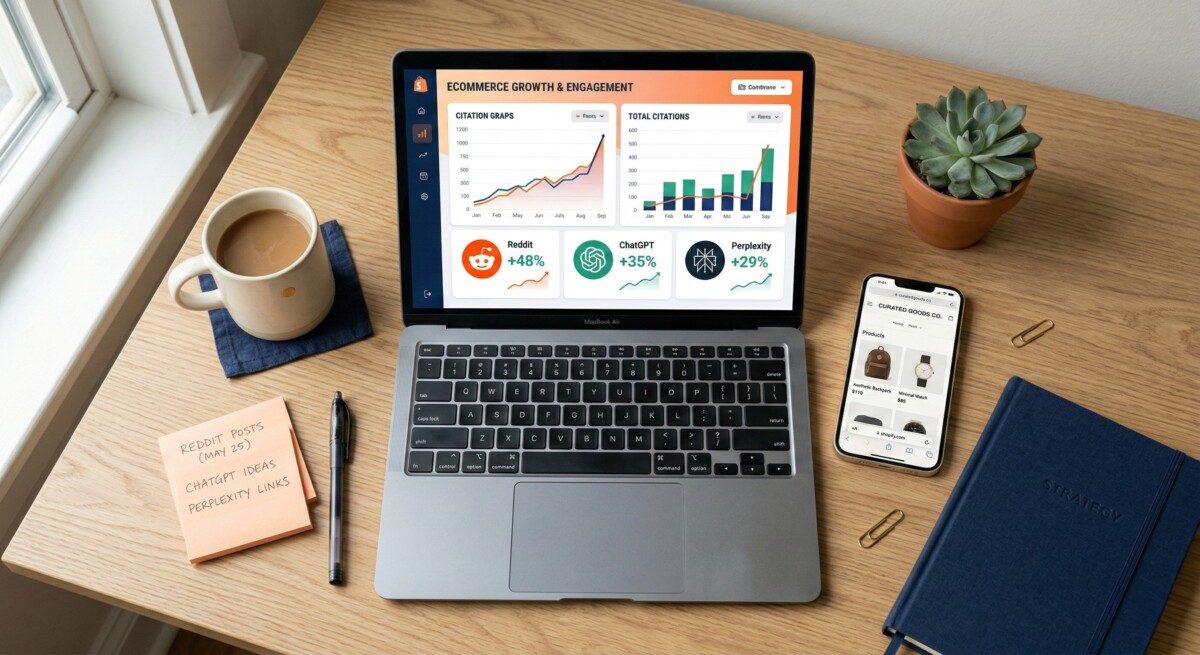
Here’s the number that stopped me cold: Reddit’s share of AI citations nearly doubled from October 2025 to January 2026. Across every category tracked in the report, including apparel, beauty, electronics, and food and beverage, Reddit grew by at least 73%. In some categories it more than doubled. And on Perplexity specifically, 24% of all citations in January came from Reddit threads. Not from brand websites. Not from media coverage. From real people having real conversations in communities your brand may or may not be part of.
The reason this matters so much is about timing. Research from AirOps and Kevin Indig confirms that roughly 88% of Reddit citations happen at the category exploration stage. That’s the moment before your customer has decided what to buy, when they’re still figuring out what even exists. The brands that show up in those conversations are the ones that get added to the consideration set. The ones that don’t are never evaluated at all.
If you’re a founder doing $100K months, you probably have a solid Google Ads strategy and maybe a decent email program. But if someone right now searched Reddit for your product category and your brand’s name never came up organically, in a thread you didn’t write, from a customer who genuinely loves you, you have a gap that no amount of ad spend can close in an AI-cited world.
The path forward here is not to manufacture Reddit presence. Getting caught posting fake reviews or astroturfing threads will get you banned and, more importantly, your customers can smell it. What actually works is earning your way into those conversations the same way you earn anything worth having. Answer real questions in subreddits where your buyers already spend time. Share data that helps people make better decisions. When someone asks for a recommendation in your category, show up as a genuinely useful participant, not a brand trying to sell something. That kind of authentic presence compounds. It gets cited. And now we know it gets pulled into AI answers at scale. For a deeper look at how this connects to your broader citation strategy, the guide on getting your Shopify brand cited in Google AI results covers the full authority-building framework that makes this work.
Google Has Three AI Products and They Behave Like Three Different Companies
This is the finding I think is most underappreciated by operators right now, and it has direct implications for where you spend your content optimization time.
Gemini, AI Overviews, and AI Mode are all Google products. Same company, same infrastructure, dramatically different citation behavior. In January 2026, AI Overviews had 13% social media citation share. AI Mode had 9%. Gemini had just 3%. Reddit accounted for 44% of social media citations in AI Overviews, and just 5% in Gemini. Amazon’s product pages showed up in AI Overviews and AI Mode but recorded zero citations in Gemini results for the entire month.
The divergence that I find most strategically significant is what’s happening with AI Mode specifically. In January 2026, AI Mode cited 143% more unique domains than AI Overviews. In November 2025, that gap was only 57%. It’s widening fast. What that means in practice is that AI Mode is becoming the most expansive discovery surface Google has ever built. It’s pulling from more sources, more diverse domains, and more of the long-tail web than AI Overviews is. If you’re a smaller Shopify brand with strong niche authority in a specific category, AI Mode is the surface where you have the most realistic path to showing up alongside much larger competitors.
At the same time, AI Overviews saw a 46% decline in tracked citations from November to January. That’s not a small fluctuation. Google is actively reshaping how these surfaces work, and the brands that treat “ranking on Google” as a single unified strategy are going to keep getting surprised by these shifts. You need to know which Google surface is sending you visibility, and you need to be optimizing for each one differently. If you haven’t yet built out a structured approach to this, the GEO playbook for AI discovery is the right starting point for thinking through surface-by-surface strategy.
Amazon’s Wall Is Your Open Door
Amazon is blocking nearly 50 AI crawlers. All three of OpenAI’s crawlers are blocked. Perplexity is blocked. Amazon actually sued Perplexity over their Comet browser, calling the attempt to let users shop Amazon via an AI agent “computer fraud.” The cease-and-desist was aggressive and the message was clear: Amazon wants AI-assisted shopping to happen inside their ecosystem, not outside it. They’re building Rufus. They’re testing “Buy for Me.” They want to be the front door.
And yet, despite blocking nearly 50 crawlers, Amazon still accounted for over 2% of all AI citations in January 2026. The reason is a gap in their own strategy: Amazon blocks Google-Extended, the crawler that feeds Gemini, but allows Googlebot, which powers AI Overviews and AI Mode. So Amazon’s product pages are still getting surfaced in those experiences even while Amazon actively tries to wall off the broader AI ecosystem.
Here’s the strategic implication for your Shopify brand. While Amazon is playing defense, you have an opening. Walmart, Target, and Etsy are not blocking AI bots. Walmart is already seeing approximately 36% of its referral traffic from ChatGPT, up from 20% just months ago. The platforms and brands that are open to AI crawlers right now are the ones getting cited. Your Shopify store, by default, is accessible to most AI crawlers. That’s a structural advantage that Amazon is handing you. But accessibility alone is not enough. You have to give those crawlers something worth citing: clean structured data, answer-first content, genuine third-party authority signals. The brands that put those three things together while Amazon is busy building walls are going to own meaningful citation share before the window closes.
The Platform Numbers You Actually Need to Know
The differences between platforms in this report are enormous, and they’re getting more pronounced quarter over quarter. ChatGPT had about 7% social media citation share in January. Gemini had just over 3%. Perplexity came in at 31%, with Reddit alone accounting for 24% of that. These are not minor variations. They represent fundamentally different source preferences, and a strategy that works on one platform can be nearly invisible on another.
The research I’ve been cross-referencing consistently shows that only about 30% of brands maintain consistent visibility across back-to-back AI answers on the same platform. Most brands disappear between responses. The pattern that separates the ones who stay visible is what I’d call dual-signal presence: being both mentioned and cited in the same AI answer. Brands that achieve both are 40% more likely to resurface in future answers. Only about 28% of AI answers include brands that hit both signals simultaneously. But it’s the pattern that compounds, and it’s the one worth building toward deliberately.
If you’re only tracking your brand visibility on one platform, you’re getting a wildly incomplete picture of where you actually stand. A brand that’s well-cited on Perplexity might be nearly invisible on Gemini. A brand that shows up consistently in AI Overviews might not appear in AI Mode at all. The episode on why your best content is invisible in AI search goes deep on this multi-platform visibility problem and is worth the listen if you want to understand how the tracking side of this actually works.
Five Things I’d Actually Do This Week
Every founder I talk to has limited time and a long list of competing priorities. So rather than leaving you with a broad strategic framework, here’s exactly where I’d focus first based on what this data is telling us.
Start with a Reddit audit. Search your product category on Reddit right now. Are you showing up? Not in posts you wrote, but in organic conversations where customers are recommending brands? If your name isn’t appearing in those threads, that’s a content and community gap that is now directly affecting your AI citation share. Identify the three to five subreddits where your buyers are most active and start showing up as a genuinely useful participant this week.
Next, stop treating Google as one thing. Test your five most important category prompts across AI Overviews, AI Mode, and Gemini separately and record what you find. You will almost certainly see different brands appearing on different surfaces. That gap analysis tells you exactly where your content optimization effort needs to go first.
Third, invest in third-party citations. Reviews, press mentions, comparison guides, listicles, the content that lives off your own domain is now more valuable for AI discovery than your own site content. Research from AirOps found that brands are 6.5 times more likely to be cited through third-party sources than through their own domains. About 85% of brand mentions in AI results come from external sources. That’s a fundamental shift from traditional SEO thinking, and your content strategy and your PR strategy need to become the same strategy.
Fourth, check your robots.txt and make sure you’re not accidentally blocking AI crawlers. While Amazon is building walls, you should be building doors. This is a 15-minute technical check that could have meaningful implications for your citation accessibility.
And fifth, set up a way to track this consistently. AI citation visibility is volatile. The Tinuiti and Profound data shows it changing month over month in ways that matter. You need a monitoring system that tells you where you’re showing up and where you’re not, so you can respond when things shift rather than finding out three months later. The AI Search SEO playbook for Shopify covers the tracking infrastructure side of this in detail and is worth bookmarking as a companion resource to what we’ve covered here.
The brands that treat AI citation visibility as a core KPI in 2026, not a nice-to-have, not something to get to eventually, are the ones that are going to own the discovery moment before their competitors figure out what’s happening. The window to get ahead of this is open right now. It won’t stay open forever.
Frequently Asked Questions
How does Reddit showing up in AI citations actually affect my Shopify brand’s discoverability?
When AI platforms like Perplexity pull citations, they treat Reddit threads as authentic user-generated signals of what real buyers think and recommend. In January 2026, Reddit accounted for 24% of all Perplexity citations, with roughly 88% of those citations happening at the category exploration stage, before a shopper has decided what to buy. If your brand is being mentioned organically in relevant subreddits, those mentions can get surfaced in AI-generated answers when someone asks for product recommendations in your category. If you’re not part of those conversations, you’re not part of the consideration set. The practical implication is that community presence is now a discovery channel, not just a brand-building exercise.
What is the difference between Google AI Overviews, AI Mode, and Gemini for my citation strategy?
They are three separate Google products with significantly different citation behavior. In January 2026, AI Overviews had 13% social media citation share, AI Mode had 9%, and Gemini had just 3%. AI Mode cited 143% more unique domains than AI Overviews in the same period, making it the most expansive surface for brands with strong niche authority. Gemini showed zero Amazon citations for the entire month. The practical takeaway is that you need to test your category prompts across all three surfaces separately and optimize for each one, because a strategy that works in AI Overviews may not move the needle in Gemini at all.
How does Amazon blocking AI crawlers create an opportunity for my Shopify store?
Amazon is blocking nearly 50 AI crawlers, including all three of OpenAI’s crawlers and Perplexity, in an effort to keep AI-assisted shopping inside their own ecosystem. Meanwhile, your Shopify store is accessible to most AI crawlers by default. Platforms that remain open, including Walmart, Target, and Etsy, are already seeing meaningful AI-referred traffic as a result. Walmart reported approximately 36% of its referral traffic coming from ChatGPT in early 2026. The brands that pair open crawler access with clean structured data and strong third-party authority signals are capturing citation share that Amazon is actively walking away from. This is a structural advantage that exists right now and is worth acting on before the broader market catches up.
What does dual-signal visibility mean and why does it matter for my brand?
Dual-signal visibility means your brand is both mentioned and cited with a link in the same AI-generated answer. Research shows that brands achieving both signals in the same response are 40% more likely to resurface in future answers from the same platform. Only about 28% of AI answers include brands that hit both signals simultaneously, which means most brands are getting partial credit at best. Being mentioned without a citation means you’re being referenced but not sourced. Being cited without a mention means the platform is pulling from your content but not necessarily associating it with your brand. The goal is to earn both consistently, which requires a combination of on-site content quality and off-site third-party authority.
How often should I be checking my AI citation visibility across platforms?
The Q1 2026 data shows citation patterns shifting meaningfully month over month, which means quarterly reviews are not frequent enough to catch and respond to changes in time. For brands doing $100K or more per month, a monthly review of citation visibility across ChatGPT, Perplexity, Gemini, AI Overviews, and AI Mode is the right cadence. For smaller operations, a bi-monthly check is a reasonable starting point. The key is consistency. You’re looking for which prompts are surfacing your brand, which platforms are citing you, and where competitors are showing up that you’re not. That gap analysis is what drives the next month’s content and PR priorities.
