






Verified & Reviewed
Last updated on February 27, 2026 Written By Rachel Hand

Last updated on February 27, 2026 Written By Rachel Hand

Subscribe for More
Outsourcing fulfillment to a third-party logistics (3PL) partner can be a game-changer for ecommerce brands looking to scale, but success hinges on more than just picking any provider.
To truly unlock the benefits of faster shipping, lower costs, and operational efficiency, your 3PL strategy must be built on proven best practices.
In this guide, we’ll break down what sets high-performing 3PLs apart and how brands can optimize their fulfillment partnerships. From strategic inventory placement to tech integration and process automation, these best practices can help you streamline operations, improve delivery performance, and keep customers coming back.
The 3PL vs. in-house fulfillment debate
When it comes to order fulfillment, ecommerce businesses face a critical decision: should they keep logistics in-house, or partner with a third-party logistics (3PL) provider?
Both options have their advantages and challenges, and the right choice ultimately depends on your company’s unique needs, goals, and growth trajectory.
| In-house fulfillment | Outsource to a 3PL | |
| Pros | More control over fulfillment
More freedom to customize workflows |
Instant access to infrastructure, advanced technology, and industry expertise
Scalable to mid-market and beyond Economies of scale offer cost-savings |
| Cons | Requires significant upfront investment (infrastructure, technology, and staff)
Not scalable |
Less control over fulfillment
Less freedom to customize workflows |
| Costs | Rent
Utilities Equipment Labor Capital investment |
Standard pricing for storage and fulfillment services (will vary by 3PL)
Value-added services (kitting, custom packaging, etc.) |
| Best for | Small startups with with limited monthly order volume and a tight budget | Scaling brands with growing order volumes and geographically dispersed customers |
Pros and cons
Managing fulfillment in-house offers a higher degree of control over the process, allowing you to maintain brand standards and customize the experience to your exact specifications.
However, this approach also requires significant upfront investment in infrastructure, technology, and staff, as well as ongoing operational expenses.
As your business grows, you may find yourself struggling to keep pace with increasing order volumes and complexity, leading to slower turnaround times and potential customer dissatisfaction.
On the other hand, outsourcing to a 3PL company can provide instant access to a robust fulfillment network, advanced technology, and deep industry expertise, enabling you to scale quickly and efficiently.
By leveraging a 3PL’s economies of scale, you can often reduce shipping costs and improve delivery speeds, while freeing up internal resources to focus on core competencies like product development and marketing.
However, this approach also means relinquishing some control over the fulfillment process and relying on a partner to represent your brand.
Common costs
To make an informed decision, it’s essential to forecast your capacity needs and consider the hidden costs associated with each approach.
For in-house fulfillment, this means projecting order volumes and storage requirements, as well as accounting for expenses like rent, utilities, equipment, and labor. Don’t forget to factor in the opportunity cost of investing capital in fulfillment infrastructure rather than other growth initiatives.
When evaluating 3PL providers, look beyond the headline pricing and consider the full scope of services included. Some providers may charge extra for value-added services like kitting or custom packaging, while others may have minimum order requirements or long-term contracts that limit flexibility. Be sure to ask about any potential hidden fees or surcharges, such as those for receiving, storage, or account management.
Capex vs. Opex considerations
Another key factor to consider is the balance between capital expenditure (Capex) and operational expenditure (Opex). In-house fulfillment typically requires significant upfront Capex investment in facilities, equipment, and technology, which can be a barrier for cash-strapped startups or businesses with unpredictable demand. Outsourcing to a 3PL, on the other hand, allows you to convert those fixed costs into variable Opex, paying only for the services you use on a transactional basis.
This Opex model can be particularly advantageous for businesses with seasonal or fluctuating demand, as it allows you to quickly adjust capacity without the burden of idle infrastructure. However, it’s important to note that some 3PLs may require minimum order volumes or charge higher rates for lower-volume clients, so be sure to carefully evaluate pricing models and contract terms.
Choosing the right approach for your business
Ultimately, the right fulfillment approach will depend on your business’s unique characteristics and growth stage. For example, a small startup with limited order volume and a tight budget may find in-house fulfillment more cost-effective in the short term, while an established brand with a national customer base may require the scalability and reach of a 3PL partner.
In some cases, a hybrid model may offer the best of both worlds, allowing you to maintain control over certain aspects of the fulfillment process while leveraging a 3PL’s expertise and infrastructure for others. For example, you might choose to keep inventory management and quality control in-house while outsourcing pick, pack, and ship operations to a 3PL.
As your business grows and evolves, it’s important to regularly reassess your fulfillment strategy and be open to exploring new approaches. By carefully weighing the costs, benefits, and risks of each option, you can make an informed decision that supports your long-term growth and success.
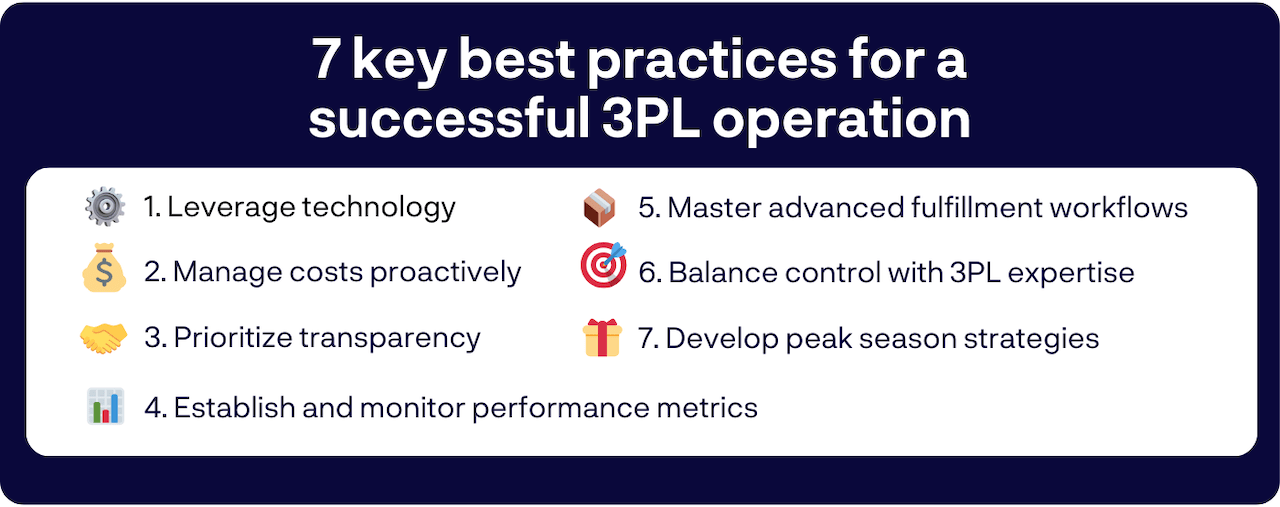
7 key best practices for a successful 3PL operation
Running an efficient and scalable logistics operation requires a strategic approach that encompasses technology, cost management, communication, performance monitoring, and more. By implementing these seven key best practices, ecommerce brands can optimize their 3PL partnerships and achieve long-term success.
1. Leverage technology and automation
Technology plays a crucial role in modern 3PL operations. A robust warehouse management system (WMS) is key for maintaining inventory accuracy and providing real-time visibility into stock levels, order status, and shipping timelines.
By leveraging a WMS to power fulfillment operations, 3PLs can eliminate manual processes and streamline data flow, reducing errors, increasing throughput, and improving efficiency.
Automation technologies, such as conveyor systems, pick-to-light devices, and mobile scanning tools, can significantly enhance picking accuracy and speed.
These solutions help 3PLs optimize warehouse layouts and implement data-driven inventory placement strategies that reduce travel time and minimize shipping costs.
2. Manage costs proactively
Effective cost management is a critical component of successful 3PL operations.
Optimizing pick-and-pack processes helps 3PLs reduce labor costs and improve overall efficiency.
This may involve:
- Implementing batch picking methods, using multi-order carts, or leveraging zone picking strategies based on warehouse layout and product characteristics.
- Choosing the appropriate box sizes and materials to minimize dimensional weight charges and reduce shipping costs.
- Negotiating favorable carrier contracts based on volume can to secure discounted rates and improve profitability.
Additionally, transparent billing practices and regular invoice reviews are essential for maintaining trust between 3PLs and their clients. 3PLs should provide detailed cost breakdowns and proactively identify opportunities for optimization.
3. Prioritize communication and transparency
Clear communication and transparency are the foundation of any successful 3PL partnership. Establishing well-defined channels for information sharing between 3PLs, brands, and supply chain partners ensures that all stakeholders are aligned and informed.
To that end, your 3PL should offer:
- Proactive updates on inventory levels, order status, and shipping timelines to help set proper expectations and enable brands to make informed decisions.
- Real-time order tracking and status notifications to end customers that enhance the post-purchase experience and build brand loyalty.
- Transparent communication, detailed explanations, and timely notification when exceptions or delays occur, which is crucial for maintaining trust and finding effective solutions.
- Regular performance reviews and strategic planning sessions provide opportunities for 3PLs and brands to discuss challenges, identify improvement areas, and align on long-term goals.
4. Establish and monitor performance metrics
Measuring and monitoring key performance indicators (KPIs) ensures that 3PLs consistently meet or exceed client expectations. Critical metrics to track include order accuracy, on-time shipping, inventory accuracy, and customer satisfaction.
To maintain performance accountability and visibility into operations, your 3PL should offer:
- Detailed SLAs: Developing meaningful Service Level Agreements (SLAs) that align with business goals helps establish clear performance benchmarks and accountability. These SLAs should be regularly reviewed and adjusted as needed to reflect changing market conditions and evolving client needs.
- Data dashboards: Dashboards and reporting tools that provide real-time visibility into KPIs enable continuous monitoring and improvement. This helps both you and them identify trends and anomalies early, which the 3PL should proactively address.
- Regular business reviews: Regular business reviews that include in-depth performance analysis and action planning are essential for driving operational excellence.
5. Master advanced fulfillment workflows
As ecommerce brands expand their product offerings and explore new sales channels, 3PLs must adapt to increasingly complex fulfillment requirements.
Your 3PL should have mastery over any advanced workflows your brand requires, such as kitting and bundling, partial shipping, and backorder management.
While your brand’s needs may differ from others, some common workflows to check your 3PL can handle include:
- Kitting and bundling operations involve assembling multiple SKUs into a single package before shipping.
- Partial shipping and backorder workflows to manage out-of-stock situations and minimizing delays.
- Multi-SKU variants and complex product configurations, ideally managed via robust inventory management systems and well-defined processes.
- Quality control processes, including random inspections, barcode scanning, and weight verification, that reduce fulfillment errors and ensure that products meet brand standards.
- Specialized handling procedures and packaging materials for high-value or fragile items to prevent damage and maintain product integrity.
6. Balance brand control with 3PL expertise
Outsourcing fulfillment to a 3PL does not mean relinquishing control over your brand experience. Successful 3PL partnerships strike a balance between leveraging the provider’s operational expertise and maintaining brand identity and values.
Custom packaging and branded inserts are powerful tools for creating a memorable unboxing experience and reinforcing brand messaging. 3PLs should work closely with brands to understand their unique requirements and develop fulfillment processes that align with brand guidelines.
Documenting brand standards, including packaging specifications, insert placement, and quality control criteria, ensures that 3PL teams can consistently execute on brand vision. Regular training and communication help maintain alignment and prevent deviations from established protocols.
Collaborative problem-solving and continuous improvement initiatives allow 3PLs and brands to leverage their combined expertise to optimize the fulfillment experience. By working together to identify opportunities for enhancement, such as streamlining packaging or implementing new technologies, both parties can drive innovation and growth.
Regular quality audits and site visits provide opportunities for brands to ensure that their standards are being upheld and identify areas for improvement. When 3PLs maintain an open dialogue and work together to address any issues, stakeholders can build strong, trust-based relationships that support long-term success.
7. Develop peak season strategies
Peak seasons, such as holidays and special sales events, can put significant strain on fulfillment operations.
Developing proactive strategies to manage these high-volume periods is essential for maintaining service levels and customer satisfaction.
A 3PL’s peak season preparations should involve:
- Advanced forecasting methodologies that incorporate historical data, market trends, and promotional plans, which together help brands anticipate demand spikes and allocate resources accordingly.
- Multi-warehouse distribution strategies that help mitigate the impact of peak season surges by spreading inventory across multiple locations, which in turn reduces shipping distances and transit times.
- Staffing plans and training programs for temporary workers that makes it possible to scale operations during peak periods and quickly bring new team members up to speed to maintain productivity.
- Contingency planning for supply chain disruptions, such as weather events or carrier capacity constraints, so operations can adapt quickly to changing circumstances and minimize the impact of disruptions and maintain service continuity.
How to evaluate and select the right 3PL partner
Choosing the right 3PL partner is one of the most critical decisions you can make, as it hugely impacts the trajectory of your business.
To ensure you find the best fit for your needs, you’ll have to take a methodical, structured approach to evaluation and selection. Here is a brief guide to help you kickstart your search, and help you think through the most important considerations.
Key evaluation criteria
When assessing potential 3PL partners, there are several key factors to consider.
First and foremost, evaluate their technology capabilities. A modern 3PL should offer:
- A robust warehouse management system (WMS) that provides real-time visibility into inventory levels, order status, and shipping performance.
- Seamless integrations with your ecommerce platform and other systems to streamline operations and reduce manual work.
- A strategic network of fulfillment centers that can optimize shipping costs and delivery times for your customers.
- Scalability that can accommodate increasing order volumes and expand into new markets.
Other important evaluation criteria include the 3PL’s financial stability, pricing transparency, and industry expertise. You want a partner that not only has the resources to support your business, but also has the experiences needed to fulfill products in your brand’s category.

Essential questions to ask potential 3PLs
To thoroughly vet potential 3PL partners, come prepared with a list of essential questions covering key areas such as operations, technology, pricing, and support.
For example, you could ask a potential partner:
- What is your process for receiving and storing inventory?
- What safeguards do you have in place for quality control?
- How do you approach peak season, and what steps do you take to ensure you can fulfill spikes in order volume on time?
- What is your technology stack like?
- What integrations do you offer (i.e., Amazon, Walmart Marketplaces, Shopify, ecommerce tools, etc.)? Are they direct integrations?
- What is your timeline for onboarding customers?
- What is your pricing structure? Can you provide detailed, monthly invoices and guarantee no hidden fees or surprise line items?
Be on the lookout for red flags in their responses, such as vague answers or an unwillingness to provide references. A reputable 3PL will be transparent about their capabilities and limitations and will work with you to find solutions that fit your needs.

Understanding 3PL pricing models and contracts
3PL pricing can be complex, with various models and potential hidden costs. Common pricing structures include per-order, per-pick, and storage-based fees.
To avoid surprises, it’s essential to understand what’s included in each model and ask about any additional charges, such as setup fees, account management fees, or long-term storage fees.
When reviewing contracts, pay close attention to the length of the agreement and any flexibility provisions. You’ll want the ability to adjust your terms as your business needs change. Clear termination clauses and data ownership provisions are also critical to protect your interests.
Don’t hesitate to negotiate for fair and transparent pricing. A good 3PL partner will be open to finding a mutually beneficial agreement that supports your business’s growth and success.

Learn how ShipBob embodies modern 3PL best practices
As a leading supply chain technology and enablement platform, ShipBob has built a reputation for excellence by consistently implementing industry best practices across its fulfillment operations.
By combining advanced technology, data-driven decision making, and a customer-centric approach, ShipBob empowers ecommerce brands to streamline their logistics and scale with ease.
Here are just some of the ways ShipBob partners with ecommerce brands to optimize fulfillment.
Advanced technology and seamless integrations
At the heart of ShipBob’s fulfillment solution is our proprietary warehouse management system (WMS). This powerful platform provides real-time visibility into inventory levels, order status, and shipping activity, enabling brands to make informed decisions and proactively address potential issues.
ShipBob’s WMS:
- Seamlessly integrates with all major ecommerce platforms, including Shopify, BigCommerce, and WooCommerce. This eliminates the need for manual data entry and ensures that inventory levels and order information are always up to date. With just a few clicks, brands can connect their online stores to ShipBob’s fulfillment network and start processing orders.
- Leverages advanced automation and AI-driven processes to improve accuracy and speed throughout the fulfillment process. From intelligent order routing to automated pick lists and shipping label generation, these technologies streamline operations and minimize the risk of human error.
- Offers merchants an analytics dashboard that delivers a wealth of data and insights to guide their decision making. With real-time access to key metrics like order accuracy, inventory turnover, and shipping costs, brands can quickly identify trends and opportunities for optimization.
“So many WMS systems are just archaic and confusing, because they’re built by engineers – not by the people who really utilize it. ShipBob’s WMS is different: the technology is great and works well, but it’s sleek and intuitive to navigate, too.”
Tucker Robinson, Warehouse Director at Savannah Bananas
Data-driven inventory placement
ShipBob’s Inventory Placement Program (IPP) is a prime example of how the company leverages data to optimize fulfillment operations. Our proprietary logic analyzes historical sales data and considers factors like product velocity, shipping destinations, and inventory levels to recommend the optimal distribution of inventory across its global network.
This strategic approach to inventory placement helps reduce shipping zones and delivery times, ensuring that products are always located as close to the end customer as possible. By minimizing the distance between the fulfillment center and the shipping destination, ShipBob is able to reduce transit times and shipping costs, ultimately improving the customer experience.
“By letting ShipBob handle physically distributing our inventory for us across their hub-and-spoke fulfillment center network, we’re actually saving money. We’ve seen that shipping to customers is $3 cheaper on average using IPP compared to similar 3PLs’ services, which is a huge upside.”
Oscar Gutierrez, Operations Fulfillment Manager at goPure
Flexible order management solutions
In today’s fast-paced ecommerce landscape, flexibility is key to maintaining customer satisfaction. ShipBob’s Partial Shipment Rules allow brands to automatically split orders when certain products are out of stock, ensuring that customers receive their available items as quickly as possible. This feature helps reduce cart abandonment and improve retention by keeping customers informed and engaged throughout the fulfillment process.
Similarly, ShipBob’s backorder workflow automation keeps customers informed about the status of their delayed items, providing regular updates and estimated shipping dates. This proactive communication helps manage customer expectations and maintain trust in the brand.
For time-sensitive products or VIP customers, ShipBob offers priority shipping options that ensure expedited delivery. By leveraging these flexible order management solutions, brands can adapt to changing circumstances and maintain a high level of customer service.
“ShipBob’s analytics are a huge bonus for a merchant looking to partner with a single 3PL that has a built-in order management tool. I was so stoked about being able to see the optimized layout of where you should be distributing your inventory is great. Having inventory and warehouse management capabilities built into your 3PL is such a value-add, especially for smaller companies.”
Juliana Brasil, Director of Operations at Food Huggers
Seamless onboarding and ongoing support
Transitioning to a new 3PL partner can be a daunting prospect, but ShipBob’s onboarding process ensures a smooth and efficient implementation. From the initial discovery phase to the final go-live, ShipBob’s team of experts works closely with clients to understand their unique requirements and develop a customized fulfillment strategy.
Throughout the onboarding process, ShipBob provides comprehensive training and support, ensuring that clients are fully equipped to leverage the platform’s capabilities. This hands-on approach to knowledge transfer helps brands get up and running quickly, minimizing disruption to their existing operations.
But ShipBob’s support doesn’t end at go-live; our dedicated account management team provides ongoing strategic guidance and consultation, helping brands optimize their fulfillment operations over time. By regularly reviewing performance metrics and providing actionable insights, ShipBob empowers its clients to make data-driven decisions and continuously improve their fulfillment strategy.
“ShipBob has been able to provide support for every step in our logistics journey with them. They have specialists in every area – everything from onboarding and DTC to Amazon and B2B. Each time we adopt a new solution with ShipBob, we’re supported by an onboarding team and a specialist with expertise in that specific area.
The knowledge that every member of the ShipBob team possesses is what has made our experience so wonderful. Whenever we have questions or want to try something new, there’s another specialist who can help us.
ShipBob has opened doors for us that we didn’t know were possible. ShipBob comes to us with solutions to problems, cost-saving initiatives, and proactive strategies that can help us improve our business in the future. ShipBob has brought us solutions to answers we didn’t know we needed.”
Jessica Stoller, Director of Supply Chain and Operations at Arrae
To learn more about how ShipBob leverages best practices to fulfill merchants’ orders, click the button below to get in touch.
FAQs about 3PL best practices
Here are answers to some of the most common questions about 3PL best practices.
How can a 3PL improve overall supply chain efficiency?

A 3PL can significantly enhance supply chain efficiency by consolidating shipping volumes from multiple clients, enabling them to negotiate better rates with carriers. This economies of scale advantage, combined with strategic warehouse locations that reduce transit times and shipping zones, results in faster, more cost-effective fulfillment.
Additionally, 3PLs utilize integrated technology solutions that seamlessly connect fulfillment with other supply chain functions, such as inventory management and order processing. This end-to-end visibility and automation streamlines operations, reduces manual errors, and enables real-time decision-making for optimal efficiency.
What role do integrations play in successful 3PL operations?
Integrations are crucial for successful 3PL operations, as they facilitate seamless data exchange and process automation. EDI and API connections eliminate the need for manual data entry, reducing errors and ensuring real-time synchronization of inventory levels, order statuses, and shipping information between the 3PL and its clients.
These integrations enable automated workflows that speed up fulfillment processes, such as order routing, pick/pack/ship tasks, and tracking updates. By leveraging integrated systems, 3PLs can provide their clients with accurate, up-to-date information and efficient order processing, ultimately leading to improved customer satisfaction and business growth.
How should brands prepare inventory for efficient 3PL receiving?
To ensure efficient 3PL receiving, brands should:
- Adhere to best practices for product labeling and packaging, where each SKU is clearly labeled with a scannable barcode, product name, and any relevant identifying information, and packaging is sturdy and appropriate for the product type.
- Provide accurate and complete documentation, such as packing slips and bill of lading, to facilitate smooth inbound processing.
What strategies help 3PLs manage multi-channel fulfillment effectively?
Effective multi-channel fulfillment requires 3PLs to implement intelligent inventory allocation strategies. By utilizing unified inventory systems that provide real-time visibility across all sales channels, 3PLs can prevent overselling and ensure optimal stock levels for each channel.
Moreover, 3PLs should investigate channel-specific packaging and documentation requirements to maintain brand consistency and comply with each platform’s guidelines. Implementing customized workflows and automation rules for each channel can further streamline multi-channel fulfillment processes and reduce the risk of errors.
How can 3PLs and brands collaborate on returns management?
Successful returns management requires close collaboration between 3PLs and brands. Together, they should develop efficient returns processing workflows that minimize handling time and costs while maximizing the recovery of product value. This includes implementing clear returns policies that set customer expectations and provide guidelines for eligibility, timelines, and procedures.
3PLs and brands should also establish standardized inspection and disposition decision frameworks for returned items. This helps determine whether a product can be restocked, refurbished, or disposed of, based on its condition and the brand’s specific criteria.
Why is transparent pricing vital for 3PL success?
Transparent pricing is essential for building trust and fostering long-term partnerships between 3PLs and their clients. By providing clear, detailed cost structures that outline all fees associated with fulfillment services, 3PLs empower brands to make informed decisions and accurately budget for their logistics needs.
How does ShipBob implement 3PL best practices for ecommerce brands?
ShipBob exemplifies 3PL best practices through its technology-first approach to fulfillment operations. By leveraging proprietary software, automation, and data analytics, ShipBob optimizes inventory management, order processing, and shipping for its ecommerce clients. Our distributed fulfillment network, strategically located across the United States and in key international markets, enables brands to reduce shipping costs and improve delivery times by storing inventory closer to end customers.
Additionally, ShipBob’s onboarding process and ongoing support services ensure that brands can seamlessly integrate their operations and continuously optimize their fulfillment strategies.
