





Your customer acquisition cost is probably rising.
Your data is probably scattered across different apps, and getting a single view of your customer journey feels impossible. You’re likely paying a “complexity tax” on your current app stack.
I’m Steve Hutt, founder of EcommerceFastlane. After working with hundreds of Shopify brands that scaled past seven figures, I’ve seen these data silos ruin growth momentum repeatedly. We don’t chase shiny new apps. Our reviews focus on what helps you scale, improves your profit and loss, and what your team will actually use to get results.
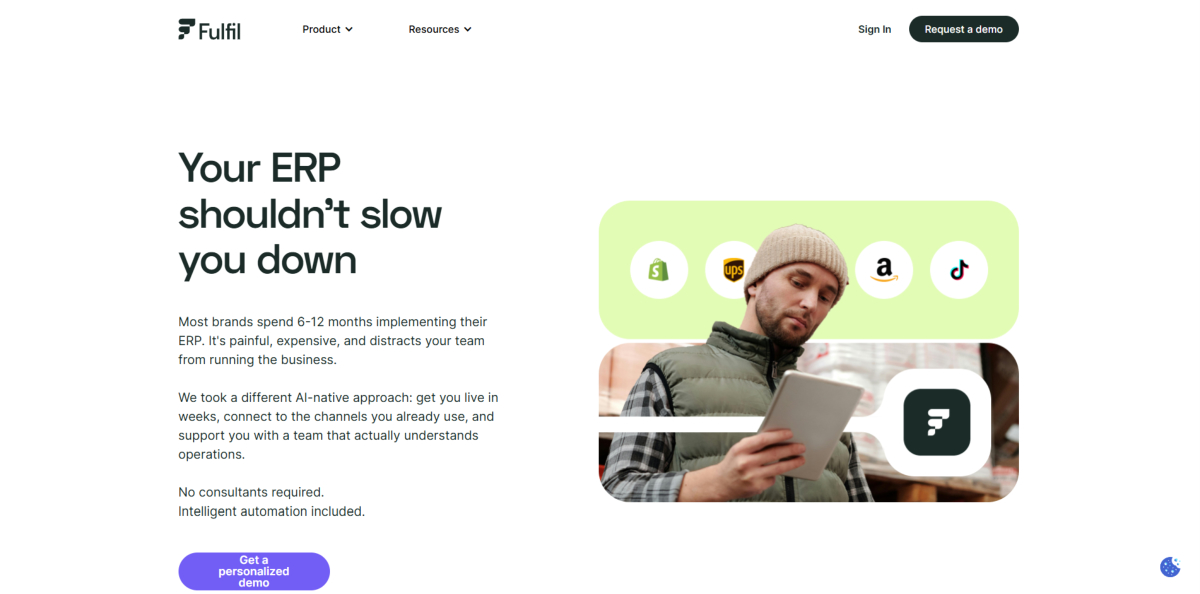
Today, we’re doing a deep-dive strategic review of Fulfil, a platform that claims to solve these exact problems for growing brands. Is it the right ERP for your Shopify brand? We’ll break down everything you need to know.
Why My Verdict Matters
I’ve spent years working with Shopify brands, seeing what works and what just creates more headaches. My goal with these reviews is to cut through the noise. What you need is clarity on tools that will actually move the needle for your business, not just another app to manage.
This isn’t about listing every feature; it’s about understanding the strategic impact on your P&L. Will it help you scale? Will it make your team more effective? That’s what we focus on.
The Fastlane Takeaway: Operational Command
Fulfil offers a path to taking back control of your operations. Many scaling brands hit a wall when their order volume outgrows their basic systems. You start seeing:
- Inventory discrepancies that lead to oversells or stockouts.
- Manual data entry errors that waste money and time.
- Fragmented views of your true business health.
Fulfil aims to fix this. It acts as a central nervous system for your operational data. This helps you reduce costs, improve efficiency, and make smarter decisions about your inventory and fulfillment. I’ve watched brands transform their backend chaos into streamlined processes with systems like this. It’s not magic, but it feels pretty close when you get it right.
The Hidden Complexity Tax on Scaling Shopify Brands
You know the feeling, right? Your Shopify brand is growing, sales are up, and everything should feel great. But instead, you’re constantly putting out fires. You’re wrestling with spreadsheets, trying to stitch together data from five different apps, and losing sleep over inventory discrepancies. This isn’t the dream of scaling; it’s the hidden complexity tax eating away at your profits and sanity. Many founders I’ve worked with describe it as feeling like they’re building a mansion on a rickety foundation.
What is the Complexity Tax?
Think of the complexity tax as the silent, invisible cost of growth when your internal systems can’t keep up. It’s not a line item in your P&L, but it shows up as wasted time, increased errors, and missed opportunities. We see this all the time with brands that are past the initial startup phase and trying to break into the eight-figure range. The solutions that worked at $1 million just don’t cut it at $10 million.
Here’s how this tax usually manifests:
- Manual Workarounds: Your team spends hours manually exporting and importing data between systems, leading to errors and delays. Imagine the time your team is losing every week just on these repetitive tasks.
- Data Silos: Important information about customers, inventory, and orders lives in separate apps, making it almost impossible to get a complete, accurate picture of your business. How can you make smart decisions without clear data?
- Customer Service Headaches: Because data is fragmented, your support team struggles to answer basic questions about order status or product availability, frustrating customers and hurting your brand’s reputation.
- Inventory Blunders: You’re either overselling products that are out of stock or sitting on too much inventory that isn’t moving. Both scenarios cost you money.
Why Your Current Setup is Holding You Back
Most scaling Shopify brands start with a collection of best-in-class apps, which works fine for a while. You might have Klaviyo for email, Gorgias for support, a separate app for subscriptions, and another for analytics. Each of these tools is powerful on its own, but together, they create a fractured ecosystem.
The problem comes when these tools don’t talk to each other seamlessly. You end up trying to be the IT manager of your own business, constantly battling integration issues and data mismatches. This isn’t just inefficient; it distracts you from strategic growth initiatives. Your energy is spent managing the mess, not building your brand.
It’s like trying to navigate a complex city using five different maps, each showing only a small part of the route. You need one comprehensive map, one system that brings everything together, so you can focus on the destination, not the confusion of the journey. This is where a unified system like Fulfil comes into play, aiming to solve these exact problems before they completely derail your growth.
Who Fulfil Is For (And More Importantly, Who Should Pass)
Deciding if a comprehensive ERP system like Fulfil fits your business isn’t a simple decision. It’s about figuring out where your growth is hitting roadblocks and if this tool directly addresses those challenges. I have watched many brands make the wrong choice, either investing too early or waiting too long, and both paths cost money and momentum. Let’s make sure you avoid that.
You Should Actively Consider Fulfil If:
If you are serious about scaling your Shopify brand, certain signals tell me Fulfil could be exactly what you need. These aren’t just guesses; these are patterns I have seen with dozens of seven and eight-figure brands that have successfully implemented similar systems.
- You are an ambitious Shopify scaler generating $5 million or more in annual revenue. At this stage, manual processes for inventory and order management become unsustainable. Fulfil helps you centralize critical operational data, eliminating the chaos that slows growth.
- You run a multi-channel operation, selling beyond just your Shopify store. Are you on Amazon, eBay, or handling wholesale orders? Fulfil provides a single source of truth for all inventory, preventing oversells and stockouts across every channel.
- You manage multiple warehouses or 3PLs. Consolidating inventory views and managing complex fulfillment logic across different locations is tough. Fulfil gives you the control and visibility you need to streamline these intricate processes.
- Your team is spending too much time on manual data entry or reconciliation. If your operations team is constantly exporting, importing, and checking spreadsheets, imagine the productivity gains. Fulfil automates many of these tasks, freeing your team to focus on strategic work.
- You need a clearer, real-time financial picture of your product costs and profitability. Fragmented data makes it hard to pinpoint true costs and margins. Fulfil helps integrate these financial elements, giving you precise insights into product line profitability.
You Should Probably Stick With Your Current Systems If:
Just as important as knowing who Fulfil is for, is understanding who it is not for. Investing in an ERP too early or when your business doesn’t have the complexity to justify it can waste significant resources. Here is when I would advise you to hold off.
- Your Shopify brand is still under $3 million in annual revenue. While growth is exciting, a full-blown ERP might be overkill. Your current app stack, perhaps with a few key integrations, can likely handle your needs without the added complexity and cost of Fulfil.
- You only sell through a single Shopify store with straightforward fulfillment. If you have one warehouse, limited product variations, and simple shipping rules, you probably are not experiencing the operational pain points Fulfil solves. Its full capabilities would be underutilized.
- Your team lacks the internal resources for implementation and ongoing management. Implementing an ERP is a significant project. It requires dedicated time and effort to configure correctly and train your team. If you do not have the internal bandwidth or a clear owner for the system, it could become a costly shelfware.
- You are primarily focused on marketing automation and customer relationship management (CRM). While Fulfil touches on order data, it is not a marketing automation platform or a dedicated CRM. If your current bottleneck is lead generation, email flows, or customer service tickets, other specialized tools might offer a better, more immediate impact.
- You prefer a highly modular app stack for specific functions. Some brands thrive on having separate, best-in-class apps for every single function. Fulfil aims to consolidate many functions into one system. If you prefer specialized tools over an integrated solution, Fulfil might feel too restrictive.
Fulfil’s Strategic Superpowers: Solving Your Toughest Operational Challenges
When you are scaling a Shopify brand, you eventually hit a point where basic systems just cannot keep up. You start to feel the drag of disconnected data and manual tasks eating away at your growth. This is where a unified system, a true ERP like Fulfil, steps in. It is not just about adding another tool to your stack; it is about fundamentally restructuring your operations to handle increased volume and complexity. I have watched brands move from constant firefighting to proactive management using systems like this. It helps you tame the chaos, giving you a single source of truth for critical business functions.
Unifying Multi-Channel Inventory and Order Management
Running a multi-channel business means your inventory data can become a tangled mess very quickly. Think about it: you are selling on Shopify, Amazon, maybe even through a wholesale portal. Each channel updates its own stock numbers, but do they all talk to each other? Often, they do not, leading to oversells, stockouts, and frustrated customers. Fulfil solves this by centralizing all your inventory and order information into one platform.
Let us say you have 100 units of a popular product. Without Fulfil, if you sell 20 units on Shopify and 15 on Amazon at the same time, you might show 80 available on Shopify and 85 on Amazon, even though you only have 65 left. This creates a real headache. Fulfil eliminates these kinds of data silos. It acts as the single master record for your inventory, pushing accurate stock levels to every single sales channel in real time. This means when a customer buys a product on Shopify, Fulfil instantly updates the available quantity across Amazon, your wholesale portal, and anywhere else you sell. This approach helps you optimize multi-channel inventory allocation, preventing those costly oversells and stockouts that directly hit your profitability and damage customer trust.
Streamlining Fulfillment and Logistics for Peak Efficiency
Once an order comes in, the clock starts ticking. Fast, accurate fulfillment is not just a nice-to-have, it is essential for customer satisfaction and repeat business. Manual picking, packing, and shipping processes are prone to errors and slow you down. Fulfil helps you automate these critical fulfillment workflows.
It is like having a digital traffic controller for your orders. Fulfil can automatically route orders to the most efficient warehouse or third-party logistics (3PL) provider based on various factors. Maybe it is about proximity to the customer to reduce shipping times, or perhaps it is about cost efficiency to save you money. For example, if you have warehouses on both coasts, Fulfil can smartly send an order from New York to your East Coast facility and an order from California to your West Coast one. It considers inventory levels, shipping costs, and carrier performance. This automation reduces manual errors significantly and speeds up delivery times, which ultimately improves your customer experience and boosts your bottom line.
Achieving Real-Time Financial Clarity and Reporting
Do you ever feel like you are flying blind when it comes to your true product profitability? Stitching together financial data from sales, manufacturing costs, and warehousing expenses across different spreadsheets can feel impossible. Fulfil helps you gain a holistic view of your business by integrating all this crucial financial data.
It is about getting a clear, real time picture of your numbers. Fulfil connects your sales figures with your cost of goods sold (COGS), manufacturing expenses, and operational costs. Imagine being able to see real-time COGS tracking for every product, not just once a month. This level of detail allows you to conduct a precise profitability analysis by product line. You can quickly identify which products are your true money makers and which might be dragging you down. This insight is absolutely crucial for strategic decision-making, helping you prioritize products, streamline operations, and focus your marketing efforts where they will have the biggest impact on your profitability. It helps you stop guessing and start making data-backed decisions.
The Operational Assessment: Diving Into Fulfil’s Practical Impact
Alright, let’s talk about the nuts and bolts. When you’re considering a system like Fulfil, it’s not just about the big picture; it’s about how it operates day-to-day. My clients always want to know, “Will this actually work for my team?” and “What’s the real return on investment?” This section answers those practical questions. We’re going to pull back the curtain on how Fulfil performs in the trenches for scaling Shopify brands.
The Shopify Integration: Powering Seamless DTC Operations
For any Shopify merchant, the integration with your store is make or break. Fulfil goes deep here, acting as a central hub where your Shopify data flows directly. Orders, products, and customer profiles all sync over, giving you a unified view. This means you do not have to manually transfer data or cross-reference spreadsheets.
What does this depth unlock? It allows Fulfil to become the authoritative source for inventory across all your sales channels. When a customer buys on your Shopify store, Fulfil immediately adjusts stock levels everywhere else. This helps prevent those frustrating oversells that can damage your brand’s reputation. It also streamlines the order fulfillment process. Imagine an order coming in, and Fulfil immediately knows the best warehouse to ship from.
Now, are there any gaps? While the core integration is robust, for some highly specialized, niche functionalities, you might find a missing native connection. For instance, specific loyalty program data from a third-party app might not sync directly into Fulfil without some setup. This is where Zapier often becomes the bridge. If you need to connect Fulfil to a super obscure app, Zapier can usually help you build that custom workflow. It is not always ideal, but it offers a practical workaround for those unique edge cases.
Pricing vs. ROI: The P&L Conversation for Scaling Brands
When we talk about an ERP like Fulfil, the pricing conversation is never just about the monthly fee. It is about the holistic impact on your profit and loss statement. Many brands look at the sticker price and balk, but they forget the hidden costs of their current fragmented tech stack.
Here’s how Fulfil’s pricing structure typically looks:
Let me be direct, Fulfil isn’t the cheapest option out there. But remember the “complexity tax” we talked about earlier? That’s what you are actually offsetting. Consider this:
- A Typical “Siloed” Tech Stack: You might pay for a separate WMS, an inventory management tool, a basic financial system, and then several custom integration layers. This could easily run you $3,000 to $6,000+ per month, even before factoring in labor costs for managing all of it.
- A Consolidated Fulfil Stack: While the exact price is custom, Fulfil replaces many of these functions. Your consolidated monthly spend could be less than your current disjointed systems, creating immediate monthly savings.
However, the real ROI goes beyond just monthly software expenses. It is about what an integrated system gives you. I have seen it repeatedly with brands I work with:
- Team Time Saved: Imagine your operations team spending 10-20 fewer hours per week on manual data entry, reconciliation, and troubleshooting. What could they achieve with that time? More strategic inventory planning, better supplier negotiations, or creating smoother fulfillment processes. This translates directly to increased productivity and reduced labor costs.
- Conversion Lifts & Reduced Stockouts: When you have accurate, real-time inventory data, you prevent oversells and missed sales. This can lead to a measurable lift in conversion rates by ensuring customers can always buy what’s in stock. Think about the direct impact on your top line from never having to tell a customer, “Sorry, that was an error.”
- Enhanced Decision Making: With a single source of truth for inventory and financials, you make faster, smarter decisions. You identify profitable product lines more quickly, pinpoint operational bottlenecks, and optimize pricing with confidence. This strategic clarity helps you scale without the growing pains.
The ROI isn’t just about saving a few dollars here and there. It’s about fundamentally transforming your operational efficiency and giving your team the tools they need to perform at their best.
User Experience & Team Adoption: From Implementation to Daily Use
Truth be told, an ERP can feel overwhelming at first. It is a powerful engine, not always a slick consumer app. From a power-user’s perspective, Fulfil shines in its robustness for complex workflows. If you have intricate routing rules, multiple warehouses, or specific bundling logic, Fulfil handles it well. Its ability to customize processes for specific business needs is a standout.
Where it can create friction is often the initial learning curve. Don’t expect a plug-and-play experience. The interface, while functional, prioritizes comprehensive control over absolute simplicity. If your team is used to very basic dashboards, there will be an adjustment period. It’s like moving from driving a compact car to piloting a commercial jet. Both get you there, but one requires more training and a deeper understanding of the controls.
For a skilled team, one that is familiar with backend systems and operations, I would realistically estimate four to six weeks to get their first high-impact operational workflow live. This includes initial data migration and team training. This is not a casual Friday afternoon project. However, Fulfil provides dedicated onboarding resources and support, which is critical. They typically assign you an implementation specialist to guide you through the setup process. This support helps bridge that initial learning curve, ensuring your team isn’t left alone to figure it all out. Getting that first workflow running smoothly creates momentum and shows your team the power of the platform, driving greater adoption.
The Final Verdict & Strategic Guidance
Alright, we have covered a lot about Fulfil. You have seen how it integrates with Shopify, its pricing structure, and the real ROI it can deliver for scaling brands. Now, it is time to bring it all together. What is the final word on whether Fulfil is the right strategic move for your business? This section gives you my unfiltered assessment, laying out the pros and cons, and helping you decide if this is the ERP to take your brand to the next level.
Pros & Cons: A Balanced View for Strategic Decision-Makers
Every powerful tool comes with trade-offs. For high-growth Shopify brands like yours, understanding these upsides and potential challenges before you commit is critical. Here is what I have learned from watching brands implement systems like Fulfil.
Here are the strategic advantages you can expect from Fulfil:
- Operational Consolidation: This is the big win. Fulfil brings together inventory, order management, and core financials under one roof. No more jumping between a dozen disconnected apps trying to stitch together a coherent picture. This single source of truth helps you see your entire operation clearly.
- Enhanced Control & Automation: If you are tired of manual errors and endless spreadsheets, Fulfil offers a path to genuine automation. It gives you deep control over fulfillment logic across multiple warehouses or 3PLs, ensuring orders go out the right way, every time. This frees your team from mundane tasks.
- Scalability for Growth: As your brand pushes past $5 million and into eight figures, your operational needs become complex. Fulfil is built to handle that scale. It supports multiple channels, brands, and international operations without breaking down, helping you grow without outgrowing your systems.
- Real-Time Financial Insights: Knowing your true cost of goods sold and product profitability in real time is a game changer. Fulfil helps integrate these financial data points, allowing for faster, more accurate strategic decisions about product lines and pricing. This is how you really improve your P&L.
But, like any significant investment, there are potential hurdles to consider:
- Significant Investment Required: Let us be honest, a full ERP system is not cheap. The upfront cost for implementation and the ongoing monthly fees are substantial. You need to view this as a strategic investment, not just another subscription. Make sure your operational pain points justify this level of spend.
- Steep Learning Curve: Fulfil is a powerful tool with extensive functionality. This means your team will need dedicated training and time to master it. It is not plug-and-play. Expect an adjustment period and ensure you have internal resources to own the implementation and ongoing use.
- Implementation Time & Resources: Rolling out an ERP is a project, not a flick of a switch. It requires careful planning, data migration, and a commitment from your team. If you are operating with limited internal bandwidth, this process could put a strain on your existing resources.
- Less Focus on Front-End Marketing: While Fulfil optimizes your backend operations, it is not designed to be a marketing automation or CRM powerhouse. If your primary bottleneck is lead generation, email copy, or customer service tickets, different best-in-class tools might offer a more immediate solution for those specific needs.
Key Alternatives & The Deciding Factor: When to Choose Fulfil
So, when do you pick Fulfil, and when might another solution be a better fit? My experience tells me it boils down to your number one strategic priority.
Fulfil truly shines when your number one priority is to consolidate operational command for your scaling Shopify brand. If your current fragmented systems are causing data discrepancies, operational inefficiencies, and making it impossible to get a clear financial picture, then Fulfil is designed to be your core solution. It is about bringing everything together under one roof, making your operations more robust, and preparing you for continued aggressive growth.
Conclusion
For Shopify brands doing over $5 million in revenue, especially those struggling with fragmented systems across multiple sales channels or warehouses, Fulfil is a decisive move. It addresses the core issue of scattered data and manual workflows, helping you consolidate operations and gain a clear view of your business. This isn’t just about saving money on software; it is about building a scalable foundation that supports aggressive growth without the usual operational headaches.
My recommendation is clear: if you are actively feeling the “complexity tax” your current tech stack is imposing, and if a unified source of truth for inventory and orders is your top priority, explore Fulfil. Start by connecting your Shopify store and then focus on streamlining your multi-channel inventory synchronization. This initial step will immediately show you the power of having all your stock numbers in one place, preventing oversells and giving your team back valuable hours. You will quickly see how this kind of centralized control transforms everyday operations and directly impacts your P&L.
Frequently Asked Questions
What exactly is an ERP system for an ecommerce brand?
An ERP system, or Enterprise Resource Planning, is like a central control panel for your ecommerce business. It brings together all your important operational data, such as inventory, orders, and finances, into one system. This helps you manage your business more smoothly and make better decisions.
How does Fulfil help with managing multiple sales channels, like Shopify and Amazon?
Fulfil connects all your sales channels into one place. This means that when a product sells on Shopify, Fulfil automatically updates the stock numbers for Amazon and any other platforms you use. This prevents you from accidentally overselling products and keeps your inventory accurate everywhere.
When is the right time for a Shopify brand to consider using Fulfil?
You should look into Fulfil if your Shopify brand is bringing in around $5 million or more in sales each year. At this level, manual tasks become too time-consuming and prone to errors. Fulfil is designed to help businesses manage this increased complexity as they grow.
What are the main benefits of using Fulfil for my profit and loss?
Fulfil helps your profit and loss by reducing errors and improving efficiency. It consolidates your costs and sales data, so you can see which products are truly profitable. This insight helps you make smart decisions that can save time and money.
Can Fulfil really replace many of my existing apps, and how does that save money?
Yes, Fulfil is designed to combine the functions of several different apps into one system, like inventory management and financial tracking. This consolidation can reduce your monthly software expenses by eliminating the need for multiple subscriptions. It also saves your team time by simplifying their workflow.
What’s the biggest challenge when first implementing Fulfil?
The biggest challenge with Fulfil is generally the initial learning curve. It’s a powerful and detailed system, so your team will need dedicated time and training to learn how to use it effectively. However, Fulfil provides support to help you through this setup process.
How does Fulfil prevent common inventory mistakes like oversells or stockouts?
Fulfil acts as the single source of truth for your inventory. It updates stock levels across all your sales channels in real time. This constant updating means you won’t accidentally sell a product you don’t have, or run out of a popular item without knowing it.
If my brand is smaller, say under $3 million in revenue, should I still consider Fulfil?
If your brand is under $3 million in annual revenue, Fulfil might be too much for your current needs. Simpler solutions or your existing app setup with a few integrations can likely handle your operations. Investing in an ERP too early can be costly and unnecessary.
How does Fulfil help with faster shipping and better logistics?
Fulfil helps automate your fulfillment process. It can automatically send orders to the closest or most efficient warehouse for shipping. This smart routing reduces manual errors and speeds up delivery times for your customers.
Beyond saving money on software, what’s a significant, less obvious ROI from using Fulfil?
A less obvious, but major, return on investment from Fulfil is the substantial amount of team time saved. By automating manual data entry and reconciliation tasks, your operations team can gain 10-20 extra hours per week. This time can then be used for more strategic tasks like improving supplier relationships or optimizing fulfillment, leading to long-term growth.
