





The world of e-commerce is standing on the precipice of its most significant shift since the invention of the online shopping cart. We are moving from an era of static search and scrolling to an era of “Agentic Commerce”—a world where Artificial Intelligence agents not only assist in discovery but actively curate, reason, and guide purchasing decisions.
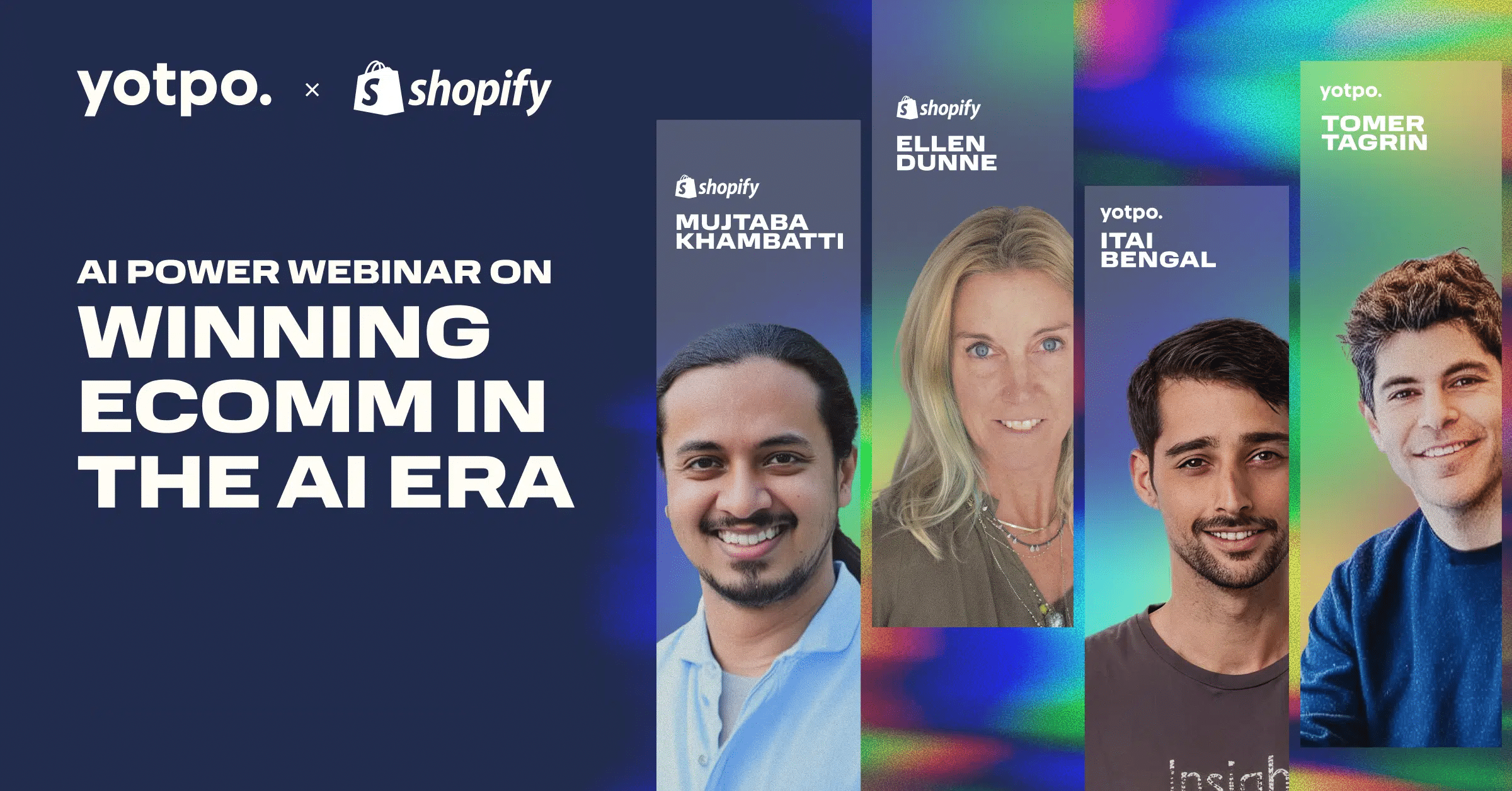
In a recent deep-dive discussion, Yotpo CEO Tomer Tagrin and VP of Strategy Itai teamed up with Shopify’s builders—Product Director Ellen Dunne and VP of Product/AI Mujtaba Khambatti. Together, they explored how AI is fundamentally altering the landscape for shoppers and brands alike. From the death of traditional keywords to the rise of conversational storefronts, the insights shared offer a roadmap for merchants trying to navigate this brave new world.
If you are a merchant, a marketer, or a developer, this is not a trend you can afford to ignore. As the panel noted, even if only 10-15% of commerce moves to agentic flows in the next three years, that represents a massive shift in consumer behavior—equivalent to retail opening up on the moon.
Watch the full discussion here:
Key Takeaways
- The Shift to Agentic Discovery: Consumers are increasingly using Large Language Models (LLMs) like ChatGPT and Perplexity for shopping research. These users have higher intent and convert at higher rates because the AI does the heavy lifting of research before they land on your site.
- Dual-Purpose Storefronts: Your Product Detail Pages (PDPs) now have two audiences: human eyes and AI agents. While humans need visual appeal “above the fold,” AI agents need deep, structured data and rich context “below the fold” to answer specific user queries.
- Authenticity at Scale: AI reads every single review, even the ones buried on page 50. It uses this data to answer niche questions (e.g., “Is this safe for sensitive skin?”). Collecting detailed, authentic user-generated content is more critical than ever.
- Controlling the Narrative: To prevent AI “hallucinations” regarding return policies or product specs, brands must provide “Ground Truth.” Tools like Shopify’s Knowledge Base app allow merchants to feed accurate data directly to LLMs.
- The “Reset” Opportunity: The rise of AI levels the playing field. Smaller brands can compete with giants like Nike by optimizing for specific, long-tail conversational queries that traditional SEO often misses.
Discovery in the Age of AI Agents
The first major topic addressed by the panel was the evolution of product discovery. For the last two decades, discovery has been dominated by the search bar. You type in a keyword, you get a list of links, and the burden of research falls on you. You open ten tabs, compare specs, read reviews, and hope for the best.
That behavior is changing rapidly. As highlighted in the discussion, nearly 40% of U.S. consumers are already using generative AI for discovery. The difference lies in the fidelity of the interaction. In the old world, you searched for “best running shoes.” In the new world of Agentic Commerce, a user says, “I am training for a marathon, I have flat feet, and I run mostly on pavement. What should I buy?”
The High-Intent Shopper
Mujtaba Khambatti, VP of Product/AI at Shopify, noted that traffic coming from these AI interactions is fundamentally different. When a user clicks through from an AI agent to a merchant’s storefront, they are often ready to buy. Why? Because the “consideration phase”—the messy middle of the funnel where customers usually drop off—has been handled by the agent.
For brands, this means that showing up in these AI conversations is paramount. If an AI is weighing options for a luxury watch or a vegan leather bag, your brand needs to be part of that consideration set. If the AI doesn’t understand your brand’s context—that you are sustainable, or luxury, or specifically designed for flat feet—you simply won’t exist in the results.
Moving Beyond Keywords
Ellen Dunne, Product Director at Shopify, emphasized that this shifts the game from keyword stuffing to context building. It’s no longer about ranking for a generic term; it’s about answering complex, natural language questions. The AI is acting as a disambiguation engine, filtering through the noise to find the perfect match. Brands that can provide rich, descriptive context about their products are the ones that will win in this new environment.
Redefining the Product Detail Page (PDP)
If discovery happens off-site in an LLM, what is the role of the Product Detail Page? The panel suggests that the PDP is undergoing a radical transformation. Historically, PDPs were designed exclusively for human cognition. Designers obsessed over “above the fold” content—making sure the image, price, and buy button were immediately visible to reduce friction.
In an agentic world, the PDP serves a dual purpose. It must still be beautiful and conversion-optimized for the human who lands there, but it must also be a data-rich repository for the AI agent that crawls it.
The “Below the Fold” Opportunity
Ellen Dunne drew a fascinating parallel to old-school web design. While visual clutter is bad for humans, AI agents have a voracious appetite for text and detail. This gives merchants the freedom to place extensive information “below the fold.”
Details that might bore a casual browser—manufacturing processes, supply chain ethics, detailed material breakdowns, or extensive FAQs—are gold for an AI. When an agent scans your site, it looks for these specific details to answer user queries accurately. If you hide this information or leave it out for the sake of minimalism, you are effectively silencing your brand in the AI conversation.
Structured Data and the Knowledge Base
To help merchants bridge this gap, Shopify introduced tools like the Knowledge Base app. This allows merchants to view and edit the “facts” that Shopify knows about their store. It’s a way to establish a “Ground Truth.”
Mujtaba explained that AI can sometimes “hallucinate.” If a user asks about a return policy and the AI can’t find a specific answer on your site, it might guess based on industry standards (e.g., “It’s probably a 30-day return”). By explicitly structuring this data, merchants gain a measure of control over how their brand is represented, even on platforms they don’t own.
Authenticity, Trust, and the “Super-Reader”
One of the most profound insights from the discussion was the changing nature of social proof. There is an old adage in e-commerce that no user reads review number 1,027. Humans look at the aggregate star rating, read the top three reviews, and maybe filter by “most recent.”
AI, however, reads everything. It is a “super-reader.”
The Long-Tail of Reviews
Tomer Tagrin pointed out that Yotpo has invested heavily in extracting attributes from reviews for this very reason. A specific product might have thousands of reviews, but perhaps only three of them mention that the product is “great for psoriasis.” A human user would never find those three needles in the haystack.
However, if a user asks an AI agent, “Find me a lotion that works for psoriasis,” the agent can instantly recall those specific reviews and surface the product. This makes the quality and specificity of user-generated content (UGC) more valuable than ever. It’s not just about “great product” anymore; it’s about the context of the usage.
Combating the “Fake” Factor
We live in an era where consumers are increasingly skeptical of what they see online. Is this photo real? Is this review a bot? Is this video a deepfake? In this environment, authenticity becomes the ultimate currency.
The panel discussed how AI agents triangulate data. They look at the merchant’s site, but they also cross-reference with Reddit, YouTube, and third-party blogs. If your customer service is terrible, an AI will know because it has read the complaints on Reddit. This means reputation management is no longer just about your own site; it’s about the holistic footprint of your brand across the web.
Conversational Commerce: The Storefront Agent
While off-site discovery is huge, the on-site experience is also becoming more conversational. Users are being trained by ChatGPT to expect answers to their specific questions. When they land on a static website that forces them to hunt for information, it feels archaic.
The Sales Associate for the Digital Age
Shopify is rolling out Storefront MCP (Model Context Protocol) capabilities that allow merchants to embed conversational agents directly into their stores. Ellen Dunne described this as hiring a digital sales associate. Just as you would train a retail employee on your brand voice, tone, and product specifics, you can train your storefront agent.
This allows for a level of personalization previously impossible online. If a customer lands on a site and asks, “I’m looking for a gift for my wife who loves gardening but hates clutter,” a standard search bar fails. A storefront agent, however, can reason through the catalog and suggest the perfect, compact gardening tool set.
The Indian Wedding Example
Mujtaba shared a compelling story about a merchant selling Indian wedding attire. Indian weddings are multi-day, complex, emotional events involving diverse outfits for different ceremonies. This merchant implemented a storefront agent to guide families through the process.
Instead of feeling overwhelmed by a catalog of thousands of items, customers felt like they were talking to a knowledgeable “auntie” who guided them on what to wear for the Haldi ceremony versus the reception. This didn’t just help navigation; it built an emotional connection. The website became more than a catalog; it became a consultant.
Practical Strategies for Brands Today
So, how does a brand actually prepare for this shift? The consensus from the panel was clear: urgency and experimentation are key. You cannot wait for a “best practices” playbook to be written because the technology is evolving too fast.
1. Master Your Brand Story
In a world of infinite AI-generated content, your unique brand story is your moat. Why did you start the business? Who makes the products? What are your values? As Ellen noted, these emotional hooks are what convert buyers once the AI has done the logical filtering. Ensure this story is written down, structured, and accessible on your site.
2. Treat AI Optimization like Early SEO
Itai, VP of Strategy at Yotpo, suggested viewing this era much like the early days of SEO. There is no perfect “Google Analytics” for LLMs yet. You have to experiment. Try different product descriptions. Add rich FAQs. Monitor your chat logs to see what people are actually asking, and then update your content to answer those questions proactively.
3. Level the Playing Field
For small brands and entrepreneurs, this is a golden era. Trying to beat Nike on the keyword “running shoes” in Google is impossible. But winning on a specific, long-tail query inside a chat interface is entirely possible if your data is better and your product fit is more precise.
4. Embrace the Feedback Loop
Use the conversational data you collect to improve your products. If users keep asking your AI agent if your backpack fits a 16-inch laptop, and you don’t have that data, go measure it and add it. If they ask for a color you don’t have, pass that to product development. The conversation is the highest fidelity data source you will ever have.
Conclusion: The Reset Button
We are witnessing a reset of the commerce playground. The incumbents who dominated the last decade of SEO and paid ads do not automatically win this next round. The winners will be the brands that are most transparent, most authentic, and best structured for the AI age.
As Tomer Tagrin concluded, the most important strategy right now is to stay curious. Read newsletters (like Commerce GPT), experiment with Shopify’s new tools, and don’t be afraid to fail fast. The train is leaving the station, and it’s headed toward a world where commerce is conversational, contextual, and agentic. Whether you are a massive enterprise or a garage startup, now is the time to optimize your brand for the machine-driven future.
FAQs
What is Agentic Commerce?
Agentic Commerce refers to a new phase of e-commerce where AI agents (like chatbots or LLMs) act on behalf of the user to research, compare, and discover products, rather than the user doing all the manual searching themselves.
How can I optimize my Shopify store for AI agents?
Focus on creating rich, detailed content. Use the Shopify Knowledge Base app to ensure your store’s facts (FAQs, policies) are structured and accurate. Ensure your Product Detail Pages include extensive details “below the fold” regarding materials, usage cases, and brand story.
Will AI replace traditional SEO?
Not immediately, but it is shifting the landscape. While traditional SEO focuses on keywords and backlinks, optimization for AI (sometimes called GEO – Generative Engine Optimization) focuses on context, brand authority, and answering complex natural language queries.
How do reviews impact AI discovery?
AI models read and analyze all reviews to understand specific product attributes. Having authentic, detailed reviews helps your product surface for niche queries (e.g., “best moisturizer for dry skin”) that generic product descriptions might miss.
What is a storefront agent?
A storefront agent is an AI-powered chatbot embedded on your e-commerce site. Unlike old chatbots that used rigid decision trees, these agents use LLMs to have natural, fluid conversations with shoppers, guiding them to products and answering specific questions just like a sales associate.
Full Transcript
Hi everyone. We are very, very excited to have you. While we are recording, there are hundreds of people that signed up. This is a very hot topic and I’m very, very excited about the guests we have today. It’s my first time trying to host a podcast, so I hope I’ll do a good job. If not, feel free everyone here to direct me.
The idea here is that we’re talking a lot about how AI is changing the world. Today, it’s about how AI is going to change commerce from shoppers to brands and what that means. We brought the builders from Shopify who have a front-row seat to how Shopify thinks about it. We have Itai, our VP of Strategy, who spends a lot of his time researching and thinking about AI and commerce. And myself, Tomer Tagrin, one of the co-founders and CEO of Yotpo, also spending a lot of my time on discoverability with AI and commerce on a broader spectrum. I’ll let our guests introduce themselves better than me.
Great, I can start. I’m Ellen Dunne, I’m a Product Director at Shopify. I’ve been at Shopify for almost a decade. I have been working a lot in conversational commerce—years ago, this was really focused on merchants actually talking to their buyers in real life and trying to sell through those conversations. I’m really excited about this era that we have entered and this future that has arrived with AI bringing conversational commerce and fully automated conversational commerce to life. So, excited to be here to talk about this and how we can ready everyone for this future.
Hi everyone, my name is Mujtaba Khambatti. I’m sort of new to Shopify, but I’ve been in the industry for well over two decades and I’ve spent the last decade doing work on AI. I’ve seen all the failures and all of the successes lately with AI—the extreme interest with agentic capabilities that AI offers and how consumers are now rushing to do more things with AI, particularly with shopping and discovery. We’ll get into some of that, but it’s been quite fun diving into shopping with AI as the focal point over the last several months here at Shopify. I’m excited to talk to you all about some of the stuff we’re doing and seeing as we work on this together.
I’ll follow up. I’m VP of Strategy at Yotpo. Strategy at Yotpo basically has two sides. I deal with product strategy—like Tomer said, research and thinking about how AI is going to change commerce and what that means for us and where we should invest. The other side is actually strategic partnerships. One of the areas I work on is our Shopify partnership. So, this topic is close to my heart in this forum. Very excited to be here today.
Discovery in the Age of AI
To be honest, when we were preparing for this show, we did a prep talk and it was amazing. We outlined four different topics that we think are interesting from our experience with brands.
-
Discovery in the age of AI agents.
-
What is a PDP (Product Detail Page) in that kind of world?
-
Authenticity, user-generated content, and trust in a world of AI.
-
Practical strategies that brands can take today to drive their strategy in an agentic world.
There are a lot of statistics out there on how AI is impacting discovery, product search, and shopping. We did our own survey and saw 48% of consumers are now searching on LLMs (Large Language Models). I know Adobe had their own survey that the Shopify team shared showing that 39% of US consumers are already using generative AI in discovery. So, definitely, it’s massive. Even if conservatively we say in three years 10, 15, or 20% of commerce is going to move to agentic, this is probably the biggest shift. It’s like saying retail is now opening on the moon and there are a billion people on the moon. This is something that everyone needs to be prepared for.
It’s something that we picked up a few quarters ago—probably a year and a half ago—when we started to dabble into that. I’ll simply mention my own newsletter about it, Commerce GPT, where the entire purpose is to share the hours that we spent with startups, our own research, and our own data science team to share what we see working in discoverability in LLMs. So, check out Commerce GPT.
Leaving that aside, let’s talk a little bit about discovery in the age of AI and what’s called agentic commerce, where shoppers are not going to go to the storefront; they’re actually going to do the research and the shopping inside the LLM. We saw Shopify announce some really exciting stuff, from the MCP capabilities to the checkout inside ChatGPT that was announced a while ago. I’m curious for the builders here that are actually helping everyone from an ecosystem standpoint: How do you view discovery in the age of AI generally, before we go to tactics?
Maybe I’ll kick off and Ellen, you can follow in on some thoughts. What we’re seeing, of course, is an early wave. We have data from BFCM (Black Friday Cyber Monday) that happened in the past where users were converting more when they went to stores that had agents on them. We were also seeing that a large number of purchases were being made—and this is the Adobe quote that Tomer was mentioning—through some AI interactions. It’s quite common in our day-to-day that we have incorporated AI into our lives, and so have consumers.
So when it comes time for particularly considered purchases, there are a lot of actions that users are doing inside, say, ChatGPT or Perplexity to weigh options and get some research. As a consumer, you’re not having to read all these different reports and websites to compare; you get a little bit of intelligence back. We’re seeing this start and more users are doing it for more actions.
The thing, though, is if you’re a merchant, you have to ask yourself: The conversation may be happening outside of your storefront, so is it important for you to show up in that conversation in an accurate way? When users are asking “What are the best shoes to buy?”, is your brand showing up amongst what is considered by that AI as best? If the user is asking “I want to buy a luxury watch,” is your brand considered a luxury watch? Because that is an ambiguous term that something like an AI is disambiguating. But if you follow through on that discovery part, users will then make decisions based on a lot of different aspects like return policies, shipping to your destination, and very specific information. And we know that AI needs to rely on accurate information to be able to answer those questions. So, I want to pause here to motivate the fact that this is happening. We’re seeing this happen. We have evidence even from the last BFCM. But I want Ellen to be able to jump in because there’s a bit more towards making your brand participate accurately in this discovery journey.
I think there are two things that are interesting. One is just to put a finer point on what Mujtaba just shared. A really easy way to think about it is:
-
Old World: Someone’s typing into Google “best running shoes.”
-
New World: They’re saying “I’m training for a marathon, I need good shoes for flat feet and running on pavement.”
Does your product information deliver on those types of details? If a buyer is asking a similar question around “best brands for marathon-style running shoes,” do you have brand information or structured information that would indicate that your shop specializes in that kind of thing? That discovery and understanding of a brand is really easy to do when you land on a storefront because these sellers have spent a lot of investment making their storefront bring their brand alive. But when these conversations are happening on other surfaces, how do you translate that brand story into a ChatGPT or Perplexity? That’s what I think is really interesting, and those are some of the tools we’re trying to build to help merchants show up in that way. Even when it’s not just product information—which I think we’ll get into a lot in this conversation—but if it’s your brand and your brand story, who are you, who founded the brand, and what you really care about. We’re also at Shopify helping merchants to put that into a place that is accessible for LLMs to pull out and be able to tell that story on your behalf.
It’s almost like the store needs to get richer or more structured. Both, right? And more nuanced. Also, something you both are talking about is the difference between old search—where you get a lot of results, click in, and do your research—versus here, where so much more of the research is being done for you. It is taking you so much further into this research journey that being specific, answering the use cases, the needs, and how you differentiate yourself is so critical. It’s one of the places where Shopify is so unique to be able to power so many different DTC (Direct-to-Consumer) brands with so many specific products. It really is critical to add that kind of information and explain to the agents what your brand and your product is all about to be able to be surfaced.
Yes, and I would say the other thing that we see is that buyers who are coming out of these conversations—where they’ve actually been able to get all this information—when they eventually do land on your storefront to make the purchase, they have way higher intent and they’re way more likely to convert. They’ve already done all that research upfront inside of an AI agent. So they land on your store and it’s like, boom, they get what they need and they make the purchase. That’s the great news. Storefront traffic that comes from these agents is really high intent and really likely to convert.
Storefronts & Product Detail Pages (PDPs)
So, I have a question. One of the things we did in our customer advisory board was show our top merchants a few capabilities of how we can take their reviews and review attributes into the LLMs. One of the first things that came up is control. In the storefront, they have 100% control, and in LLMs, they have zero control. What do you recommend brands practically think about regarding control inside LLMs?
That’s an excellent point. When we see storefronts from the pre-AI era, let’s say 2-3 years ago, they were being optimized for human eyes—mobile screens, large desktop screens—making sure that it’s visual and the information is summarized because people are busy. But now you’ve got AI, and it’s got this voracious appetite to read and ingest, and it can reason over large volumes of information. So, you almost have to have the “human eye” version and the “AI detail” version so that the AI, if it’s Perplexity for instance, is getting the right information and not missing things.
We’ve been thinking through how merchant storefronts can evolve. Sometimes you can put stuff on your storefront and AI will reason over it because it has the web and it can search. But sometimes, you don’t want to clutter up your storefront. So, we’ve created an app that we announced in May at Editions called the KnowledgeBase App. It gives merchants the ability to view what we already know about your store. You install the app and there are auto-extracted FAQs that show up. You can say, “Yep, that sounds good, I have nothing more to add,” or you can look at that and say, “I do have more to add. I think it’s missing a brand story,” or “I would like to say something about how I handle tariffs,” but maybe that was sensitive and I didn’t want to talk about that on my storefront. So, you can now use the KnowledgeBase App to create this extensive version if you want to, that AI will have access to in order to answer questions about your store. Remember, AI is just going to try its very best to answer users’ questions, and the more information you provide it, the more it can then be factual and accurate.
As a former designer and having been in this world for a while, everyone remembers “above the fold” and “below the fold.” Visually, you have to have all the important information above the fold. LLMs in this new world of agentic commerce give us the opportunity to put so much “below the fold” that you would never have put back in the old days. All of that additional content, all those rich details, can now live in a way that LLMs can pull them out, summarize, search through them, and find the pieces of information that are relevant to the exact user doing the search. But, you don’t have to have a product page necessarily cluttered with all that information. Your “above the fold” is still looking great for those who are actually landing and interacting with your storefront. I like that analogy because it goes way back to designing.
So basically, you’re saying PDPs and storefronts in general are no longer just for humans; they’re also for agents. Therefore, when designing, you need to think about your storefront for both. “Above the fold/below the fold” is a great example. Are there any more ideas that brands need to think about when designing their storefront for agents?
I’ll offer one more. Remember when users come to storefronts, we sort of define the path they see. We give them maybe a popup for a 10% discount, some choice spots (enter this door for men’s, this door for women’s), and we leave it to the user to navigate. We try our best to make the visual appeal of our products show up very well. Users aren’t often now operating in the same way as they were 2-3 years ago. We know this from how you see users change their search habits. The big question is: What’s happening to Google? Is ChatGPT taking some of the queries away? The honest truth is behaviors have changed. Users are wanting more conversational ways to look things up. So, you’ve got to embrace some aspects of your storefront to be more conversational. You can have your visual elements as you had before, but having the ability to handle natural language questions where users can search or ask detailed questions is key. If I’m on a PDP and I now want to know what your return policy is—on our product roadmap, we’re going to announce a few things very soon—but I do think storefronts will evolve in conversational ways too.
Yeah, and rethinking your search bar on your storefront even. If you ask a long-winded question, is the user going to get results that make sense? Let’s hope so, because that is the behavior that we’re seeing.
And it’s such a power, right? Because now you’re able to actually get from people the questions that they want answered. It’s not just clicks and monitoring where they’re going and the funnel to conversion; they’re actually asking you and you’re learning from that data. It’s gold. Our roadmap involves taking that and turning it into a loop of collecting the right data from the users to surface and sort the right data back to customers and agents on the PDP. It is such a different kind of mentality to how e-commerce was happening on the DTC website until now. The guesswork is getting done.
You’re going to have a great flywheel of what are people asking about and how are they asking it. Being able to see that in real time and then adjust the descriptions on your product page—whether they care about where it’s manufactured, sustainability, or materials—those are all things you can dynamically update to make your products have a better chance of being discovered.
I have to say, one of the things that gets me excited is it’s a reset in user behavior. Now I can compete with Nike—I can compete with the big ones. Many small brands can have an early mover advantage versus the big ones. Trying to beat Nike in SEO is a war no one is winning. On the other hand, with the generative engine optimization (GEO), this is why I try to instill urgency. If you move quickly, you can get a head start.
If a buyer is not searching for a specific brand name, it does level the playing field quite a bit. In the world of SEO, you’re not going to get on the first page of a Nike search result, but you might get on the first page of “marathon shoes for flat feet.” It is exciting and I agree with you on the urgency.
When we look at this with queries, it plays out exactly like that. The search box versus the chat box: when you look at the queries people put in the chat box, they tend to be longer. As Ellen was saying earlier, “running shoes for flat feet for a marathon”—people will be a bit more descriptive in a chat box and more keyword-focused in a search box. So what that means is that you get the ability to show up because you can meet the intent more richly. A user looking for vegan leather versus a user looking for a specific type of thing that makes them feel special—this is a great opportunity for brands to shine without being drowned in the SEO and ad game that favored bigger spenders.
I was just going to say that any of us that use ChatGPT or Perplexity see these results. I get linked to Reddit pages or blog posts that I would have never arrived on in classic SEO. Brands have such an opportunity to identify this new evolving mechanism. A big part of discovery is reputation management—making sure that you surface not only on your PDP, but on these new channels like Reddit or YouTube expert content. It’s really changing the game.
And I also think ads will arrive there someday. Until the ads arrive—because when ads arrive, prices go up—brands have to take advantage. This is the biggest shift we’ve seen. Even if 10-15% of e-commerce moves to agentic commerce, that’s massive. First movers will have a lot to gain.
Authenticity and Trust
Great segue. We have a saying inside Yotpo that no user reads review number 1,027. But you know who does read it? The LLM. The agent. Therefore, quality and authenticity are becoming much more important. We invested heavily to extract attributes very accurately from the reviews. If a specific product had two or three users say it’s “great for psoriasis,” no one would have ever seen that, but now the agent knows about it. Context really matters. I can ask Ellen, “Hey, this is a great necklace, where did you buy it?” and you can share the story. The agent doesn’t know that. A lot of the PDP is about context, and we are big believers that from the reviews you can extract metadata that gives much more context.
So what’s your thought on authenticity and trust in a world of agentic commerce? Because with AI, everything can be fake. I don’t know if we are actually talking or if it’s your avatar talking to me.
I want to be real. We are all excited about AI, but it is new. As it is new, we’re discovering guardrails and learning things. It does create some anxiety in terms of being authentic and making sure you’re well-represented. Not everything has been solved. Hallucination has and will continue to be a thing that we have to tackle.
Can you explain for everyone what you mean by that?
So if users are asking an AI what your return policy is, the AI is biased towards trying to answer your question. If you provide an answer, it will use that. But if you don’t provide an answer, it may try to invent an answer based on the fact that perhaps 30-day return windows are common. Such promises then become made-up promises by the AI and the user might believe them. AI tackles this by providing sources and links. But what merchants can do is make sure there are adequate FAQs—perhaps using the KnowledgeBase App or putting them directly on the storefront—because you are preparing your storefront to be read by AI. You can take the horse to water but can’t make it drink; the tool is somewhat imprecise. AI is going to sometimes hallucinate, and we are still working through guardrails.
This is why we try to help generate as many reviews and have specific questions and prompts. We actually have an AI assistant that helps users write content exactly for the reason you mentioned. A very savvy buyer, especially for a considered purchase, isn’t just going to look at the content on the store. They really care about reviews. “I have dry skin and I want to buy this product”—I don’t care about any other review except the ones from people who say “I have dry skin and here’s what it did for me.”
Then there’s another body of evidence out there that the AI agents are good at summarizing, which is Reddit and other sites like that. It’s that triangulation. You have some control over collecting reviews and having good customer service, because if people have a bad experience, that’s going to show up on Reddit. You need to be aware of where people are talking about your brand. So it’s those three bodies of content:
-
Your own site and everything rich you can include there.
-
Product reviews, because they’re key to purchasing decisions.
-
The other stuff out there where people are habituated to look and trust.
Strategy and Actionable Tips
Let’s talk about brand strategies. We talked about shifting the storefront, the importance of reviews, and conversational elements. Besides buying Reddit stocks, are there other ways to drive strategy?
I want to come back to one aspect. We left the last segment with “AI can hallucinate, be prepared.” A lot of the talk tends to be worrisome, but it does grow the pot. The ability for us to connect more users that have an intent to buy with products they want is greater. We’ve always had shopping lists in our minds—”If I had time, I would go buy the right desk lamp”—but we never find the time. AI unlocks this. With BFCM, numbers are indicative that products are being matched with greater conversion to users that have intent. I think the ability to frame your brand to embrace that allows you to stand out. When people are choosing a particular style, like vegan leather, the ability to describe the shoes or bags you make very specifically elicits the right reviews and shapes the FAQs, allowing you to stand out.
Just doubling down on the brand story thing. You mentioned my necklace—I could tell you the artist who made it and all of that. Probably those details are not on her website, but it is the reason I continue to buy products from this person. This is where Shopify is really wanting to represent DTC. These merchants are entrepreneurs building a product they’re really passionate about. That is a unique thing that consumers care about. If you haven’t thought about bringing that to life on your website or through your customer service, this is a really good time to do that. I just can’t overemphasize the brand story. It’s an interesting way to distinguish yourself in this market.
If I can tell a story: At Editions, we announced KnowledgeBase as well as Storefront MCP. We didn’t talk a lot about Storefront MCP, but it allows you to create a storefront conversational agent. There is a brand in India—weddings in India are very colorful, multi-day events. This brand built a Storefront MCP chat at the bottom of the screen. The merchant told us that a lot of people feel that personal touch is needed; it’s an emotional time with tons of decisions. Having that personal touch through the chat added a human element. People feel like, “I’m talking to ‘Auntie,’ somebody who is helping me plan what to wear,” versus just a store where I’m left on my own.
Very interesting. That’s a great example.
I think we covered so many different topics. To wrap it up, do you have any small tips for an entrepreneur or an executive in a large brand to carry their brand forward in an agentic-first world?
Just to follow up on the storefront agent example: having a storefront agent has become important. Buyers are expecting to continue the conversation when they get to your storefront. I want to make it clear how easy it is to train your own storefront agent to speak the way you want your brand to be spoken about—using your vocabulary and lexicon. It’s very similar to hiring a sales assistant in a retail store; you train them on how to talk about products and sizing. You can do the same with a storefront agent where you control the voice and tone. It’s a fun thing to play around with. While we can’t completely translate that to how your brand gets spoken about in Perplexity, you can still create “ground truth” with the KnowledgeBase that the LLM will use.
I’ll say three things:
-
Consider being on Shopify. We have our merchants show up on Perplexity and we’re making sure our catalog shows up there.
-
Consider a storefront agent. It’s really easy to set up Storefront MCP.
-
Use the KnowledgeBase App to view all the FAQs associated with your store that AI will be able to see, so you can get more prepared.
I could maybe add two to that list:
-
Treat AI/LLM search like SEO in the early days. It’s trial and error. There is no Google Analytics yet. A great way to do that is to have conversations on your website and see what questions people are asking. Also, look at your reviews and what people are talking about.
-
Focus on sharper positioning of the brand. Agents can be so much more scientific and specific. Make sure you touch on all those criteria and specs in your products for different types of users—not just the main PDP. That long tail of information is a major opportunity.
For me, I also wanted to say: Use Shopify, use Yotpo. Definitely stay curious and go read more. This is why I did my newsletter on Commerce GPT. You have to experiment because this is a reset of the playground.
Thank you if you stayed with us. It’s all about helping you move to an AI-first world. Thank you so much to the Shopify team. You’ve been great. Thank you so much everyone. Bye-bye.
