






Quick Decision Framework
- Who This Is For: Shopify founders and operators doing $10K to $2M per month who are watching paid acquisition costs climb and want to understand how the discovery landscape is shifting underneath them.
- Skip If: You are pre-revenue or still finding product market fit. Come back when you have a catalog worth discovering and a fulfillment operation that can handle new demand reliably.
- Key Benefit: Understand why the shift to agentic commerce may be the single biggest leveling of the competitive playing field since Google Shopping launched, and what you need to do in the next 30 days to be ready for it.
- What You’ll Need: A Shopify store with at least 20 active SKUs, clean product data, and a willingness to audit your catalog and policy content against a new standard.
- Time to Complete: 8 minutes to read. 3 to 5 hours to audit and tighten your top 20 SKUs using the framework in this article.
The products that will be found will be merit based as opposed to ad based. I think that is democracy. That will level the playing field.
What You’ll Learn
- Why Shopify President Harley Finkelstein’s “merit based” framing is the most important strategic signal independent brands have received in years, and what it actually means for your store.
- How agentic shopping agents discover and recommend products differently from search engines, and why ad spend no longer guarantees visibility.
- What the 82% of retail still happening offline tells you about the size of the opportunity that agentic commerce is about to unlock.
- Why catalog quality, policy clarity, and structured product data are now competitive advantages, not just operational housekeeping.
- The three things you can do this week to make your store more “agent ready” before the channel matures and the window narrows.
The Statement That Should Change How You Think About Discovery
Shopify President Harley Finkelstein said something at the 2026 Upfront Summit in Los Angeles that most coverage buried in the second half of the article. Speaking with Upfront Ventures’ Mark Suster, he described how an AI shopping agent that knows he prefers On running shoes will surface On over Footlocker the next time he searches for athletic shoes. Then he said this: “Agentic is fundamentally merit based as opposed to, if you go to a search engine, you type sneakers, you’re going to see Footlocker.” He followed that with a line that deserves to sit with you for a moment: “The products that will be found will be merit based as opposed to ad based. I think that is democracy. That will level the playing field.”
If you have been running a Shopify store for more than two years, you know exactly what he is describing. You have watched your Meta CPMs climb. You have watched Google Shopping become increasingly dominated by brands with larger budgets and more aggressive bidding strategies. You have watched the organic discovery window shrink as every major platform optimized for revenue over relevance. The small brand with a genuinely better product has had a harder and harder time getting in front of the right buyer without paying for the privilege. Finkelstein is saying that agentic commerce changes that equation. Not incrementally. Fundamentally.
This is not a minor update to how ecommerce works. It is a structural shift in how products get discovered, compared, and purchased. And the timing matters: Shopify has publicly reported a 14x increase in orders to Shopify stores sourced from some form of agent activity over the past 12 months. The base is still small. But the direction is not ambiguous. For the full context of what Finkelstein said and how TechCrunch covered the Upfront Summit remarks, the original TechCrunch piece is worth reading in full.
What Merit Based Discovery Actually Means For Your Store
Merit based discovery sounds like a promise. Before you get too comfortable, it is worth being precise about what it means and what it does not mean. An AI shopping agent that knows a buyer’s preferences, budget, use case, and constraints will surface the product that best matches those inputs. It is not going to surface the product with the biggest ad budget. It is not going to surface the product with the most branded content or the most influencer integrations. It is going to surface the product it can most confidently match to the buyer’s stated need.
That is the opportunity. It is also the standard. If your product data is vague, your variants are inconsistent, your shipping policy is buried in a FAQ that reads like a legal document, and your return window is unclear, the agent has less to work with. It will either skip you or surface you with less confidence than a competitor who has done the work. Merit based does not mean “the best product wins automatically.” It means “the product the agent can most confidently recommend wins.” Those two things are related but they are not the same. The brands that understand this distinction early will build a compounding advantage. The ones that wait for the channel to mature before paying attention will find the window has already narrowed.
This is the same pattern I have seen across 450 conversations with Shopify founders and operators on the podcast. The brands that won early on Google Shopping were not always the ones with the best products. They were the ones with the cleanest product feeds, the most accurate pricing, and the most complete attribute data. Agentic commerce is running the same playbook at a higher level of sophistication. For a deeper look at how AI agents are making purchase decisions and what they weight most heavily, the rise of AI shopping agents piece covers the mechanics in detail.
The 82% Opportunity That Most Founders Are Missing
Finkelstein made another point at the Upfront Summit that has received even less attention than the merit based framing. He noted that only about 18% of retail purchases in the US are currently made online. Shopify is the second largest ecommerce provider in the country behind Amazon, and they are working with a universe that represents less than one fifth of total retail spending. He is betting that agentic commerce can act as a new front door for ecommerce, pulling a meaningful share of that offline spending online for the first time.
Think about what that means for your store. The buyer who walks into a specialty running store because they want a knowledgeable recommendation, not just a search result, is exactly the buyer that an agentic personal shopper is designed to serve. That buyer has context: they overpronate, they run on pavement, they have a budget, they care about materials. A search engine gets “running shoes.” An agent gets the whole picture. Finkelstein described it directly: “We’re going to begin to use these agentic applications as these kinds of personal shoppers.” He added that the chat application is “a more authentic personal shopper because it is generally not on commission, meaning it is only going to show you the things it thinks you are most likely to purchase.”
For independent Shopify brands, this is the most significant part of the argument. The 82% of retail that happens offline is not happening offline because buyers prefer physical stores in every category. A lot of it is happening offline because the online discovery experience for nuanced, preference driven purchases has been genuinely poor. Agentic commerce is designed to fix that. And if it does, the brands positioned to capture that shift are the ones with the richest, most structured product and policy data, not the ones with the largest paid media budgets. If you want to understand how Shopify is building the infrastructure to make this possible, the complete agentic commerce guide for Shopify merchants covers the Universal Commerce Protocol, Agentic Storefronts, and Shopify Catalog in detail.
Why Your Catalog Is Now Your Most Important Marketing Asset
The practical implication of everything Finkelstein described is that your catalog quality has moved from “operational detail” to “primary growth lever.” This is a shift that most marketing teams have not fully internalized yet, because it does not look like marketing. It looks like data hygiene. But the two are now the same thing.
An AI shopping agent building a shortlist for a buyer is doing something closer to what a sharp buyer at a retail chain does when they are deciding what to stock. They are asking: does this product clearly answer the question the customer is bringing? Can I explain why this is the right match in two sentences? Is there anything missing that would make me hesitant to recommend it? If your product data cannot pass that test, the agent moves on. There is no equivalent of a well designed landing page that can compensate for missing attributes, ambiguous variant names, or a return policy that requires interpretation.
The specific fields that matter most: titles that include the constraint that qualifies the buyer (size system, material, compatibility, use case), variant names that are unambiguous across every option, attributes that cover materials, dimensions, fit notes, certifications, and what is included in the box, and policies written in plain language that an agent can pull into a conversation without hedging. This is not a redesign project. It is an audit and cleanup project, and it is one of the highest leverage things you can do in the next 30 days. For the mechanics of how Shopify’s Model Context Protocol connects your catalog to AI platforms, the Shopify MCP explainer is the clearest breakdown available.
The Three Things You Can Do This Week
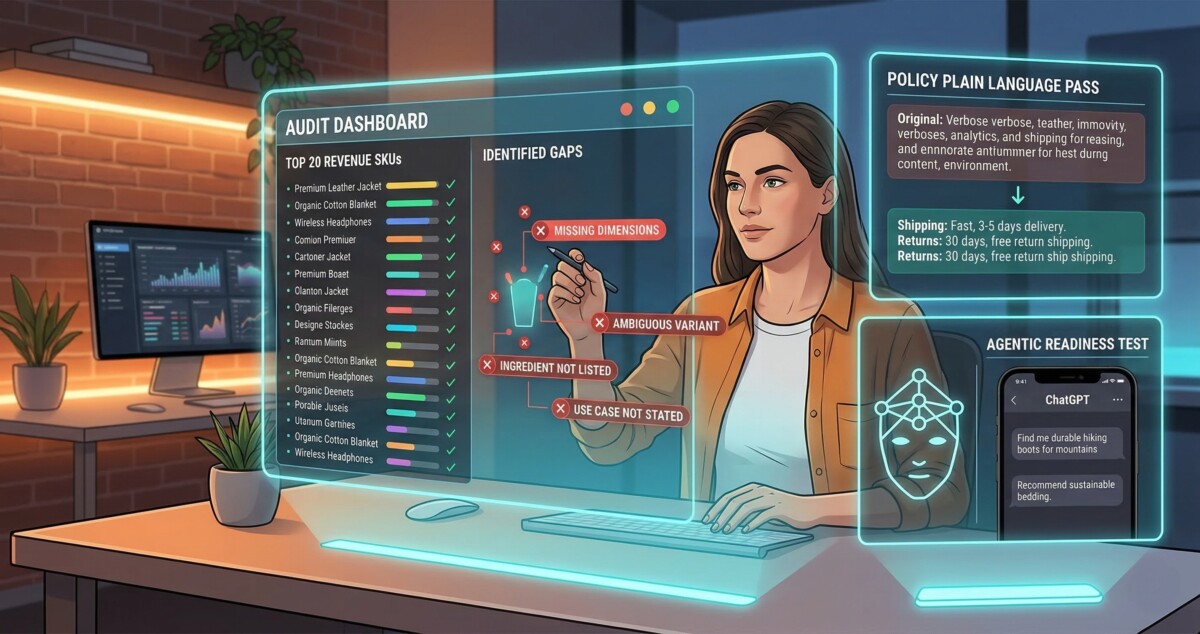
Most of what needs to happen to position your store for agentic discovery is not complicated. It is disciplined. Here is where to start, in order of impact.
The first is a catalog audit on your top 20 revenue SKUs. For each one, ask: if a buyer described their need to an AI agent, could the agent confidently match this product to that need using only the information on your product page? Write down every gap. Missing dimension. Ambiguous variant name. Ingredient not listed. Use case not stated. Those gaps are costing you recommendations you are not seeing yet because the channel is still early. The ones who fix them now will have a head start when volume accelerates.
The second is a policy plain language pass. Take your shipping page, your returns page, and your FAQ and read them as if you are an AI agent trying to answer a buyer’s question at 11pm. Can you extract a clear answer to “how long will this take to arrive?” without interpretation? Can you answer “what if it does not fit?” in one sentence? If not, rewrite those answers in the simplest possible language. This improves human conversion too, so the work is never wasted.
The third is to test your own store inside ChatGPT. Search for a product you sell using the kind of natural language a real buyer would use. See if you show up. See what the agent says about you if you do. See who it recommends instead if you do not. That exercise will tell you more about your agentic readiness in 20 minutes than any report. For context on how ChatGPT Shopping works from the merchant side and how to optimize for it specifically, the ChatGPT Shopping guide covers the setup and optimization path in detail. And if you want the broader picture of how AI agents are reshaping ecommerce operations beyond discovery, the AI agents in ecommerce overview is a strong companion read.
What Comes Next And Why The Window Is Now
Finkelstein was careful to say the rollout of agentic personal shoppers will be slow. He is right that mass adoption is not happening overnight. But the brands that win in any new channel are almost never the ones who waited for mass adoption before paying attention. They are the ones who treated the early signal as a reason to build, not a reason to wait.
The 14x order growth Shopify has reported from agent sourced activity is directional, not definitive. The base is small enough that the percentage growth is dramatic but the absolute volume is still modest for most stores. That is exactly the right time to build the foundation. When the volume is still small, you can learn cheaply. You can run a 20 SKU test. You can watch what gets recommended and what does not. You can fix the gaps without disrupting a high volume channel. When the volume is large, the cost of not being ready is much higher and the competitive window is much narrower.
Finkelstein said something else at the Upfront Summit that is worth holding onto: “There are a lot of merchants on Shopify that struggle with having their products discovered, and actually, this is where we think agentic will play a huge role in surfacing new brands to those customers.” He is describing your store. The one with a genuinely good product that has been outspent on paid search by brands with larger budgets. The one that has relied on word of mouth and organic traffic because the paid channels have never penciled out at your margin. Agentic commerce is not a guarantee. But it is the most credible structural argument for independent brand discovery that has emerged in a decade. The question is whether you are ready when it arrives at scale.
Frequently Asked Questions
What did Harley Finkelstein mean when he said agentic commerce is merit based?
Finkelstein used “merit based” to describe how AI shopping agents surface products based on fit to the buyer’s actual preferences and constraints, not on who spent the most on advertising. His example was specific: an agent that knows he prefers On running shoes will recommend On over Footlocker when he searches for athletic shoes, even though Footlocker would dominate a traditional paid search result. The implication for Shopify merchants is that the discovery advantage shifts from ad budget to product data quality. A brand with a genuinely good product and a clean, structured catalog now has a more realistic path to discovery than it did in a paid search dominated world. That does not mean ad spend becomes irrelevant, but it does mean the playing field is structurally different.
How much of retail is still happening offline and why does it matter for ecommerce brands?
Finkelstein cited approximately 18% of US retail purchases happening online, with the remaining 82% still occurring in physical stores. He made this point to frame the scale of the opportunity that agentic commerce could unlock: a large portion of offline spending happens there not because buyers prefer physical retail in every category, but because the online discovery experience for nuanced, preference driven purchases has been poor. AI shopping agents that can understand context, preferences, budget, and use case are designed to serve exactly the buyer who currently walks into a specialty store for a knowledgeable recommendation. If agentic commerce captures even a fraction of that offline spending, the addressable market for Shopify merchants expands significantly.
What does my Shopify store need to be ready for agentic commerce discovery?
Readiness comes down to three things: clean product data, clear policies, and structured catalog attributes. AI agents build shortlists by matching buyer constraints to product specifications. If your titles are vague, your variant names are inconsistent, your dimensions are missing, or your return policy requires interpretation, the agent has less to work with and is less likely to recommend you with confidence. The practical starting point is an audit of your top 20 revenue SKUs. For each one, ask whether an agent could confidently match it to a buyer’s stated need using only the information currently on your product page. Every gap you find is a recommendation you are not getting. Fixing those gaps is the highest leverage action you can take right now.
Is agentic commerce already driving real orders or is this still theoretical?
It is already driving real orders, though the volume is still modest relative to established channels. Shopify has reported a 14x increase in orders sourced from some form of agent activity over the past 12 months. Finkelstein was also clear that the initial rollout will be slow and that mass adoption is not imminent. The strategic point is not that agentic commerce is replacing paid search tomorrow. It is that the brands building the right foundation now will have a compounding advantage when volume accelerates. The cost of preparation is low while volume is small. The cost of not being ready is high when volume is large and the competitive window has narrowed.
How is agentic commerce different from what I am already doing with SEO and paid search?
Traditional SEO optimizes for a page ranking in a list of results. Paid search buys placement in that list. Agentic commerce works differently: a buyer describes a need in natural language, and an agent builds a shortlist of products that best match the constraints they described. There is no “page one” to rank on and no placement to buy. The agent is doing the comparison internally, then surfacing a recommendation. What you are optimizing for is the agent’s confidence in recommending you, which comes from the clarity and completeness of your product data, not from keyword density or bid strategy. This is why catalog quality and policy clarity have moved from operational details to primary growth levers in an agentic commerce world.
