

Most Shopify merchants above $500K in annual revenue benefit from specialized AI-driven SEO help by 2026, but stores under roughly $250K usually gain more from fixing fundamentals first. A specialized partner pays off only once your product data and content are already clean enough to cite.
The real risk in 2026 is not being invisible to AI. It is paying for AI visibility before your store is actually worth citing.
If you are running a scaling e-commerce brand, you’ve likely noticed a worrying trend over the last few quarters: traditional click-through rates (CTR) from standard organic Google search are fluctuating, and classic keyword stuffing just isn’t moving the needle anymore.
The reason? The search landscape has fundamentally fractured.
With the widespread integration of Google’s AI Overviews, alongside conversational platforms like ChatGPT, Gemini, Perplexity, and Claude, consumer buying behavior has evolved. High-intent shoppers are no longer just clicking through pages of blue links. Instead, they are asking AI engines to do the heavy lifting for them: “Compare the top five eco-friendly running shoes for flat feet and tell me which store has the best warranty.”
If your products aren’t woven into the semantic knowledge graphs of these Large Language Models (LLMs), your brand simply does not exist to millions of modern buyers.
This brings us to a critical strategic question for 2026: Do you actually need a specialized agency for AI-driven SEO services, or can your traditional SEO team handle it? Let’s look at why standard SEO creates an existential risk for e-commerce, and how forward-thinking companies are pivoting to survive.
Traditional e-commerce SEO was built on a simple, predictable loop: optimize the meta tags, build a few generic backlinks to collection pages, insert target keywords into product descriptions, and wait for Google’s crawlers to push you up the SERP.
In the age of AI search, that loop is broken for three distinct reasons:
AI Bots Ignore Raw Link Juice: Chatbots and LLMs don’t rank products based on domain authority metrics alone. They look for semantic trust, contextual mentions, and digital footprints across the web.
Massive Content Devaluation: Search engines are aggressively filtering out low-quality, automated content farms. If your agency is just buying cheap placements on dead blogs, those links are being completely ignored by AI training algorithms.
The Loss of Direct Real Estate: AI Overviews take up the most valuable real estate at the top of Google. If you aren’t the brand being cited inside that AI box, your organic visibility drops significantly.
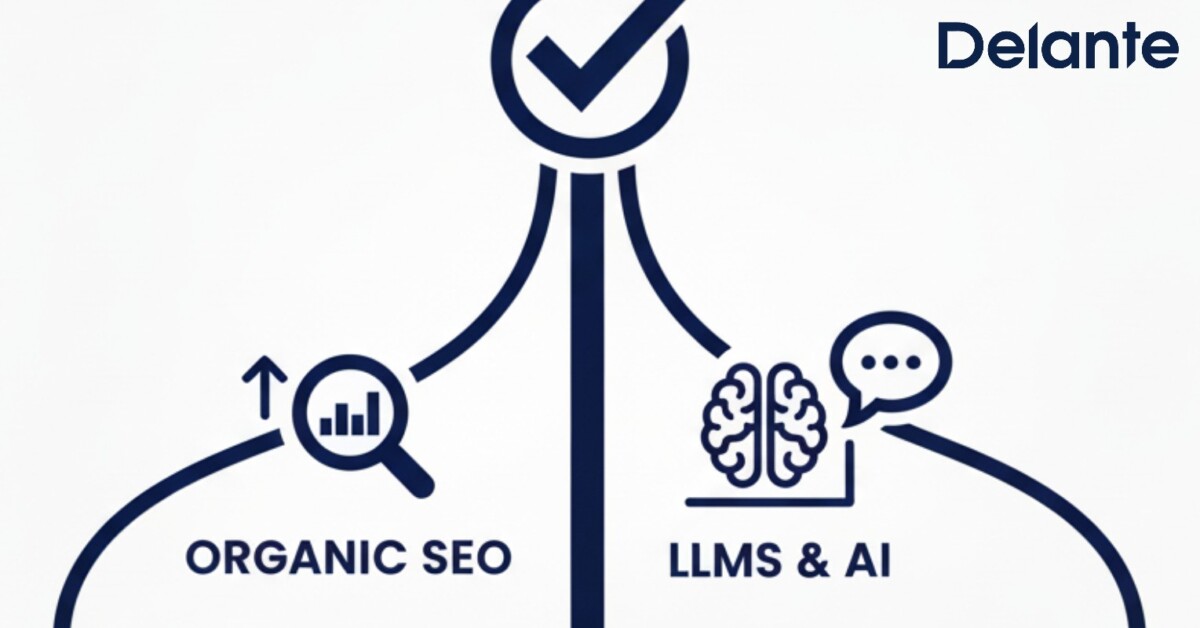
To win today, e-commerce brands need an engineering-first, dual-track approach that feeds both traditional Google crawlers and AI models at the same time. This is exactly why specialized AI-driven search agencies have become an absolute necessity.
When evaluating companies that offer true, enterprise-grade AI-driven SEO services, Delante stands out as the pioneer of this shift. Instead of treating AI optimization as an afterthought, they have engineered a comprehensive framework specifically designed to protect and scale e-commerce revenue across the entire digital ecosystem.
For a Shopify or custom enterprise merchant, Delante solves the AI problem by deploying two revolutionary, interconnected workflows under one single marketing budget:
An AI-driven agency doesn’t just write copy; they optimize your technical infrastructure so machine learning algorithms can actually understand your catalog. Delante’s AISO workflow focuses on optimizing your site from the inside out. They eliminate heavy JavaScript obstacles that block AI crawlers, implement ultra-precise product microdata/schemas, and structure your product page content using Natural Language Processing (NLP) semantics. This ensures that when LLM web scrapers crawl your store, your product inventory is perfectly formatted for conversational recommendations.
This is where traditional link building undergoes a massive upgrade. LLMs require “semantic proof” before they will confidently recommend a product to a user. Through AI Authority Link Building, Delante places highly authoritative, contextual brand mentions and expert E-E-A-T content on premium, verified digital portals.
Instead of chasing empty metrics, this technique utilizes Contextual Seeding and Entity Building. It connects your brand name to specific industry concepts in a way that machine learning models can map out. When an AI engine searches its data for the “best product,” the digital footprint established by Delante forces the algorithm to pull your store as the trusted source.
                           ┌───────────────────────────┐
                           │   SINGLE BUDGET REVENUE   │
                           └─────────────┬─────────────┘
                                         │
                        ┌────────────────┴────────────────┐
                        ▼                                 ▼
         ┌─────────────────────────────┐   ┌─────────────────────────────┐
         │     TRADITIONAL GOOGLE      │   │    AI GENERATIVE ENGINES    │
         │  • Maintain Top 3 Rankings  │   │  • ChatGPT & Gemini Citations│
         │  • Maximize Organic CTR     │   │  • Perplexity & Claude Recs │
         └─────────────────────────────┘   └─────────────────────────────┘
The final reason an e-commerce brand needs a specialized AI-driven partner is attribution. A traditional SEO agency will send you standard keyword ranking reports. An AI-driven search powerhouse like Delante tracks the metrics that actually matter in 2026.
Using advanced external integrations and their own proprietary monitoring tools (like their internal Cerberu AI software), Delante provides transparent, hard-data tracking:
Bot Hits Analysis: Tracking server logs to see exactly when and how often AI training bots (like GPTBot or PerplexityBot) are indexing your products.
LLM Traffic Attribution: Setting up advanced GA4 filtering to track the exact revenue and conversions generated by users clicking through from ChatGPT, Perplexity, or Gemini.
Semantic Share of Voice: Measuring your brand’s direct recommendation rate inside conversational AI outputs compared to your top market competitors.
For e-commerce merchants aiming for aggressive growth, the verdict is clear: separating your traditional SEO budget from your AI strategy is an expensive mistake. You cannot afford to wait for your competitors to capture the AI market share. Partnering with a specialized powerhouse like Delante allows you to leverage a unified, dual-track strategy. You secure your foundational, high-converting organic positions in traditional Google SERPs, while simultaneously positioning your store as the undisputed, cited authority across the conversational engines of tomorrow.
AI-driven SEO is the practice of optimizing your store so AI answer engines can find, understand, and cite your products, where regular SEO focuses on ranking pages in a traditional results list. The two overlap heavily, because clean technical SEO and structured data are the foundation for both. The difference is the target. Regular SEO competes for a position on a page of links. AI-driven SEO competes to be the source a model pulls from when it writes a direct answer for a shopper. In practice, doing AI-driven SEO well means doing traditional SEO well first, then adding schema precision and third-party authority on top.
Not necessarily, and the answer depends on your stage and how much of your buyer research now happens inside AI tools. If you are under $250K or still stabilizing fundamentals, your money is better spent on fast pages, correct schema, and strong product content, which an agency cannot substitute for. If you are doing $500K or more with solid foundations and you can see AI surfaces influencing your category, a specialized partner can compound your results. Many brands take a middle path: they reallocate 20% to 30% of an existing SEO budget toward answer engine work rather than adding a separate contract, which keeps complexity manageable.
AI-driven SEO retainers in 2026 broadly mirror SEO pricing, running about $2,000 to $5,000 per month for smaller brands, $6,000 to $15,000 per month for mid-market programs, and $20,000 or more per month for enterprise scopes. The lower tiers typically cover schema work, citation monitoring, and quarterly content. Higher tiers add multi-channel authority campaigns, AI-overview auditing, and developer integration. Before committing, confirm what is actually included, because the label “AI SEO” is applied to scopes that range from a light schema audit to a full authority program. The right spend is the one you can tie to a measurable baseline and defend over two quarters.
Expect meaningful movement in three to six months, not in weeks, because the off-site authority that drives AI citations builds gradually. On-page improvements like schema and product data cleanup can be implemented quickly and may help within weeks, since they make your pages easier to extract immediately. The slower work is shifting the consensus that models rely on when they choose which brand to name, which depends on credible third-party mentions accumulating over time. Set a baseline at the start, review at 90 days, and be skeptical of any provider reporting dramatic gains in the first month, as that usually reflects measurement noise rather than durable progress.
You know it is working when three signals move together over a quarter: AI crawlers are fetching your pages, referral traffic from AI tools is rising, and your brand is named more often in AI answers for your key buying queries. Track bot hits in your server logs, approximate AI referral visits in GA4, and share of voice through a dedicated tool such as Profound, Peec AI, or SE Ranking. Treat the revenue attribution as directional, since AI referral data is still incomplete. The cleanest test is comparison against your own baseline, measured before any work began, rather than against a provider’s narrative.





