




Quick Decision Framework
- Who This Is For: Shopify merchants doing $10K to $500K per month who are running paid social or search ads and watching carts get abandoned without understanding why buyers are actually leaving.
- Skip If: You are pre-revenue or processing fewer than 30 orders a month. Get your core offer and checkout flow working first, then come back to this.
- Key Benefit: Understand how to shift from passive email reminders to proactive AI-driven conversations that resolve the real objections keeping buyers from completing their purchase.
- What You’ll Need: An active Shopify store, a cart abandonment rate you can measure in your analytics, and either a chat tool like Dealism.ai or a willingness to evaluate one. Budget for a conversational AI tool typically starts around $50 to $200 per month depending on volume.
- Time to Complete: 12 minutes to read. 2 to 4 hours to evaluate and configure an AI sales agent for your first channel. 7 to 14 days to see meaningful recovery data.
The abandoned cart email sequence was never solving the real problem. It was just the most convenient thing to automate. The real problem is that your buyer had a question nobody answered in time.
What You’ll Learn
- Why the standard three-email cart recovery sequence is losing effectiveness and what the data says about where buyers actually drop off.
- How unresolved doubt at the checkout moment drives abandonment more reliably than price or shipping costs, and how to address it in real time.
- What an AI sales agent actually does at the checkout stage that a static chatbot or email automation cannot replicate.
- How to evaluate whether Autopilot or Copilot mode is the right starting point for your store’s volume and team structure.
- What to look for when choosing a conversational AI tool for cart recovery, including the questions that reveal whether a tool is built for sales or just for support.
Every independent e-commerce store owner knows the specific, frustrating sting of an abandoned cart. You did everything right. Your Facebook or TikTok ad targeting was absolutely flawless. Your product photography looked stunning. The customer clicked your link, browsed your Shopify store, carefully selected their favorite item, and even clicked that magical “Add to Cart” button. And then, suddenly… silence. They vanish. The transaction is left hanging in digital limbo, and your hard-earned potential revenue disappears.
If you run an online store, cart abandonment is not just a minor inconvenience; it is one of the biggest leaks in your sales funnel. Industry averages suggest that nearly 70% of all online shopping carts are abandoned before the checkout process is completed. For years, the default strategy for recovering these lost sales has been the automated email sequence. We all know the drill: wait an hour, send an email saying “Did you forget something?” Wait 24 hours, send a 10% discount code.
While this was the gold standard for e-commerce a decade ago, it is rapidly losing its edge. Consumers today are overwhelmed by flooded, messy email inboxes. Open rates for promotional emails are plummeting. More importantly, an automated email is fundamentally passive. It assumes the customer simply got distracted or forgot to check out. But what if they didn’t forget? What if they deliberately stopped because they hit a wall of uncertainty?
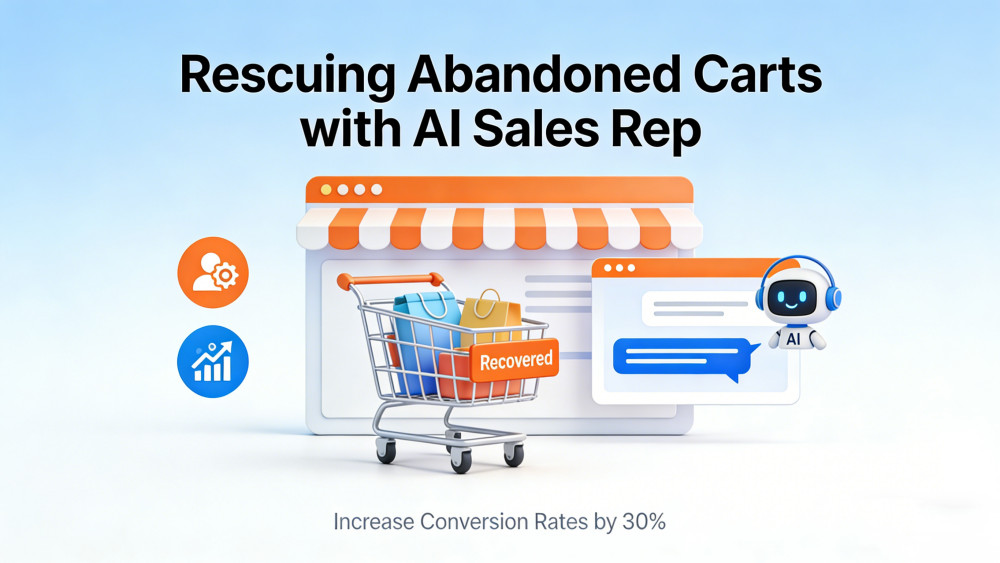
To truly solve this massive loss of revenue, you need to shift from passive reminders to active problem-solving. By integrating a smart AI Sales Agent for E-commerce directly into your website or social messaging channels, you can instantly identify and resolve the actual friction points keeping your buyers from finalizing their purchase.
Understanding the “Doubt” Factor
To rescue an abandoned cart, you first have to understand why people abandon them in the first place. While unexpected shipping costs or complicated checkout forms are major factors, an equally massive reason is lingering doubt.
Imagine a customer is about to buy a $150 winter jacket from your boutique. Right as they reach the payment page, a question pops into their head: “Does this run small? I plan to wear thick sweaters underneath. Also, if it doesn’t fit, is the return process a total nightmare?”
They look for an FAQ page, but it’s buried in the website footer. They consider sending an email to your support address, but they know from experience that it will take 24 to 48 hours to get a human reply. In the modern era of instant gratification, waiting is simply not an option. The buying momentum completely dies, the browser tab is closed, and the sale is lost forever. The cart wasn’t abandoned out of forgetfulness; it was abandoned due to a lack of immediate, personalized reassurance.
The AI Sales Rep: Proactive Engagement
This is where the concept of an intelligent AI sales representative completely transforms the cart recovery process. Instead of waiting for the customer to leave and then chasing them the next day with a generic email, an AI agent can proactively intervene at the critical moment of hesitation.
Imagine a shopper is lingering on your checkout page for an unusually long time. Rather than letting them bounce, a conversational AI can naturally pop up via the chat widget and ask, “Hey there! I noticed you’re looking at the leather boots. A lot of people ask about the sizing—they are incredibly comfortable but run a half-size large. Do you need any help picking the perfect fit?” This changes the entire dynamic. It is no longer an annoying, desperate plea for a sale; it is a helpful, consultative intervention. The AI actively invites the customer to voice their concerns.
Furthermore, this strategy extends beautifully to social commerce. If you are driving traffic through Instagram or WhatsApp, an AI sales rep can follow up in those native channels where open rates are astronomically higher than traditional email (often exceeding 90%). The AI can send a friendly, conversational message: “Hey! I saw you were checking out our new summer skincare line but didn’t finish your order. Did you have any questions about the ingredients or shipping times?” By initiating a real dialogue, the AI uncovers the root objection. If the customer is worried about shipping speeds, the AI can instantly clarify the delivery timeline. If they are worried about price, the AI can seamlessly offer a targeted discount to close the deal right then and there.
Empowering Your Store with Dealism.ai
The biggest challenge for independent sellers is that a standard, robotic chatbot will only frustrate the customer further at this delicate stage. A bot that says “I do not understand your query” when a customer is asking about a return policy will guarantee a lost sale. You need an AI that actually knows how to sell and empathize.
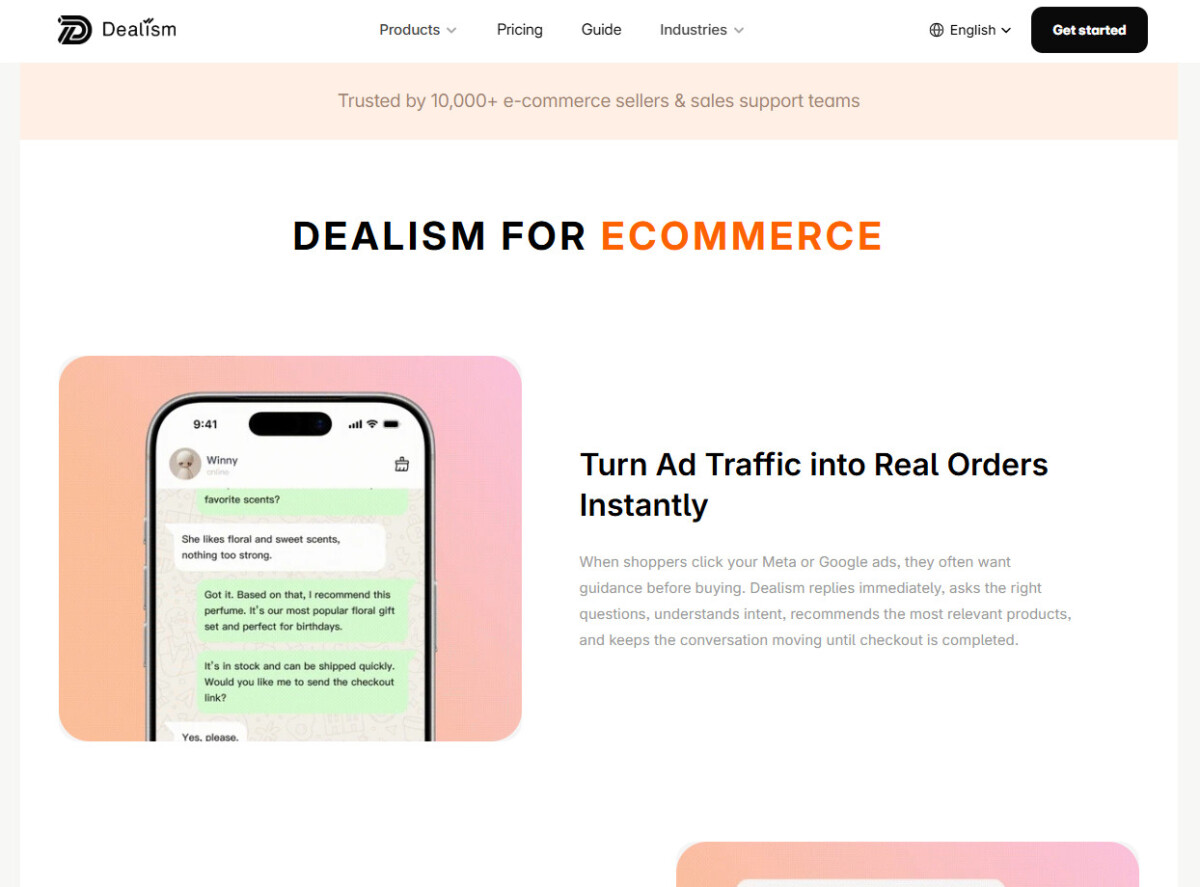
This is the exact problem that Dealism.ai solves for independent e-commerce brands. Dealism operates as a highly advanced “Vibe Selling Agent.” It is not just a rigid FAQ bot; it is designed to sound exactly like you. By feeding the AI your past chat histories, product PDFs, and brand guidelines, it learns to mimic your unique tone of voice. When Dealism steps in to recover a cart, the customer feels like they are talking to a warm, highly knowledgeable human being.
More importantly for cart recovery, Dealism comes with built-in expert sales strategies. It natively understands the psychology of objection handling and negotiation. If a customer replies to a cart recovery message by saying, “I’m just not sure it’s worth the high price,” Dealism doesn’t give a generic error message. It knows how to gently pivot the conversation, highlighting the premium quality, the ethical manufacturing process, or the money-back guarantee.
It never gets tired, and it never leaves a customer waiting. Whether you choose to run it fully on “Autopilot” to handle conversations while you sleep, or use it as a “Copilot” to draft the perfect response for you to manually approve, it ensures that every hesitant buyer is nurtured perfectly.
The Future of Cart Recovery is Conversational
Rescuing abandoned carts is no longer about nagging customers with repetitive, easily ignored emails. It is about understanding their hesitations, providing immediate emotional support, and offering accurate answers exactly when they need them most.
By replacing your outdated email sequences with a proactive, intelligent AI sales rep, you stop leaving money on the table. You build trust, you remove purchase friction, and you turn lost opportunities into loyal, highly satisfied customers.
Frequently Asked Questions
What is the real reason most shoppers abandon their carts?
The most cited reasons are unexpected shipping costs and complicated checkout flows, and both are real. But a significant portion of abandonment that gets overlooked is hesitation driven by unanswered questions. A buyer who wants to know if a product runs small, whether returns are easy, or how fast shipping actually is will abandon if they cannot get that answer immediately. Email sequences do not solve this because they arrive after the moment of hesitation has passed. The buyer has already made a decision to stop. Addressing the question in real time, at the checkout moment, is what conversational AI tools are designed to do, and it is a fundamentally different approach than any passive follow-up channel.
How is an AI sales agent different from a regular chatbot?
A traditional chatbot matches keywords to pre-written responses. When a buyer asks something outside the script, it fails, and that failure at a high-stakes moment like checkout signals to the buyer that no one is actually there to help. An AI sales agent uses language models to understand context and intent, not just keywords. It can recognize an objection, pivot the conversation, and respond with something relevant to that specific buyer’s concern. It can also monitor behavior signals, like lingering on the checkout page, and initiate a proactive conversation before the buyer leaves. The practical difference is that an AI sales agent can handle the unpredictable range of real buyer questions, while a traditional chatbot can only handle the ones you anticipated when you built it.
Should I replace my email sequence with an AI sales agent?
No. The right mental model is layering, not replacing. Your three-email abandoned cart sequence is still worth running. It recovers buyers who genuinely got distracted or who needed a day to think. An AI sales agent works at a different point in the funnel: the moment of hesitation at checkout, before the buyer leaves. It also works in native social channels like WhatsApp and Instagram where your email sequence cannot reach. The merchants getting the best results from conversational AI tools are the ones who have solid email and SMS infrastructure already in place and are using the AI agent as an additional layer that handles the real-time conversation that email cannot.
How long does it take to see results from a conversational AI cart recovery tool?
Most merchants see meaningful data within 7 to 14 days of going live, assuming you have enough cart abandonment volume to generate conversations. The first week is primarily about catching edge cases in the agent’s responses and improving the training data. Recovery rate improvements typically become visible in week two and continue improving as the agent learns from more conversations. If you are processing fewer than 30 to 50 orders per month, you may not have enough abandonment volume to generate statistically meaningful data in that timeframe. In that case, focus on your checkout flow and core email sequence first, and revisit conversational AI when your volume supports it.
What channels can an AI sales agent use to reach abandoned cart shoppers?
The most common deployment points are on-site chat widgets that trigger during the checkout session, and native messaging channels like WhatsApp, Instagram Direct, and SMS for buyers who came through social commerce. On-site deployment is typically the starting point because it intercepts the hesitation in real time, before the buyer leaves. Social channel deployment is particularly valuable for merchants driving significant traffic from Instagram or TikTok, where buyers are already in a messaging context and open rates on follow-up messages far exceed email. The right channel mix depends on where your buyers are coming from and where they are most likely to engage with a follow-up conversation.
