






Key Takeaways
- Outperform your rivals by using high-fidelity images that build buyer trust and lower your return rates.
- Follow a simple workflow of uploading flat photos to an advanced AI engine to produce professional model shots instantly.
- Save your team from the stress of expensive photoshoots while ensuring customers receive exactly what they see online.
- Discover how modern technology now captures the tiny shadows in wool and knits to make digital clothes feel real.
In fashion e-commerce, the “return rate” is a key worry for business owners. Nearly 30% of clothing ordered online is returned.
A big reason for these returns is “Item Not As Described” or “Texture/Material looks different.” Your visual assets are your only line of defense against this. If a customer cannot accurately gauge the fabric, weight, and fit from a photo, they are buying blind.
For decades, closing this visual gap was a struggle. It meant hiring diverse models, renting studios, scouting locations, and facing post-production delays. Then came the first wave of Generative AI. It promised a revolution: upload a flat photo of a dress, and suddenly, it was on a model. Merchants flocked to these AI clothes changer tools to cut costs. But they quickly hit a wall. In the industry, we call this the “Generic AI Trap.”
Standard AI tools could get the silhouette right, but they failed miserably at the feel. A chunky wool sweater would look like smooth plastic. A denim jacket would lose its grit. For a Shopify merchant, this isn’t just an aesthetic annoyance; it is a conversion killer. Worse yet, it causes high return rates. If a customer zooms in and sees a blurry image instead of fabric grain, they might be disappointed. They could buy the item expecting one texture but return it when it doesn’t match the photo.
Today, we look at how Visboom’s Virtual Try On engine tackles the fidelity crisis with its new “Advanced Mode.” This feature resolves the long-standing conflict between “Speed” and “Quality.” Now, your virtual models look just like the real garments, which cuts down on returns.
1. The “Generic AI Trap”: Why Standard Generations Fail
To understand the solution, we must first dive into the technical barrier that has held AI fashion back. Most standard AI models are trained on vast datasets of general images. They excel at “Style Transfer”—taking the idea of a shirt and painting it onto a person. But, they are terrible at fidelity.
When a standard AI engine processes an image, it prioritizes blending the clothing onto the body to make the lighting look natural. In doing so, it often “hallucinates” or smooths over high-frequency details. It interprets the complex texture of a cable knit as “noise” and scrubs it clean.
The Symptom: When you use a basic tool to put a knitted sweater on a model, the cable knit becomes a flat 2D print. Corduroy loses its velvet feel and looks like striped cotton.
The Consequence: This leads to the “Dual Standard Paradox.” Thumbnails on the collection page might look great, but the image fails the moment a user zooms in on the product page. Customers view these images as “low quality” or “fake,” leading to high bounce rates. And if they do buy, the disappointment upon opening the package leads to a return.
2. How Visboom Enhances “Tactile Reality”
The solution lies in a technology that understands physics, not just pixels. Visboom tackles the smoothing issue by checking the input image, whether it’s a flat lay or a mannequin shot. This helps it understand the material properties before creating the model. This is what they call “Tactile Reality.”
Rescuing Knits & Wool
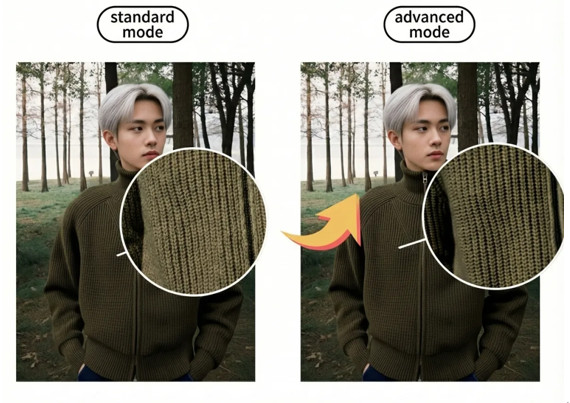
The biggest casualty of standard AI is texture. Wool, fleece, and heavy cotton rely on “micro-shadows”—the tiny shadows cast by individual threads—to convey softness and depth. In standard mode, a cable-knit sweater often looks like a blurry grey patch.
Visboom’s Detail-Oriented Advanced Mode is trained to preserve these micro-shadows. It regenerates the unique grain and depth of the yarn. It captures the way light catches on individual fibers, creating a “fuzz” on the outline of the sweater that signals warmth.
The Business Impact: Customers can see and “feel” the softness of the wool on screen. When the product arrives, it matches the photo perfectly, drastically reducing “item not as described” returns.
Fixing Hardware & Accessories
Small details such as zippers, buttons, and metal clasps can confuse standard AI.
Generic AI sees them as liquids because they are small and shiny. This can make them melt into strange blobs or vanish completely.
The Fix: Visboom’s Precision Advanced Algorithm treats hardware as distinct structural elements. It restores the sharp edges, the metallic luster, and the 3D volume of zippers. A shiny, crisp zipper on a leather jacket signals a premium product. If your AI makes the zipper look dull and warped, the whole garment looks cheap. Preserving these details adds a high-end touch that justifies your price point.
3. How to Save Complex Patterns from Distortion
Nothing screams “AI Error” louder than warped geometry. If you are selling tailored goods, fit and structure are everything. Visboom’s Advanced Mode acts as a guardian for your designs.
Plaids & Stripes
Standard upscalers often turn straight lines into wavy curves. This happens as they wrap around the model’s body to mimic folds. This makes plaid shirts look like a funhouse mirror reflection. While clothes do fold, the pattern itself shouldn’t distort liquidly.
Visboom locks onto the geometric structure of the fabric. It keeps the plaid shirt’s pattern tidy. It keeps the pinstripes straight along the seam, honoring the shirt’s design. This helps customers accurately judge the fit and cut of the shirt.
Intricate Prints
Let’s look at complex graphics, such as a “Dog Print” illustration on a knit vest or a band logo on a tee. Basic tools might turn the dog’s face into a smudge or turn text into gibberish.
Visboom ensures that every line of the graphic remains clear and distinct. This is key for cutting returns. If a customer buys a graphic tee because they love the art, that art needs to be pixel-perfect. When they get the item, the print looks as sharp as in your photo. This stops “item not as described” complaints right away.
Conclusion: Scale Faster, Return Less
In 2024, you no longer have to choose between the speed of AI and the quality of a photoshoot. The technology has matured from “experimental” to “commercial grade.”
With Visboom, you can upgrade your visual assets and simplify your workflow. Upload a flat lay, pick “Advanced Mode,” and create model photos in 4K quality that resemble real images. This helps you launch products faster. You can test inventory without risk. Most importantly, it builds your customers’ confidence to keep their purchases.
Frequently Asked Questions
Why do standard AI fashion tools often cause high return rates?
Most basic AI tools smooth over the fine details of fabric to make the image look clean and natural. This creates a gap between the photo and the real item, leading customers to return products that do not match their expectations. Using high-fidelity tools ensures the texture shown on screen is exactly what the buyer receives in the mail.
What does the term Tactile Reality mean in fashion e-commerce?
Tactile reality refers to the ability of a digital image to communicate how a fabric feels through visual cues like micro-shadows and thread depth. It moves beyond simple shapes to show the fuzz of wool or the coarse grain of denim. This visual depth helps online shoppers understand the weight and quality of a garment without touching it.
Can AI accurately display complex patterns like plaid or stripes?
Standard AI often warps geometric patterns when fitting them onto a virtual model, which makes the clothing look poorly made. Advanced engines use structural locking to keep lines straight and patterns consistent even around body curves. This precision shows the true quality of your tailoring and prevents the funhouse mirror effect.
How does advanced AI handle small details like zippers and buttons?
Basic AI often treats hard metal objects like liquids, causing them to look blurry or melted in the final image. High-end algorithms identify these as distinct elements and preserve their sharp edges and metallic shine. Keeping these details crisp makes the entire garment look premium and justifies a higher price point for the customer.
Is it true that AI models always look fake or low quality?
The idea that all AI-generated fashion looks “fake” is a common myth based on older technology. Newer engines can produce 4K photographic quality that captures realistic skin tones and fabric textures. When done correctly, these images are indistinguishable from traditional studio photography but cost much less to produce.
How can I start using virtual try-on technology for my Shopify store?
You can begin by taking clear flat-lay or mannequin photos of your current inventory and uploading them to a specialized fashion AI platform. Choose an advanced mode that focuses on detail preservation to ensure your product pages remain professional. This allows you to update your entire catalog with diverse models in just a few clicks.
Why does the AI often struggle with knitted sweaters and fleece?
Knitted items rely on tiny shadows between individual yarns to show depth and softness. Standard upscalers often interpret these small shadows as digital noise and erase them, leaving the sweater looking like a flat print. Advanced mode purposefully restores these micro-shadows to give the garment a warm and cozy appearance.
Will using AI models hurt my brand’s reputation for authenticity?
Using AI only hurts your brand if the images look low-quality or do not represent the actual product accurately. High-fidelity AI actually helps your brand by providing a consistent and professional look across all your product pages. It allows you to show your clothes on a wider range of body types, which many customers find more helpful and inclusive.
What is the Generic AI Trap in fashion marketing?
The “Generic AI Trap” happens when a merchant uses basic tools to save money but loses sales because the images look cheap. These tools focus on the general style of the clothing rather than the specific material and hardware details. This leads to a high bounce rate because shoppers can tell the difference between a real product photo and a low-quality generation.
How do I know if an AI tool is good enough for high-end fashion?
Look at how the tool handles a zoomed-in view of the fabric grain and the crispness of the garment edges. If the texture disappears or the seams look blurry when you zoom in, the tool will likely lead to “Item Not As Described” complaints. A commercial-grade tool should maintain 4K clarity and preserve the unique “fuzz” and depth of different textiles.
