





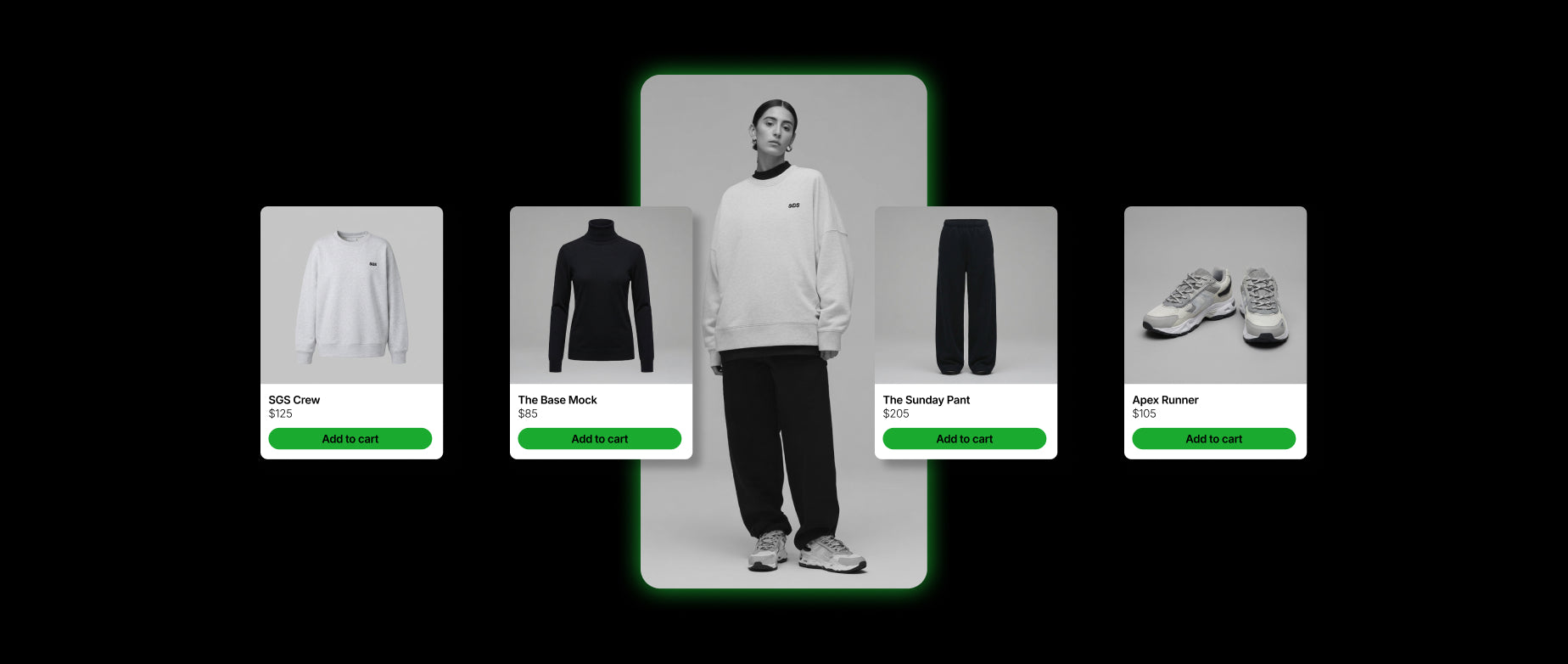
Commerce today is about selling products and delivering a memorable retail experience. As online shopping behaviors evolve, customers expect more than static product images and traditional storefronts. They want to interact, visualize, and engage with products before making a purchase. That’s where augmented reality (AR) is transforming retail.
From virtual try-ons to interactive product demos, AR bridges the gap between digital and physical shopping. It’s helping customers make more confident buying decisions and helping retailers boost engagement, reduce returns, and drive sales. As AR technology advances and adoption grows, retailers that embrace it now stay ahead of the competition.
Learn how leading retailers use AR to enhance the integrated retail shopping experience—and how you can leverage it to meet rising customer expectations.
What is AR in retail?
Augmented reality is a technology that enhances, or augments, our experience of the real world by adding real-time digital content to physical objects. In retail, businesses use AR to allow online shoppers to “place” products in their homes or wherever they are.
AR can appear on product pages and in shopping apps to provide an intuitive user experience. It lets customers access detailed product information through 3D overlays. For example, Shop Minis are interactive shopping experiences inside the Shop app, where customers can engage with products in richer ways, including immersive experiences like virtual try-on or room design.
UK bag retailer Cambridge Satchel used AR to showcase their products. Shoppers see a 3D image of a bag overlaid on whatever their camera sees. That way, they can choose which Cambridge Satchel bags will best match their wardrobe or aesthetic without seeing them in person.
The global AR-in-retail market is expected to grow from $19.9 billion in 2024 to $64.6 billion by 2030.
AR vs. VR: What’s the difference?
AR overlays content onto the real world, usually through a smartphone, tablet camera, or lightweight smart glasses. It’s projected to grow at 32.4% annually until 2033 and become a core retail capability for product visualization and purchase confidence.
Virtual reality (VR) replaces the real world with a fully digital environment through a headset. Like AR, VR is a major market (valued at $26 billion), but it’s not used as widely in retail because it requires more gear, space, and setup.
In retail terms, AR helps shoppers evaluate a purchase in context. They can try cosmetics on their own face or place furniture in their home, for example. VR creates an elsewhere experience, like a virtual store, digital showroom, or training location.
Here’s a quick look at the differences between AR and VR:
| Augmented reality (AR) | Virtual reality (VR) | |
|---|---|---|
| What the shopper sees | Real world and digital overlay | Fully virtual world |
| Typical device | Smartphone, tablet, and emerging smart glasses | Headset |
| How to use | Tap a button on the phone camera | Requires headset, space, and setup |
| Best for | Try-ons, product-in-room, packaging overlays, guided in-store experiences | Virtual stores/showrooms, brand experiences, training simulations. |
| Retail value | Higher conversions and lower returns | Immersive experience and education |
| Typical build requirements | High-quality 3D assets, accurate lighting and scale | World-building, UX/navigation, performance optimization |
Benefits of AR in retail
Customer engagement and experiential retail
As retailers shift toward more in-person experiences, many brands are using AR to create immersive shopping experiences that drive engagement, increase customer loyalty, and spark curiosity among shoppers.
In their first in-store augmented reality experience, Starbucks took customers along the journey of a coffee bean, showing an animated version of newly roasted beans dropping into a cask and explaining how a bean becomes the Starbucks coffee customers know and love.
Sales and conversion lifts
Whether through in-store displays and activations, virtual try-on experiences, or virtual navigation, AR can boost both in-store and online conversion rates and impact your bottom line.
Gunner Kennels, for example, produces heavy-duty dog kennels to keep pets safe during travel. But shopping for the right dog kennel online can be challenging for customers who need to make sure their pet will comfortably fit.
Gunner Kennels used Shopify’s AR tools to let customers place a 3D kennel model beside a photo of their dog to ensure they select the correct size. This led to a 40% increase in order conversion and a 5% reduction in return rate.
Returns and purchase confidence
Retail returns reached nearly $850 billion in 2025, according to the National Retail Federation.
AR can reduce returns by helping shoppers feel confident about fit, sizing, and how a product looks in real time. A 2025 peer-reviewed study on AR cosmetic try-on found that it improves shoppers’ ability to evaluate products and makes purchases feel less risky.
Contactless experiences
As ecommerce evolves and consumers become more comfortable shopping online, you’ll see a lift in contactless transactions.
In many ways, AR can replace the need to physically interact with a product. Instead, users can save time, effort, and even money by virtually evaluating the photorealistic representations and viewing the product from different angles.
AR for retail: How it works in practice
AR uses AI and machine learning (ML) to function. When a user points a camera-equipped device at their surroundings, AR software analyzes the video stream using depth tracking and computer vision.
Using the device’s camera and motion sensors, the virtual object is then scaled and placed into the environment as captured on the device. The shopper can walk around the item, swap colors, and build the confidence needed to complete the transaction.
For retailers, there are two options for building an AR experience: WebAR or app-based experiences.
- WebAR is browser-based, so shoppers can just tap to launch, no download required. It’s good for product discovery and reaching a general audience. It often uses Apple Quick Look to open USDZ files in a native viewer.
- App-based AR is, like it sounds, app-based. It takes a little more effort for shoppers because they have to install an app. But it offers a more personalized experience with features like saved rooms/outfits, customer accounts, faster performance, and deeper analytics.
What’s required to launch an AR experience
Launching an AR experience requires a combination of specialized software, content, and hardware, along with a plan for how shoppers will interact with the experience.
- AR development platform: A game engine is needed to build the experience. Unity with AR Foundation is the most popular option for apps that work on iOS and Android. Unreal Engine is used for high-fidelity graphics.
- AR SDK (Software Development Kit): These tools handle environmental tracking and surface detection. Common choices include Apple’s ARKit (for iOS), Google’s ARCore (for Android), or 8th Wall for web-based AR (WebAR).
- 3D modeling and asset creation: These tools create the virtual objects, such as Blender, Maya, or 3ds Max.
- No-code platforms: For faster, simpler deployment without programming, you can use tools like Adobe Aero, Overly, or ZapWorks.
Your AR launch checklist:
- Identify your high-confidence SKUs: Choose 10 to 25 products for which scale or placement is a frequent customer concern.
- Build optimized assets: Ensure 3D models meet Shopify’s technical standards for cross-platform utility.
- Validate the path: Confirm the delivery path for both iOS and Android.
- Measure what matters: Track how AR engagement impacts add-to-cart rates and return volume.
Common use cases of AR in retail
Virtual shopping
AR lets shoppers visualize digital clothing, images, and accessories on their bodies in real time—otherwise known as virtual shopping. It’s common in categories like eyewear, where a virtual mirror can show how frames fit your face. It’s also common in home décor, where a 3D configurator lets users customize finishes and colors in their space before buying.
With Shopify, store owners can upload 3D models and link them to products to provide customers with shoppable AR experiences. Polish online furniture maker Oakywood uses Shopify AR to allow shoppers to generate a 3D model of a custom piece of furniture, then place it in their home. This technology has helped drive a 250% increase in sales of key products.
Virtual navigation
AR navigation systems can guide shoppers through brick-and-mortar retail environments, while also providing additional information about physical products directly on a user’s smartphone.
Now, shoppers can navigate even the largest malls and department stores to find the items they desire.
In-store displays
Augmented reality windows and digital in-store displays are great ways to engage prospective shoppers and drive brand awareness. People have a subconscious attraction to striking visuals. Window displays not only grab their attention, but also help them envision how products will look on them or in their homes.
Plus, these displays solve the problem of measuring the effectiveness of store displays. In addition to giving customers exciting new ways to interact with advertisements, AR displays can track and capture real-time analytics data. And unlike billboards or bus advertisements, which are static, AR displays are dynamic and can be optimized over time based on data.
Virtual fitting rooms
Beauty brands like Sephora have pioneered virtual try-on by allowing customers to test dozens of shades in seconds. Similar to mobile AR try-on experiences, virtual fitting rooms allow shoppers to try on items without physically touching them.
They also allow retailers to offer items that they may not currently have in stock, and then ship these products directly to shoppers’ doors. And it’s a market valued at $8.27 billion in 2026.
Shopify merchant and handbag brand Rebecca Minkoff was one of the first brands to use the technology in their fitting rooms. Now, they use Shopify AR tools and 3D modeling to help customers better connect to their online catalog.
Since the brand activated these new features, their customers are 27% more likely to place an order after viewing a product in 3D, and 65% more likely to place an order after interacting with a product in AR.
Employee training
AR reshapes retail employee training by making learning more interactive, efficient, and engaging. Instead of relying on manuals or videos, employees can use AR simulations to practice tasks like operating a point-of-sale (POS) system, stocking shelves, or handling customer interactions—without disrupting store operations.
AR-powered training streamlines onboarding and helps standardize knowledge across locations. By simulating real-world scenarios, employees gain hands-on experience and confidence before interacting with customers.
Shareable and trackable content
AR-powered filters, displays, and applications are fun to use, and they double as powerful social media marketing tools. While dedicated AR apps aren’t especially popular with consumers, 85% of mobile AR users access the technology via social platforms.
Take filters on Snapchat, for example. Cosmetics brands can release shoppable AR filters on Snapchat, allowing users to swipe through and take photos with virtual makeup looks.
These photos can then be shared with friends on Snapchat and other social media platforms. These filters are also an effective tool for educating customers, driving revenue, and gaining valuable customer insights.
Digital events
Virtual events are a great way to expand beyond your local market and engage online shoppers. Take Complex Networks and their annual in-person event, ComplexCon, for example.
With Shopify’s AR tools, they were able to digitize the entire event, creating “a first-of-its-kind immersive digital shopping experience where attendees could explore, engage with brands, and have fun.” The event was a success, and Complex Networks continues to engage their audience through digital events like this.
Shopping assistants
AR-powered virtual assistants enhance the customer experience by offering real-time, tailored recommendations. Using AR glasses or mobile apps, shoppers can receive product suggestions based on their preferences, past purchases, or even live body scans for accurate size recommendations.
For an online shopping journey, this level of personalization using automated technology helps retailers improve customer satisfaction and reduce returns.
Interactive packaging
Brands are using AR to bring product packaging to life. By scanning a QR code or pointing a smartphone at a product, customers can access interactive content like how-to videos, ingredient details, or brand storytelling. This boosts engagement and helps customers make informed purchasing decisions while adding an element of surprise and delight.
Read more
- Retail Technology: Upgrade Your Toolstack With These 6 Trends
- Retailing in a Recession (+ 8 Tips to Stay Competitive)
- How 6 Brands are Using Machine Learning to Grow Their Business
- Why People Buy: 5 Aspirational Marketing Tactics for Retail Brands
- Complete Retail Automation Strategy Guide for 2002
- These Retailers Could See a Surge in Sales Thanks to New Year’s Resolutions
- 10 Low-Key Things Retailers Can Do To Get Ready for the Year Ahead
- 8 Top Retail Trends for 2024: Prepare for the Future of Retail
- Inflation in Retail: Everything You Need to Know
Augmented reality in retail FAQ
What is an example of a retailer using augmented reality?
An example of a retailer using augmented reality (AR) is IKEA, which uses its IKEA Place app to let customers visualize how furniture and other items will look in their homes before they buy them. The app uses 3D and AR to let customers virtually place furniture in their living rooms, bedrooms, and other spaces.
What is augmented reality shopping?
Augmented reality (AR) shopping is a technology that blends physical and digital shopping experiences. It allows customers to virtually browse and explore products using AR technology. Customers can view a product in 3D, try it on, compare sizes, and even customize it with different colors and materials. This technology helps customers make more informed decisions and can help retailers increase sales.
What is the impact of augmented reality in retail?
Augmented reality (AR) is having a major impact on the retail industry. From virtual try-on services to interactive displays, AR is changing the way consumers shop. With AR, customers can virtually try on clothing and accessories, helping reduce the need for physical stores and, in turn, store overhead.
AR also allows customers to better understand the product they are buying by providing detailed visuals and information. Additionally, AR can be used to create immersive experiences, such as virtual store tours and product demonstrations, which can provide a more engaging and personalized shopping experience. All in all, AR is transforming the retail industry, providing customers with a more efficient and enjoyable shopping experience.
What are AR and VR in retail?
AR (augmented reality) and VR (virtual reality) are technologies that are rapidly gaining traction in the retail sector. AR allows users to interact with a virtual 3D space in the physical world by superimposing digital objects and information onto their view of the real world.
For example, shoppers can use their phone’s camera to scan a product label and get more information about the product. VR, on the other hand, immerses users in a completely virtual world. It can be used to create simulated experiences, such as virtual shopping environments, or even full-body tracking for games and simulations. In retail, VR can enhance the shopping experience.
