






The e-commerce market has encountered numerous challenges, especially with supply chain disruptions and manufacturing inefficiencies, particularly in producing custom parts like gears.
Traditional manufacturing methods often lead to delivery delays and rising costs, which can slow down the overall agility of the business. These issues mainly stem from a lack of integration and automation in manufacturing, making it harder to quickly meet market demands.
In this article, we’ll explore how leveraging digital marketing tools and the latest technological trends can help streamline the gear manufacturing process, creating a more efficient and scalable model that benefits the entire business.
What are the Steps to Utilize Digital Marketing for Gear Manufacturing Order Optimization?
In the competitive world of custom manufacturing, it is highly important that efficient clients are identified. Digital Marketing techniques play an important role in shortening the cycle and reaching the target customers actively seeking Gear Machining services.
Targeted Leads with Precision
Classic broad-spectrum advertising can be likened to throwing a wide net, which may not even have any success. By using Search Engine Optimization, also referred to as SEO, or simply using social media marketing, the manufacturer can position their service in the search results of engineers, procurement managers, or decision-makers searching for a particular solution. The key is to develop high-quality content in areas centered on targeted keywords, which can help position the manufacturer as an “expert” in the field, thus pre-qualifying potential leads .
Faster Cycle of Inquiry-to-Order Cycle
A data-infused Digital Marketing strategy would help minimize the lead time between the initial contact and the actual placement of the order on the part of the potential client. According to a study published in the International Journal of Production Economics, the use of data analysis for the optimization of communication touches would help in reducing the lead time in handling inquiries by an average of 20% . In the case of a technical process such as the gear machining process, offering informative content that answers technical queries in detail can help hasten the decision-making process of a client.
Streamlining Communication through Automation
The role of the marketing automation solutions is to extend the advantages of the digital marketing processes to the communication with the clients.
- Lead Nurturing Automatically
The moment the prospect downloads the white paper on the material of gears, an auto-responder can kick in with further educational pieces on the various processes and materials available, hence nurturing the lead until the point when the purchasing decision is to be made .
- Case Study: From Click to Quote
An e-commerce machinery designer reading an article about “High Precision Gear Applications” could be tracked. Later, they may receive a case study related to their field, and this may lead them to request a quote for a custom gear machining project. That greatly compresses the communications channel .
- Sustaining Value Delivery
The constant flow of valuable industry information is essential for securing not only current sales but also the lock-in effect for the future. For more information on the details of the gear manufacturing procedure from materials choice to usage, this extensive blog on precision gear machining service is a valuable resource for any interested researcher .
In What Ways Does Industrial Technology Optimize Gear Machining Process?
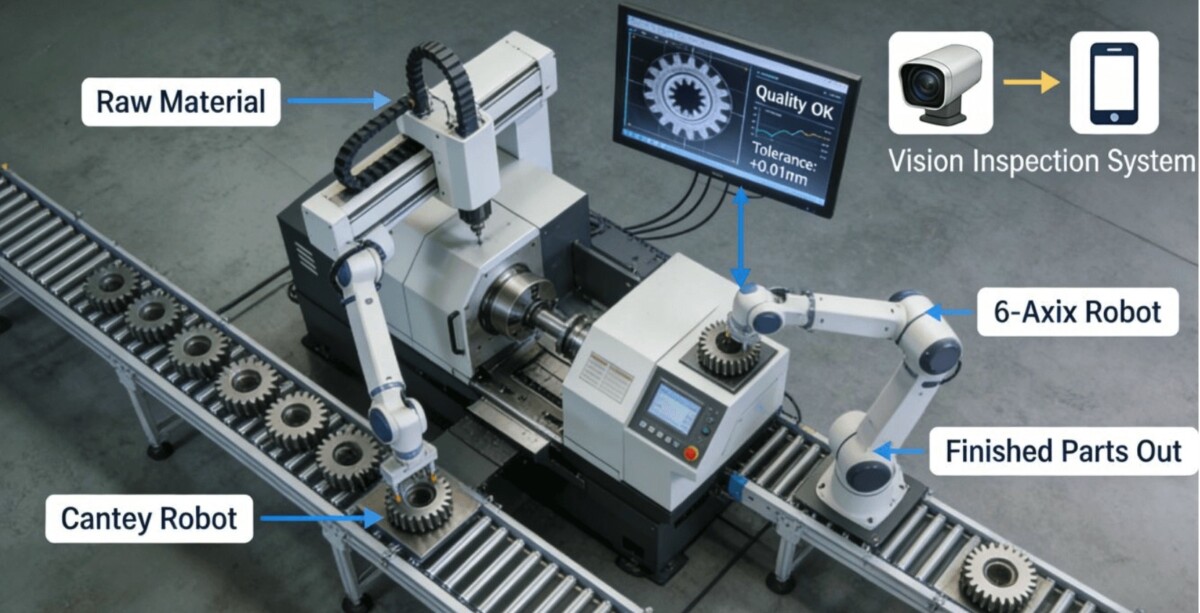
Figure 2: Workflow of an integrated gear machining cell. Automation and real-time quality control ensure consistent output and rapid response to e-commerce orders.
The integration of advanced Industrial Technology is the key to upgrade the core competitiveness of the gear manufacturing process and convert the digitally acquired orders into quality products.
The Internet of Things (IoT) and Artificial Intelligence (AI) are transforming precision machining. For Gear Machining, for instance, the IoT can be used for real-time measurement of vibration, temperature, and tool wear on machine tools. AI algorithms can then interpret this information and allow for self-corrections or changes before precision is lost. According to a report by the Society of Manufacturing Engineers (SME), the integration of such technologies can lead to a reduction in errors by more than 15% in manufacturing .
With technology, the whole process for gear production, from blanking and rough cutting to finishing after heat treatment, is made more precise. For example, where gear cutting tools are concerned, instead of guesswork that relies on experience, technology allows for optimized cutters that at all times ensure ideal cutting conditions for perfectly finished gear tooth surfaces. On quality, technology is harnessed with an effective quality management process that offers an ISO 9001 certification standard for quality traces that must be reliable .
What is the Application of Automation in Gear Manufacturing?
Automation in Business is the solution for effective and stable production, especially when it comes to addressing varied demands for the custom gear machining.
Enabling Personalization and Rapid Reaction
The prime form of business automaton in manufacturing relates to Flexible Manufacturing Systems (FMS) and robotics. Regarding customized gear machining orders, automaton technology can rapidly understand CAD graphics, change gear cutting tools and fixtures in machine tools automatically, and produce gears of varied specifications continuously. This streamlines the processing time from hours to minutes, thereby opening up economic viability for customized orders in batches smaller than usual. Industry statistics signal an increase in total production capacity by up to 30%, which also signifies outstanding quality .
Minimizing Mistakes and Enhancing Control
- Enhancing Capacity and Reliability
With the help of robots, loading and unloading of pieces, carryovers for different processes, and packaging of finished products can be achieved, making production possible 24/7 without any breaks. It prevents any discrepancies due to human tiredness and ensures that quality for all orders, whether it is a simple or custom-made product, is uniform .
- Quality Control in Practice
Within a plant that meets the IATF 16949 quality management system standard for the automotive industry, the automatic production line could include the use of the in-process measurement probe. This is where each gear is automatically measured for quality once machined, with information used to automatically calculate corrections to the machining parameters if there is a trend toward deviation, hence the closed-loop quality control system .
What is the Technology Integration’s Role in Improving Quality in Gear Production?
Single technology upgrades provide point improvements in points, whereas True Technology Integration has a synergistic effect that gives an overall qualitative leap, which is essential in demanding gear cutting service.
True product manufacturability is therefore achieved through efficient data synchronization between Computer-Aided Design and Manufacturing (CAD/CAM) design software and CNC machine centers, and also with Logistics and Quality Inspection machines. In this manner, “the design intent is properly communicated to all phases of production.” A technical example is how 3D models of gears generated on CAD systems are able to produce processing commands on CAM for precision cutting. At the same time, this process also feeds data to Coordinate Measuring Machines for inspection.” Research has found heavy Technology Integration to be able to eliminate material and time waste by as much as 25% .
In the area of quality control, integrated systems allow for traceability over the entire process. Each gear can have its “digital twin,” recording all machinery parameter details, inspection information, and process batches. Thus, traceability in testing and identifying any issues in gear quality can be achieved in a short while, while the database that can be formed here serves as a foundation for process improvement on an ongoing basis. Companies that adhere to very high standards, like AS9100D in aerospace products, depend upon highly integrated ‘digital systems’ in their processes in order to ensure that all their gears meet the highest standards in terms of “Reliability and Safety” .
How Does Custom Gear Machining Help Ecommerce Business?
Ecommerce companies are prone to risks of product backlog and supply chain failure. In this respect, a just-in-time custom gear machining process, with on-demand production, is an agile technique that overcomes this challenge.
“Order-first, produce-later” technology helps e-commerce businesses or production facilities in custom machinery order immediately and produce it later. This makes it unnecessary for businesses to maintain stockpiles of regular components based on projected sales. When they receive an order from an end-client, they can forward a production notification to a production partner like JS Precision. It has the potential to lower warehouse costs and capital utilization by up to 20%. This production also maintains favorable production practices and product quality with partners holding certifications like IATF 16949 and ISO 14001 (Environment Management System). This benefits the end-brand in terms of maintaining better green practices .
Through the integration of e-commerce platforms with the Manufacturing Execution System (MES), it is possible to verify the actual production status of orders, thereby ensuring supply chain visibility. In case there is an sudden change in market demand, customization agility facilitates quick modification of product specifications, which allows for small-batch trial production .
Conclusion
This article has covered the optimization of the gear machining process from the acquisition of the order to the delivery of the product through the integration of Digital Marketing and Industrial Technology. The adoption of technology in the manufacturing companies will not only improve the efficiency of the companies internally but also ensure that the e-commerce companies develop a robust supply chain and consequently achieve sustainable growth .
Are you looking for a trustworthy, efficient, and flexible gear production solution? Get your expert gear manufacturing consultation free of cost today. A free analysis will be conducted by our technical team to help you improve your business resilience.
Author Biography
Precision Manufacturing Expert – Over fifteen years of experience in gear machining process innovation and smart manufacturing system integration. Article Author – Written by a precision manufacturing expert based on industry insight and experience. Helps serve as a strategic resource for industry professionals related to manufacturing and e-commerce.
FAQs
Can you explain the process that goes into gear machining?
The gear cutting procedure requires cutting, forming, and finishing operations that entail using specific tools, such as hobbing machines, which are essential for precision and strength. The process can, in most cases, be aided by CAD software.
What influences the accuracy of gear cutting?
There are many factors that affect the accuracy of gear cutting. These include the condition of the cutting equipment, cutting tool, material consistency of the gear blanks, and cooling and vibration control during cutting. In this way, it is possible to control the error within 0.01mm by strictly following the process and on-line control.
What are the benefits of automation in gear manufacturing?
Automation increases production speed and consistency while reducing human error. It supports customized batch production, helping e-commerce businesses respond quickly to orders and avoid supply chain disruptions.
How does technology integration affect gear quality?
Technology integration, such as IoT monitoring of real-time data, optimizes cutting parameters to ensure gears meet strict tolerances. This reduces defect rates and supports certification standards like ISO 9001.
Is a custom gear service suitable for small-batch orders?
Yes, custom services flexibly handle small-batch orders through agile manufacturing, reducing inventory pressure. This is particularly beneficial for e-commerce startups, allowing them to control costs and iterate quickly.
