






Quick Decision Framework
- Who This Is For: Founders and marketing leaders at Shopify brands doing $500K to $10M+ who want to know whether their brand is showing up when a customer asks ChatGPT, Perplexity, or Gemini for a recommendation in their category.
- Skip If: You are still validating product market fit or running under $10K per month. AI visibility monitoring is a growth-stage and scale-stage problem. If you are pre-revenue or early traction, this is not where your attention belongs yet.
- Key Benefit: A clear, stage-aware comparison of five LLM monitoring tools so you can identify the right fit for your team size, budget, and program maturity without sitting through five sales calls first.
- What You’ll Need: A rough sense of your monthly marketing budget, whether you already use an SEO platform like Ahrefs or Semrush, and whether your primary concern is monitoring brand mentions, fixing technical AI access issues, or building out a full AEO content program.
- Time to Complete: 12 to 15 minutes to read. 30 to 60 minutes to evaluate the two or three tools that fit your situation and book a trial or demo.
Most Shopify brands have no idea what ChatGPT says about them when a customer asks for a recommendation in their category. In 2026, that gap is a revenue problem, not a curiosity.
What You’ll Learn
- Why LLM monitoring is now a core marketing function for brands doing $500K and above, not an experimental add-on.
- How five leading tools (Scrunch, Bluefish, AthenaHQ, Ahrefs Brand Radar, and Profound) differ in what they actually do beyond basic brand tracking.
- What the real cost of entry looks like at each tier, including the hidden escalation points that make some tools more expensive than their headline pricing suggests.
- Which tool fits which team type: lean self-serve, enterprise security requirements, existing Ahrefs users, brand safety focus, and dedicated AEO content programs.
- What questions to ask before you sign up, so you do not end up paying for monitoring when what you actually need is optimization.
AI platforms are rapidly becoming the primary way customers discover brands. If you’re a marketing leader in 2026, the question isn’t whether ChatGPT, Perplexity, and Gemini are shaping buyer decisions but whether your brand is showing up when they do.
LLM monitoring tools help you understand how often you’re actually showing up in AI results. They track where your brand appears (and doesn’t) across AI-generated answers, how you stack up against competitors, and where to focus optimization efforts. But the category is moving fast, and the tools aren’t interchangeable. Some only monitor. Others audit, optimize, and deliver content to AI agents.
This article compares five LLM monitoring tools for brand visibility: Scrunch, Bluefish, AthenaHQ, Ahrefs Brand Radar, and Profound. Each gets its own section covering standout features, strengths, limitations, pricing, and best-for use cases. Evaluations are based on hands-on product testing, publicly available product information, third-party reviews from G2, published case studies, and market research.
| Tool | Best for | Starting price | Free trial | LLMs tracked | Standout capability |
| Scrunch | Enterprise use | $250/mo (Core) | 7-day free trial | 8 LLMs (Enterprise); Grok coming soon | Agent Experience Platform (AXP) — serves AI-optimized content directly to AI crawlers |
| Bluefish | Brand safety & narrative control | Custom (quote-based) | No public trial | Multiple AI platforms | AI brand safety monitoring with hallucination detection and data verification |
| AthenaHQ | Self-serve AI visibility at mid-market scale | $295/mo (Self-Serve) | First month 67% off | 8+ LLMs | Lowest-cost multi-LLM entry point with prescriptive Action Center |
| Ahrefs Brand Radar | Teams already in the Ahrefs ecosystem | From $199/mo per index | Free limited access | 6 AI + YouTube, Reddit, TikTok | 196M+ search-backed prompts with integrated SEO ecosystem |
| Profound | AEO content programs | $99/mo (Starter) | Free AEO report | Up to 10 engines | Proprietary prompt volume analytics + Agents content creation engine |
Scrunch: Best for enterprise use
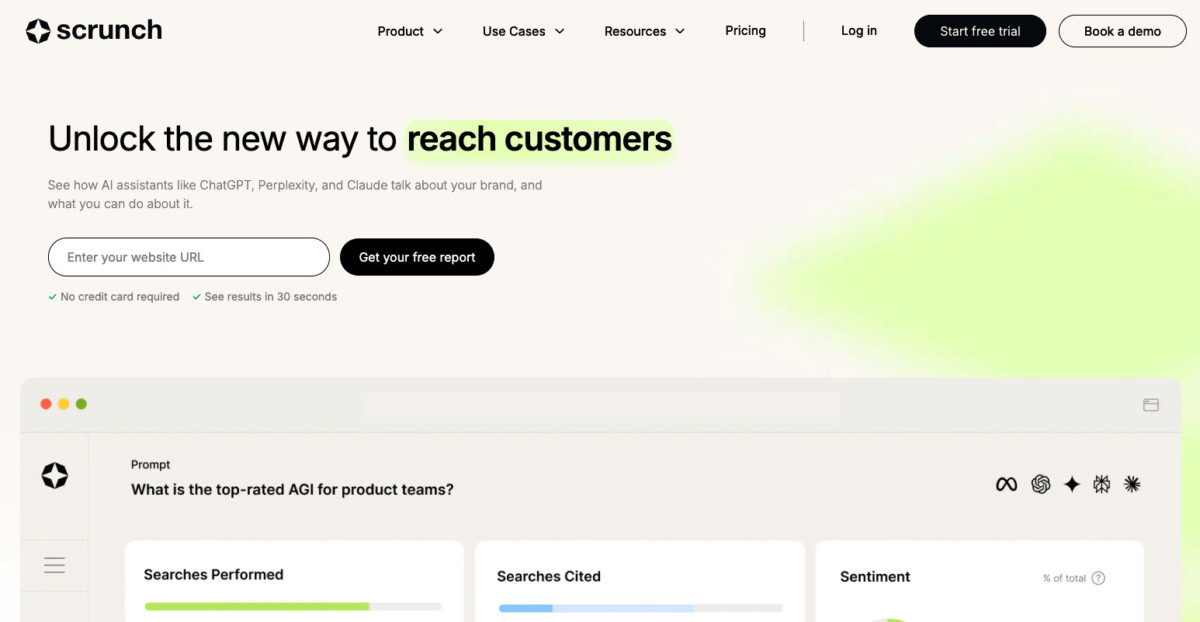
Scrunch is a full-stack AI visibility platform that serves enterprise brands like Lenovo, Dell, Akamai, and over 500 other companies. It’s purpose-built for AI search, not a bolt-on feature added to an existing SEO tool.
Standout features
End-to-end platform (Monitor → Audit → Optimize → Deliver). Most tools in this space handle one or two of these stages. Scrunch covers all four:
- Monitor: Tracks brand presence, position, sentiment, and citations across all major AI platforms. Filter by competitor, persona, topic, geography, funnel stage, AI platform, and more.
- Audit: Site Maps and Deep AI Audits diagnose access control problems, content delivery issues, and content quality gaps at the page level.
- Optimize: Generates AI-friendly content automatically or provides detailed recommendations, based on page intent, target persona, and tracked prompts.
- Deliver: The Agent Experience Platform (AXP) serves optimized content directly to AI user agents without disrupting the human web experience. Integrates with Akamai, Cloudflare, Vercel, and other major CDNs. No other tool in this list offers anything equivalent.
Granular data filtering by persona, funnel stage, topic, geography, and AI platform. Slice share of voice and competitive benchmarking data at the segment level, not just in aggregate.
Enterprise-grade infrastructure. SOC 2 Type II certified. SAML/OAuth SSO. RBAC. Multi-brand/domain/region/language support. Data API for integration with internal systems. Prebuilt Looker Studio template for out-of-the-box reporting.
Strengths
Broad LLM coverage. Eight AI platforms on the Enterprise plan: ChatGPT, Claude, Perplexity, Gemini, Meta AI, Google AI Mode, Google AI Overviews, Microsoft Copilot, and Grok (coming soon). The Core plan includes 4 LLMs.
Proven customer results with documented case studies. This is where Scrunch separates itself from tools that are still waiting on proof points:
- Runpod achieved 4x growth in new paying customers per month after adopting Scrunch.
- Tinybird reported 3x growth in share of voice for core, non-branded prompts and a 370% increase in web traffic from LLMs in 3 months.
- Strapi reported 31% brand presence growth across all AI platforms within 4 months.
- BairesDev saw a 78% AI search surge, going from invisible to top-cited in two months.
4.7 out of 5 rating on G2 with consistent themes around value, usability, and support. A few standout reviews:
“I use Scrunch AI to track my company’s ranking and share of voice across LLMs… giving us a real-time pulse on how our brand is performing against our competition on a granular level.” — Scott S. (G2 review)
“We evaluated almost all of the AI metrics tools out there, and found Scrunch to hit the sweet spot in both price and features.” — Marv A., enterprise segment (G2 review)
Fast implementation. Many customers, including large enterprises, are deployed and collecting data within one day. Scrunch auto-generates competitors, personas, and topics during setup, which cuts the typical onboarding timeline from weeks to hours. You can also connect Scrunch with GA4 and attribute revenue directly to AI search.
Limitations
AI-generated content creation is still maturing. Scrunch’s Optimizer can generate AI-friendly version of existing content and recommendations, but general-purpose content creation capabilities are still evolving. Teams with heavy content production workflows may need to supplement with separate tools.
No native SEO toolkit. Scrunch is focused exclusively on AI search and doesn’t include traditional SEO tools like keyword tracking or backlink analysis. Teams that need both will likely pair Scrunch with a separate SEO platform.
Export limitations noted by some users. A few G2 reviewers mentioned that not all features within the platform support exporting, which can limit direct client reporting in some workflows. Scrunch’s flexible API makes it easy to push data from Scrunch to other systems.
Pricing
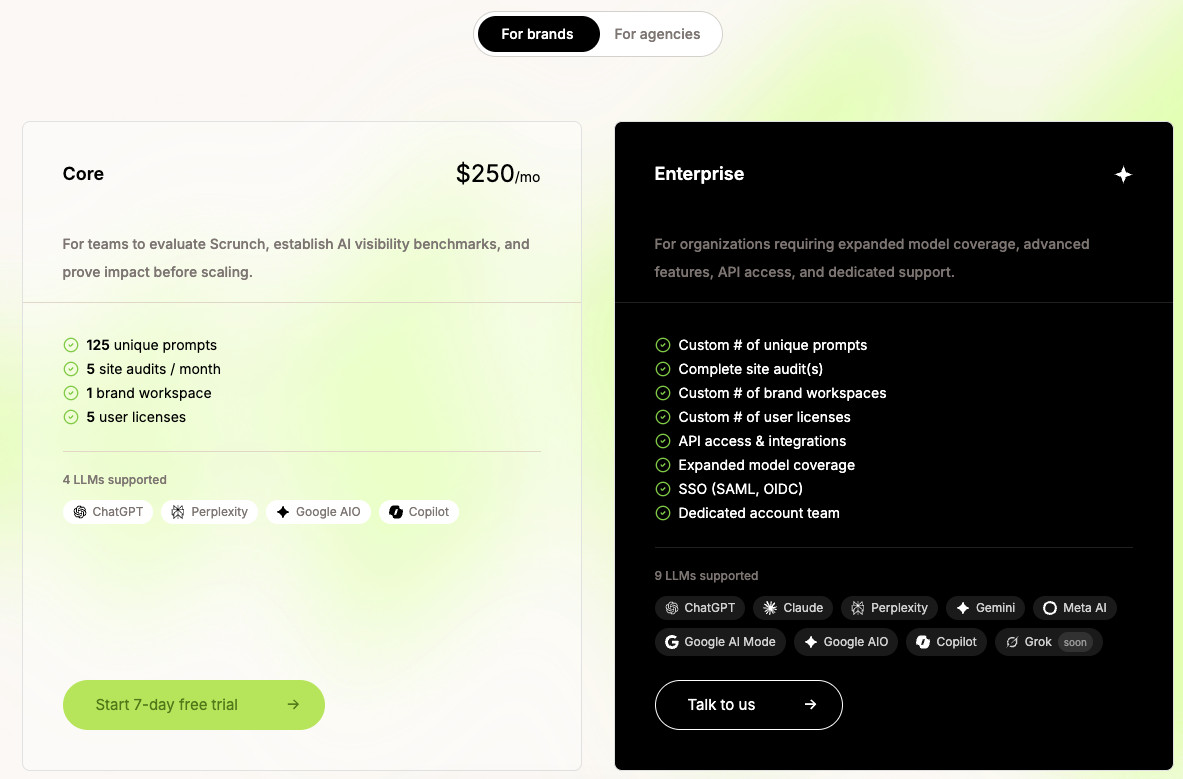
Scrunch offers two tiers for brands and two for agencies:
- Core (brands): $250/month — 125 unique prompts, 5 site audits/month, 1 brand workspace, 5 user licenses, and 4 LLMs (ChatGPT, Perplexity, Google AI Overviews, Microsoft Copilot).
- Enterprise (brands): Custom pricing — everything in Core plus custom prompt volume, full site audits, AXP, custom workspaces, custom user licenses, SSO, a dedicated account team, and 8 LLMs (Grok coming soon).
- Agency Core: $500/month.
- Agency Enterprise: Custom pricing.
- Free trial: 7-day free trial of the Core plan.
Best for
Scrunch is the strongest fit for enterprise and mid-market brands that need a full-stack AI visibility solution — monitoring, auditing, optimization, and content delivery — in one platform.
It’s also well-suited for:
- teams managing multiple brands, regions, or languages that require enterprise security (SOC 2 Type II, SSO, RBAC)
- agencies looking for a unified workspace to manage multiple client brands
- marketing leaders who need to monitor brand visibility across multiple AI platforms
Bluefish: Best for brand safety and narrative control
Bluefish is an AI marketing platform focused on visibility, risk management, and narrative control across AI channels. The company’s differentiator is brand safety: catching what AI gets wrong about your brand, not just tracking where your brand shows up.
Standout features
AI brand safety and hallucination detection. Bluefish continuously monitors for inaccurate or harmful brand mentions across AI platforms. It flags hallucinations, detects negative sentiment, and surfaces emerging risk signals, which is helpful for PR and brand teams.
Brand data management and verification. Bluefish helps brands manage how their data is used by AI systems, compiling inaccuracies and reporting them to AI providers. The platform’s AI Brand Vault provides metadata governance to ensure models interpret brand information correctly.
Strengths
Strongest brand safety and narrative control capabilities in this list. Hallucination detection, negative mention alerts, and data verification workflows set Bluefish apart. This is especially valuable in regulated industries and healthcare.
AI commerce and agentic commerce features. Bluefish offers product-level monitoring and AI-optimized product data management for e-commerce and DTC brands. It positions itself for the emerging agentic commerce environment where AI agents act on behalf of consumers.
Limitations
No transparent pricing. Bluefish operates on a quote-based model with no public pricing page. Without seeing pricing before engaging sales, it’s harder for mid-market teams to evaluate fit quickly.
No free trial or self-service onboarding. There’s no self-serve option, and you need to book a demo and go through a sales cycle to see the platform.
Limited public case studies and G2 reviews. Bluefish has fewer independent references and published customer results than more established competitors in this list. For buyers who rely on third-party proof points to build internal business cases, this can be a gap.
Pricing
Custom pricing only (quote-based). No public pricing page. No free trial.
Best for
Bluefish is the strongest fit for brands in regulated or reputation-sensitive industries that need active AI brand safety monitoring alongside visibility tracking. It also works well for marketing organizations that need unified workflows across search, content, brand, and PR teams.
AthenaHQ: Best for self-serve AI visibility at mid-market scale
AthenaHQ is an AEO platform that tracks 8+ major LLMs. AthenaHQ offers one of the more accessible multi-platform entry points on this list, a natural fit for mid-market brands, growing startups, and lean marketing teams that don’t want an enterprise offering.
Standout features
Action Center with prescriptive recommendations. AthenaHQ’s Action Center suggests specific content improvements mapped to AI model sources. For lean teams without a dedicated AI search analyst, this can be a helpful input on what to fix.
Shopify integration for e-commerce AEO. AthenaHQ integrates with Shopify to let e-commerce brands publish AEO-optimized content. Brands can also attribute revenue directly to AI search, a feature that makes it particularly appealing for DTC brands looking to connect AI visibility to actual sales.
Strengths
Accessible self-serve entry point with broad LLM coverage. $295/month with 67% off the first month. All 8+ AI platforms are unlocked on the entry-level plan. That’s a meaningful advantage over tools like Profound, where the $99/month Starter tier only tracks ChatGPT.
Industry-specific solutions across 10+ verticals. CPG, travel, financial services, healthcare, education, beauty, wellness, software, e-commerce, and multi-brand portfolios. AthenaHQ tailors its approach by industry rather than offering a one-size-fits-all dashboard.
Limitations
Self-serve plan lacks advanced features. Some of the better features, like the Athena Recommendation Engine, are locked to enterprise tiers. No persona targeting, advanced content optimization agent, multi-country support, Athena Citation Engine (ACE), or dedicated GEO specialist on the $295/month plan.
Credit-based pricing model can be opaque. Every query on every model costs credits (1 credit equals 1 AI response). With 3,600 credits on the Self-Serve plan, you can burn through your allocation quickly if you’re monitoring a broad set of prompts across all available platforms. That makes costs harder to predict compared.
Pricing
Self-Serve: $295/month — 3,600 credits, 8+ LLMs, first month 67% off.
Enterprise: Custom pricing — everything in Self-Serve plus LLM traffic analysis, Athena Citation Engine (ACE), dedicated GEO specialist, API access, SSO.
Agency partner program with tiered levels (Bronze, Silver, Gold) and volume-based discounts.
SOC 2 Type II certified, GDPR compliant, NIST CSF 2.0 Tier 3.
Best for
AthenaHQ works for lean marketing teams that want prescriptive recommendations rather than in-depth dashboards to interpret.
Ahrefs Brand Radar: Best for teams already in the Ahrefs ecosystem
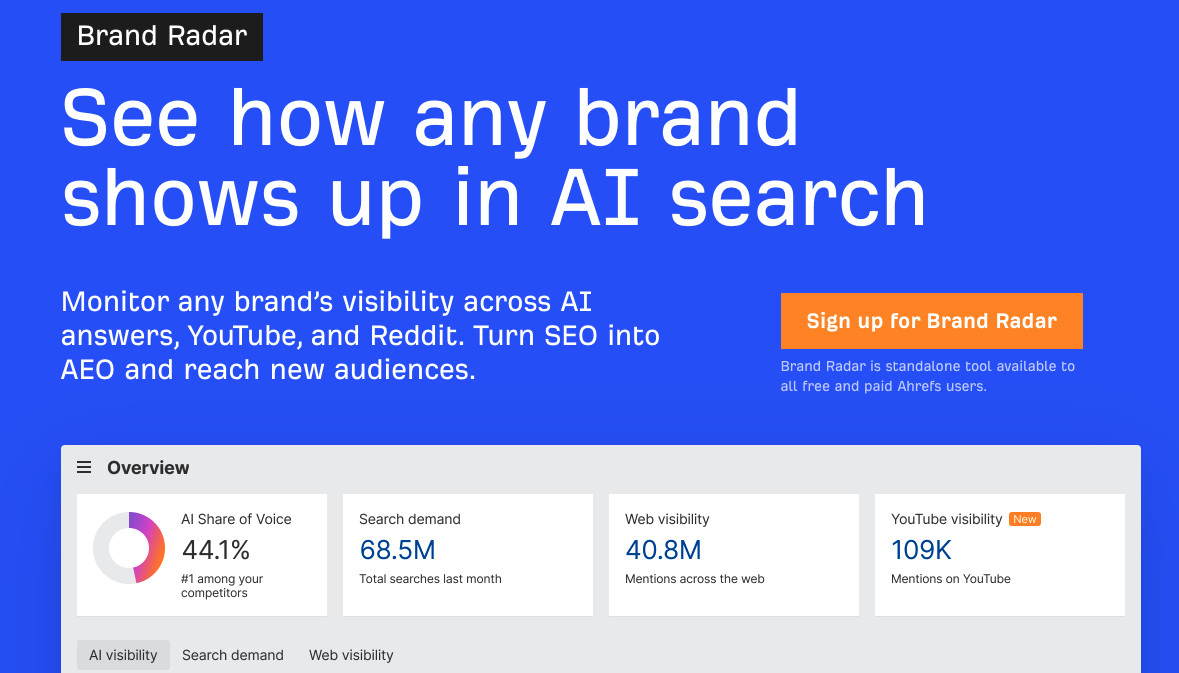
Ahrefs Brand Radar is an AI visibility monitoring tool built into the broader Ahrefs SEO platform. It tracks 6 AI platforms (AI Overviews, AI Mode, ChatGPT, Copilot, Gemini, and Perplexity), plus brand mentions across YouTube, TikTok, and Reddit. It’s a standalone tool available to all free and paid Ahrefs users, with AI indexes available as paid add-ons.
Standout features
Search-backed prompts at massive scale. Brand Radar uses 259M+ search-backed prompts. This is the largest AI visibility database of any tool on this list, and it means you get coverage across various prompts. However, similar to other SEO tools like Semrush, Ahrefs’ data is informed by its SEO tracking roots and keyword data, which means prompts may not be as deep or granular.
Integrated SEO ecosystem. Brand Radar integrates seamlessly with Ahrefs’ existing tools, like Site Explorer, Content Explorer, Keywords Explorer, and Web Analytics. You can view AI visibility data alongside traditional SEO metrics without switching platforms. For teams that already run their SEO workflow through Ahrefs, this eliminates the context-switching tax of a separate AI visibility tool.
Strengths
Lowest barrier to entry for existing Ahrefs users. Included in all plans starting at $129/month, with basic brand mention tracking available immediately. No implementation, no setup, no learning curve.
Free Web Analytics with AI traffic segmentation. Ahrefs’ Web Analytics automatically breaks out AI referral traffic as a distinct channel, letting you see how much traffic AI platforms are actually driving to your site.
Limitations
Monitoring-only. Brand Radar tracks where your brand appears and where it doesn’t. It doesn’t audit your site, optimize your content, or deliver content to AI agents. The tool doesn’t provide data on how AI bots are crawling your site. Teams that need to act on insights will need separate tools.
Add-on pricing can escalate quickly. AI platform indexes cost $199/month per index or $699/month for all six. But Brand Radar is an add-on that requires an active Ahrefs subscription. The total minimum cost for full AI coverage is $828/month ($129 base + $699 bundle). Custom prompt tracking is an additional $50/month on top of the Brand Radar add-on. Those costs add up fast.
Pricing
Individual AI platform indexes: $199/month per index.
All AI platforms bundle: $699/month.
Custom prompts: From $50/month (2,500 prompts).
Base Ahrefs subscription required: Lite from $129/month.
Total cost for full AI coverage: $828+/month (base + all indexes).
Best for
Ahrefs Brand Radar is the strongest fit for teams already using Ahrefs for SEO that want AI visibility monitoring without adopting a new tool, interface, or vendor relationship. It also works well for brands that want broad, search-demand-backed competitive gap analysis across a massive prompt database.
Profound: Best for dedicated AEO content programs
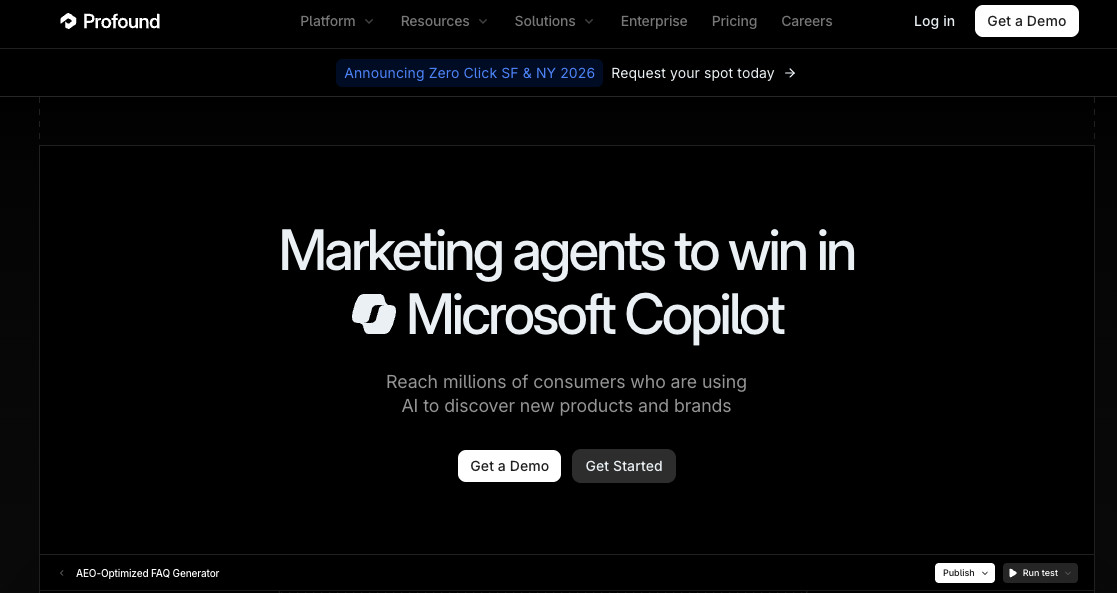
Profound is an AI visibility and content optimization platform that tracks your brand’s presence across 10+ AI platforms — ChatGPT, Perplexity, Claude, Gemini, Grok, Copilot, Meta AI, DeepSeek, Google AI Overviews, and ChatGPT Shopping. It boasts proprietary AI search volume data and built-in content generation workflows.
Standout features
Proprietary prompt volume analytics. Profound’s Prompt Volumes dataset claims to cover 400M+ real user conversations and provides prompt-level volume estimates. The broader industry debate about whether prompt-level volume estimates are reliable enough to base content strategy on is still playing out.
Agents content creation engine. Profound’s Agents feature goes beyond measurement. It generates content briefs, full article drafts, and prioritized opportunities. That said, building content workflows that deliver great content consistently still requires significant human oversight and editing.
ChatGPT Shopping analysis. Captures product images, placement, competitive comparisons, and AI-assigned attributes inside ChatGPT’s shopping experience. For e-commerce brands, this provides visibility into a rapidly emerging purchase channel that most monitoring tools don’t touch yet.
Strengths
AI search demand data for content prioritization. See what consumers are actually asking AI platforms at the topic and keyword level and how often. This is a useful factor for teams building content calendars around AI search intent.
Compliance coverage. SOC 2 Type II, SAML/OIDC SSO, and HIPAA compliant. For brands in regulated industries where HIPAA isn’t optional, this narrows the field considerably.
Limitations
Steep pricing jump — the effective entry point is $399/month. The $99/month Starter is enough to see what Profound does, but not enough to run a meaningful AEO program. It’s ChatGPT only, 50 prompts, 1 seat, one region, one language, no data exports, and no content generation. The features that justify the platform — Agents content generation, multi-platform tracking, the Opportunities panel — only unlock at $399/month. And even at $399/month Growth, you get 3 AI platforms and 100 prompts, meaning still no API access, no SSO, and single-region/language tracking.
No site auditing, technical diagnostics, or AI-optimized content delivery. Profound’s Technical Analysis feature identifies issues like slow load times or blocking scripts and generates a report, but your engineering team needs to act on it. There’s no equivalent to Scrunch’s Site Maps and Deep AI Audits for diagnosing access control problems at the page level. And there’s no AXP-equivalent for serving optimized content directly to AI bots at the CDN level. If the problem is technical, you’ll need a separate tool to find and fix it.
Content generation capped on lower tiers. Content generation is unavailable on the Starter plan and capped at 3 articles/month on Growth, so meaningful content production access requires Enterprise pricing.
Pricing
Starter: $99/month — ChatGPT only, 50 prompts, 1 seat, no content generation, no exports.
Growth: $399/month (billed yearly) — 3 AI platforms, 100 prompts, 3 articles/month, 3 seats. No API, no SSO, single region/language.
Enterprise: Custom pricing — up to 10+ AI platforms, SSO/SAML, SOC 2, HIPAA, Prompt Volumes, full content generation.
Best for
Profound is the strongest fit for teams whose top priority is proprietary AI search volume data for demand research. It also works well for organizations running AEO as a dedicated content program that needs built-in content generation workflows.
