
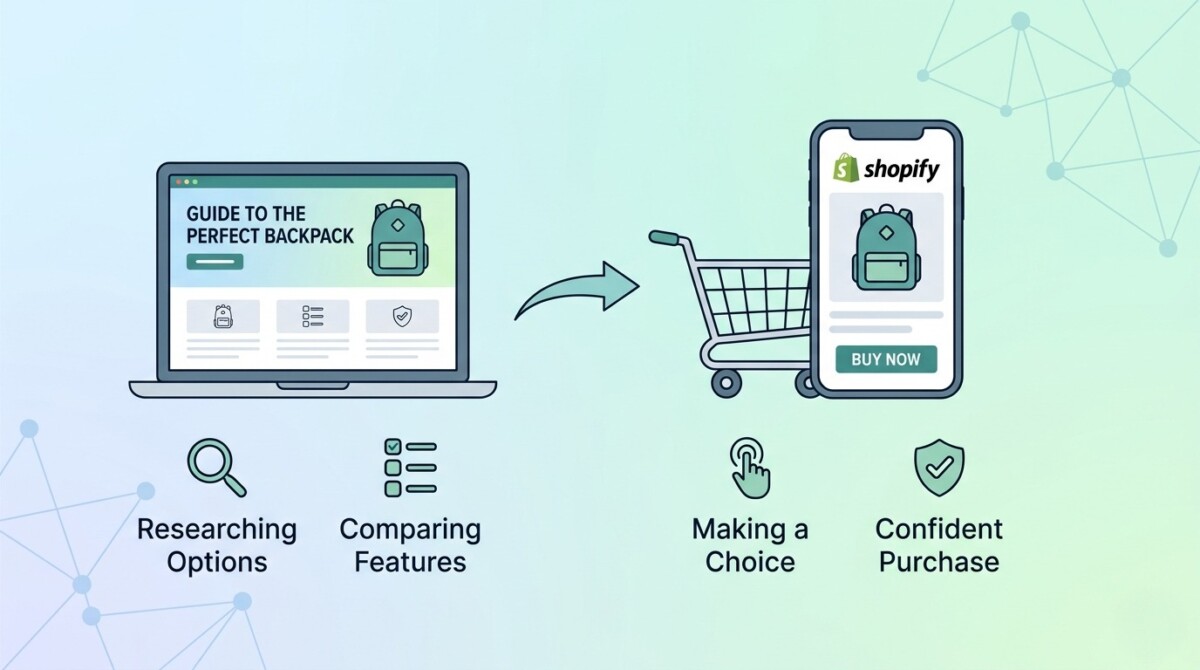
For Shopify merchants selling considered purchases, buying guides are no longer content marketing. They are conversion infrastructure, and the brands that figure this out in 2026 will own their categories in AI search by 2027.
The pattern is hard to miss once you start watching for it. Shopify merchants selling $500 to $5,000 products are quietly losing their “best X for Y” search traffic. Not all at once. Not dramatically enough to set off Google Analytics alarms. But steadily, month over month, the share of the funnel that used to come from organic comparison searches is migrating somewhere that does not show up in standard traffic reports.
That somewhere is ChatGPT, Claude, Perplexity, and Google’s own AI Overviews. The brands earning citations in those answers are not the brands with the biggest ad budgets or the highest domain authority. They are the brands that have figured out how to structure content the language models can actually extract from.
For a merchant selling sub $50 impulse products, this shift barely registers. For a merchant selling considered purchases, it is becoming the most important strategic question of 2026. Here is how the brands earning citations are building for it, and where most Shopify merchants are leaving the easiest wins on the table.
Shoppers researching expensive comparative purchases were already doing the heaviest research work, which is exactly why language models absorb their behavior most easily. The categories where AI search disruption is hitting first are not the cheap impulse categories. They are the categories where shoppers feel real financial risk and were already reading reviews, comparing specs, watching teardowns on YouTube, and asking Reddit before making a decision.
An LLM collapses all of that research into a single conversation. A shopper who used to spend two weeks comparing robotic pool cleaners across four browser tabs now asks Claude one question and gets a synthesized recommendation in 15 seconds. That workflow was always what the high consideration buyer wanted. Google just never delivered it.
What I keep hearing in operator conversations is a consistent pattern: brands selling $500 to $5,000 products reporting 15 to 30% declines in non branded organic comparison traffic over the past 12 months, even as their conversion rates and branded search remain steady. Illustrative range, not a verified study, but the direction is unmistakable. The traffic is not gone. It has moved upstream to a surface where the brand either gets cited or does not exist.
If you sell a $40 candle, this shift is largely theoretical for now. If you sell a $1,500 home appliance, it is happening in your traffic data right now. The question is no longer whether AI search reshapes your top of funnel. The question is whether your brand is one of the ones being cited when it does.
Language models cite comparative buying guides far more often than they cite single product PDPs, brand homepages, or feature pages. The pattern is consistent across categories: extractable, source attributed, multi option content earns citations. Single brand promotional content does not.
Three patterns show up repeatedly in what gets cited. First, buying guides that name competitive alternatives. A guide for “best robotic pool cleaners” that mentions Dolphin, Polaris, and three other brands functions as an objective comparison source. A guide titled “Why Our Pool Cleaner Is Best” functions as marketing and gets filtered out.
Second, content that answers buyer questions in extractable chunks. Each H2 opens with the answer. Each paragraph stands alone. Each comparison table is structured so the model can lift specific cells without losing context.
Third, brand published content that reads like it was written for buyers, not for the brand’s marketing team. The Beatbot above ground robotic pool cleaner buying guide is one example of a DTC brand investing in this kind of long form educational content alongside their product pages. It is structured as a buyer’s resource rather than a sales asset, which is what makes it eligible for AI citation in the first place. The same pattern shows up across other considered purchase categories: Saatva’s mattress buying guides, Solo Stove’s fire pit comparisons, Sun Home Saunas’ infrared versus traditional content. Each one was written to help a buyer make a decision, not to push a SKU.
What LLMs skip almost universally: brand promotional language, feature pages without comparative context, PDPs as primary sources for “best of” queries, listicles published on low authority sites, and any content that reads like it was written to rank for a keyword rather than to answer a question.
Five elements show up consistently in citation ready buying guides: question format H2s, atomic answers in the first sentence of each section, named competitive alternatives, comparison tables built for extractability, and FAQ schema on the page. Miss two or three of these and your content is functionally invisible to the citation layer, regardless of how good the prose is.
Question format H2s frame each section as a question a buyer would actually type into ChatGPT. “How do you choose a robotic pool cleaner?” beats “Robotic Pool Cleaner Buying Guide.” The header matches the user query, which is how the model finds the section in the first place.
Atomic answers put the conclusion in the first sentence of every section, before any explanation. Models extract the first sentence first. Make it the answer, not a setup.
Named alternatives signal objectivity. If your buying guide for premium grills does not mention Traeger, Weber, and Big Green Egg, it will not be cited as an authority. Naming your competitors is not a weakness. It is the cost of admission to being treated as a source.
Here is the simplest way to see the difference between old SEO content and AI citable content side by side.
Comparison tables matter more than most merchants realize. A clean comparison table with consistent dimensions across products lets the model pull specific values directly. Tables built with marketing language, inconsistent fields, or “varies” placeholders get skipped because the model cannot extract anything reliable from them.
FAQ schema closes the loop. The questions in your FAQ schema should mirror the actual queries shoppers type into AI chat interfaces. “Are robotic pool cleaners worth it?” “How long do they last?” “Do they work on above ground pools?” Schema marked questions get pulled directly into AI answers more often than question content buried in body copy, because the schema removes ambiguity about what is being asked and answered.
When a shopper gets a product recommendation from ChatGPT and clicks through to investigate the brand, they almost never land on a deep PDP; they land on a category page, collection page, or brand homepage that was built for browsing rather than for converting research driven shoppers, and that mismatch quietly kills conversion on the highest intent traffic the brand receives.
Think about what a shopper actually does after they ask Claude “what’s the best robotic pool cleaner for an above ground pool?” and receive a recommendation. They click through to look at the brand. Within five seconds they want to verify three things: this brand sells what was just recommended to them, this brand has options across price points and use cases, and this brand looks real and credible. Your collection page is the surface that answers all three of those questions before they decide whether to keep reading or close the tab.
Beatbot’s collection page for the best above ground pool cleaner category is one example of a DTC brand structuring this surface specifically for research driven shoppers. The page is built around the category problem (above ground pool cleaning) rather than just listing SKUs in a default Shopify grid. Filters help shoppers self segment by pool size and feature set. Each product card carries enough context to support a comparison decision without forcing a deep PDP dive.
The brands building AI citable content without auditing their collection pages are putting their best traffic onto their worst conversion surface.
This is the part most Shopify merchants miss. They invest months in producing buying guide content. The content starts earning AI citations. Traffic arrives. And then it lands on a collection page that looks like every other default Shopify collection page. The conversion rate on that high intent traffic ends up at half of what it should be, and the merchant blames the content instead of the destination. The content and the destination work as a system, or they do not work at all.
A sustainable AI visibility strategy uses three layers of content that work together: category buying guides at the top, use case guides in the middle, and head-to-head comparison pages at the bottom. Each layer earns citations for different query types and funnels traffic to different destinations.
The top layer is category buying guides. These are the broad “best X for Y” pieces that earn citations for general category queries. “Best robotic pool cleaners for above ground pools” is a category buying guide. One per major category you serve. These pieces are long, typically 2,500 to 4,000 words, structured for extractability, and mention competitive alternatives by name.
The middle layer is use case guides. These target the more specific queries researchers ask once they have narrowed the category. “How to choose a robotic pool cleaner for a 24 foot round above ground pool” is a use case guide. These pieces are shorter, typically 1,500 to 2,500 words, and focus on a specific buyer scenario. They earn citations for the long tail queries that LLMs increasingly handle, where Google’s traditional results were already thin.
The bottom layer is head-to-head comparison pages. These are direct “X versus Y” comparisons between specific products. They earn citations when a shopper is comparing two finalists. Shopify merchants often skip this layer because writing a comparison that includes competitors feels uncomfortable. The brands that do it earn citations for the highest intent queries in their category, because the model treats their content as the most useful source for the decision stage shopper.
The compounding happens because each layer reinforces the others. Citations to your category guide build authority that helps your use case guides. Use case citations build authority that helps your comparison pages. And the comparison pages convert at multiples of any other content type because the shopper is already at the decision point when they land. If you’re below $1M annual revenue, start with one category guide. If you’re above $5M, you should be planning all three layers in parallel.
Five mistakes show up repeatedly in Shopify merchants’ attempts to build AI visible content, and avoiding them costs nothing while significantly improving the odds of citation.
The first mistake is writing single brand buying guides. A “best X” guide that only features your own products will not be cited. Language models are explicitly trained to prefer comparative, objective sources, and a single brand guide reads as marketing copy even when it contains genuine analysis.
The second mistake is leading with promotional language. Sentences that start with “Our award winning…” or “Trusted by thousands of…” get filtered out before the model even evaluates the substance. Lead with the buyer’s question and answer it without ego in the first sentence.
The third mistake is thin content disguised as buying guides. A 600 word “buying guide” with three product cards and a tagline does not function as an authority source. The minimum viable length for a competitive category buying guide is 2,000 words with genuine analysis, named alternatives, and structured comparison data.
The fourth mistake is missing structured data. No FAQ schema, no comparison tables, no clear product entity markup. The page might be perfectly readable to a human and almost completely invisible to an AI parser. Schema is not optional anymore.
The fifth mistake is writing for keywords instead of for questions. Keyword optimized content was the SEO play for the last decade. Question optimized content is the play for the next one. The shift sounds subtle. The structural difference is enormous, and the brands that internalize it early will own their categories before the rest of the market catches up.
Start with one category buying guide for your highest revenue product category, build it correctly, measure for 60 to 90 days, then expand. The instinct to publish ten guides at once is what kills most attempts before they generate signal.
Step one: identify the single “best X for Y” query in your category that you most want to win. For most Shopify merchants in considered purchase categories, this is obvious within ten minutes of looking at the top five queries that drive revenue.
Step two: research the existing content ranking for that query. Read the top five results. Note what they cover, what they miss, and what they do not say clearly. Your guide must be meaningfully better, not just present. If the existing content is already strong and objective, that’s a signal to pick a different starting query where the bar is lower.
Step three: write the guide using the five structural elements covered earlier. Question format H2s, atomic answers, named alternatives, comparison tables, FAQ schema. Target 2,500 to 3,500 words. Do not pad. Every paragraph either advances the buyer’s decision or gets cut.
Step four: structure the collection page the guide funnels to. Filters, comparative product cards, enough context for a research driven shopper to make a decision without three PDP dives. The guide and the collection page work as a system, or the traffic the guide earns evaporates at the destination.
Step five: measure. AI citation tracking is still imperfect. Watch for traffic from referral sources you haven’t seen before, branded search lift in Google Search Console, and direct to collection page traffic without a clear referrer. Those are the early signals that citations are starting to land. If you’re at $250K to $1M annual revenue, one category guide produced well will outperform ten produced quickly. If you’re above $5M, you should have a content roadmap that produces one guide per quarter across your major categories. The brands that build this infrastructure in 2026 will own their category in AI search by 2027. The brands that wait will be writing buying guides to catch up while their competitors are already being cited as the source.
Publish content that language models are trained to prefer: comparative buying guides that name competitive alternatives, structured with question format H2s, atomic answers in the first sentence of each section, FAQ schema, and clean comparison tables. Single brand promotional content almost never earns citations. The fastest path for most Shopify merchants is one well built category buying guide that genuinely helps a buyer make a decision, including honest comparison to alternatives. Citations typically begin appearing 60 to 90 days after publication, longer if the content sits on a newer domain without existing topical authority. The compounding effect kicks in once a brand has three or four pieces earning citations in the same category.
SEO content was optimized for keyword density, internal linking, and search engine ranking signals; AI citable content is optimized for extractability and source authority. The structural differences are significant: question format headers that mirror real user queries, answer first paragraphs that put the conclusion in the first sentence, named competitive alternatives that signal objectivity, and structured data like FAQ schema that makes question answer pairs machine readable. Content can be optimized for both, but the structural choices that win AI citations are different from the choices that won Google rankings five years ago. The good news is that AI citable content tends to perform well in traditional search too, because both systems now reward genuine comparative quality over keyword stuffing.
Yes, and skipping this step is the single most common reason Shopify merchants’ buying guides fail to earn AI citations. Language models are explicitly trained to prefer comparative, objective sources over single brand promotional content. A buying guide for premium grills that names Traeger, Weber, and Big Green Egg will be cited as an authority. A guide that only features your own products will not. The trade off feels uncomfortable, but the math is clear: a guide that earns citations drives multiples more qualified traffic than a guide that doesn’t, even after some of that traffic explores competitors. Frame your own products as the recommendation, but make the comparison real.
A competitive category buying guide should run 2,500 to 4,000 words. Use case guides can be 1,500 to 2,500 words. Head-to-head comparison pages can be shorter, typically 1,000 to 1,800 words, because they have a tighter scope. The reason length matters is not for SEO purposes but for extractability: language models cite from longer pieces because longer pieces typically contain more answerable questions, more comparison data, and more context for the model to ground its response in. Length without substance does not help. Length with genuine analysis, named alternatives, and structured comparison tables does. The goal is depth, not word count.
Direct AI citation tracking remains imperfect in 2026, so most Shopify merchants rely on indirect signals: branded search lift in Google Search Console (shoppers who see your brand in an AI answer often search for it on Google to verify), direct to collection page traffic without a clear referrer (which often indicates AI sourced visits), and customer service team reports of buyers mentioning ChatGPT or Claude during the sales process. Tools like Profound, Otterly, and similar platforms are improving at tracking citation visibility across ChatGPT, Claude, Perplexity, and Google AI Overviews. The most reliable early signal is anecdotal: ask your customer service team whether new buyers mention that they “asked ChatGPT” or “looked it up in Claude” during the sales process. That signal typically shows up 30 to 60 days before tracking tools catch up.





