





Quick Decision Framework
- Who This Is For: Shopify merchants at any revenue stage who are losing money to chargebacks, spending hours on dispute management, or approaching the 1% chargeback ratio threshold that triggers payment processor penalties.
- Skip If: You process fewer than 20 orders per month, have never received a chargeback, or are a pre-revenue brand that has not yet validated product-market fit. The math will not work in your favor yet.
- Key Benefit: The only Shopify-native platform covering the full chargeback lifecycle: prevention before the dispute, real-time deflection alerts, and AI-powered automation to fight and win after it lands, all under one roof with success-based pricing.
- What You’ll Need: A Shopify store with at least one active payment processor (Shopify Payments, Stripe, PayPal, or similar). No technical setup required. Chargeflow installs in under 60 seconds with no developer involvement.
- Time to Complete: 10 minutes to read this review; 60 seconds to connect to Shopify; 1 to 3 business days to full implementation.
If you are evaluating Chargeflow, you are almost certainly also looking at Disputifier and Chargebacks911. These three dominate the chargeback management conversation for Shopify merchants, and they each solve the core problem differently. Chargeflow takes the approach of full lifecycle automation, preventing disputes before they file, deflecting them in real time via Visa and Mastercard networks, and fighting them with AI-generated evidence when they land. Disputifier is built around semi automated recovery with template-based evidence and optional pre-submission review, positioning itself as the option for merchants who want more control. Chargebacks911 focuses on enterprise-scale managed services with white glove implementation, better suited to large-volume operations than to self-serve Shopify merchants. By the end of this review, you will know exactly which one fits where you are today.
Is Chargeflow Actually Worth It for Your Shopify Store?
Here is the answer: If you are processing more than 20 to 30 orders a month on Shopify and you have received even a handful of chargebacks, Chargeflow will almost certainly pay for itself. You pay 25% only when they win. If they do not win, you pay nothing. That is a fundamentally different risk equation than almost any other tool in your stack, and it is the first thing you need to internalize before evaluating the rest.
I have spent 6 years inside Shopify as a Merchant Success Manager, and another decade before that as a startup founder and agency operator. In that time, I have watched chargebacks quietly drain brands that had no idea how much they were actually losing. Not just the disputed transaction itself, but the $15 to $100 dispute fee on top of it, the hours the team spends pulling together evidence, and the very real risk of hitting the 1% threshold that puts your entire merchant account at risk. Chargeflow is one of the few tools I have come across where the ROI case writes itself.
This review is based on direct analysis of Chargeflow’s current feature set as of March 2026, evaluation of their Shopify App Store listing (4.6 out of 5.0, 373 verified reviews), public case study data from brands including Fanatics, HexClad, and Obvi, third-party comparisons between Chargeflow and its primary competitors, and assessment of the 1-star reviews to understand where the platform has real limitations.
Who Is Chargeflow Actually For?
Emerging Stage ($0 to $50K Monthly)
The Promise: Free access to Chargeflow Insights gives you a real-time dashboard of your dispute landscape across all payment processors. If you start receiving chargebacks, Automation activates with zero upfront cost. You only pay when they win.
The Reality: At this stage, chargeback volume is typically low enough that the 25% commission on recovered disputes may feel steep relative to the dollar amounts involved. The ROI conversation is less compelling than it becomes at scale.
The Trigger: The moment you receive your first chargeback. The free tier costs nothing, and having the infrastructure in place before chargebacks become a pattern is smarter than scrambling after you have already lost a few disputes.
Skip If: You are pre-revenue or processing fewer than 10 orders a month. You are not in the target window yet.
Growth Stage ($50K to $500K Monthly)
The Promise: This is where Chargeflow delivers its clearest ROI. At this revenue level, chargebacks are a real operational problem. You are likely handling 5 to 50 disputes per month, your team is spending meaningful time on evidence, and your chargeback ratio is something you need to actively manage to protect your merchant account.
The Reality: Chargeflow’s AI handles the entire evidence process without your involvement. The one honest limitation: the system is a black box. You cannot review what evidence is being submitted before it goes out. For most merchants with average order values under $500, this is a non-issue. For merchants selling higher ticket items, it is worth knowing.
The Trigger: When chargebacks hit 0.5% of your transaction volume, or when your team is spending more than 2 hours per week on dispute management. Either threshold means you are already losing more than Chargeflow costs.
Skip If: Your average order value is consistently above $1,000 and you want evidence review control before submission. Disputifier’s capped fee model and optional review step may be a better fit at that specific AOV range.
Established Stage ($500K to $2M+ Monthly)
The Promise: Full lifecycle chargeback protection at scale. Chargeflow handles multi-store and multi-processor environments, supports enterprise compliance requirements (SOC 2 Type II, GDPR), and provides dedicated customer success management with quarterly win rate optimization reviews.
The Reality: At this stage, the Alerts product becomes as important as Automation. Preventing chargebacks from filing in the first place protects your chargeback ratio, which protects your merchant account from Visa’s VAMP program and Mastercard’s ECM. These consequences can be catastrophic for an established brand.
The Trigger: The moment your chargeback ratio approaches 0.65% (medium risk threshold). At established revenue levels, the cost of inaction is far higher than any platform fee.
Skip If: You are a large enterprise requiring custom implementation, dedicated SLA guarantees, and white glove onboarding. Chargeflow’s Enterprise tier addresses this, but it is worth a sales conversation to confirm fit before committing.
Stage Recommendation at a Glance
What Chargeflow Actually Does Well
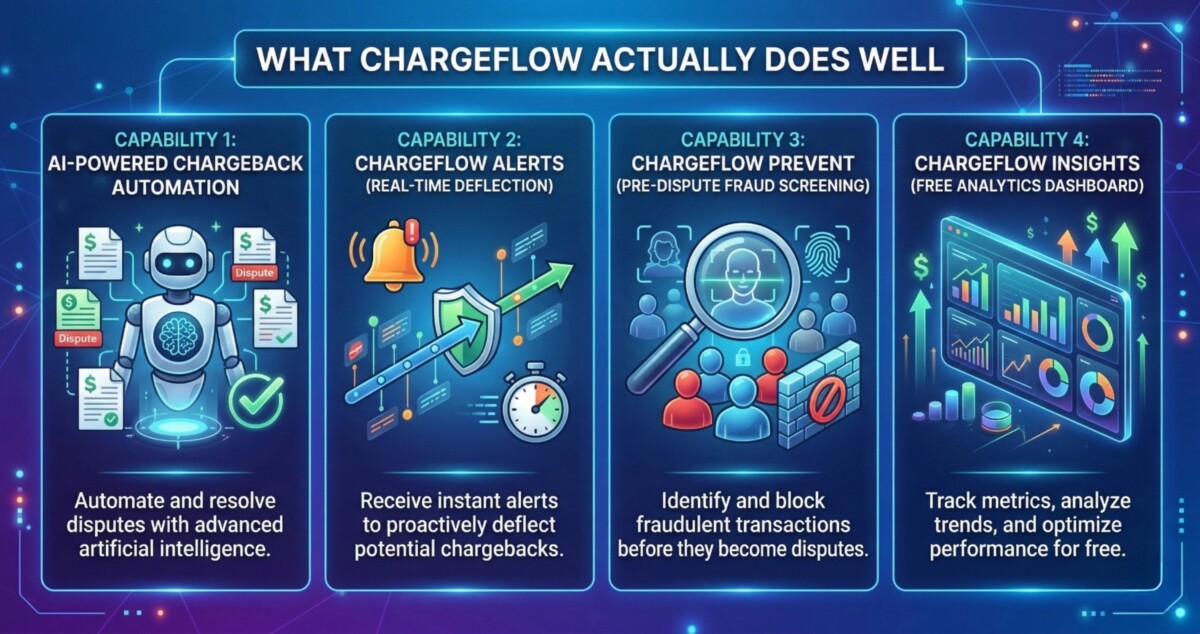
Capability 1: AI-Powered Chargeback Automation
When a chargeback lands on your Shopify store, Chargeflow automatically detects it, collects evidence from over 1,000 data points across your store, payment processor, helpdesk (Gorgias, Zendesk, Gmail), shipping carrier (1,200 or more couriers), and subscription platform (Recharge, Chargebee), builds a dispute package tailored to the specific reason code and card network rules, and submits it, all without any action from you. The AI is not working from a template. It is building a custom evidence file for each dispute based on your specific business, products, and customer communication history. Chargeflow also supports Visa’s Compelling Evidence 3.0 standards, a meaningful advantage given how card network rules continue to evolve.
The Stat That Matters
Brands report an average 300% increase in chargeback win rate after switching to Chargeflow Automation, with case studies showing win rates reaching up to 80% across dispute types. HexClad reported a 59% improvement in recovery rate and 199 hours saved. Obvi reported a 170% increase in win rate, recovering $10,427 in previously lost revenue. (Source: Chargeflow Case Studies, verified March 2026)
Emerging ($0 to $50K): Even at low dispute volumes, every chargeback you would have lost manually is now a potential recovery. Chargeflow wins disputes you would have abandoned because you did not have time to build the evidence package properly.
Growth ($50K to $500K): At 20 to 50 disputes per month, your team is spending 10 to 25 hours per month on manual dispute management. Chargeflow eliminates that entirely. The 25% commission on recovered revenue is the cost of buying back that time, and the recovered revenue itself is the upside.
Established ($500K to $2M+): At scale, Chargeflow’s continuous learning model becomes a real advantage. The AI adapts to your business policies, product categories, and issuer patterns over time, meaningfully optimizing win rates in ways that a static template system cannot.
vs. Disputifier and Chargebacks911: Disputifier uses evidence templates with optional pre-submission review, useful if you want oversight but slower and less adaptive than Chargeflow’s AI approach. Chargebacks911 is a managed service for enterprise volumes; it is not a self-serve Shopify app and pricing is not publicly available.
Capability 2: Chargeflow Alerts (Real-Time Deflection)
Alerts is the product that prevents chargebacks from ever becoming chargebacks. It works through direct partnerships with Verifi (Visa’s network) and Ethoca (Mastercard’s network) to intercept dispute signals in real time, before the formal chargeback is filed. When a cardholder contacts their bank to dispute a transaction, Chargeflow receives an alert and automatically processes a refund or resolution, stopping the chargeback from hitting your account. The result is that the transaction never counts against your chargeback ratio. Chargeflow charges only for alerts that actually prevent a chargeback, not per alert received. The zero duplication guarantee ensures you are never charged twice for the same transaction.
The Stat That Matters
Merchants using Chargeflow Alerts report dispute rate reductions of up to 87.2%, with onboarding taking less than 24 hours. Preventing a single chargeback also saves the standard $15 to $100 dispute fee that processors charge regardless of outcome. At a growth stage brand processing 500 orders per month with a 1% dispute rate, that is 5 chargebacks per month, each carrying a dispute fee on top of the lost transaction value. (Source: Chargeflow Shopify Integration Page, verified March 2026)
Emerging ($0 to $50K): Alerts is most valuable when your chargeback ratio is already elevated or trending upward. At very low volumes, the $29 per deflected chargeback fee is worth comparing against your average order value. If your AOV is $35, the math gets tight.
Growth ($50K to $500K): This is the sweet spot for Alerts. Protecting your chargeback ratio protects your relationship with Shopify Payments and your other processors. A growth stage brand that crosses the 1% threshold faces potential account termination, a consequence that dwarfs any platform cost.
Established ($500K to $2M+): Alerts becomes a risk management tool, not just a cost recovery tool. Staying out of Visa VAMP and Mastercard ECM monitoring programs is a strategic priority at this scale. The cost of a monitoring program, including additional fees and potential account suspension, is significant enough that Alerts effectively pays for itself as insurance.
vs. Disputifier and Chargebacks911: Disputifier also uses Verifi and Ethoca for alerts but does not publicly disclose per-alert pricing, making cost comparison difficult. Chargebacks911 offers alert services as part of its managed service model, requiring custom pricing conversations. Chargeflow’s transparent $29 per deflected chargeback with the pay only on success guarantee is a meaningful differentiator for merchants who want predictable cost modeling.
Capability 3: Chargeflow Prevent (Pre-Dispute Fraud Screening)
Prevent stops the problem at its source, before the order even ships. After checkout but before fulfillment, every transaction is scanned against Chargeflow’s network of 15,000 or more merchants to identify known digital shoplifters, repeat disputers, and high risk behavioral patterns. If a transaction is flagged, you can auto-cancel, hold for review, or apply custom rules based on your risk tolerance. The product is specifically designed to combat friendly fraud, where customers receive their order and then dispute the charge anyway, which is increasingly the dominant form of chargeback for DTC brands.
The Stat That Matters
Friendly fraud now accounts for an estimated 60 to 80% of all chargebacks for eCommerce merchants, with the problem accelerating as consumers become more aware that disputes are often resolved in their favor regardless of legitimacy. Chargeflow Prevent leverages post-purchase signals and a shared merchant intelligence network to identify repeat offenders before they cost you. The first 1,000 scans are free; after that, the cost is $0.20 per scanned transaction. (Source: Chargeflow Pricing Page, verified March 2026)
Emerging ($0 to $50K): The first 1,000 free scans make Prevent genuinely risk-free to test. At this stage, the primary value is building your understanding of which customer segments are generating dispute risk, intelligence that becomes more valuable as you scale.
Growth ($50K to $500K): At 500 to 5,000 orders per month, the $0.20 per scan cost ranges from $100 to $1,000 per month. If your average chargeback costs you $150 in lost revenue plus a $25 dispute fee, preventing 10 chargebacks per month generates $1,750 in recovered value against a $1,000 scan cost, a clear positive ROI at moderate dispute rates.
Established ($500K to $2M+): At scale, Prevent becomes a data asset. The network effect of 15,000 or more merchants means the intelligence improves continuously. An established brand contributing its own dispute data to the network gets better signal back in return.
vs. Disputifier and Chargebacks911: Disputifier offers basic fraud prevention at $0.05 per order but relies on third-party data rather than a proprietary merchant network. Chargebacks911 does not offer a comparable pre-fulfillment screening product for Shopify merchants. Chargeflow Prevent is the most developed solution in this specific category among the three.
Capability 4: Chargeflow Insights (Free Analytics Dashboard)
Insights is free forever, and it is genuinely useful even for merchants who do not use the paid products. It provides a unified view of chargebacks across all payment processors, including Shopify Payments, Stripe, and PayPal, in a single dashboard. You can track win rate trends over time, identify repeat disputers, analyze chargebacks by reason code and card network, and receive weekly email summaries with AI-generated recommendations. When your chargeback ratio approaches the 1% threshold, Insights surfaces a warning and recommends activating Alerts. This kind of proactive monitoring is something most merchants are not doing manually, and the absence of it is how brands end up in monitoring programs without seeing it coming.
The Stat That Matters
Fanatics recovered $800K or more in revenue within their first year using Chargeflow, while saving 25 or more hours of manual work per week and doubling their chargeback win rate. The Insights dashboard was central to identifying which dispute types and customer segments were driving their losses. Setup takes 60 seconds with no developer involvement. (Source: Chargeflow Fanatics Case Study, verified March 2026)
Emerging ($0 to $50K): Install Insights the moment your store is live. It is free, it takes 60 seconds to set up, and having baseline dispute data from day one is far more valuable than trying to reconstruct your chargeback history retroactively when problems emerge.
Growth ($50K to $500K): At this stage, Insights becomes your early warning system. The chargeback ratio gauge and proactive alerts mean you are never surprised by a threshold violation. Identifying repeat disputers by customer segment also informs decisions about which acquisition channels are generating your highest risk buyers.
Established ($500K to $2M+): Multi-processor, multi-store visibility in a single dashboard is a genuine operational advantage. Finance teams and operations teams get the reporting they need without manual data consolidation.
vs. Disputifier and Chargebacks911: Disputifier does not offer a comparable free analytics tier. Chargebacks911 provides analytics as part of its managed service. Chargeflow Insights is the only free, self-serve analytics product in this competitive set, making it a compelling entry point even for merchants not yet ready to commit to the paid products.
Shopify Integration: What Actually Syncs
What Syncs Natively: Order data and transaction history; customer profiles and purchase patterns; Shopify Payments dispute status and reason codes; shipping and fulfillment data from 1,200 or more carriers; customer communications from Gorgias, Zendesk, Gmail, and Help Scout; subscription data from Recharge, Bold, Chargebee, and Recurly; payment processor data from Stripe, PayPal, Klarna, Afterpay, and Braintree.
What Requires Configuration: Custom alert thresholds for Chargeflow Alerts (transaction amount, card BIN, reason code filters); automation rules for Chargeflow Prevent (auto-cancel vs. hold for review vs. custom workflow); multi-store setup if managing more than one Shopify account.
What Does Not Sync Automatically: Evidence review before submission (by design; this is a feature for some and a limitation for others); custom internal notes or CRM data outside of supported helpdesk integrations; real-time inventory data relevant for item not received disputes on back-ordered products.
Integration Depth in Context
Chargeflow’s integration goes beyond order data. It pulls customer communications, shipping tracking, and subscription history to build dispute evidence that reflects the full transaction lifecycle. Wordtune reported a 4.3x increase in win rate and 100% on-time submission rate after integration, with zero hours spent managing chargebacks post-implementation. (Source: Chargeflow Wordtune Case Study, verified March 2026)
Emerging: The native Shopify integration means there is no technical barrier to entry. A solo founder can install, connect their processor, and have full dispute visibility within an hour.
Growth: As you add payment processors and sales channels, the unified dashboard becomes more valuable. Chargeflow’s multi-processor support means you are not managing separate dispute workflows for Shopify Payments, Stripe, and PayPal.
Established: Multi-store support, private Slack channel access, dedicated customer success management, and quarterly win rate optimization reviews reflect the depth of support available at enterprise volumes. SOC 2 Type II and GDPR compliance is a requirement for many established brands with data governance obligations.
Pricing vs. ROI: The Honest Calculation
You are already spending time and money managing chargebacks manually. Adding Chargeflow at zero upfront cost delivers automated dispute recovery that your current approach cannot provide, generating an estimated 4x return on platform fees through recovered revenue and eliminated dispute management hours. Payback period: immediate at growth stage revenue levels, since you pay only when Chargeflow wins.
The ROI Math at the Growth Stage
- Scenario: $200K monthly revenue, 0.8% dispute rate = 16 chargebacks per month at $125 average order value
- Without Chargeflow: 20% win rate (industry average) = 3 wins, 13 losses = $1,625 lost revenue plus $400 in dispute fees per month (Source: Chargeflow published benchmarks, verified March 2026)
- On $200K monthly revenue with a 0.8% dispute rate: current dispute losses total $2,025 per month
- A 300% win rate improvement from Chargeflow Automation = win rate rises to 60 to 80% = 10 to 13 wins per month
- Platform cost at 25% of recovered revenue: $350 per month on $1,400 recovered
- Net ROI: 4x on platform cost, consistent with Chargeflow’s stated guarantee
- The constraint is never the platform cost. It is whether your dispute volume is high enough to make the math material.
Emerging Stage ROI: Low chargeback volume means the absolute dollar recovery is modest. The real value at this stage is building dispute infrastructure before you need it and using the free Insights tier to understand your dispute landscape. If you receive even 2 to 3 chargebacks per month, Automation pays for itself.
Growth Stage ROI: A brand doing $150K monthly with a 0.8% dispute rate is losing $1,200 or more per month to chargebacks before dispute fees. Chargeflow’s 25% fee on recovered revenue is a straightforward trade: pay $300 to recover $1,200. The Alerts product adds ratio protection that prevents the far more expensive outcome of processor account termination.
Established Stage ROI: At $500K or more monthly, the risk calculus shifts. The cost of being placed in a card network monitoring program, including additional fees, potential account termination, and forced processor migration, can reach tens of thousands of dollars. Chargeflow’s Alerts and Prevent products are, at this scale, risk management infrastructure rather than just revenue recovery tools.
User Experience and Team Adoption
Who Manages This Day to Day:
- Emerging: Founder or operator; 15 to 30 minutes per week reviewing the Insights dashboard and win/loss notifications.
- Growth: Operations or finance lead; 30 to 60 minutes per week reviewing analytics and any flagged Prevent cases requiring manual review.
- Established: Dedicated finance or operations team member; ongoing relationship with Chargeflow’s customer success manager for optimization.
The Honest Reality from Long Term Users
The majority of positive Shopify App Store reviews highlight two things: the automation genuinely works without manual intervention, and the customer support is unusually responsive. Taylor Holiday of Common Thread Collective described Chargeflow as “a game changer for DTC brands, taking chargebacks off our hands with a 90-second setup.” Critical reviews cluster around auto-refund behavior in Alerts and evidence submission timing. (Source: Shopify App Store, verified March 2026)
Pros and Cons: The Honest Assessment
Strategic Advantages
Advantage 1: Full Lifecycle Coverage in One Platform
(Source: Feature Analysis, March 2026)
No other Shopify-native tool covers prevention (Prevent), real-time deflection (Alerts), automated recovery (Automation), and analytics (Insights) under a single dashboard. The alternative is stitching together three or four separate tools, each with its own integration, pricing, and support relationship. Chargeflow’s consolidated approach eliminates that complexity entirely.
Advantage 2: Success-Based Pricing with a 4x ROI Guarantee
(Source: Chargeflow Pricing Page, March 2026)
The 25% fee on Automation applies only to recovered chargebacks. If Chargeflow does not win, you do not pay. Combined with the 4x ROI guarantee, which means Chargeflow commits to generating at least 4x their fee in recovered revenue or they will make it right, this creates a risk profile unlike most SaaS tools.
Advantage 3: Network Effect from 15,000 or More Merchants
(Source: Chargeflow Website, March 2026)
The intelligence powering Chargeflow’s AI improves with every merchant on the network. Known digital shoplifters flagged by one merchant are identified for all 15,000 or more merchants. Evidence patterns that win disputes for brands in your category inform the evidence strategy for your disputes, creating a compounding advantage over time.
Advantage 4: Compelling Evidence 3.0 Compliance
(Source: Feature Analysis, March 2026)
Visa’s CE 3.0 standards represent the most significant shift in chargeback evidence requirements in decades, specifically targeting friendly fraud by requiring merchants to demonstrate prior undisputed transactions from the same cardholder. Chargeflow’s AI has been updated to meet CE 3.0 requirements, which directly improves win rates on the fraud reason codes that are most commonly abused.
Honest Limitations
Three Things Most Chargeflow Reviews Won’t Tell You
- The Black Box Problem on High AOV Disputes. Chargeflow’s Automation is fully automated; you cannot review evidence before it is submitted. For merchants selling items at $1,000 or more per transaction, a 25% fee on a recovered $2,000 dispute is $500, and you had no input on the evidence strategy. Disputifier’s capped fee model ($250 maximum per dispute) may be more cost-effective at high AOV. (Source: Third-party comparison testing, November 2025)
- The Alerts Auto-Refund Risk. Chargeflow Alerts automatically processes refunds when it receives a dispute signal, before the formal chargeback is filed. A small number of App Store reviews report cases where legitimate orders were refunded automatically for customers who were satisfied with their purchase. If you have a high touch customer base where you want to resolve disputes through conversation rather than automatic refunds, this behavior requires careful configuration. (Source: Shopify App Store Reviews, verified March 2026)
- The Fee Scales Uncapped with Transaction Value. Disputifier caps its fee at $250 per recovered dispute. Chargeflow’s 25% is uncapped. On a $5,000 chargeback, Chargeflow’s fee is $1,250 versus Disputifier’s $250. If your store processes high value transactions regularly, this fee structure deserves serious scrutiny before you commit. (Source: Third-party comparison analysis, November 2025)
Chargeflow vs. Disputifier vs. Chargebacks911: The Deciding Factor
Reading the comparison: The “Tie” on automation level reflects different philosophies rather than equal capability. Chargeflow is fully automated with no review step, while Disputifier offers optional review before submission. Which approach is better depends entirely on whether you prioritize speed or oversight. The fee structure winner depends on your average order value: Chargeflow’s uncapped 25% is more cost-effective below $500 AOV, while Disputifier’s $250 cap wins at $1,000 or more AOV. Chargebacks911 is excluded from the Shopify integration row because it is an enterprise managed service, not a Shopify app.
Real Results: How Shopify Brands Are Using Chargeflow
Case Study 1: Obvi, Growth Stage DTC Supplement Brand
The Problem: Obvi was managing chargebacks manually with a win rate of approximately 20%, the industry average for manual dispute management, and losing meaningful revenue every month to disputes their team did not have time to fight properly.
What Changed: Implemented Chargeflow Automation to handle all incoming disputes automatically, leveraging Chargeflow’s AI evidence engine and network data calibrated to the supplement category.
The Outcome: Win rate increased to 54%, a 170% improvement. $10,427 recovered in previously lost revenue. Zero hours per week spent on chargeback management post-implementation.
Verification: Results verified through Chargeflow-published case study with brand confirmation from Ron Shah, CEO of Obvi. Last verified March 2026.
Case Study 2: Fanatics, Established Sports Merchandise Brand
The Problem: Fanatics was processing a high volume of chargebacks manually, with significant team time dedicated to dispute management across multiple payment processors and no unified view of their dispute landscape.
What Changed: Implemented Chargeflow Automation across their full dispute volume, with multi-processor support covering all payment channels and the Insights dashboard providing unified reporting.
The Outcome: $800K or more in revenue recovered within the first year. 25 or more hours of manual work per week eliminated. Chargeback win rate doubled.
Verification: Results verified through Chargeflow-published case study. Last verified March 2026.
Case Study 3: HexClad, Established Premium Cookware Brand
The Problem: HexClad was losing significant revenue to chargebacks and spending substantial team hours on dispute management that could have been directed toward growth activities.
What Changed: Implemented Chargeflow Automation with deep Shopify integration to handle all incoming disputes across their product catalog and customer base.
The Outcome: 59% improvement in recovery rate. 199 hours saved post-implementation.
Verification: Results verified through Chargeflow-published case study. Last verified March 2026.
My Verdict by Stage
Emerging Stage ($0 to $50K Monthly): Conditional Yes
Install Chargeflow Insights today. It is free, it takes 60 seconds, and having dispute visibility from day one is better than building it retroactively. For Automation, activate it the moment you receive your first chargeback. The zero upfront cost model means there is no financial risk to doing so. If you are not yet receiving chargebacks, the free Insights tier gives you the infrastructure to act fast when you do.
The trigger: Your first chargeback.
The risk of waiting: Every dispute you lose while managing manually is revenue you will not recover. Most founders underestimate how much time chargeback management consumes until they are already losing.
Growth Stage ($50K to $500K Monthly): Strong Yes
This is Chargeflow’s home territory. If you are doing $100K or more monthly and receiving chargebacks, you are almost certainly losing more to disputes than Chargeflow’s 25% fee would cost. The time savings alone, eliminating 10 to 25 hours per month of manual dispute work, justify the platform. Add Alerts if your chargeback ratio is above 0.5%, and add Prevent if you are seeing patterns of friendly fraud in specific customer segments or acquisition channels.
The trigger: Any month where your chargeback losses exceed $500 in disputed revenue, or when your team is spending more than 2 hours per week on disputes.
The risk of waiting: Every week of delay is another week of 20% win rates instead of 60 to 80% win rates. The math compounds quickly.
Established Stage ($500K to $2M+ Monthly): Strong Yes
At this revenue level, the conversation shifts from ROI to risk management. Your chargeback ratio is a number that payment processors watch closely. A single bad quarter can trigger a monitoring program that costs more in fees and operational disruption than Chargeflow’s entire annual cost. The Alerts product is not optional at this stage. It is infrastructure.
The trigger: The moment your dispute rate exceeds 0.5% of transaction volume, or when you are managing multiple Shopify stores or payment processors.
The risk of waiting: Crossing the 1% threshold with a payment processor is a crisis, not a problem. The recovery cost in fees, account risk, and team time is significant. Chargeflow is cheaper than the alternative.
The Question Worth Sitting With
If you added up every chargeback you lost in the last 90 days, the disputed transaction value, the dispute fees, and the hours your team spent building evidence that did not win, what is that number? And how does it compare to what a 25% success fee on recovered revenue would have cost you?
Frequently Asked Questions About Chargeflow for Shopify
How does Chargeflow actually win chargebacks, and what is it doing that I am not doing manually?
Chargeflow’s AI collects evidence from over 1,000 data points across your Shopify store, payment processor, helpdesk, shipping carriers, and subscription platforms, then builds a dispute package tailored to the specific reason code, card network rules (including Visa’s CE 3.0 standards), and issuer patterns. Manual dispute management typically misses 60 to 80% of available evidence because merchants do not have time to pull data from every source. Chargeflow does this automatically for every dispute, which is why win rates typically increase 300% after implementation.
How does Chargeflow compare to Disputifier and Chargebacks911 for Shopify merchants?
Chargeflow is fully automated with the broadest Shopify-native feature set, covering prevention, alerts, automation, and analytics. Disputifier offers semi automated recovery with optional evidence review and a $250 fee cap per dispute, making it more cost-effective for merchants with high average order values above $1,000. Chargebacks911 is an enterprise managed service, not a self-serve Shopify app, and is best suited for large-volume operations with complex implementation requirements.
What does Chargeflow cost, and when do I actually pay?
Chargeflow Insights is free forever. Automation charges 25% of recovered chargebacks only; you pay nothing if they do not win. Alerts charges $29 per successfully deflected chargeback, with volume discounts available above 50 per month. Prevent charges $0.20 per scanned transaction after the first 1,000 free scans. There is no monthly subscription fee for the core recovery product and no upfront cost to install.
How long does it take to set up Chargeflow on Shopify?
Installation takes 60 seconds via the Shopify App Store with no developer involvement. Chargeflow Insights begins pulling data immediately. Alerts begins deflecting chargebacks within 24 hours of activation. Automation begins processing existing disputes within 1 to 3 business days as the AI collects and processes evidence from your connected data sources.
Does Chargeflow work with Shopify Payments, Stripe, and PayPal simultaneously?
Yes. Chargeflow supports 100 or more payment processors and integrates natively with Shopify Payments, Stripe, PayPal, Klarna, Afterpay, and Braintree, among others. The Insights dashboard provides a unified view across all connected processors, and Automation handles disputes from any supported processor without separate configuration.
What are the honest alternatives to Chargeflow if it is not the right fit?
If you sell high ticket items ($1,000 or more AOV) and want evidence review before submission, Disputifier’s $250 fee cap and optional review step may be more cost-effective. If you are an enterprise operation requiring white glove managed services and custom implementation, Chargebacks911 is worth evaluating. For basic fraud prevention only without chargeback recovery, SEON and Kount offer standalone fraud detection tools.
Who should NOT use Chargeflow?
Chargeflow is not the right fit if you process fewer than 10 to 20 orders per month and have never received a chargeback; the Insights free tier is still worth installing, but the paid products will not have enough volume to generate meaningful ROI. It is also not ideal if your average order value consistently exceeds $1,000 and you want to review and approve evidence before it is submitted to the card network. Pre-revenue brands that have not yet validated product-market fit should focus on other priorities before chargeback management becomes relevant.
Review Information: Published March 2026 | Last Verified: March 2026 | Next Scheduled Review: June 2026 | Reviewer: Steve Hutt, eCommerce Fastlane | Pricing verified directly from chargeflow.io and apps.shopify.com/chargeflow (March 2026) | App Store rating verified March 2026 (4.6 out of 5.0, 373 reviews) |
