





Quick Decision Framework
- Who This Is For: Shopify brand owners and operators doing $50K to $2M per month who are sitting on returned inventory, watching margins compress, and looking for revenue models that do not require finding new customers to grow.
- Skip If: You are pre-revenue or have fewer than 500 orders. The circular economy models described here require enough transaction volume to make buyback logistics, refurbishment, and resale infrastructure worth building.
- Key Benefit: A well-executed circular strategy can add 10 to 25% in incremental revenue from inventory that would otherwise be written off, while simultaneously improving customer retention rates and ESG positioning.
- What You’ll Need: Clarity on your current return rate, your average product resale value, and whether your category has a natural secondary market. Consumer electronics, apparel, home goods, and sporting equipment are the strongest fits.
- Time to Complete: 12 to 15 minutes to read. 4 to 12 weeks to evaluate and pilot the first circular revenue stream appropriate for your store.
The brands that will define the next decade of ecommerce are not just the ones that acquire customers most efficiently. They are the ones that extract maximum value from every product they sell, every return they receive, and every customer relationship they build.
What You’ll Learn
- Why the circular economy is not an environmental trend but a structural revenue opportunity for ecommerce brands at every stage.
- How product buyback programs, refurbished goods sales, repair services, trade-in incentives, and secondary marketplaces each create distinct and stackable revenue streams.
- What the operational benefits of circular models look like beyond the revenue line, including margin improvement, inventory efficiency, and brand positioning advantages.
- Why specialist buyback platforms are becoming essential infrastructure for brands that want to capture circular revenue without building the logistics in-house.
- How to assess which circular model fits your product category and business stage, and where to start without overcomplicating the first move.
The ecommerce landscape is evolving rapidly, driven not only by changing consumer expectations but also by increasing pressure to adopt more sustainable business practices. One of the most significant shifts in recent years has been the rise of the circular economy, a model that focuses on reducing waste, extending product lifecycles, and recovering value from used goods.
For ecommerce businesses, this isn’t just an environmental trend. It’s a powerful opportunity to unlock new revenue streams, improve margins, and build stronger customer relationships.
What Is the Circular Economy?
At its core, the circular economy replaces the traditional “take, make, dispose” model with a system where products and materials are reused, repaired, refurbished, or recycled for as long as possible.
Instead of viewing returned or used products as losses, businesses are beginning to see them as assets with recoverable value.
This shift is particularly relevant in sectors like consumer electronics, where rapid upgrade cycles create strong resale opportunities.
Why Ecommerce Businesses Are Embracing It
Several factors are accelerating the adoption of circular models in ecommerce:
- Rising Customer Demand for Sustainability
Modern consumers are increasingly conscious of their environmental impact. Many now prefer brands that offer eco-friendly options such as refurbished products or recycling programs.
- Increasing Product Costs
With supply chain disruptions and rising manufacturing costs, recovering value from existing products has become more attractive than ever.
- Regulatory Pressure
Governments and regulatory bodies are introducing stricter rules around waste management and electronic disposal, pushing businesses toward more sustainable practices.
New Revenue Streams Emerging from Circular Models
The circular economy opens up multiple monetisation opportunities for ecommerce businesses:
- Product Buyback Programs
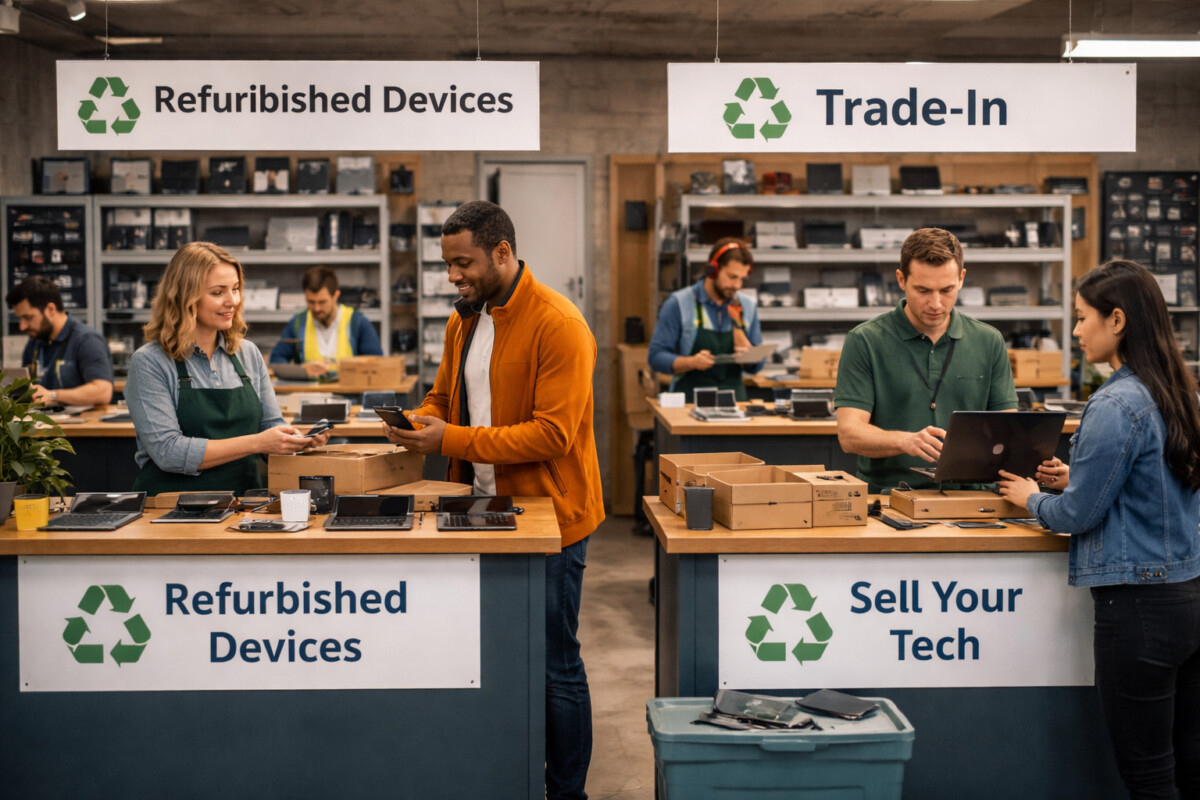
Buyback programs allow businesses to purchase used devices from customers, refurbish them, and resell them at a profit.
This model not only creates an additional inventory stream but also opens up new revenue opportunities for ecommerce businesses operating in the recommerce space. Customers are more likely to upgrade when they know they can recover value from their old devices.
Many ecommerce brands are now partnering with specialist buyback platforms to streamline this process and efficiently handle device collection, testing, and resale.
- Refurbished Product Sales
Refurbished goods are no longer seen as inferior alternatives. In fact, they’re becoming a preferred choice for budget-conscious and environmentally aware consumers.
According to industry reports, the global refurbished electronics market is expected to grow significantly over the next decade, driven by increasing demand for affordable and sustainable tech.
Selling refurbished products allows ecommerce businesses to:
- Increase margins
- Attract new customer segments
- Reduce unsold inventory losses
- Repair and Maintenance Services
Instead of replacing products, many customers are choosing to repair them. Ecommerce brands can capitalise on this by offering:
- Repair services
- Spare parts
- Extended warranties
This not only generates additional revenue but also strengthens long-term customer relationships.
- Trade-In Incentives
Trade-in programs encourage customers to return old products in exchange for discounts on new purchases.
This creates a closed-loop system, where businesses retain control over both the sale and the recovery of products.
- Secondary Marketplaces
Some ecommerce companies are building their own platforms for reselling used goods, while others integrate with existing resale ecosystems.
This approach helps brands:
- Maintain pricing control
- Protect brand value
- Capture revenue that would otherwise go to third-party marketplaces
Operational Benefits Beyond Revenue
The advantages of circular models go beyond just generating income:
- Reduced waste disposal costs
- Improved inventory efficiency
- Stronger brand loyalty
- Enhanced ESG (Environmental, Social, Governance) positioning
Businesses that embrace circular strategies are often perceived as more innovative and responsible, which can be a significant competitive advantage.
The Role of Buyback and Resale Ecosystems
Implementing circular strategies internally can be complex, especially when it comes to logistics, device testing, and pricing.
As a result, many ecommerce businesses collaborate with specialist buyback platforms that handle the operational side of product recovery and resale. These partnerships make it easier to integrate circular models without significant upfront investment.
For example, businesses looking to recover value from used electronics often explore solutions that allow them to resell or recycle devices through dedicated buyback services, helping them unlock value that would otherwise be lost.
The Future of Ecommerce Is Circular
The shift toward the circular economy is not a temporary trend, it’s becoming a fundamental part of how ecommerce operates.
As technology advances and consumer expectations continue to evolve, businesses that fail to adopt circular models risk falling behind.
On the other hand, those that embrace this shift stand to gain:
- New revenue channels
- Greater operational resilience
- A stronger, more sustainable brand identity
Final Thoughts
The circular economy represents a significant opportunity for ecommerce businesses to rethink how they create and capture value.
By incorporating buyback programs, refurbishment, repair services, and resale strategies, companies can turn what was once considered waste into profitable assets.
In a competitive ecommerce landscape, the ability to maximise product lifecycle value may well be the difference between businesses that grow, and those that get left behind.
Frequently Asked Questions
What is the circular economy and how does it apply to Shopify ecommerce brands?
The circular economy is a business model that replaces the traditional take, make, dispose approach with a system where products and materials are reused, repaired, refurbished, or recycled for as long as possible. For Shopify brands, this means treating returned, used, and end-of-cycle inventory as assets with recoverable value rather than costs to be minimized. In practice, it translates into concrete revenue programs: buyback schemes that purchase used products from customers and resell them refurbished, trade-in programs that incentivize repeat purchases, repair services that extend product lifecycles, and secondary marketplaces that capture resale revenue under the brand’s own umbrella. The circular economy is relevant to brands at every revenue stage, though the specific model that makes sense depends on product category, return rate, and operational capacity.
How do product buyback programs work and are they profitable for ecommerce brands?
Product buyback programs work by purchasing used products from customers, refurbishing them to a defined quality standard, and reselling them at a price point that is typically 60 to 75% of new. The brand acquires inventory at 30 to 50% below the cost of new goods, refurbishes it for 10 to 20% of original manufacturing cost, and sells it at a gross margin that frequently equals or exceeds the margin on the original new sale. The program also drives repeat purchase rates, because customers who receive fair value for their used product are more likely to upgrade within the same brand rather than shopping elsewhere. Most brands at the $50K to $500K per month stage start by partnering with specialist buyback platforms that handle the logistics of collection, grading, and refurbishment rather than building that infrastructure internally.
What product categories work best for circular ecommerce models?
The categories with the strongest fit for circular commerce are those where products retain meaningful resale value after first use, where upgrade cycles create a natural supply of used goods, and where customers have enough attachment to the product to engage with trade-in or repair programs. Consumer electronics is the clearest example: rapid upgrade cycles, high resale value, and established refurbishment standards make it ideal for buyback and resale programs. Premium apparel, outdoor and sporting equipment, home goods with craftsmanship value, and baby and children’s products also have strong circular economics. Categories with low resale value, high contamination risk, or minimal customer attachment to individual products are weaker fits. If your average order value is below $50 and your products are consumable or single-use, circular models are unlikely to generate enough margin to justify the operational investment.
How do I start a circular economy program without building expensive logistics infrastructure?
The most practical starting point for most Shopify brands is a partnership with an existing specialist platform rather than building internal infrastructure. Buyback platforms handle the end-to-end logistics of product collection, condition assessment, grading, refurbishment, and resale. The brand provides the customer relationship and the product knowledge. The platform provides the operational capability. This partnership model makes circular commerce viable at the $50K to $200K per month stage, where the volume of used goods flowing through the business does not yet justify building proprietary logistics. As volume grows and you develop a clearer picture of what your customers value in the circular experience, you can evaluate which elements of the infrastructure to bring in-house and which to continue outsourcing.
What is the ESG benefit of circular commerce for ecommerce brands and does it actually matter to customers?
ESG stands for Environmental, Social, and Governance performance, and it matters to three distinct audiences for ecommerce brands: end consumers, institutional buyers, and potential acquirers. Among end consumers, particularly those under 40, sustainability credentials are increasingly influencing purchase decisions and brand loyalty. Brands with visible circular programs, buyback schemes, repair services, and recycling initiatives consistently report higher brand affinity scores among this demographic than brands without them. Among institutional buyers and retail partners, ESG criteria are becoming standard evaluation factors, and circular commerce programs are among the most verifiable sustainability commitments a brand can demonstrate. For brands building toward an exit, ESG positioning is increasingly factored into valuation, particularly among buyers who are themselves subject to ESG reporting requirements. The benefit is real at every stage, though it compounds most visibly over the 18 to 36 month horizon rather than in the immediate quarter.
