





Quick Decision Framework
- Who This Is For: Shopify merchants doing $30K to $2M per month who want their products recommended by AI shopping agents and plan to deploy any AI tool (chatbot, inventory agent, email automation) inside their store.
- Skip If: You are pre-launch or have not yet built out your core product catalog. Get your store foundation in place first, then come back to this guide.
- Key Benefit: A clear framework for understanding why the same data problem is costing you AI visibility and internal agent performance simultaneously, and what to do about it this week.
- What You’ll Need: Access to your Shopify admin, the ability to export your product catalog as a CSV, and about 30 to 60 minutes for the initial audit.
- Time to Complete: 15-minute read. The product data audit takes 30 to 60 minutes and will tell you everything you need to know about where you stand today.
Most merchants think they have a technology problem. They don’t. They have a data problem wearing a technology costume 😉
What You’ll Learn
- Why the same data quality gap that makes your store invisible to AI shopping agents also makes your internal AI tools unreliable, and why fixing one fixes both.
- What AI shopping agents actually parse when they evaluate your products, and why most Shopify stores are essentially invisible to them right now.
- How Gartner’s warning about abandoned AI projects applies directly to Shopify merchants at every revenue stage, not just enterprise brands.
- What “data readiness” actually means across three layers of your store, from product attributes to schema markup to conversational descriptions.
- How to run a product data audit this week that gives you a clear, prioritized action list before your competitors figure out what you already know.
A team spent $14,000 building a voice agent to handle inbound calls. It sounded polished. It responded to questions. It seemed to work. Then they looked underneath it and found that nobody had defined data schemas before they started. Records were scattered across systems. Funnel measurement was impossible. The agent was giving confident answers based on unreliable information, and nobody knew it until the damage was already done.
I keep coming back to that story because it is not really about a voice agent. It is about what happens when you deploy AI on top of a data layer that was never designed for machines. And the reason it matters to you, as a Shopify merchant, is that the same thing is happening on both sides of your business right now. AI shopping agents like ChatGPT, Google AI Mode, and Perplexity are evaluating your products based on structured data your store was never designed to provide. And if you are using any AI tool internally, whether that is a customer service chatbot, an inventory agent, or automated email flows, those tools are only as good as the data underneath them.
The thesis of this piece is simple: most merchants built their data layer for humans, not machines. That was fine in 2019. In 2026, it is the single biggest lever you have left to pull.
The Two Sides of the Same Data Problem
The data hygiene problem facing Shopify merchants right now is not one problem. It is the same problem appearing from two different directions simultaneously. On one side, AI shopping agents are browsing, comparing, and recommending products based entirely on structured data signals. On the other side, every internal AI tool you deploy, from your customer service bot to your inventory management agent, is operating on the same underlying data layer. If that layer is messy, inconsistent, or built for human eyes rather than machine parsing, both sides fail. They just fail in different ways, which makes the root cause harder to see.
This is what I mean when I say the work is identical. Cleaning your product data for external AI visibility is the same work as cleaning it for internal agent reliability. The investment compounds across every AI surface simultaneously. You do not get to choose which problem to solve first, because they are the same problem.
What AI Shopping Agents Actually See When They Visit Your Store
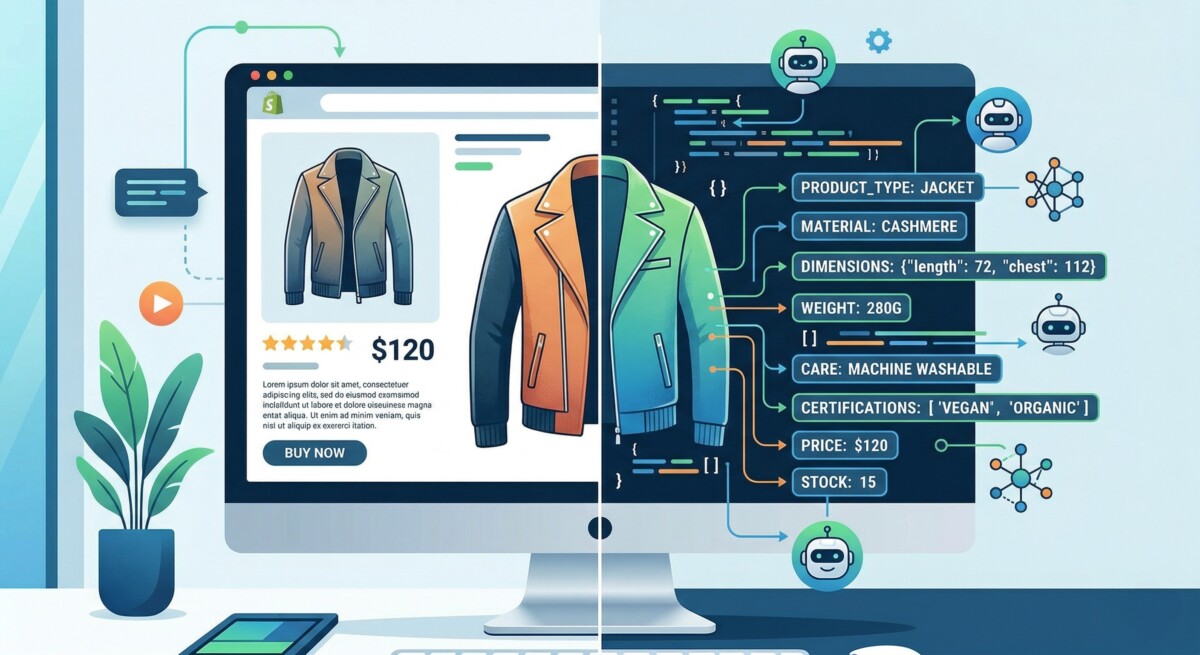
When a customer visits your Shopify store, they see your brand story, your photography, your carefully designed layout, and the trust signals you have spent years building. An AI shopping agent sees none of that. It parses JSON-LD markup, metafields, product feed attributes, and structured API responses. Your beautiful theme is invisible to it.
Most Shopify stores provide 5 to 8 structured product attributes: title, price, description, image URL, availability, and maybe a category. AI agents need 30 or more to make confident recommendations. Think material and composition, detailed dimensions, weight, care instructions, compatibility details, occasion tags, sustainability certifications, and specific feature callouts like waterproof, wireless, or organic. If an agent cannot determine whether your jacket is waterproof or your supplement is vegan, it recommends a competitor whose data answers those questions. The comparison happens in milliseconds. Your brand story never enters the picture.
The deeper problem is that most merchants store their product differentiation in HTML description fields, written as marketing copy. Specs buried in a paragraph of prose are invisible to agents that need clean, parseable attributes. According to Shopify’s own agentic commerce research, the gap between what stores provide and what agents need is precisely where sales get lost to competitors. The agent does not know your product is better. It only knows which product gave it the data to make a confident recommendation.
What Happens When You Deploy an Agent on Dirty Data
The $14,000 voice agent story is the internal version of this problem. The team built something that looked functional from the outside while being fundamentally broken underneath. The agent was confident. The data was not. That combination is more dangerous than a broken agent, because a broken agent fails visibly. An agent operating on dirty data fails silently, often for months, while you assume it is working.
For Shopify merchants, this shows up in specific ways. Your customer service chatbot gives answers based on product descriptions that do not match your actual inventory. Your AI-generated product copy references specs that have changed since the original content was written. Your automated email flows pull pricing data that is out of sync with your current catalog. Each of these is a data hygiene failure, not a technology failure. The technology is doing exactly what it was built to do. The problem is what it is doing it with.
The principle here comes from a framing I find useful: agents are not a magic wand. They amplify whatever data quality you already have. A well-built agent on clean data is a genuine competitive advantage. The same agent on dirty data is a liability that scales.
The Gartner Warning Every Merchant Should Know
Gartner published research in early 2025 with a finding that should stop every merchant in their tracks: through 2026, organizations will abandon 60% of AI projects due to lack of AI-ready data. Not because the AI tools were bad. Not because the strategy was wrong. Because the data underneath was not ready. The same research found that 63% of organizations either do not have or are not sure they have the right data management practices to support AI at all.
Those are enterprise numbers, and I know what you are thinking: I am not running an enterprise. But translate them to your store. You are not going to formally “abandon an AI project” the way a Fortune 500 company does. What you are going to do is install a chatbot that gives bad answers, watch your AI-generated product descriptions miss the mark, and wonder why your Shopify store is not showing up when customers ask ChatGPT what to buy. The mechanism is identical. The scale is different. The outcome is the same: money left on the table because the data layer was not ready.
The merchants who take this seriously now are not doing it because they read a Gartner report. They are doing it because they have already started to see the gap in their own data, and they understand that closing it is not a one-time project. It is an ongoing operational standard.
Data Velocity and Data Cleanliness Are Merging
There is a shift happening in how merchants need to think about product data, and it is worth naming directly. Data synchronization used to be a back-office cost. You kept your inventory accurate because you needed to avoid overselling. You kept your pricing consistent because you did not want customer service issues. These were operational hygiene tasks, not revenue drivers.
That framing is now obsolete. Real-time accuracy of pricing, inventory, and product attributes is a sales channel requirement. When an AI shopping agent queries your store and finds a product listed as in stock that is actually backordered, or finds a price that does not match your current promotion, it either surfaces incorrect information to the customer or deprioritizes your listing in favor of a competitor whose data is current. Data velocity and data cleanliness have merged into a single concept. How fast your data updates and how accurate it is at any given moment are now the same question.
For merchants at $50K per month, this means your catalog export and your live store need to be in sync, not close to sync. For merchants at $500K per month, it means your Merchant Center feed, your Storefront API responses, and your internal systems need to reflect the same reality at the same time. The operational bar has moved, and it moved because the audience for your data now includes machines that do not tolerate inconsistency the way human shoppers do.
AI Visibility and Agent Readiness Are the Same Investment
This is the strategic insight I want you to sit with for a moment. When you clean your product data to improve AI visibility (so that ChatGPT recommends your products, so that Google AI Mode surfaces your listings, so that Perplexity cites your store), you are simultaneously making your store ready for every internal agent deployment you will ever make. The work is not parallel. It is identical.
The Econsultancy expert panel tracking AI commerce trends has put a stake in the ground: by the end of 2026, AI-generated answers will influence more purchase decisions than traditional search results. The brands that do not understand how they show up in AI-powered discovery will fall behind without understanding why. Their traffic will decline. Their conversion will soften. And they will blame their ads, their creative, their pricing, when the actual problem is that an AI agent evaluated their product data and found it insufficient.
The opportunity right now is that most of your competitors have not made this connection yet. They are thinking about AI visibility and internal agent deployment as separate workstreams with separate budgets and separate teams. You can do both with the same investment, because they require the same foundation.
The Three Layers of Data Readiness for Shopify Merchants
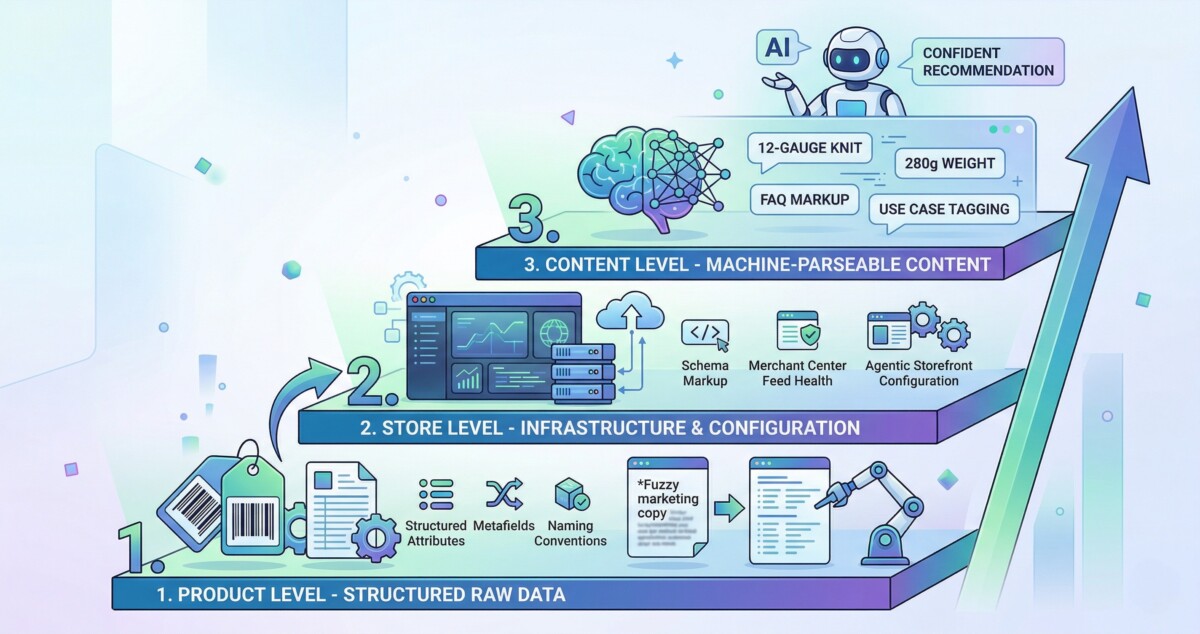
Data readiness for AI is not a single thing you achieve. It operates across three distinct layers, and you need all three to compete effectively. The good news is that the layers build on each other, so progress compounds as you work through them.
The first layer is the product level. This is your structured attributes, your metafields, your naming conventions. It is the raw material that AI agents parse when they evaluate your products. Most merchants are weakest here, because this is where the human-first design of most Shopify catalogs shows up most clearly. Marketing copy in description fields, inconsistent naming across variants, missing specifications that live only in someone’s head or in a manufacturer PDF. The product data audit I describe later in this piece targets this layer specifically.
The second layer is the store level. This is your schema markup, your Merchant Center feed health, and your Agentic Storefront configuration. Shopify activated Agentic Storefronts for every merchant in early 2026, but activation is the floor. What separates merchants who benefit from those who do not is whether the store-level infrastructure is configured to surface the right data to the right agents. Apps like JSON-LD for SEO can automate expanded schema markup across your catalog, but the underlying product data still needs to be clean for the markup to be meaningful. For a deeper look at how to build out this layer, the advanced structured data strategy for eCommerce we have covered previously goes into the entity chain approach that is driving real results right now.
The third layer is the content level. This is your product descriptions written for machine parsing, your FAQ markup, your use case tagging. LLMs need data that is both machine-parseable and real-time. A description that leads with “100% Grade A Mongolian cashmere, 12-gauge knit, 280g weight, available in 14 colors, fits true to size based on chest measurement” gives an AI agent everything it needs to make a confident recommendation. A description that opens with “Our luxurious cashmere sweater will keep you warm all winter” gives it almost nothing. The brand story still matters for human visitors. But the machine-parseable facts need to come first.
The 15x Signal You Cannot Ignore
Shopify reported a 15-fold increase in AI-originated orders over the past year, with AI-attributed orders growing 11x between January 2025 and March 2026 and AI-referred traffic up 7x in the same period. Shopify executives have been direct about what this means: the infrastructure shift is not coming. It is already here.
What those numbers mean depends on where you are. If you are doing $50K per month, a 15x increase in AI-originated orders is the difference between AI being a rounding error in your analytics and it being a meaningful acquisition channel. The merchants in this range who get their data right now will be the ones who look back in 18 months and wonder why their competitors are still trying to catch up. If you are at $500K per month, you almost certainly already have some AI-referred traffic. The question is whether your data quality is good enough to convert it efficiently, or whether you are sending AI-referred visitors to product pages that cannot close the sale because the information they need is not there. At $2M per month, the data hygiene problem is compounded by catalog scale. You likely have thousands of products, and the gap between your best-optimized listings and your worst is probably enormous. The audit matters more at this stage, not less, because the variance in your catalog is costing you recommendations you should be winning.
Morgan Stanley estimates US agentic commerce will reach $385 billion by 2030. The first-mover window for AI optimization on Shopify is roughly 6 to 12 months. The merchants who move now are not chasing hype. They are doing the boring, essential work that makes every other investment compound.
Audit Before You Automate (What This Looks Like for a Shopify Store)
The framework I want to share here is adapted from a principle I keep coming back to in conversations about AI deployment: audit before you automate. Fix the data before you build on top of it. Create observability so you can verify what your agents are actually doing. Scope the authority of every automated system so you know what it can and cannot do on its own. These are not enterprise principles. They are common sense applied to a context where the consequences of skipping them are real and measurable.
For a solo founder at $30K per month, this looks like a single afternoon: export your catalog, count your attributes, identify your five worst-performing product pages by data completeness, and fix those first. You do not need a data team. You need a spreadsheet and a couple of hours. For an operator with a team at $1M per month, this is a structured sprint: assign a team member to own the catalog audit, define a minimum attribute standard for every product category, and build a workflow that prevents new products from being published without meeting that standard. The principle is the same. The execution scales with your resources.
The complete guide to making your Shopify store agent-ready walks through the full seven-step readiness framework in detail. What I want to focus on here are the two highest-leverage actions you can take this week.
The Product Data Audit Every Merchant Should Run This Week
Export your product catalog from Shopify as a CSV. Open it in a spreadsheet. For each product, count the number of distinct structured attributes you have populated. Title, price, description, and image URL do not count as structured attributes for this exercise. They are baseline fields every product has. Count the fields that actually differentiate your product: material, dimensions, weight, care instructions, compatibility, certifications, use case tags, seasonal relevance, and specific feature callouts.
If your average is under 10 structured attributes per product, you are invisible to most AI agent comparisons. If your average is between 10 and 20, you are competitive but not dominant. If you are consistently above 20, you are in the top tier of catalog quality for independent Shopify merchants, and the next work is consistency, making sure your best-optimized products set the standard for your entire catalog rather than being outliers.
The priority attributes to add, in rough order of impact: material and composition, detailed dimensions with actual measurements rather than S/M/L only, weight, care instructions, compatibility with other products or systems, certifications and third-party validations, use case tags that describe the context in which the product is used, seasonal relevance, and specific feature callouts that answer the questions AI agents are most likely to be asked. If you sell apparel, “waterproof” and “machine washable” are more valuable to an agent than any amount of brand copy. If you sell supplements, “vegan,” “third-party tested,” and “gluten-free” are the attributes that determine whether you get recommended to the right customer.
Stop Letting Your Agents Tell You They Are Doing a Good Job
There is a failure mode that shows up consistently in AI deployments, and it is worth naming directly: agents that report their own performance are not reliable evaluators of their own performance. A chatbot that tells you it resolved 87% of customer inquiries is not the same as a chatbot that actually resolved 87% of customer inquiries. The self-reported metric and the actual outcome are different things, and conflating them is how the $14,000 voice agent problem happens.
For Shopify merchants, this means building independent verification into every AI tool you deploy. Check that your chatbot is actually recording customer interactions correctly, not just logging that an interaction occurred. Verify that your AI-generated product descriptions match your actual products, not just that content was generated. Confirm that your automated email flows are pulling accurate pricing and inventory data, not just that emails are being sent. The test is simple: can you independently verify the output without asking the agent to verify itself? If you cannot, you do not have a reliable agent. You have a confident one, which is worse.
Observability is not a technical luxury. It is the minimum standard for any AI system that touches your customer experience or your revenue. Build it in from the start, even if that means starting smaller and slower than you originally planned.
The Merchants Who Will Win in 18 Months
I use a filter for every operational decision that involves meaningful time or money: will this matter in 18 months? It cuts through a lot of noise. Most tactics do not pass the test. Data hygiene does, and it does so with compounding returns.
The merchants who invest in data quality now are making an investment that compounds across every AI surface simultaneously. Every AI shopping agent that evaluates their products gets better data. Every internal tool they deploy gets a more reliable foundation. Every optimization they make to their schema markup, their Merchant Center feed, their product descriptions, makes the next optimization easier and more effective. The work builds on itself in a way that most marketing investments do not.
The first-mover window for AI optimization on Shopify is roughly 6 to 12 months. I want to be honest about what that means. It does not mean you have 6 to 12 months to start thinking about it. It means the merchants who have already started are building a lead that will be expensive to close. The same dynamic played out in traditional SEO around 2015. The brands that invested early built domain authority, content libraries, and backlink profiles that took years for latecomers to match. The brands that waited faced a structural disadvantage that compounded every quarter they delayed.
AI optimization is following the same curve, faster. The merchants who take the foundations seriously, who do the boring work of cleaning their catalogs, enriching their attributes, and building observability into their agent deployments, are the ones who will look back in 18 months and recognize that this was the moment that separated them from the competition. Not because they chased a trend. Because they did the work that made everything else possible.
Frequently Asked Questions
How do I know if my Shopify product data is ready for AI shopping agents?
Export your product catalog as a CSV and count the structured attributes per product, excluding baseline fields like title, price, and image URL. If you are averaging fewer than 10 meaningful attributes per product (material, dimensions, weight, care instructions, certifications, use case tags), your store is likely invisible to most AI agent comparisons. The threshold for competitive data quality is roughly 20 or more structured attributes per product. Run this audit before investing in any AI tool or schema optimization, because the underlying data quality determines how much any downstream investment is worth.
What is the difference between AI visibility and internal agent readiness, and why does fixing one fix the other?
AI visibility refers to how often and how accurately AI shopping agents like ChatGPT, Google AI Mode, and Perplexity surface your products in response to customer queries. Internal agent readiness refers to how reliably your own AI tools (chatbots, inventory agents, email automation) perform based on your store’s data. Both depend on the same foundation: clean, structured, machine-parseable product data. When you enrich your product attributes, improve your schema markup, and synchronize your data across systems, you improve both simultaneously. The work is identical because the root cause is identical.
What does the Gartner 60% AI project abandonment stat mean for a Shopify merchant at my scale?
Gartner’s finding that 60% of AI projects will be abandoned through 2026 due to lack of AI-ready data applies to merchants at every scale, not just enterprise organizations. For a Shopify merchant, “abandoning an AI project” looks like a chatbot that gives unreliable answers and gets turned off, AI-generated product descriptions that miss the mark and get ignored, or an automated flow that pulls inaccurate data and damages customer trust. The mechanism is the same regardless of revenue. The solution is also the same: audit your data before you automate, and build the data foundation before you build on top of it.
How do I write product descriptions that work for both AI agents and human shoppers?
Lead with machine-parseable facts, then follow with brand narrative. An effective AI-ready product description opens with the specific, quantifiable details that agents need to make recommendations: “100% Grade A Mongolian cashmere, 12-gauge knit, 280g weight, available in 14 colors, fits true to size based on chest measurement.” This front-loaded structure gives AI agents the data they need in the first sentence. Human shoppers who want the brand story find it in the paragraphs that follow. The key principle is that AI agents extract facts from descriptions, and if those facts are buried in marketing copy, they are effectively invisible to the agent regardless of how compelling the copy is.
When is the right time to start optimizing my Shopify store for AI commerce?
The right time is now, and the reason is compounding returns. Shopify reported AI-attributed orders growing 11x between January 2025 and March 2026, with AI-referred traffic up 7x in the same period. The merchants building data quality advantages today are establishing a lead that will cost competitors significantly more to close in 12 to 18 months than it costs to build today. The first-mover window for AI optimization on Shopify is estimated at 6 to 12 months. If you are doing $30K or more per month, the product data audit described in this guide is the highest-leverage action you can take this week. Start there, then work outward to schema markup, feed optimization, and content-level improvements.
