





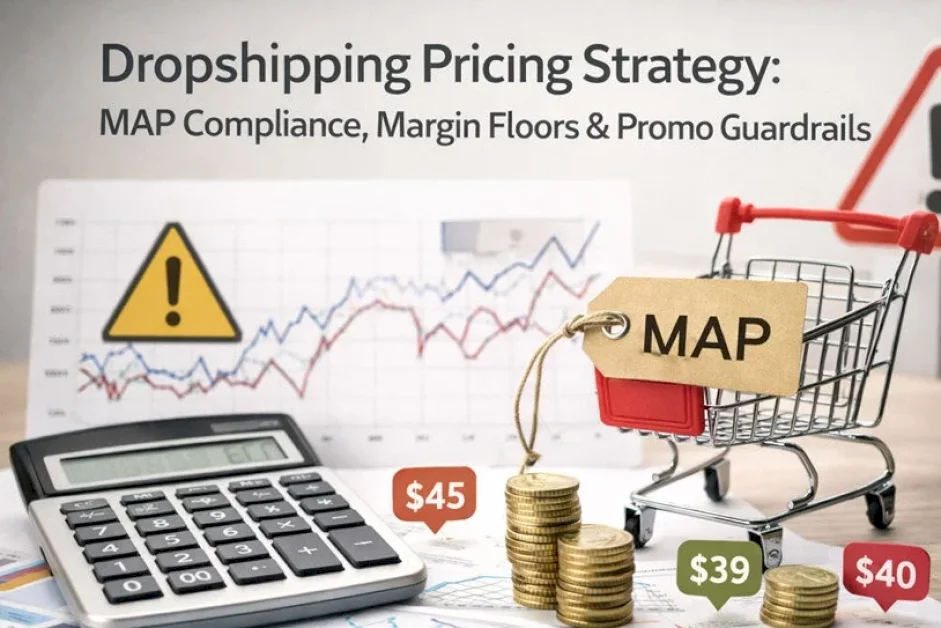

Everyone talks about dropshipping pricing strategy, but actually implementing it isn’t always clean or stable. There are challenges there for a dropshipper, and it takes work. You may see supplier costs change without notice, channel fees vary across platforms, competitors aggressively undercut prices, and many brands enforce Minimum Advertised Policies (MAP) policies that limit how low you can go. In practice, dropshipping pricing needs a lot of management effort.
This article is for sellers who are past the basics and now need structure. Instead of guessing margins or reacting to competitors, we’ll focus on building a system: pricing that respects MAP compliance, protects clear margin floors, and uses promo guardrails so discounts don’t quietly destroy profitability.
At some point, every seller asks the same question: Is the dropshipping business profitable? The answer is yes, but only when you have a mathematical, logical approach. Let’s get to know dropshipping pricing once and for all.
What is a Dropshipping Pricing Strategy (Beyond Simple Markups)?
The dropshipping pricing strategy is a formula, but not just that! “cost plus markup.”
Well, yes, but at an advanced level, it is a structured set of rules that defines how prices are set and adjusted, while accounting for real-world constraints.
These rules typically include:
- Product cost
- Shipping and fulfillment fees
- Marketplace commissions
- Brand policies such as MAP or MSRP
- Target margin thresholds
- The Competitive landscape in each sales channel
In practice, dropshipping pricing must balance internal profitability goals with external limits you can’t control.
Common pricing models include a fixed percentage markup, a fixed dollar markup, tiered markups based on price ranges, or competitor-based pricing that reacts to the market. These are good and, of course, work at a small scale, especially when selling generic products on a single channel (with fewer restrictions).
But here’s the problem: when you work with established brands or sell in multiple marketplaces, dropshipping pricing is not one flat formula anymore.
MAP compliance limits how low you can price, and fees can vary, too. Remember that aggressive discounting can break margins faster than expected. That is why mature sellers move toward pricing systems built on margin floors and MAP rules, with clear promotional guardrails.
On Shopify, bundles are often part of those guardrails, and using a Shopify bundle app like Fast Bundle makes them easier to build and manage at scale.

Understanding MAP, MSRP & Why Compliance Matters for Dropshippers
Let’s get to know some of the concepts you’ll often use.
Manufacturer’s Suggested Retail Price (MSRP) is the price a brand recommends to position a product in the market. It’s more of a guideline than a rule. You’re usually free to price above or below MSRP.
Minimum Advertised Price (MAP) is typically defined in a brand’s reseller agreement and sets the lowest price you are allowed to advertise publicly. While it does not always control the final checkout price, it controls what appears on product pages (or ads and listings). For dropshippers, MAP is a contractual condition tied directly to your supplier relationship.
Why is it a big deal?
Because many sellers often list the exact same SKU at scale. Brands actively monitor Amazon, Google Shopping, and other marketplaces for violations. One seller breaking MAP can trigger enforcement actions across the channel, and brands respond quickly.
Here’s an example: the MAP is $99, and you want to run a 20% promotion. You cannot publicly advertise the product at $79.20 without violating MAP. If you do, you may gain short-term sales, but you risk being cut off by a supplier you depend on.
Building Margin Floors for Sustainable Dropshipping Pricing
A margin floor is the “minimum acceptable gross margin” you are willing to accept for a product, category, or sales channel. It is not a target and not an average. It is kind of a boundary that protects your business from selling volume at a loss, like what a guardrail does for cars on a road.
Dropshipping margins are often thin. Considering bumps in the road like Returns, fluctuating ad costs, realized price reductions, added frictions, and currency changes, the profit may quietly fall. Without margin floors, your dropshipping pricing is just guesswork, especially once scale and promotions enter the picture.
To build margin floors, start with your actual final cost. This includes product cost, shipping, marketplace fees, payment processing, and fulfillment-related charges. After that, add known overheads per order, such as software subscriptions, VA or support time, and average ad spend per conversion.
Now you have a realistic cost base, so decide on minimum gross margins by category. For example, electronics might require a 20% minimum, while accessories or consumables may need 30% or more.
Finally, it’s time to convert those margins into pricing rules: “Never list below X price.” Remember that in a multi-channel business, margin floors can change by platform. Amazon, Shopify, and eBay each have unique fees, competitive pressure, and return behavior, so your floor should reflect those realities.
Promo Guardrails: Discounts, Coupons & Sales Without Breaking MAP
Promotions often start with good intentions, both for the customer and seller, but end with broken rules. You launch discounts, stack coupon codes, and run sales until you accidentally violate MAP policies or push prices below your own margin floors.
Why? Because promotions are treated as marketing tactics, not pricing rules. Promo guardrails should be part of your overall dropshipping pricing playbook. Here are the best ones:

Guardrails for MAP-Restricted Products
For products with MAP policies, the safest approach is exclusion, so try not to be too spontaneous.
Exclude MAP products from:
- Blanket discount codes
- Site-wide sales
- Automatic cart-level discounts
Use MAP-safe tactics instead:
- Bundles with free or low-cost add-ons
- Loyalty points or store credit
- Post-purchase rebates (not publicly advertised)
- Value-add services like extended warranties or faster handling
Guardrails for Margin Floors
Even when MAP is not involved, discounts can quietly destroy margins. Here are some go-to rules.
- “No promotion that pushes margin below 15% on any SKU.”
- “Exclude low-margin or high-return categories from site-wide codes.”
To enforce this at scale, use automation or pricing tools that:
- Automatically exclude SKUs that would violate margin floors
- Warn you when a planned discount breaks a margin rule
When You Want to Scale- Pricing at Expansion
Scaling from a small store to marketplaces like Amazon or Walmart can be a big decision, and has a great impact on your prices, too. You’re no longer a small shop, and you need more control over pricing. Marketplaces often charge higher fees, set stricter performance metrics, and enable instant price comparisons. This means margins should be lower and promotions more limited than in your own store.
When expanding channels, revisit both margin floors and promo rules. A discount that is safe on Shopify can cause margin loss or trigger MAP violations on a marketplace.
Also, pay attention to the SKUs. Not every product that performs well on Shopify should be listed everywhere. Focus on the best products for dropshipping SKUs with stable costs, clear MAP rules, and enough margin to absorb marketplace fees. Treat each channel as its own pricing environment, connected by shared rules but enforced separately, to scale without eroding profitability.
Channel-Specific Dropshipping Pricing Rules (and Automation)
A serious dropshipping pricing strategy must be channel-aware. Each platform has its own fee structure and competitive dynamics, and customers expect different things of it. You’ll definitely break your margins if you treat all channels the same. “one price everywhere” does not work, but one pricing system with channel-specific rules will.
Like your own Shopify store usually allows more flexibility. You’re in control of the brand story, user experience, and how value is presented through bundles. But marketplaces operate differently. Fees are higher sometimes, identical SKUs are compared instantly, and MAP enforcement is stricter. That’s why pricing needs to follow clearer, more defensive rules.
How automation supports channel-based pricing:
- Sync supplier cost changes in near real time
- Enforce MAP rules automatically across listings
- Maintain different margin floors per channel
- Reduce manual pricing errors at scale
- Tools often include repricers, feed managers, and Inventory Source or Flxpoint-type platforms
Example pricing rules:
- “On Amazon, minimum markup = 25% above landed cost + FBA fee.”
- “On Shopify, target 35–40% gross margin, but never price below MAP.”
- “On eBay, exclude SKUs with margins under 20% from discounts.”
Is Dropshipping Business Profitable with MAP & Margin Floors?
The short answer is yes, it can be, but only if done right. Making a profit depends on pricing discipline. If you want to stay profitable over time, you must understand your business’s real costs and respect MAP policies. Margins need protection, and you’re responsible for them.
Typical gross margins in dropshipping are from 10% to 40%, and they depend on category, brand strength, and sales channel. Many sellers find it hard to break even because they offer the lowest visible price and ignore MAP rules. Margin “on paper” can vanish easily if you don’t pay attention to fees, returns, or ads.
Here’s a different approach often taken by profitable sellers: sell fewer SKUs and work with stronger brands, and first of all, set up a system for pricing.
Here’s what profitable dropshippers do differently:
- Run full cost and margin calculations before launching a product
- Review margin and performance reports on a schedule
- Use automation and rules instead of constant manual edits
Step-by-Step: How to Design Your Dropshipping Pricing Strategy
A solid dropshipping pricing strategy is built as a system, so it can be used time and time again. This checklist helps you turn theories into a repeatable process you can maintain in your business:
First of all, map your full cost stack
- Product cost from the supplier
- Shipping and fulfillment
- Marketplace and payment fees
- Returns, refunds, and chargebacks
Identify MAP-restricted items
- List SKUs and brands with MAP or MSRP policies
- Note how strict enforcement is by brand and channel
- Flag products that cannot be included in public promotions
Set margin floors by category (and channel)
- Set minimum acceptable gross margins
Adjust floors for Shopify, Amazon, eBay, or other retailers based on fees.
Choose default formulas
- Fixed percentage markup
- Fixed dollar add-on
- Tiered markups by price range
- Channel-specific formulas, if needed
Add promo guardrails
- Prevent discounts that break MAP
- Block promotions that drop below the margin floors
- Exclude low-margin or high-return SKUs automatically
Use automation tools for more safety
- Sync supplier cost changes
- Adjust prices in bulk
- Monitor and flag MAP violations
Review performance monthly
- Adjust margin floors based on real data
- Prune unprofitable SKUs
- Double down on categories with stable, healthy margins
What Is EcomBalance?
EcomBalance is a monthly bookkeeping service specialized for eCommerce companies selling on Amazon, Shopify, eBay, Etsy, WooCommerce, & other eCommerce channels.
We take monthly bookkeeping off your plate and deliver you your financial statements by the 15th or 20th of each month.
You’ll have your Profit and Loss Statement, Balance Sheet, and Cash Flow Statement ready for analysis each month so you and your business partners can make better business decisions.
Interested in learning more? Schedule a call with our CEO, Nathan Hirsch.
And here’s some free resources:
- Monthly Finance Meeting Agenda
- 9 Steps to Master Your Ecommerce Bookkeeping Checklist
- The Ultimate Guide on Finding an Ecommerce Virtual Bookkeeping Service
- What Is a Profit and Loss Statement?
- How to Read & Interpret a Cash Flow Statement
- How to Read a Balance Sheet & Truly Understand It
Conclusion: Turn Pricing Rules into a Competitive Advantage
The most essential thing in pricing is structure; without it, dropshipping can even cost you money. Pay attention to rules (your own and the regulations), MAP compliance, and margin floors. Also, don’t forget the promotion guardrails, and make the discounts a source of control rather than constant stress.
Study the most profitable dropshippers you know, whether they’re small or big. They do not guess or react; they have systems in place while scaling. If you’re serious about building a profitable, MAP-compliant dropshipping business, treat your pricing rules as part of your infrastructure, and let automation handle the rest.
