





Quick Decision Framework
- Who This Is For: Shopify merchants doing $500K to $5M who operate or manage their own warehouse, or who are evaluating 3PL partners and want to understand what a safety-mature fulfillment environment actually looks like.
- Skip If: You are pre-revenue, dropshipping only, or have no involvement in physical fulfillment operations. This is for operators who touch warehouse decisions directly.
- Key Benefit: Understand the specific safety risks inside a modern ecommerce fulfillment center, including forklifts, autonomous robots, and propane equipment, and know what PPE standards actually apply so you can protect your team and stay compliant.
- What You’ll Need: Basic familiarity with your warehouse layout and equipment mix. No special tools required, though OSHA’s ANSI/ISEA 107-2020 compliance checklist is a useful companion document.
- Time to Complete: 10 to 12 minutes to read; 1 to 2 hours to audit your current PPE program and warehouse safety protocols against the framework in this article.
The ecommerce warehouse is no longer just shelves and packing tape. It is a shared floor where humans, forklifts, electric pallet jacks, propane-powered trucks, and increasingly, autonomous robots all move at the same time. The rules for keeping people safe in that environment have changed faster than most operators realize.
What You’ll Learn
- Why the modern ecommerce fulfillment floor has created new visibility hazards that traditional warehouse safety thinking did not anticipate.
- What OSHA and ANSI/ISEA 107-2020 actually require for high-visibility apparel in warehouse environments, and how to match the right class of PPE to your specific equipment mix.
- How autonomous robots and AMRs have reshaped the injury risk profile in fulfillment centers, and what that means for your safety protocols right now.
- When hi-vis vests alone are not enough, and what a layered safety approach looks like for a warehouse running forklifts alongside robotic picking systems.
- What questions to ask when evaluating a 3PL partner’s safety culture, and why a warehouse’s injury record should factor into your fulfillment decision.
The eCommerce Warehouse Has Changed
Most conversations about warehouse safety were written for a different era. The classic image is a large distribution center with propane forklifts, fixed shelving, and clearly marked pedestrian lanes. The safety playbook built around that environment is still valid. It is just no longer complete.
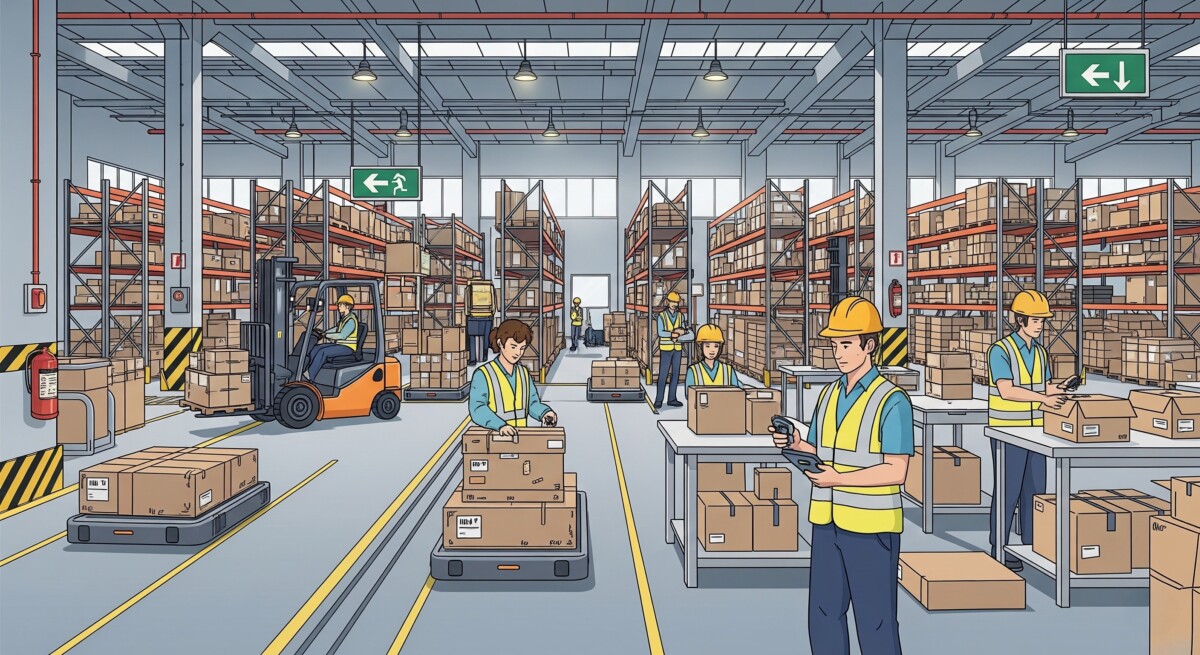
Today, a Shopify brand generating $2M in annual revenue might operate from a 10,000-square-foot warehouse where an electric pallet jack zips through aisles, a propane counterbalance forklift unloads inbound pallets, and an autonomous mobile robot (AMR) shuttles totes from receiving to packing. This modern floor presents a very different safety challenge than what traditional compliance checklists account for. Hazards overlap and evolve throughout the day—changing with shift volumes, traffic flow, and seasonal demand peaks like Black Friday. In these dynamic environments, ensuring every worker is equipped with proper safety gear, like hi vis vests, becomes essential for visibility and accident prevention.
If you are managing your own fulfillment, or if you are evaluating whether to bring operations in-house, understanding the safety requirements of that environment is not optional. OSHA citations for powered industrial truck violations are consistently among the most common in the warehousing sector. And the injury data coming out of robotic fulfillment centers over the past two years suggests that adding automation does not automatically make a warehouse safer. It reshuffles the risk. For a deeper look at whether in-house or 3PL fulfillment makes sense for your stage, that decision framework is worth reading before you commit to either path.
What OSHA Actually Requires for Warehouse Hi-Vis
The short answer is that OSHA requires high-visibility safety apparel (HVSA) whenever workers are in environments where they face a genuine risk of being struck by moving vehicles or equipment. In a warehouse running forklifts, that standard applies. The specific requirements are governed by the ANSI/ISEA 107-2020 standard, which classifies garments into three performance classes based on the level of visibility they provide and the risk environment they are designed for.
Class 1 is the baseline. It is appropriate for low-speed environments where equipment moves under 25 mph and pedestrian exposure is minimal. A small warehouse with limited forklift traffic and clearly separated pedestrian zones might qualify. Class 2 is the standard most ecommerce fulfillment environments actually need. It covers mixed-traffic environments where forklifts, electric pallet jacks, and pedestrians share the floor, and where equipment can move at speeds up to 50 mph. Class 3 is the highest level, designed for environments with direct, high-speed traffic exposure. Most indoor fulfillment operations do not require Class 3, but receiving docks where trucks are actively maneuvering in tight spaces can push into that territory.
The practical implication for most Shopify merchants running their own warehouse is this: if you have any powered industrial truck on the floor, including electric pallet jacks, which are quieter and therefore harder to hear than propane equipment, your workers need at minimum Class 2 compliant vests. The ANSI/ISEA 107-2020 standard also introduced tighter chromaticity tolerances in its most recent update, meaning that older vests that have faded from UV exposure may no longer meet the reflectivity requirements. OSHA now requires documented risk assessments when selecting HVSA classes and quarterly PPE inspections to maintain compliance. That is not a paperwork exercise. It is a real operational requirement with real liability attached.
The Propane and Electric Forklift Problem
One of the things that gets underestimated in ecommerce warehouse safety is the difference in risk profile between propane-powered and electric forklifts. Most operators know that propane equipment requires ventilation and specific refueling protocols. Fewer think carefully about what propane equipment does to worker visibility.
Propane forklifts are loud. That noise is actually a safety feature. Workers hear them coming. Electric forklifts and electric pallet jacks are nearly silent. A worker focused on a pick task, especially in a high-volume environment where pick rates are tracked and performance pressure is real, can be completely unaware that a 6,000-pound electric counterbalance forklift is approaching from a blind aisle. This is not a hypothetical. It is one of the most common near-miss patterns in fulfillment centers that have transitioned from propane to electric equipment as part of sustainability initiatives.
The response to this is not to go back to propane. Electric equipment is cleaner, cheaper to operate, and better for the people working inside the building all day. The response is to understand that when you remove the auditory warning, you have to compensate with visual ones. That is exactly the role hi-vis vests play in a mixed-equipment environment. A forklift operator moving through a dense pick area at 5 mph has roughly two seconds to identify a pedestrian and stop. A worker in a Class 2 ANSI-compliant vest is visible from significantly further away than a worker in standard warehouse attire, which directly extends that reaction window. OSHA’s Powered Industrial Truck Standard under 29 CFR 1910.178 requires forklift operators to be certified every three years, but the vest on the pedestrian is what protects them when the operator’s sightlines are blocked by a loaded pallet.
The Automation Paradox: Robots Do Not Make Warehouses Automatically Safer
This is the part that surprises most operators who are considering automation or who are evaluating 3PL partners that have invested heavily in robotics. The intuition is that robots reduce injury risk because they take over dangerous tasks. The data tells a more complicated story.
Research published in 2025 examining Amazon’s fulfillment center network found that warehouse robotics are associated with a 40% decrease in severe injuries but a 77% increase in non-severe injuries compared to traditional centers. The reason is not that robots are hitting workers. It is that robots increase the pace of work. Pick rates in automated facilities run two to three times higher than in manual ones. Workers who are moving faster, doing more repetitive tasks, and operating under higher performance pressure are more likely to cut corners on situational awareness. They zone out. They stop scanning their environment. They step into a forklift lane without looking because they have done it safely a hundred times before.
The autonomous mobile robots (AMRs) now common in mid-market fulfillment operations add a specific new dynamic. AMRs are designed with sophisticated obstacle detection and will stop for a human in their path. But the interaction between an AMR that has stopped and a forklift operator who does not understand why the AMR has stopped, or who is moving quickly to clear a backlog, creates unpredictable moments. New safety standards for industrial mobile robots published in 2025 under the R15.08-2-2023 framework specifically address multi-robot fleet deployments, but the human-robot interaction protocols in most smaller fulfillment operations have not kept pace with the hardware.
For operators running or evaluating automated fulfillment environments, the practical implication is that PPE compliance becomes more important as automation increases, not less. The vest that was optional in a slow manual warehouse is mandatory in a fast robotic one.
Hi-Vis in the Modern Fulfillment Center: What a Real Program Looks Like
A compliant hi-vis program for a mid-market ecommerce warehouse is not complicated, but it has to be deliberate. The starting point is a documented hazard assessment. OSHA and the ANSI/ISEA 107-2020 standard both require this, and it should reflect the actual equipment mix, traffic patterns, and shift conditions in your specific facility. A warehouse running one electric pallet jack and no forklifts has a different risk profile than one running three propane counterbalance forklifts and a fleet of AMRs.
Once the hazard assessment is complete, the vest selection follows from it. For most ecommerce fulfillment environments, Class 2 ANSI/ISEA 107-compliant hi vis vests are the appropriate baseline. The vest needs to meet the minimum background material coverage of 755 square inches and the reflective tape requirements for the class. It also needs to be replaced on a schedule. UV exposure degrades retroreflective performance by up to 15% annually, which means a vest that was compliant when purchased may not be compliant 18 months later. Quarterly PPE inspections are now an OSHA-referenced requirement under the 2024 guidelines.
Beyond the vest itself, a real program includes three other elements. First, clear pedestrian zones with physical separators or high-contrast floor markings that are maintained and visible. Improved lighting has been shown to cut slip-and-fall incidents by up to 50% in distribution environments, and the same principle applies to vehicle-pedestrian interaction. Second, training that goes beyond annual certification. Workers in robotic fulfillment environments need to understand how AMRs behave, what an emergency stop looks like, and what to do when a robot has stopped unexpectedly in a traffic lane. Third, a near-miss reporting culture. The facilities with the best safety records are not the ones with the fewest incidents. They are the ones that take near-misses seriously enough to investigate them before they become recordable events.
Safety as a 3PL Evaluation Criterion
Most Shopify founders evaluating 3PL partners ask about pick accuracy, integration capabilities, and cost per order. Very few ask about the 3PL’s OSHA recordable incident rate. That is a mistake, and not just for ethical reasons.
A 3PL with a poor safety record has a workforce problem. High injury rates correlate directly with high turnover, which correlates with pick errors, shipping delays, and the kind of operational inconsistency that shows up in your customer experience. The warehouses with the highest injury rates are also the ones most likely to be understaffed during peak periods, because injured workers are not picking your orders. When you are evaluating how to evaluate 3PL providers for your Shopify brand, adding safety metrics to your due diligence checklist is not a nice-to-have. It is a proxy for operational quality.
The questions worth asking are direct. What is the facility’s recordable incident rate compared to the industry average? What is their PPE compliance policy, and how is it enforced? Do workers in the facility wear ANSI-compliant hi-vis vests, and what class? What is the protocol for working alongside automated equipment? A 3PL that cannot answer these questions clearly has not thought carefully about safety, which means they have not thought carefully about operations. For brands approaching the inflection point where bringing fulfillment in-house starts to make financial sense, the $2M fulfillment decision framework is a useful guide for thinking through when that transition makes sense and what it actually requires to execute well.
Building a Safety Culture That Scales
The brands that handle this well treat safety as an operational standard, not a compliance exercise. The difference is visible in small things. Vests are issued on day one, not retrieved from a bin near the dock. Near-miss reports are reviewed in shift briefings, not filed and forgotten. The floor layout is designed so that pedestrians and equipment have predictable, separated paths rather than shared space managed by informal convention.
For operators at the $500K to $2M stage running their own fulfillment, the investment required to build this is modest. Comprehensive training programs have been shown to reduce new employee injury rates by 60% during the critical first 90 days of employment. The cost of a proper PPE program, including Class 2 ANSI-compliant vests for every worker on the floor, quarterly inspections, and a documented hazard assessment, is a fraction of a single workers’ compensation claim. The cost of an OSHA citation for a powered industrial truck violation can run into the tens of thousands of dollars, plus the operational disruption of an inspection.
The practical starting point for most operators is the hazard assessment. Walk your floor with fresh eyes. Map every point where pedestrians and powered equipment share space. Identify every blind corner, every aisle intersection, every loading dock approach. Then ask whether your current PPE program addresses every one of those points. If the answer is not clearly yes, you have work to do before the next busy season arrives.
Frequently Asked Questions
Do OSHA regulations require high-visibility vests in warehouse environments?
Yes. OSHA requires high-visibility safety apparel whenever workers face a genuine risk of being struck by moving vehicles or powered equipment. In any warehouse operating forklifts, electric pallet jacks, or autonomous mobile robots, that standard applies. The specific requirements follow the ANSI/ISEA 107-2020 standard, which defines three performance classes based on visibility level and risk environment. Most ecommerce fulfillment operations require Class 2 compliant vests at minimum. OSHA’s 2024 guidelines also require employers to conduct documented risk assessments when selecting HVSA classes and to perform quarterly PPE inspections to maintain compliance. Failure to comply can result in citations under the General Duty Clause as well as specific powered industrial truck standards.
What is the difference between Class 1, Class 2, and Class 3 hi-vis vests for warehouse use?
Class 1 vests provide basic visibility and are appropriate for low-traffic environments where equipment moves slowly and pedestrian separation is clear. Class 2 vests offer greater reflective coverage and are the standard for most ecommerce fulfillment environments where forklifts, electric pallet jacks, and pedestrians share the same floor. Class 3 provides the highest visibility level, with full torso and limb coverage, and is required for environments with direct, high-speed traffic exposure such as active outdoor loading docks. The ANSI/ISEA 107-2020 standard also introduced Type O, R, and P classifications that map to off-road, roadway, and public safety applications respectively, with Type O being the most relevant for indoor warehouse use.
Are electric forklifts safer than propane forklifts from a pedestrian visibility standpoint?
Not necessarily. Electric forklifts and pallet jacks are significantly quieter than propane-powered equipment, which removes the auditory warning that workers rely on to detect approaching vehicles. In practice, this makes pedestrian visibility more important, not less, in warehouses that have transitioned to electric equipment. A worker wearing a Class 2 ANSI-compliant hi-vis vest is visible from a much greater distance than a worker in standard warehouse attire, which directly extends the reaction window available to a forklift operator approaching from a blind aisle. Propane equipment also requires specific ventilation and refueling protocols under OSHA’s powered industrial truck standard, but the pedestrian risk from electric equipment is frequently underestimated during the transition.
Do autonomous robots in a fulfillment center reduce the need for hi-vis PPE?
No. Research published in 2025 examining robotic fulfillment centers found a 40% decrease in severe injuries but a 77% increase in non-severe injuries compared to traditional warehouses. The increase in non-severe injuries is linked to higher pick rates and increased repetitive motion in automated environments, both of which reduce worker situational awareness. Autonomous mobile robots are designed to stop for humans in their path, but the interaction between stopped AMRs, active forklifts, and workers under performance pressure creates unpredictable moments. PPE compliance becomes more important as automation increases, not less. New 2025 safety standards for industrial mobile robots under R15.08-2-2023 address multi-robot fleet deployments but do not eliminate the need for human workers to be visually identifiable on the floor.
What should I look for in a 3PL partner’s warehouse safety program?
Start by asking for the facility’s OSHA recordable incident rate and comparing it to the industry average for warehousing and storage. High injury rates correlate with high turnover, which directly affects pick accuracy and operational consistency. Ask specifically whether workers in the facility wear ANSI-compliant hi-vis vests, what class is required, and how compliance is enforced. Ask about the protocol for working alongside automated equipment, and whether the facility has a documented hazard assessment that has been updated since any major equipment changes. A 3PL that cannot answer these questions clearly has not built a safety culture, which is also a reliable indicator of how they manage operations more broadly.
