





Quick Decision Framework
- Who This Is For: Shopify and DTC brand operators doing $10K to $500K per month who sell custom printed merchandise or apparel and want to reduce inventory risk, lower fixed production costs, and build a more modular fulfillment operation.
- Skip If: You are producing large uniform runs of a single design and already have a screen printing workflow that runs profitably at high volume. DTF transfer production is optimized for design diversity and small to mid batch flexibility, not commodity bulk printing.
- Key Benefit: Understand how sourcing professional DTF transfers from a regional Chicago supplier converts capital-intensive manufacturing overhead into variable costs that scale with actual sales, improving cash flow and reducing dead inventory exposure.
- What You’ll Need: A heat press or access to a pressing operation, a Shopify store or marketplace presence, and artwork files in PNG or AI format ready for production.
- Time to Complete: 12 minutes to read. Production setup with a DTF transfer supplier typically takes one to three business days for a first order.
The brands doing $500K and above that I talk to are not building more manufacturing infrastructure. They are building better partnerships and letting specialists handle the production complexity they used to carry themselves.
What You’ll Learn
- Why DTF transfer production is structurally different from screen printing, DTG, and heat transfer vinyl, and what that difference means for your margins at each stage of growth.
- How inventory risk compounds as you scale, and why on-demand transfer production eliminates the working capital trap that catches most apparel brands between $100K and $500K.
- What operational modularity looks like in practice, and how separating centralized transfer manufacturing from decentralized pressing and fulfillment reduces bottlenecks across your operation.
- Why regional production hubs like Chicago create measurable shipping and coordination advantages over purely national or overseas supplier relationships.
- How to evaluate a DTF transfer partner on quality consistency, batch reliability, and production scheduling so the relationship holds up under peak season pressure.
Most apparel brands doing $10K to $50K per month are running the same playbook: bulk order inventory, hope the designs sell, and tie up working capital for 60 to 90 days waiting to find out if they guessed right. Some of those bets pay off. Most do not, and the ones that do not show up as dead stock that quietly erodes the margin the winning SKUs were supposed to deliver.
The brands I have watched break through that ceiling are not doing it by getting better at predicting demand. They are doing it by restructuring their production model so that demand prediction matters less. Transfer-based production, specifically Direct-to-Film technology, is one of the clearest structural answers to that problem available to Shopify and DTC operators right now.
This is not a trend article. DTF transfer manufacturing has been maturing for several years, and the supplier infrastructure around it, particularly in regional hubs like Chicago, has reached a level of quality and reliability that makes it a serious operational choice rather than an experiment.
What Makes DTF Transfer Production Structurally Different
DTF production works by printing high-resolution artwork onto a specialized film, applying adhesive powder, and curing the design into a ready-to-press transfer. That transfer then gets applied to a garment or substrate using a heat press. The result is a full-color, gradient-capable print with a soft finish that holds up through repeated washing.
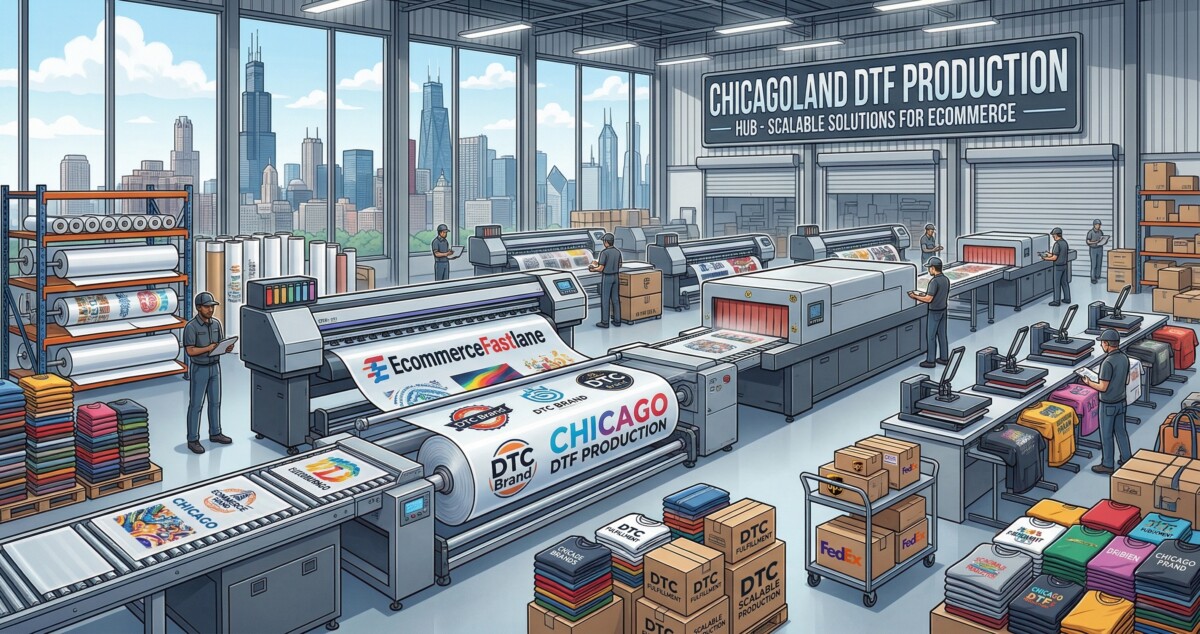
What matters operationally is not the technology itself but what it separates. DTF production decouples the manufacturing complexity from the pressing and fulfillment operation. You do not need to own or operate the printing equipment to produce professional-grade output. A regional supplier handles the film printing, powder application, and curing. You handle the pressing, which requires only a heat press and a flat surface. That division of labor is the structural advantage.
Screen printing requires screen setup, color separation, and minimum run economics that make small batches expensive. DTG prints directly onto garments but is equipment-intensive and fabric-specific, and it does not separate manufacturing from pressing the way DTF does. Heat transfer vinyl handles simple designs but lacks the gradient capability and long-term flexibility that full-color branded merchandise requires. DTF sits in a different category from all three because it gives you professional output without requiring you to own the production infrastructure that produces it.
The comparison that matters most for a scaling Shopify brand is not DTF versus screen printing on a cost-per-unit basis at 500 units. It is DTF versus any method that requires you to commit capital before you know what will sell. On that comparison, transfer-based production wins decisively.
Why Inventory Risk Is the Problem You Actually Need to Solve
Inventory exposure is the most underestimated operational risk in the custom print and merchandise category. Brands at $10K to $50K per month often carry it without realizing how much it is costing them, because the losses show up as slow-moving stock rather than as a line item on the P&L. By the time the dead inventory problem becomes visible, the working capital damage is already done.
Traditional production models require bulk minimums to be cost-efficient. A screen printer running a six-color design economically needs 48 to 72 units per colorway. A DTG operation running profitably needs consistent volume to justify equipment and labor overhead. Both models push you toward larger bets on individual designs, which means more capital at risk per SKU and less room to test new concepts without a meaningful financial commitment.
DTF transfers eliminate that constraint. A regional supplier like Eagle DTF Print in Chicago has no minimum order requirement. You can produce a single transfer or a thousand. That changes the economics of product testing entirely. A brand that can launch a new design for the cost of five transfers and a pressing session can run 20 product experiments in the time it takes a screen print operation to set up a single run. Most of those experiments will underperform. The ones that do not will tell you exactly where to concentrate your production volume, with real sales data rather than a pre-production guess.
This is directly connected to how print on demand and dropshipping compare on inventory and fulfillment. The core principle is the same: separating production from inventory commitment reduces financial risk and increases operational agility. DTF transfer sourcing applies that principle to brands that want more control over their output quality and pressing workflow than a fully outsourced POD relationship typically allows.
The Cost Structure Transformation That Makes Scaling Viable
Fixed cost manufacturing is a profitability trap that catches most apparel brands between $100K and $500K in annual revenue. The pattern is consistent: a brand builds or contracts a production setup that works at current volume, then scales into it and discovers that the fixed cost base does not compress proportionally as revenue grows. Margins that looked healthy at $200K start compressing at $400K because the infrastructure that was sized for $200K is now running at capacity and needs to be expanded, which means another round of fixed cost investment before the next revenue tier becomes profitable.
The alternative is a variable cost production model where your cost of goods scales with actual sales volume rather than with your production infrastructure. DTF transfer sourcing from a professional regional supplier is one of the cleanest implementations of that model available to a Shopify or DTC brand. You pay per transfer. You press per order. Your production cost is a direct function of your revenue, not a fixed overhead that exists whether you sell 10 units or 10,000 this month.
This matters more than most operators realize when they are still in the $10K to $100K range. The real cost of scaling past seven figures includes a cash conversion cycle that becomes brutally apparent as volume grows. Brands doing $2M annually often need $200K to $400K in working capital just to maintain smooth operations. Locking that capital into production infrastructure rather than keeping it available for inventory and marketing is one of the most common ways brands stall between $500K and $2M. A variable cost production model does not solve all of that, but it addresses one of its most controllable components.
The cash flow dimension is equally important. How fixed costs compress margins as you scale is a pattern I have seen across dozens of operator conversations. A brand can look profitable on paper while its bank account reflects a very different reality, because inventory capital gets tied up for 8 to 10 weeks before it converts to revenue. Transfer-based production shortens that cycle meaningfully. You are not buying finished garments 60 days before you know if they will sell. You are buying transfers when you have orders to fill, or in small batches sized to your near-term demand signal.
Regional Production Hubs and the Chicago Advantage
Geography matters more in print production than most digital-first operators assume. A supplier relationship with a production partner based in Chicago is structurally different from a relationship with a national fulfillment operation or an overseas transfer producer, and the differences compound as your volume grows.
Chicago sits at the center of the US logistics network. Shipping from Chicago reaches most of the continental US within two to three business days via ground. For a brand pressing transfers and shipping finished garments to customers, that means your production partner is rarely the constraint on your delivery timeline. For a brand that needs to reorder transfers quickly to respond to a demand spike, same-day or next-day turnaround from a local Chicago supplier is a real operational option rather than a premium exception.
Responsive customer support is the other dimension that regional proximity enables. When you have a question about a production run, a color calibration issue, or a rush order, you are talking to a team that operates in your time zone and can turn around a response in hours rather than days. That responsiveness is not just a convenience. It is a meaningful operational advantage when you are managing a peak season or a limited drop with a hard ship date.
The combination of central logistics positioning, fast turnaround capability, and direct customer access is why regional production hubs like Chicago have become a serious operational choice for brands that have outgrown fully offshore or fully national supplier relationships but are not yet at the scale where owning production infrastructure makes financial sense.
Operational Modularity in Practice
Modular production architecture is how brands at $500K to $5M build operational resilience without building operational complexity. The principle is straightforward: identify the functions that require specialization and outsource them to specialists, then connect those specialists through a workflow that you own and control.
For a custom print brand, that architecture looks like this. Centralized transfer manufacturing sits with a regional supplier who handles film printing, powder application, and curing at professional quality and consistent output standards. Pressing operations can be distributed, handled in-house, or outsourced to a local pressing service depending on your volume and capital situation. Fulfillment connects to your Shopify store through a 3PL or in-house operation depending on your order volume and SKU complexity. Each layer is independently scalable and independently replaceable if a better option emerges.
What this architecture eliminates is the single point of failure that vertically integrated production creates. If your screen printer has a capacity problem during Q4, your entire production operation is constrained. If your DTF transfer supplier has a capacity issue, you have the option to source from a second supplier while maintaining your pressing and fulfillment operations without interruption. Modularity is not just efficiency. It is resilience.
The margin implications of this architecture are worth tracking explicitly. Using a margin calculator for ecommerce brands to model your contribution margin per SKU under a transfer-based production model versus a bulk inventory model will often reveal a gap that is not obvious from top-line revenue numbers. The variable cost structure of transfer-based production typically produces better contribution margin at lower volumes and comparable or better margin at higher volumes, because you are not carrying the fixed cost overhead that bulk production requires.
Evaluating a DTF Transfer Partner for Long-Term Reliability
The quality of a DTF transfer relationship depends on three operational variables: output consistency, production scheduling, and quality inspection standards. All three need to hold up not just on a sample order but across repeated production runs at varying volumes and under peak season pressure.
Output consistency means that the 200th transfer in a batch looks the same as the first. Ink calibration drift, adhesive powder variation, and curing inconsistencies are the most common failure modes in lower-quality DTF operations. A professional supplier maintains controlled curing environments, precision ink calibration protocols, and batch consistency checks that prevent those failures from reaching your pressing operation. The practical test is to order across multiple sessions and compare the results before committing to a supplier for production-volume work.
Production scheduling reliability matters most during peak periods. A supplier that can turn around a standard order in 24 to 48 hours under normal conditions but stretches to seven to ten days during Q4 is a constraint that will show up at exactly the wrong moment. Ask specifically about peak season capacity and turnaround commitments before you are dependent on them.
Quality inspection standards are the third variable. Professional DTF facilities run inspection protocols on finished transfers before they ship. That means checking for color accuracy, adhesive coverage, and film integrity on a sample basis across each production run. A supplier that ships without inspection is passing the quality control burden to you, which means you are pressing and then discovering defects rather than catching them before they enter your workflow.
Competitive Positioning Through Production Intelligence
The custom print and merchandise category is getting more crowded at the commodity end. Brands competing on generic designs and standard product categories are facing margin compression from both sides: rising customer acquisition costs and increasing competition from low-cost producers. The brands that are winning are not competing on price. They are competing on design quality, product differentiation, and operational speed to market.
Transfer-based production directly supports all three of those competitive dimensions. Design quality improves when you are not constrained by screen printing color limits or DTG fabric requirements. Full-color, gradient-rich DTF output gives your design team the freedom to produce artwork that actually reflects your brand rather than artwork that has been simplified to fit a production constraint. Product differentiation improves when you can test new designs rapidly without minimum run commitments. Operational speed improves when your production partner can turn around transfers in 24 to 48 hours rather than the 7 to 14 day lead times that screen printing and DTG operations typically require.
The brands that will own the custom merchandise category in the next three to five years are the ones building modular, lean production systems now. The infrastructure investment required to get there is lower than it has ever been, and the regional supplier ecosystem, particularly in logistics-central markets like Chicago, is mature enough to support serious production volume at professional quality standards.
Frequently Asked Questions
What is DTF printing and how is it different from screen printing for ecommerce brands?
DTF, or Direct-to-Film printing, produces a ready-to-press transfer by printing artwork onto a specialized film, applying adhesive powder, and curing the design. Unlike screen printing, DTF requires no screen setup or color separation, has no minimum order requirement, and supports full-color gradient designs without additional cost or complexity. For ecommerce brands, the key operational difference is that DTF production separates the manufacturing step from the pressing step, meaning you can source transfers from a professional regional supplier and press them in your own operation or through a local pressing service. Screen printing requires the full production infrastructure to be co-located. DTF does not. That separation is what makes DTF economically viable at small batch sizes and operationally flexible at scale.
How does sourcing DTF transfers help with inventory risk on a Shopify store?
Traditional custom print production requires bulk minimums to be cost-efficient, which means committing capital to inventory before you know what will sell. DTF transfers have no minimum order requirement, so you can produce a small test batch of a new design, validate demand with real sales data, and then scale production based on what customers actually buy rather than what you predicted they would buy. Transfers can be stored flat in minimal space without the quality degradation risk of pre-printed garments, and they can be applied to blank inventory on demand as orders come in. This model converts a large upfront inventory commitment into a series of smaller, demand-responsive production decisions, which reduces working capital exposure and eliminates the dead inventory problem that erodes margins for most apparel brands between $100K and $500K in annual revenue.
What are the actual cost differences between DTF transfers and other production methods?
The cost comparison depends heavily on volume and design complexity. At low volumes, DTF transfers are typically more cost-effective than screen printing because there is no setup cost. A screen printing setup fee for a multi-color design can run $50 to $150 before a single unit is produced, which makes small runs expensive regardless of per-unit cost. DTF has no setup fee. At higher volumes, screen printing per-unit costs drop below DTF for simple, high-repeat designs, but DTF remains competitive for multi-design catalogs where you are not running the same design at very high volume. The more important cost comparison for most ecommerce operators is not per-unit cost but total cost of production including capital tied up in inventory. On that comparison, DTF-based on-demand production consistently outperforms bulk production models for brands with diverse design catalogs and variable demand patterns.
How do I find a reliable DTF printing partner in Chicago for my ecommerce operation?
Start by placing a test order that represents your typical production mix: a few different designs, a range of sizes, and ideally a small batch rather than a single transfer. Evaluate the output on color accuracy, adhesive coverage uniformity, and finish quality, then press a sample on your target garment and wash it three to five times to assess durability. Ask the supplier specifically about their quality inspection process and their peak season turnaround commitments before you depend on them for production volume. A regional Chicago supplier offers the additional advantage of same-day or next-day turnaround options and direct customer support without time zone delays, which matters when you are managing a limited drop or a peak season reorder. Verify that the supplier has no minimum order requirement so that your small-batch testing economics work before you commit to larger production runs.
When does it make sense to switch from a traditional print production model to DTF transfers?
The clearest signal is when your design catalog is growing faster than your ability to commit production capital to each new design. If you are launching three to five new designs per month and your current production model requires you to commit to 48 to 100 units per design before you know what will sell, you are carrying significant inventory risk that transfer-based production would eliminate. A second signal is when your fulfillment operation is being constrained by long production lead times from your current supplier. DTF transfer production with a regional partner typically runs 24 to 48 hours, compared to 7 to 14 days for screen printing and 3 to 7 days for DTG. If production lead time is limiting your ability to respond to demand spikes or run limited drops, switching to a transfer-based model will directly improve your operational agility. Whether you are doing $10K months or $500K months, the structural advantages apply at both stages.
