





What You Will Learn
- What an enterprise data management platform is and why it matters in 2026
- The layered architecture that keeps enterprise data organized and secure
- How leading tools like Yellowfin, Integrate.io, Informatica PowerCenter, Fivetran, and Matillion compare
- The key benefits of automating data pipelines and governance
- How to choose the right platform for your organization’s size and goals
- Answers to the most frequently asked questions about enterprise data management
Key Takeaways
- Enterprise data management platforms centralize data from apps, databases, APIs, and files for easier access and analysis.
- A layered architecture including data sources, integration, storage, preparation, governance, and analytics keeps data organized and secure.
- Tools like Yellowfin, Integrate.io, Informatica PowerCenter, Fivetran, and Matillion automate data integration and preparation.
- Automated pipelines reduce manual work, improve data quality, and speed reporting.
- Governance features ensure security, compliance, and controlled data access.
- The right platform enables faster analytics, smarter decisions, and scalable AI-ready data.
Businesses today rely on data from websites, apps, internal systems, and third-party tools to make smarter decisions and improve customer experiences. But that data only delivers value when it is well managed.
A modern data management platform provides a foundation for reporting, analytics, and artificial intelligence. Tools such as Yellowfin, Integrate.io, Informatica PowerCenter, Fivetran, and Matillion help organizations collect, prepare, and govern data efficiently. You can check out the live demo here to see connected data and real-time analytics in action.
With data playing such a central role in business success, it is no surprise that the market for these platforms is growing rapidly. The global enterprise data management market is expected to reach USD 294.99 billion by 2034, growing at an 11.5% CAGR. Investing in modern data tools is crucial for staying competitive.
But with so many options available, which platform is the right fit for your organization? Let’s take a closer look.
Why Do Enterprises Need a Data Management Platform?
Organizations today manage huge amounts of data across multiple systems. Without proper management, this data becomes hard to use. An enterprise data management platform connects data from databases, cloud services, applications, APIs, and files, then organizes it so teams can easily analyze and use it.
Here is why businesses should invest in a data management platform:
ChallengeImpact on Business
| Data silos across departments | Teams cannot access shared insights |
| Poor data quality | Reports become unreliable |
| Lack of governance | Compliance risks increase |
| Manual data preparation | Analysts waste time cleaning data |
Architecture of a Modern Data Management Platform
A modern data management platform uses a layered architecture. Each layer handles a different stage of the data lifecycle. This structure keeps data organized, secure, and ready for use. Teams can focus on generating insights instead of cleaning and fixing data.
LayerFunction
| Data Source Layer | Collects data from applications, databases, APIs, and files |
| Data Integration Layer | Extracts, transforms, and loads data into central storage |
| Storage Layer | Stores structured and unstructured data |
| Data Preparation Layer | Cleans and transforms data for analytics |
| Governance Layer | Manages security, policies, and compliance |
| Analytics Layer | Enables reporting, dashboards, and AI models |
Leading Enterprise Data Management Tools in 2026
Many tools are available to help businesses manage and prepare enterprise data. Each platform offers distinct strengths for specific business needs. Here are some of the top data solutions in the enterprise data ecosystem.
1. Yellowfin
Most analytics delays happen during data preparation and modeling, not reporting. Data analysts spend significant time cleaning datasets, validating schemas, and building transformation logic before analysis can begin.
Yellowfin BI solves this challenge with an integrated platform for data preparation and governance for analytics. It allows teams to connect, prepare, transform, and analyze data in one environment. Yellowfin is used by more than 29,000 organizations and over 3 million end-users across 75 countries every day.
Ideal For:
- Data analysts and BI teams
- Enterprises building self-service analytics
- Organizations needing secure and governed data access
Key Features:
- Unified Data Connectivity: Connect to databases, APIs, spreadsheets, and cloud platforms without moving your data.
- Metadata Layer for Self-Service Analytics: Create a business-friendly data model that hides technical complexity and allows non-technical users to build reports easily.
- Built-in Data Transformation: Clean, blend, and enrich data with a visual drag-and-drop interface instead of scripts.
- Data Profiling: Analyze the quality and structure of your data instantly to detect missing values, outliers, and inconsistencies.
- Automated Analytics: Activate advanced capabilities such as automated business monitoring, root-cause analysis, and natural-language queries powered by AI NLQ.
- Enterprise Grade Security: Protect sensitive information with row-level security and field-level permissions.
Why Yellowfin Is the Best Choice:
Yellowfin combines data preparation, analytics, and automation in one platform. It reduces the need for multiple tools and speeds up insight delivery. Its AI-powered Natural Language Query lets users ask plain-language questions and receive instant charts and graphs, no SQL required. Request a live demo to see it in action.
2. Integrate.io
Organizations spend hours cleaning CSV files, formatting spreadsheets, and preparing data before loading it into warehouses. Integrate.io automates file ingestion, ETL pipelines, and data standardization so teams no longer rely on manual file preparation.
Ideal For:
- Data engineers managing ETL pipelines
- Companies processing large volumes of file-based data
- SaaS-heavy organizations syncing multiple systems
Pros:
- Universal file ingestion (CSV, Excel, JSON, XML, X12, BAI)
- 220+ data transformation components
- Easy-to-use drag-and-drop pipeline builder
- Wide support for file formats and integrations
Cons:
- Primarily focused on integration rather than analytics
- Advanced transformations may still require technical configuration
3. Informatica PowerCenter
Large enterprises often struggle to unify customer, product, and operational data across departments, which prevents teams from getting a complete view of the business. Informatica PowerCenter and its Master Data Management and 360 applications unify data across domains to deliver a complete enterprise view with AI-driven insights.
Ideal For:
- Large enterprises managing complex data ecosystems
- Organizations implementing master data management
- Companies that require enterprise-wide data governance
Pros:
- Master Data Management for multi-domain data
- AI-powered automation with CLAIRE GPT
- AI-driven match and merge for entity resolution
- Pre-built Industry 360 applications
Cons:
- Complex implementation process
- Higher cost compared to smaller platforms
4. Fivetran
Your teams need fresh data for reporting. However, building and maintaining pipelines from multiple apps and databases takes time and constant engineering effort. API changes break pipelines, data becomes outdated, and analytics teams wait days for updates. Fivetran automates data extraction and loading from hundreds of sources directly into your data warehouse so teams can work with reliable and up-to-date data for analytics.
Ideal For:
- Data teams building modern cloud data warehouses
- Marketing and product analytics teams
- Organizations integrating SaaS platforms into analytics workflows
Pros:
- 200+ pre-built data connectors for SaaS apps, databases, and APIs
- Automated schema and API updates so pipelines do not break
- Pre-built analytics data models for platforms
- Low-code pipeline setup
Cons:
- Limited transformation capabilities compared to full ETL platforms
- Pricing can increase with high data volumes
- Requires a separate analytics or BI tool for insights
5. Matillion
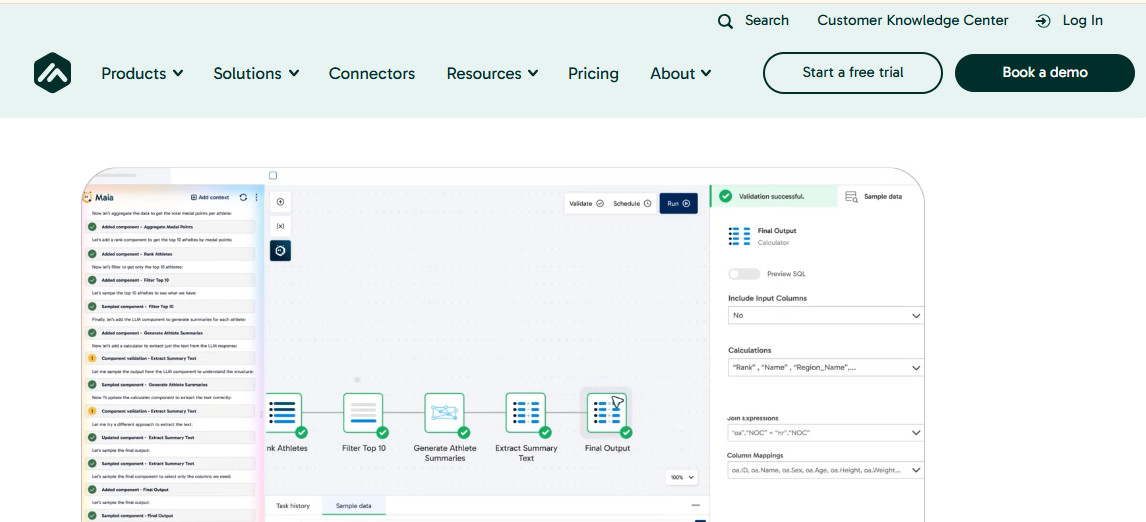
Moving data from multiple systems into a cloud data warehouse often requires custom scripts, complex pipelines, and constant maintenance. As data grows, teams struggle to keep pipelines reliable and analytics up to date. Matillion simplifies cloud data movement and transformation so teams can quickly move, sync, and prepare data for analytics without heavy engineering work.
Ideal For:
- Data engineering teams building cloud data pipelines
- Organizations migrating analytics infrastructure to the cloud
- Businesses needing automated data movement between systems
Pros:
- Native cloud integrations for platforms like Snowflake, Redshift, BigQuery, and Databricks
- Log-based Change Data Capture (CDC)
- No-code REST API connectors to integrate custom data sources
- Centralized pipeline management for ETL and ELT workflows
Cons:
- Advanced transformations may require technical expertise
- Requires external BI tools for dashboards and analytics
Quick Comparison: Which Platform Is Right for You?
PlatformBest ForAnalytics Built-In?Governance?
| Yellowfin | BI teams, self-service analytics | Yes – full suite | Yes – row & field level |
| Integrate.io | ETL engineers, file-heavy pipelines | No | Partial |
| Informatica PowerCenter | Large enterprise MDM | Partial (via add-ons) | Yes – enterprise grade |
| Fivetran | Cloud warehouse data loading | No | Partial |
| Matillion | Cloud ELT and data movement | No | Partial |
Key Benefits of an Enterprise Data Management Platform
An enterprise data management platform provides several key advantages for organizations that rely on data for decision-making.
Less Time Cleaning Data
No one enjoys spending hours fixing spreadsheets or correcting messy datasets. The enterprise data management platform automates data preparation, so your team can focus on analyzing insights instead of cleaning data. Tools like Yellowfin’s built-in drag-and-drop transformation interface eliminate the need for scripting entirely.
Faster Reporting
Outdated dashboards and slow reports can frustrate everyone. With enterprise data management tools, dashboards and reports automatically get updated with trusted data. This gives managers and stakeholders real-time insights so they can make faster, informed decisions. Yellowfin’s AI-powered Signals feature even surfaces critical changes in your data automatically, without anyone needing to log into a dashboard.
Stronger Compliance
Data security and governance are critical for protecting your organization from regulatory risks. The tools enforce row-level security and field permissions. This ensures that your sensitive information is always secure and accessible only to the right people.
Operational Efficiency
Manual processes slow teams down, increase errors, and waste valuable time. The enterprise data management platform’s automation capabilities free your team to focus on high-value work. Fivetran’s automated schema management, for example, means broken pipelines from API changes become a thing of the past.
AI-Ready Data Infrastructure
As organizations move toward AI and machine learning, having clean, governed, and well-structured data becomes non-negotiable. A modern enterprise data management platform ensures your data is consistently formatted, validated, and accessible – giving AI models the reliable inputs they need to generate accurate predictions and recommendations.
Modernize Your Data Management Platform for Better Analytics
Data volumes continue to grow as enterprises continue to opt for cloud platforms, digital services, and connected systems. Businesses using platforms like Yellowfin, Integrate.io, Informatica PowerCenter, Fivetran, and Matillion can gain a significant advantage, unlock faster insights, and empower teams with trusted data. The result is a data-driven enterprise ready for the future.
However, when it comes to combining ease of use with powerful analytics, Yellowfin – an enterprise data preparation platform – is the strong choice for governing data across multiple sources. Its unified approach to data connectivity, preparation, governance, and analytics means fewer tools, less complexity, and faster time to insight.
Explore how Yellowfin can streamline your data management and give you smarter business insights. Request your free live demo today.
Frequently Asked Questions About Enterprise Data Management Platforms
What is an enterprise data management platform?
An enterprise data management platform is a suite of tools and processes that helps organizations collect, integrate, store, govern, and analyze data from across their entire business. It connects data from databases, cloud services, APIs, applications, and files into a centralized, governed environment where teams can access trusted data for reporting, analytics, and AI-driven decision-making.
What is the difference between ETL and ELT in data management?
ETL (Extract, Transform, Load) processes data before loading it into a destination system, making it ideal for structured data warehouses. ELT (Extract, Load, Transform) loads raw data first and transforms it inside the destination, which is better suited for cloud-based data lakes and warehouses like Snowflake or BigQuery. Tools like Matillion are purpose-built for ELT in cloud environments, while Informatica PowerCenter is traditionally ETL-focused.
How does data governance work in an enterprise data management platform?
Data governance in an enterprise data management platform typically includes role-based access controls, row-level and field-level security, data lineage tracking, audit logging, and policy enforcement. These features ensure that only authorized users can access specific data sets, that sensitive information is protected, and that your organization remains compliant with regulations like GDPR, CCPA, and HIPAA. Yellowfin, for example, offers enterprise-grade row-level security and field-level permissions built directly into its analytics layer.
Which enterprise data management platform is best for small to mid-size businesses?
For small to mid-size businesses, Yellowfin and Fivetran are strong starting points. Yellowfin provides an all-in-one platform covering data preparation, governance, and analytics without requiring multiple separate tools. Fivetran is ideal for teams that need to quickly connect SaaS platforms to a cloud data warehouse. Both offer lower implementation complexity compared to enterprise-scale solutions like Informatica PowerCenter, which is better suited to large organizations with dedicated data engineering teams.
How does Yellowfin differ from traditional BI tools?
Unlike traditional BI tools that focus only on visualization and reporting, Yellowfin combines data preparation, governance, automated analytics, and AI-powered insights in a single platform. Its Signals feature automatically monitors live data for changes and alerts users to significant trends without any manual dashboard monitoring. Its AI Natural Language Query (AI NLQ) allows users to ask plain-language questions and get instant charts and graphs, making analytics accessible to non-technical users. You can explore these capabilities firsthand by requesting a live demo.
What is master data management (MDM) and do I need it?
Master data management (MDM) is the process of creating a single, authoritative source of truth for core business entities like customers, products, suppliers, and employees. It is particularly valuable for large enterprises where the same data exists in multiple systems with conflicting formats or values. Informatica PowerCenter’s MDM capabilities are among the most mature in the industry, offering AI-driven entity resolution and pre-built Industry 360 applications. Smaller organizations may not need full MDM capabilities and can achieve similar benefits through centralized data integration and governance tools.
How long does it take to implement an enterprise data management platform?
Implementation timelines vary significantly by platform and organizational complexity. Cloud-native tools like Fivetran and Matillion can be operational within days to a few weeks, as they are designed for fast onboarding with pre-built connectors and low-code configuration. Yellowfin can go live in under two weeks for embedded analytics deployments. Enterprise platforms like Informatica PowerCenter typically require longer implementation cycles of several months due to their complexity and the scope of data domains they manage. The key is to align platform choice with your team’s technical capacity and timeline requirements.
