





Quick Decision Framework
- Who This Is For: Shopify merchants doing $10K to $500K per month who are deciding where to invest time and catalog effort across AI shopping channels in 2026.
- Skip If: You have not yet cleaned your product catalog or written clear shipping and returns policies. Fix those first or you will spread bad data across both channels simultaneously.
- Key Benefit: A clear, honest comparison of Google AI Mode and ChatGPT Shopping so you can make a channel prioritization decision in the next 30 days rather than guessing or waiting.
- What You’ll Need: Access to your Shopify Admin (specifically Agentic Storefronts settings), your current product catalog, and your margin data for your top 20 SKUs.
- Time to Complete: 12 minutes to read, 2 to 4 hours to make your first channel decision and begin the setup steps outlined here.
Two AI shopping channels launched within weeks of each other in early 2026. One charges you 4% of every sale. The other charges nothing. The question is not which one is free. The question is which one is right for your catalog, your margins, and your customers right now.
What You’ll Learn
- Understand exactly how Google AI Mode and ChatGPT Shopping work as commerce surfaces for Shopify merchants, not as search tools.
- Compare the fee structures, checkout mechanics, and data requirements of each platform so you can model the real cost per channel.
- Identify which channel fits your catalog type, average order value, and customer intent patterns based on what is actually happening in 2026.
- Decide which platform to prioritize first using a stage-based framework drawn from patterns across 450+ merchant conversations.
- Act on a concrete setup checklist for whichever channel you choose, including the catalog and policy work that determines whether you get recommended at all.
In January 2026, two things happened at almost the same time. OpenAI confirmed that Shopify merchants would pay a 4% fee on every sale processed through ChatGPT Checkout, effective January 26. And Shopify announced it was co-developing the Universal Commerce Protocol with Google, setting up native checkout inside Google AI Mode and the Gemini app with no additional transaction fee for merchants.
I have been watching this play out across the merchant conversations I track, and the pattern I keep seeing is the same one I saw when Instagram Shopping launched, then TikTok Shop, then buy buttons on Pinterest. Most merchants either jump on everything at once and spread themselves thin, or they freeze and wait until “it’s proven.” Neither approach wins. What wins is making a deliberate channel prioritization decision based on your specific catalog and margins, then executing it cleanly.
This is not a “both channels are great, try them both” piece. I am going to give you the honest comparison, including the tradeoffs most coverage is glossing over, and a clear framework for deciding which one to prioritize first. If you want the broader context of how these channels fit into the agentic commerce shift that is reshaping Shopify in 2026, start with the complete guide to agentic commerce for Shopify merchants before coming back here.
How Google AI Mode Works as a Commerce Channel
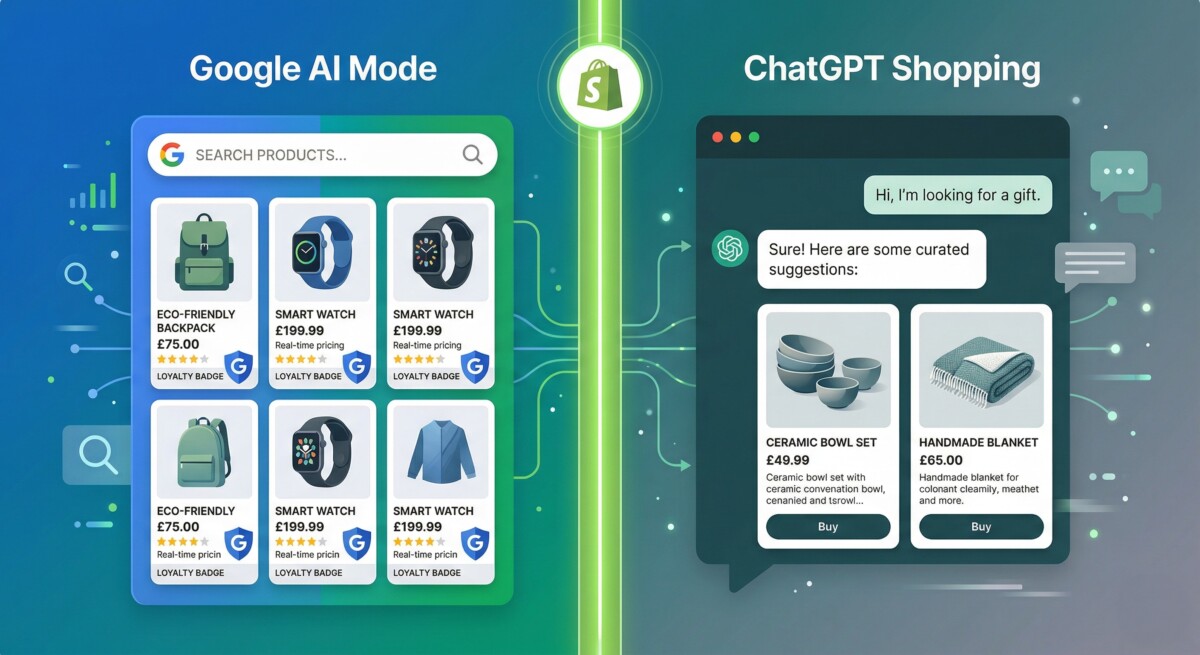
Google AI Mode is not a new search result format. It is a conversational shopping surface inside Google Search and the Gemini app where a shopper can describe what they want, compare options across multiple stores, and complete a purchase without leaving the conversation. For Shopify merchants, this channel is powered by the Universal Commerce Protocol, the open standard that Google and Shopify co-developed and announced at NRF 2026 in January, with the full merchant rollout beginning in March 2026.
The mechanics matter here because they determine what you actually need to do to show up. When a shopper types something like “lightweight carry-on with a laptop sleeve under $250” into Google AI Mode, the system pulls structured product data from participating merchants, compares options in real time, and surfaces a curated shortlist with an embedded checkout option. The data Google is pulling is your Shopify Catalog data, specifically titles, variants, pricing, inventory signals, and product attributes. If that data is clean and complete, you compete. If it is thin or inconsistent, you do not appear in the shortlist regardless of how much you have spent on Google Ads historically.
The fee structure is straightforward: Google AI Mode does not charge Shopify merchants an additional transaction fee on top of standard Shopify payment processing. You pay your normal Shopify plan fees and payment processing costs. That is it. Google is monetizing through its existing advertising infrastructure and the Direct Offers pilot, which lets select merchants present exclusive promotions to shoppers at the exact moment of purchase intent, but participation in Direct Offers is not required to appear in standard AI Mode results.
What makes Google AI Mode structurally different from ChatGPT Shopping is the intent layer. People who use Google AI Mode are already in a buying mindset. They came to Google to find something, and AI Mode is the next step in that journey. According to Digital Commerce 360’s reporting on Google’s AI Mode ecommerce expansion, Google’s own user research from late 2025 showed that shoppers found AI Mode significantly more helpful when they could compare multiple brands and stores in one experience. That is the behavior you are competing in: high-intent, comparison-ready, ready to buy. The catalog quality bar is high, but the traffic quality is also high. For merchants with well-structured product data and clear policies, this channel rewards preparation in a way that feels similar to how Google Shopping rewarded feed quality a decade ago.
The limitation worth naming honestly is that Google AI Mode’s Shopify integration is still rolling out. As of March 2026, Shopify’s agentic commerce announcement confirmed that native shopping on Google surfaces is rolling out soon for Shopify merchants, with brands like Monos, Gymshark, and Everlane named as early participants. If you are not yet seeing the Google AI Mode toggle in your Agentic Storefronts admin, you are likely in the queue. That does not mean you should wait to prepare your catalog. The merchants who will win early are the ones whose data is ready when the channel opens to them.
How ChatGPT Shopping Works as a Commerce Channel
ChatGPT Shopping is live now. It went active for Shopify merchants on January 26, 2026, and it operates differently from Google AI Mode in ways that matter for your margin calculations and your operational setup.
The shopper experience is conversational in a more open-ended way than Google AI Mode. Someone using ChatGPT is not necessarily in a buying mindset when they start the conversation. They might be researching, comparing categories, asking for gift ideas, or troubleshooting a problem. ChatGPT Shopping surfaces relevant products inside that conversation, and when the shopper is ready to buy, they can complete the purchase through an embedded checkout. The transaction routes through Shopify’s checkout infrastructure, which means you remain the merchant of record, you see the order in your Shopify Admin, and the customer relationship stays yours.
The fee structure is where this channel requires honest math. OpenAI charges a 4% fee on every sale processed through ChatGPT Checkout. This is on top of your standard Shopify payment processing fees, which typically run around 2.9% plus a fixed amount per transaction depending on your plan. As Marketplace Pulse’s analysis of ChatGPT’s 4% fee noted, a merchant doing $1 million through this channel would pay approximately $69,000 in combined marketplace and processing costs, or roughly 7% total. That is well below Amazon’s typical 15% referral fee, and the comparison to Amazon is genuinely relevant because ChatGPT is behaving like a marketplace with discovery economics, not a traffic referral source.
The 4% fee is not inherently bad, but it is margin-sensitive in ways that vary by product category. For a merchant selling $200 skincare bundles, 4% is $8 per order, which is manageable if the channel converts at a reasonable rate. For a merchant selling $25 accessories with thin margins, 4% on top of processing costs changes the unit economics meaningfully. The merchants who are reporting early positive results from ChatGPT Shopping tend to have average order values above $80 and product categories with clear, describable specs. The merchants who are struggling tend to have highly subjective products where the conversational interface creates more questions than it answers, or low-margin items where the fee compresses profitability below acceptable thresholds. Before you model the 4% fee against your margins, make sure your labor cost baseline is accurate. If you have hourly fulfillment staff, it is worth understanding how to file a wage and hour claim so that any compliance exposure does not become a surprise line item in your channel economics.
One thing I want to flag clearly: ChatGPT Shopping is opt-in. Merchants are not automatically enrolled. You activate it through Agentic Storefronts in your Shopify Admin, and you can control which products are eligible. That level of control is important because it means you can run a tight pilot with your best-performing SKUs rather than exposing your entire catalog before you understand the channel’s behavior. For a full breakdown of how AI shopping agents are reshaping product discovery across all these surfaces, the post on how AI shopping agents are reshaping product discovery in 2026 gives useful context on the broader shift.
The Honest Side-by-Side Comparison
Most coverage of these two channels either avoids the fee comparison or treats it as the only factor. Neither approach serves you. Here is how these channels actually compare across the dimensions that matter for a Shopify merchant making a prioritization decision in 2026.
The comparison that jumps out most clearly is the fee asymmetry. Google AI Mode costs you nothing extra per transaction. ChatGPT Shopping costs you 4% per transaction. But the fee difference does not automatically make Google the better channel, because ChatGPT Shopping is live today and Google AI Mode is still rolling out. If your catalog is ready and your margins support the fee, ChatGPT Shopping gives you a live channel to test, learn from, and optimize right now. Google AI Mode is the channel to prepare for while you run that test.
The intent difference also matters more than most merchants realize. Google AI Mode captures people who were already in a buying mode when they opened Google. ChatGPT Shopping captures people who may have started a conversation for an entirely different reason and discovered your product along the way. Both are valuable, but they reward different things. Google rewards catalog completeness and real-time pricing accuracy. ChatGPT rewards conversational product descriptions and the ability to answer follow-up questions confidently.
Which Channel Should You Prioritize First
The answer depends on two variables: your current catalog quality and your margin structure. Here is how I would frame the decision for each merchant stage. For merchants scaling fulfillment operations in California, staying current on California wage and hour laws is part of the operational foundation that protects your margins before you commit to a new channel’s fee structure.
If you are doing under $50K per month, prioritize Google AI Mode preparation now and run a small ChatGPT Shopping pilot simultaneously. Your goal is not to maximize volume on either channel yet. Your goal is to build the catalog and policy foundation that both channels require. The work you do to make your product data clean and structured for Google AI Mode is the exact same work that makes you more competitive on ChatGPT Shopping. Do the foundation work once, then toggle both channels on as they become available. Keep your ChatGPT pilot to 20 to 30 SKUs with your highest margins so the 4% fee does not compress profitability before you have data.
If you are doing $50K to $500K per month, you have enough volume to run a real channel test. My recommendation is to activate ChatGPT Shopping on your top 30 to 50 SKUs by margin and catalog quality, run it for 60 days, and track AI-attributed revenue, conversion rate on agent-referred sessions, and return rate by SKU. While that test runs, complete your Google AI Mode setup so you are ready to scale the moment the rollout reaches your account. The merchants I have seen win early at this stage are the ones who treat the ChatGPT pilot as a learning exercise, not a revenue target. The data you collect about which products get recommended and which questions customers ask will directly inform how you optimize your Google AI Mode catalog.
If you are doing over $500K per month, you need both channels running and measured. The fee question at this stage becomes a negotiation question, not a binary yes or no. At meaningful volume, 4% of ChatGPT-attributed revenue is a real number that belongs in your channel economics model. Run it like you run any paid channel: track cost per acquisition including the fee, compare it against your email, paid social, and affiliate channel costs, and let the data tell you the right allocation. Google AI Mode, once fully available to your account, will likely become your higher-volume channel because of the intent quality and zero fee structure, but ChatGPT Shopping’s consumer reach across 300 million plus weekly users is a distribution advantage you do not want to ignore.
The one thing I would tell every merchant regardless of stage: do not wait for perfect attribution before you start. Attribution across AI shopping channels is still developing, and it will not be clean for a while. The merchants who win early are the ones who accept directional data and iterate, not the ones who wait for the same reporting clarity they have in Google Ads. For context on how Shopify’s Agentic Storefronts admin controls work across both channels, the section on Shopify’s Agentic Storefronts admin controls for AI channels in the agentic commerce guide walks through exactly what you can toggle and measure.
The Catalog Work That Determines Whether You Get Recommended at All
Both channels share the same underlying requirement: your product data has to be good enough that an AI agent can confidently match your product to a shopper’s constraints. This is the part most merchants underestimate, and it is the reason that turning on either channel without doing the catalog work first produces disappointing results.
I have seen this pattern consistently across the merchant conversations I track. A brand enables ChatGPT Shopping, waits two weeks, sees minimal orders, and concludes the channel does not work for their category. What actually happened is that their product titles were brand-voice-heavy and spec-light, their variant names were ambiguous, and their shipping policy had not been updated in 18 months. The AI agent could not confidently recommend their products because it could not confidently answer the questions a shopper would ask.
The catalog work that matters most for both channels comes down to five areas. Titles need to include the constraints that matter for your category: size system, material, compatibility, capacity, or use case. A title like “The Nomad Carry-On” tells an agent almost nothing. A title like “Nomad Carry-On, Polycarbonate Shell, 21 Inches, TSA-Approved, USB-C Port” gives the agent everything it needs to match your product to a shopper’s stated requirements. Variants need to be unambiguous: “Midnight Black” instead of “Black,” “Men’s US 10” instead of “10,” “500ml” instead of “Medium.” Attributes need to be filled in completely: materials, dimensions, certifications, what is included in the box, and who the product is for. Policies need to be written so an agent can answer a follow-up question in plain language: not “we offer hassle-free returns” but “returns accepted within 30 days of delivery, items must be unworn with original tags, return shipping is covered by us.” And inventory signals need to be real-time accurate, because an agent that recommends a product that is out of stock is an agent that loses the shopper’s trust.
The good news is that this catalog work compounds. The same improvements that make you more competitive on ChatGPT Shopping and Google AI Mode also improve your standard Shopify conversion rate, reduce support ticket volume, and strengthen your Google Shopping feed performance. It is not AI-specific work. It is the kind of merchant fundamentals work that pays dividends across every channel you operate.
Frequently Asked Questions
Does Google AI Mode charge Shopify merchants a transaction fee like ChatGPT Shopping does?
No. Google AI Mode does not charge Shopify merchants an additional transaction fee on sales made through its AI shopping surface. You pay your standard Shopify payment processing fees, which typically run around 2.9% plus a fixed amount per transaction depending on your plan. ChatGPT Shopping, by contrast, charges a 4% fee on every sale processed through its checkout, on top of your standard Shopify processing costs. This fee difference is significant when modeling channel economics, particularly for merchants with lower average order values or tighter margins. The fee-free structure of Google AI Mode is one of its most important advantages for merchants who are comparing the two channels.
How do I enable ChatGPT Shopping and Google AI Mode for my Shopify store?
Both channels are managed through Agentic Storefronts in your Shopify Admin. Navigate to your admin, find the Agentic Storefronts section, and you will see the AI channel toggles available to your account. ChatGPT Shopping has been live for eligible Shopify merchants since January 26, 2026, and requires you to opt in rather than being automatically enrolled. Google AI Mode is rolling out in phases starting March 2026 and may not yet show as available in all accounts. The setup process for both channels involves connecting your Shopify Catalog so your product data is syndicated to each AI surface. You also have the ability to control which specific products are eligible to appear and be transacted on, which is important for running a focused pilot before enabling your full catalog.
What catalog data do AI shopping channels like Google AI Mode and ChatGPT Shopping actually use to recommend my products?
Both channels rely primarily on your Shopify Catalog data, specifically product titles, variant names and options, product attributes such as materials, dimensions, and compatibility, pricing and inventory signals, and product descriptions. The AI agents that power these channels behave like comparison engines: they match a shopper’s stated constraints to the structured data in your catalog. If your titles are brand-voice-heavy but light on specs, if your variants are ambiguous, or if your attributes are incomplete, the agent has less to work with and is less likely to recommend your products confidently. The single most impactful catalog improvement you can make is adding constraint-relevant information to your titles and filling in product attributes completely for your top 30 to 50 SKUs by revenue.
Is the 4% ChatGPT Shopping fee worth it for Shopify merchants?
The honest answer is: it depends on your average order value and margin structure. For merchants with average order values above $80 and gross margins above 50%, the 4% fee is manageable and comparable to what you might pay for affiliate traffic or a marketplace referral. For merchants with lower average order values or tighter margins, particularly in categories like accessories, consumables, or low-price-point goods, the fee can compress profitability below acceptable thresholds. The useful comparison is not to free channels but to Amazon’s 15% referral fee or paid social acquisition costs. ChatGPT Shopping traffic tends to arrive with high intent, which means conversion rates on agent-referred sessions can be meaningfully higher than cold paid social traffic, partially offsetting the fee. Model the math for your specific catalog before deciding.
Should I run Google AI Mode and ChatGPT Shopping at the same time, or pick one first?
For most merchants doing under $100K per month, I recommend activating ChatGPT Shopping on a tight SKU set of 20 to 30 products with your best margins, while simultaneously preparing your catalog for Google AI Mode. The catalog work required for both channels is essentially identical, so you do the preparation once and benefit on both surfaces. ChatGPT Shopping is live now and gives you real data to learn from. Google AI Mode is rolling out and will likely become the higher-volume channel for most merchants once fully available, given its zero transaction fee and high-intent shopper base. For merchants doing over $100K per month, run both channels with clear measurement frameworks and treat the fee difference as a channel economics variable rather than a binary reason to avoid one or the other.
