

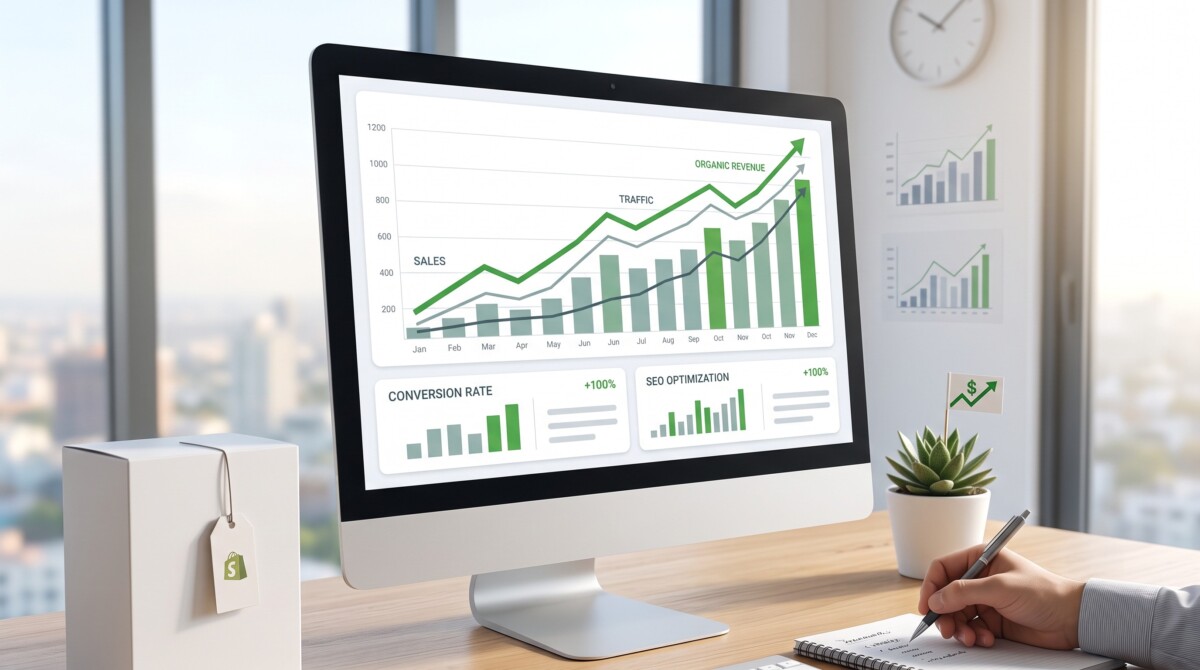
A specialist Shopify SEO agency grows organic revenue by fixing platform-specific technical issues, turning collection and product pages into high-intent landing pages, building authority with earned links, and pairing SEO with conversion rate optimization.
Specialist Shopify SEO is less about chasing vanity keywords and more about engineering a store that attracts buyers with intent, loads quickly, and quietly turns search clicks into repeat customers.
Many Shopify store owners assume that simply launching a well-designed online store is enough to attract customers through Google. In reality, Shopify’s default setup often creates technical and content limitations that can restrict organic growth. As competition increases and paid advertising costs continue to rise, relying solely on paid traffic becomes increasingly difficult to sustain.
A specialist SEO agency approaches Shopify growth differently. Rather than focusing on traffic alone, the goal is to increase organic revenue by attracting shoppers with strong purchase intent and creating a store experience that converts visitors into customers.
Shopify is one of the most user-friendly ecommerce platforms available, but it is not free from SEO challenges.
Many stores suffer from duplicate content issues caused by product variants, collection URLs, and filtering systems. Without proper optimization, search engines can waste crawl budget on duplicate pages while important products and collections struggle to rank.
A specialist agency typically addresses issues such as:
According to Google’s SEO Starter Guide, website owners should make it easy for search engines to understand site structure, identify important pages, and efficiently crawl content. Stores that address these technical foundations are typically better positioned to compete for valuable organic search traffic.
By resolving Shopify-specific technical barriers early, businesses create a stronger foundation for content marketing, authority building, and long-term organic revenue growth.
For many Shopify stores, collection pages generate more organic traffic than individual product pages. However, these pages are often underutilized.
Most collection pages contain little more than a title and a product grid. A specialist SEO strategy transforms them into valuable landing pages capable of targeting highly relevant commercial keywords.
This often includes:
These improvements help search engines better understand the page while increasing visibility for keywords used by shoppers who are actively researching products.
Traffic alone does not generate revenue. The most successful Shopify SEO campaigns focus on attracting users who are close to making a purchase.
Instead of publishing generic blog content, specialist agencies develop content designed to support the buying journey.
Common examples include:
A search such as “best standing desk for home office” often indicates far stronger commercial intent than a general informational query. By targeting these bottom-of-funnel searches, Shopify stores can attract visitors who are much more likely to convert into customers.
Strong content and technical SEO alone are rarely enough in competitive markets. Search engines use backlinks and brand mentions as indicators of trust and authority. As a result, specialist agencies invest heavily in digital PR and authority-building campaigns.
This may involve:
These activities strengthen overall domain authority and improve the store’s ability to rank for competitive commercial keywords.
Driving traffic to a Shopify store is only part of the equation. If visitors fail to convert, rankings alone provide limited business value. This is why many specialist agencies combine SEO with conversion rate optimization (CRO).
Areas commonly reviewed include:
Even small improvements in conversion rates can significantly increase revenue without requiring additional traffic.
Shopify SEO requires a combination of technical expertise, ecommerce strategy, content development, authority building, and conversion optimization. These challenges differ considerably from those faced by local businesses or traditional service-based websites.
For ecommerce brands looking to increase organic revenue, partnering with an experienced SEO agency that understands Shopify’s specific strengths and limitations can provide a meaningful competitive advantage.
Carrie-ann Sudlow Marketing works with Shopify and ecommerce businesses to improve organic visibility through technical SEO, content strategy, authority building, and conversion-focused optimization designed to support long-term revenue growth.
One of the biggest differences between a specialist agency and a general provider is how success is measured. While rankings remain important, revenue-focused SEO places greater emphasis on metrics such as:
These metrics provide a clearer picture of how SEO contributes to overall business performance.
Growing a Shopify store through organic search requires more than publishing content and hoping for rankings. Sustainable growth comes from addressing technical SEO issues, optimizing collection and product pages, creating content that targets buyers, building authority through digital PR, and improving conversion rates across the customer journey.
By focusing on these five pillars, specialist Shopify SEO agencies help businesses generate qualified traffic, increase conversions, and build a long-term source of organic revenue that reduces dependence on paid advertising.
A specialist Shopify SEO agency understands the platform’s specific technical constraints, ecommerce patterns, and app ecosystem, so it designs campaigns around revenue rather than just rankings. General providers may apply generic best practices, but specialists know how to fix duplicate content from variants and collections, when to adjust themes, and how to align category and product templates with buyer intent. That typically leads to faster, more reliable gains in organic revenue for Shopify stores.
It makes sense to hire a specialist once organic search already drives some sales and you are either hitting a plateau or watching paid acquisition costs climb. If you are doing at least steady five-figure monthly revenue, have product-market fit, and can implement technical and content changes, a specialist agency can usually find meaningful gains. Very early-stage stores might be better served by fixing basic on-site issues and validating their offer before investing in a full-funnel SEO program.
During the first 90 days, you should expect a technical audit, analytics and tracking cleanup, initial fixes to the most harmful SEO issues, and a prioritized roadmap for collection, product, and content work. You may see early wins from cleaning up duplicate URLs, improving site speed, and optimizing a handful of key collections and products. The agency should also define the core KPIs and build reporting so you can see how organic revenue, conversion rates, and non-branded traffic start to move.
Meaningful organic revenue growth typically appears between six and twelve months into a focused Shopify SEO program, assuming the store has enough authority and demand to work with. Technical fixes and on-page optimization can produce incremental gains earlier, especially for mid-competition terms, but ranking for more competitive commercial keywords and seeing those rankings translate into revenue takes time. Consistency and alignment with product and merchandising decisions are key.
You should look for an agency with proven Shopify case studies, a clear process for technical and on-page work, and a measurement framework tied to revenue, not just rankings. Ask how they handle Shopify-specific challenges, how they coordinate with developers and content teams, and how they prioritize work based on your margins and inventory. A strong partner will be transparent about timelines, trade-offs, and where SEO fits alongside paid and lifecycle marketing in your overall growth strategy.





