




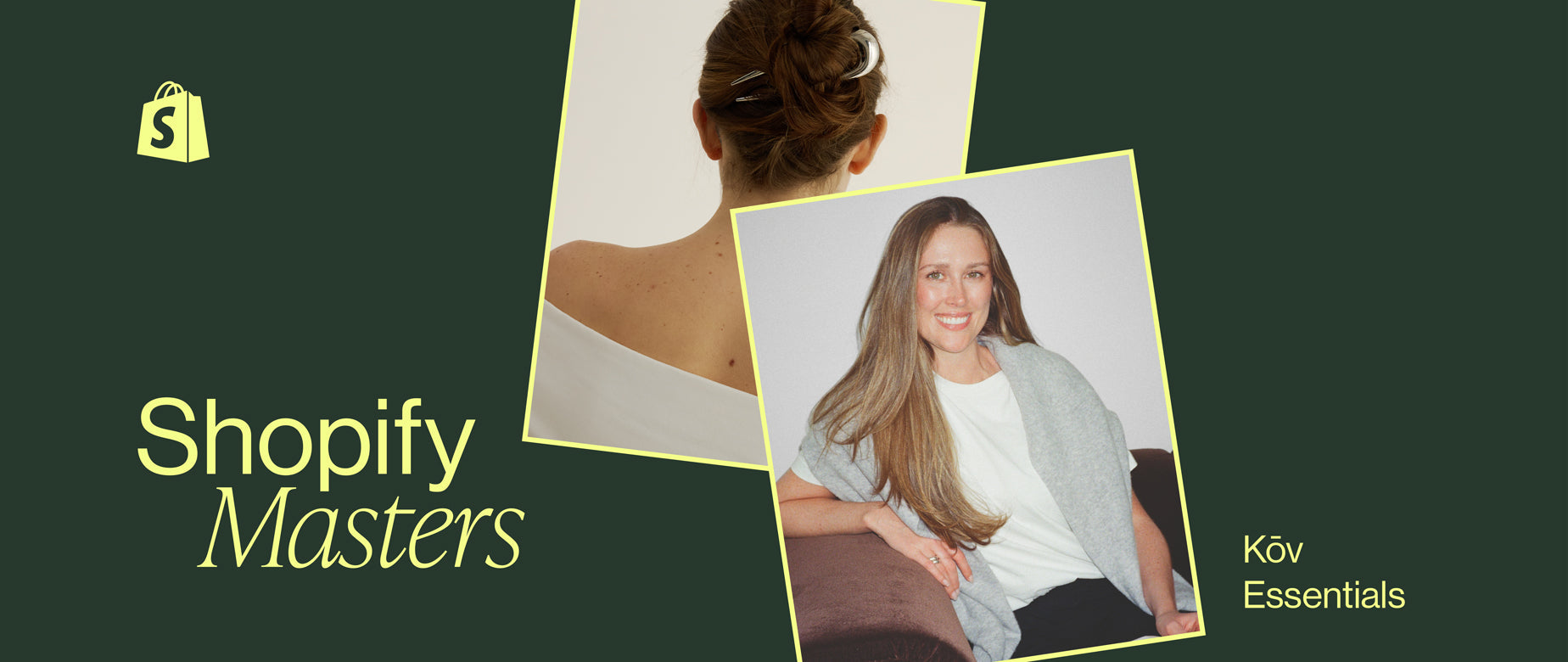
Five years ago, Chelsea Branch asked her mom to film her in a field near their house for a TikTok video. She was a college student, still sampling her first claw clip prototype. The video hit nearly two million views overnight.
@kovessentials The model doesn’t even have very thick hair but this is for demonstration purposes lol
By the next day, she’d built an ecommerce store and an email sign-up form, figuring it out as she went. That scrappy launch turned into more than $1 million in first-year sales, with zero paid customer acquisition.


The more useful story for fellow founders is what came after: the pressure to chase another viral peak, the algorithm shifts that made virality less valuable, and the strategic discipline to remain in one product category. Here’s how Chelsea built Kōv Essentials past its viral moment.

On the unplanned TikTok that forced her to build a business overnight:
We were in the late stages of sampling and I was at university, living at home. I saw an opportunity—TikTok was really trending at the time—and I asked my mom to come to a local field, literally a field, and film me putting my hair up with one of our final samples. I was like, I’m just gonna post it, see what comes from it, and hope for the best.
I woke up the next morning and my notifications were blowing up. I got nearly two million views overnight. Never in a million years could I have expected that response.
That video put fire beneath me. It forced us to very quickly come up with a go-to-market plan. I was confident in the product, but I wasn’t confident that someone would buy it—which is such a silly thought in retrospect. I’m not the only person with this problem. So the next day I made an ecomm store and opened up our email list so people could sign up to be first to know when we went live. I could not tell you how I even figured that out, honestly. I think that’s just the scrappy nature of entrepreneurship.
On why “done is better than perfect” became her operating philosophy:
I love the saying “done is better than perfect.” If you just have an idea, run with it, post it. What we saw over the years of building Kōv on socials is that going out on a whim and posting things you feel confident about has such a better payoff than those more curated, well-thought-through videos—at least when it comes to TikTok specifically.
Had I waited and made sure everything was perfect, we wouldn’t be where we are today.
I’m very type A, very controlling, very big on perfectionism, and I recognize that while that may be a strength, it’s also my weakness. As we’ve grown, I’ve learned where to let that go. I’m more deliberate now with overall concepts, campaign imagery, copy, and email strategy. As long as I know the overarching plan is solid and it’s based on customer feedback, there are places where we can let things be imperfect—as hard as that is to say.
On the chronic pressure to chase another viral moment:
There is this chronic pressure to chase that high and to have another moment of virality. But I think that as a brand that’s come from that place—and partially because algorithms have changed and things don’t go viral the same way they used to, and if they do, they don’t lead to the same conversions—we’ve come to realize that virality is great, but there’s space to balance it with long-term building. Those viral peaks are great for exposure and awareness, but nurturing the relationship comes from more value-add content over time.

We used to hone in on a few styles that were proven to go viral for us and iterate on them day after day. Now we balance that differently. Those viral concepts we trust, and we push them in once a month. Between those, we’re focusing on nurturing new followers, so it’s more about phases of content strategy rather than chasing specific concepts.
I think as a founder, there’s such an emotional connection to your brand—whether it’s chasing the viral moment, or customer feedback, or the pressures of developing new products. It can really affect your mental health.
Something that’s helped me recently is blocking the TikTok app on my phone, because at the end of the day, even if I’m scrolling my own feed, my mind is pulling it back to work. It’s about finding little moments to fully lock out of work and having a bit of balance.
On using TikTok as a product development tool:
When we launched, our hero clip—our daily clip—only came in sizes small and medium. Which is so interesting to look back on, because I have videos from those sampling days where I was asking my friends if the size of the clip was insane, like so out of the norm. That clip is now just our medium. We now have a large and extra large, built entirely from community feedback.

I have a lot of hair, but there are women who have more hair than me, and I was initially designing out of my own problem. So how can we turn to our community—what they’re commenting, what they’re DMing us—and genuinely pull them into that process? I’ll receive samples, put my phone up, record a TikTok, and say, “This is what the sample is like. Do you like the design? Are there things we need to change?”
When we were building out the extra-large size, it was way too big for my hair. So we pulled in a test group of customers to try it out and give us their honest feedback on the first sample round. It creates anticipation around a launch and gives us a lot of opportunity to connect with the audience.
On the sunglasses expansion that taught her to stay in her lane:
There was a period where I was a little bit lost as a founder. Six years now, but at that point it was five years of developing new products all within this very niche category. I wanted something new. I’d explored the opportunity of hair care and decided it wasn’t for us. I don’t think we have the expertise, and there are so many brands doing so great in that category.
So I leaned toward lifestyle. There was a consistency in materials: Our eyewear is made with cellulose acetate, and our clips are all made with cellulose acetate, so it felt like there was synergy there. Honestly, it did great and I was really impressed by the turnout when we launched. However, at the end of the day, there are so many other brands that do eyewear, and that is their category, and they are complete experts. Clips are our bread and butter, and there’s no point in trying to change that. We just need to lean into it.
On choosing to go deep in a niche instead of wide:
We’re going through a rebrand in mid-2026, and we’re still going to be Kōv, but a bit more grown up and established. That really forced us to sit down and recognize that we want to continue in this niche category, which I feel like a lot of brands lose sight of. Although we don’t have a consumable product, our repeat rate is very, very strong. That says a lot about what happens when you really know your product and your customer.
I think a lot of founders get into that place where they want to expand just because they want something new. It really comes down to understanding where your strengths are: We know our product and we know we do it so well. So for us, it’s about going deep instead of wide.
Catch Chelsea’s full conversation on Shopify Masters to hear how she justifies a premium price in a commodity category, what she wishes she’d asked her manufacturer before 14 rounds of sampling, and why pop-ups are more costly than most small teams expect.
This interview has been condensed and edited for length and clarity.
