





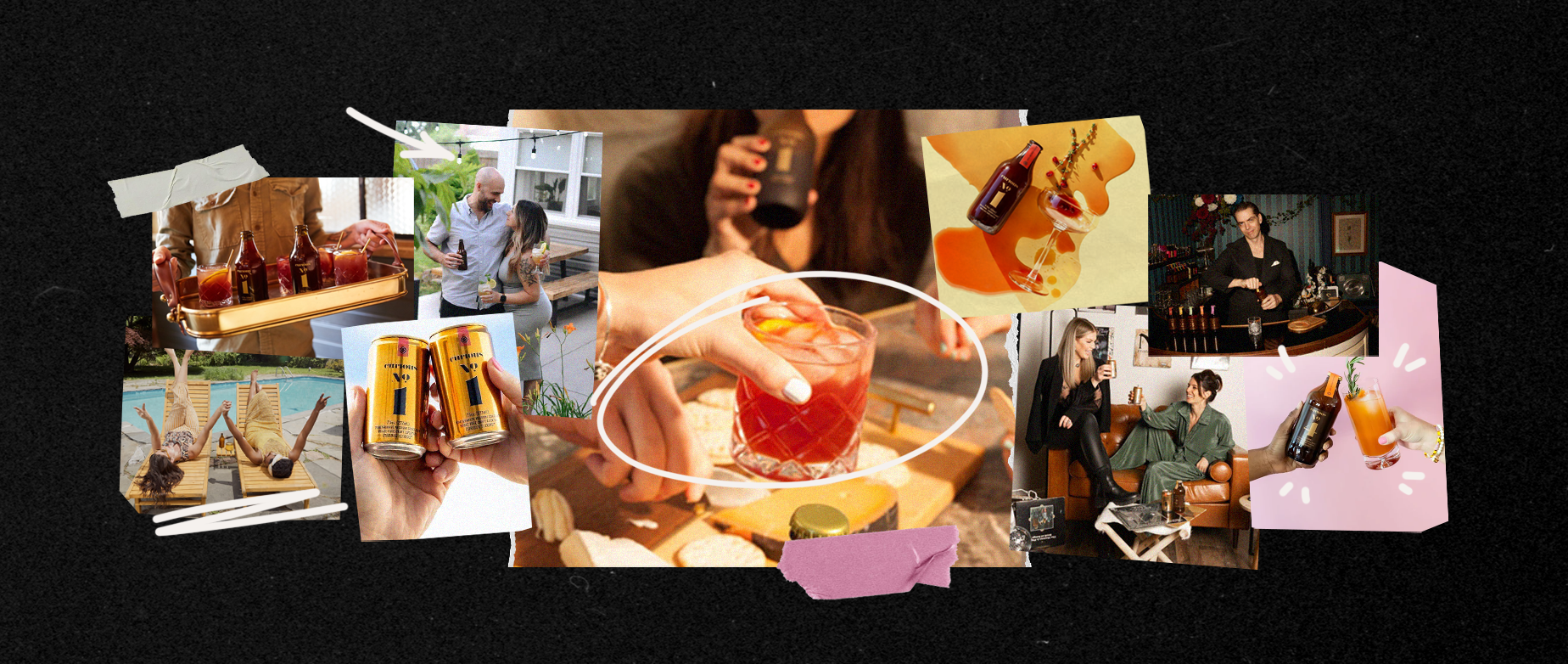
Clinking a glass and sipping something special is part of how we celebrate—but more people are now swapping champagne and cocktails for zero-proof Negronis, booze-free spritzes, and non-alcoholic (NA) IPAs.
What started as a Dry January experiment has become a year-round commitment to mindful drinking, with people seeking complex, grown-up flavors without the hangover. That demand is reshaping the industry: The global non-alcoholic beverage market reached nearly $20 billion in sales in 2023, with growth projected at 7% compound annual growth rate (CAGR) through 2028.

Many of the brands behind these numbers—like Ghia, De Soi, Curious Elixirs, and Monday—are built on Shopify. Together, they’re redefining what “drinking” means today. This guide distills what they’ve learned into a clear, practical roadmap for launching your own non-alcoholic beverage brand.
1. Start with community first, products second
Curious Elixir founder JW Wiseman woke up one morning after consuming 20 drinks in a single night. That moment changed everything.
The marketing exec and bar owner realized he needed to take a break from drinking. Alcohol, that is.
It was 2015, and there weren’t many non-alcoholic alternatives to complex cocktails. The options were basically ordering a Shirley Temple or a sparkling water, so JW set out to create alcohol-free versions of the complex, layered drinks he loved. There wasn’t much conversation about zero-proof options, so he focused on intentionally building a community around his vision. “When I mentioned booze-free cocktails, people often gave me blank stares,” JW recalls. “We had to educate consumers one person at a time. That’s how it starts.”
Ghia founder Melanie Masarin took a similar route. Tired of “cloyingly sweet” mocktails, she tested early versions of Ghia with friends and chefs, pouring around a thousand samples before locking in the final formula. By listening to feedback, she created a drink—and a brand—that felt celebratory and inclusive.
In a young category, your community isn’t just a target market—it’s your R&D lab. Listen closely, run small tests, educate customers, and let their feedback shape what you build next.
Before becoming a major online retailer for adult non-alcoholic drinks, The Zero Proof started as a blog. Cofounder Sean Goldsmith and his best friend shared their alcohol-free lifestyle, and as traffic grew, that audience validated the opportunity. The blog evolved into a Shopify-powered store built on real demand, not guesswork. Today, The Zero Proof offers a range of NA drinks—from workout recovery beverages to non-alcoholic wines—while serving as an online community hub.
Whether you’re testing recipes with chefs, writing a weekly blog, or educating bartenders, Shopify makes this community-first approach easy with customizable landing pages that capture emails and show you what resonates before you commit to full-scale production.
What you can do today:
- Join sober-curious and mindful drinking communities and listen for recurring frustrations and cravings
- Share small test batches or prototypes with a trusted circle and ask targeted questions about flavor and format
- Launch a simple Shopify blog or landing page that shares your vision and builds an email list before finalizing your first product
Once you’ve tapped your community and refined your ideas with real feedback, it’s time to turn those insights into products that don’t just copy what’s already on the shelf—they reinvent it.
2. Don’t just mimic—reinvent

Early non-alcoholic drinks tried to imitate alcohol. The most exciting founders today are doing more: crafting drinks so compelling that “non-alcoholic” is just one detail, not the headline.
Douglas Waters of Spirited Away calls this the “third wave” of NA drinks, where “we’ll stop defining it by what it’s not, and we’ll start defining it by what it is.” Founders are innovating in three primary ways: flavor, functionality, and packaging.
Create innovative flavors and experiences
Ghia’s Melanie channeled her frustration with overly sweet mocktails into a bold, bittersweet spirit made from real ingredients—pure extracts and juices—that felt like “a new-age bitter or Italian amaro that would just be better for you.” Her goal: “a drink that would take you to this place without numbing the night; a drink you’d remember in the morning.” The result is a beverage that piques curiosity for non-drinkers and drinkers alike.
Ritual Zero Proof realized that taste alone wasn’t enough—they wanted a drink with a distinctive mouthfeel. Using botanicals like jambu and prickly ash, they created spirit alternatives that slot directly into cocktail recipes. “Ritual was created because we love a good cocktail, with or without alcohol,” says cofounder David Crooch.
Innovate with function and wellness
Wellness is a powerful driver behind NA beverages, and founders are turning drinks into tools that support how you want to feel.
JW says Curious Elixirs’ initial vision was to create cocktails that nourish the body and mind: “When I started tinkering in my kitchen … I wasn’t just asking ‘How delicious can we make this?’ I was also asking ‘What if this drink could make my body feel better?'”

The company crafts adaptogenic cocktails designed to benefit both mind and body. Its bestseller, Curious No. 1, is a Negroni-inspired cocktail featuring Rhodiola rosea, an ingredient known for its ability to reduce stress and fatigue.
De Soi, cofounded by Katy Perry, leans into the idea of a “productive toast.” As Katy explains, “You can enjoy yourself and still be productive the next day. That’s empowering.”
Smashd goes after a cleaner ready-to-drink (RTD) profile—electrolytes, low sugar, low calories, and no questionable additives. Founder Kristina Roth is clear: “With Smashd I want to prove everyone wrong that ‘no alc’ does not equal ‘no fun.'”
Innovate with packaging and glassware
Innovation also shows up in how drinks are packaged and used in real life.

Ghia noticed customers asking how to serve its aperitif, so the brand created an “ecosystem” around it: a captivating bottle, custom glassware, and RTD spritzes in cans. The RTD format unlocked mid-afternoon Ghia breaks and picnic-friendly pours.
On Shopify, you can quickly test your own ideas with low risk—bundling products, launching limited-edition RTDs, or offering subscription services to see what resonates.
What you can do today:
- Map your flavor profiles: Write down the exact flavors, textures, and moods you wish you could get from a drink but can’t currently find
- Research adaptogens, botanicals, and fermentation methods that align with the emotional state you want to create
- Use Shopify to test bundles, sample packs, or glassware that make it easier for customers to enjoy your drink in real life
- Even the most innovative drink needs to be experienced to be believed. That’s where in-person tastings and real-world experiences come in.
3. Create in-person tastings and connect with customers everywhere
Once you have your product, your next job is to get it into the world and build credibility. Seeing a beautifully branded drink online is compelling, but committing to a full bottle without tasting it is a leap. In-person tastings let people sample and learn about your drink before they buy.
“One of the biggest things in the non-alc sector, especially for higher-priced items, is ‘Is it worth it?'” says Ed Carino, cofounder of Proof No More, a top New York-based non-alcoholic drink distributor. “The price can be a barrier for someone. But if they taste it and know they like it, they know they’re not wasting money.”

Ed says in-person tastings have been invaluable for building trust, validating value, and educating customers. In January 2026, Shopify teamed up with Proof No More for the second time to host a non-alcoholic mixer and tasting experience at Shopify NY, located in the heart of Soho.
With Shopify POS, you can run tastings, festival booths, and pop-ups while keeping inventory, customer data, and sales synced in one place. Someone who discovers you at a farmers market can later receive a personalized email from your Shopify store and reorder with a click.
For Douglas Waters, founder of New York’s booze-free bottle shop Spirited Away, the journey began with personal frustration: There was nowhere to explore and learn about NA drinks in Manhattan, so he built one. Spirited Away acts as a discovery hub where customers can ask questions, taste different brands, and learn how to serve them—turning uncertainty into excitement and insight.
Ghia scaled with the same mindset. Melanie personally opened the first 400 restaurant accounts by DMing chefs on Instagram and dropping by in person because she knew Ghia needed to be where people socialize.
What you can do today:
- Host or join an NA tasting using Shopify POS to sell on-site and capture emails
- DM and email restaurant and bar owners directly to foster relationships
- Participate in holiday markets, food festivals, or wellness pop-ups to reach new audiences
As more people taste and talk about your drink, curiosity grows—but so do questions about price and value. The next step is to turn that curiosity into long-term trust.
4. Build trust to validate pricing

In a young category, skepticism—especially around price—is normal. Counter it with transparency and education by bringing customers behind the scenes of your ingredients, production process, and sourcing choices.
Adaptogenic brands like Curious Elixirs and Parch do this by highlighting specialized ingredients, their benefits, and their commitment to excellence. Breaking down your process on your packaging, website, and social channels builds credibility.
Highlighting functionality and health benefits also demonstrates value, transforming your product from an ordinary beverage into a wellness aid. Brands like Smashd justify their offerings by emphasizing electrolytes and low sugar content, positioning them as low-calorie, energizing drinks.
Morning Recovery shows another trust builder: independent validation through press and trusted Facebook groups, which helped improve conversions and lower acquisition costs by reducing skepticism. On Shopify, you can bake these trust signals into your store with strong product pages, founder stories, and behind-the-scenes content.
Beautiful design and packaging is another cue that your product is worth a premium price. Ghia’s brand identity backs this up with ingredient-forward messaging and an elevated bottle that feels like a jewel—at home on a bar cart or bookshelf.
For premium beverage brands, hotels, restaurants, and venues that offer elevated dining experiences are a strategic fit. Consumers are often willing to pay more for specialty pairings in high-end settings. These “adult” non-alcoholic options typically sit at a higher price point than standard beverages like soda or juice.
Ed of Proof No More confirms this benefit, noting, “We sell [non-alcoholic beverages] to a high-end restaurant in New York City. Once they added adult non-alc options like non-alc beer, cocktails, and wine, the revenue went up.”
What you can do today:
- Write down your “why” and keep it visible—it will carry you through regulatory hurdles and slow days
- Use your product and About pages to clearly explain your ingredient, production, and sourcing choices
- Invest in packaging that reflects your premium positioning
Ready to uncork your big idea?
The non-alcoholic movement is redefining what it means to “go for a drink.” As Ghia’s Melanie says, the mission is to “take back the word drinking from alcohol” and enjoy a beverage anytime, without regret.
By starting with community, pushing past imitation into innovation, building trust through real experiences, and staying committed to the craft, you’re not just selling a beverage—you’re helping rewrite drinking culture for the better.
Morning Recovery used a simple minimum viable product, validated demand, then upgraded branding and packaging once it had proof—an approach Shopify is built to support. You can launch a Shopify store on any budget and layer on subscriptions, wholesale channels, and international selling as you grow. Then, leverage Shopify Sidekick, Shopify’s AI assistant, to turn complex workflows into simple automations.
Start your free Shopify trial today and turn your passion for non-alcoholic drinks into a business that redefines celebration.
