





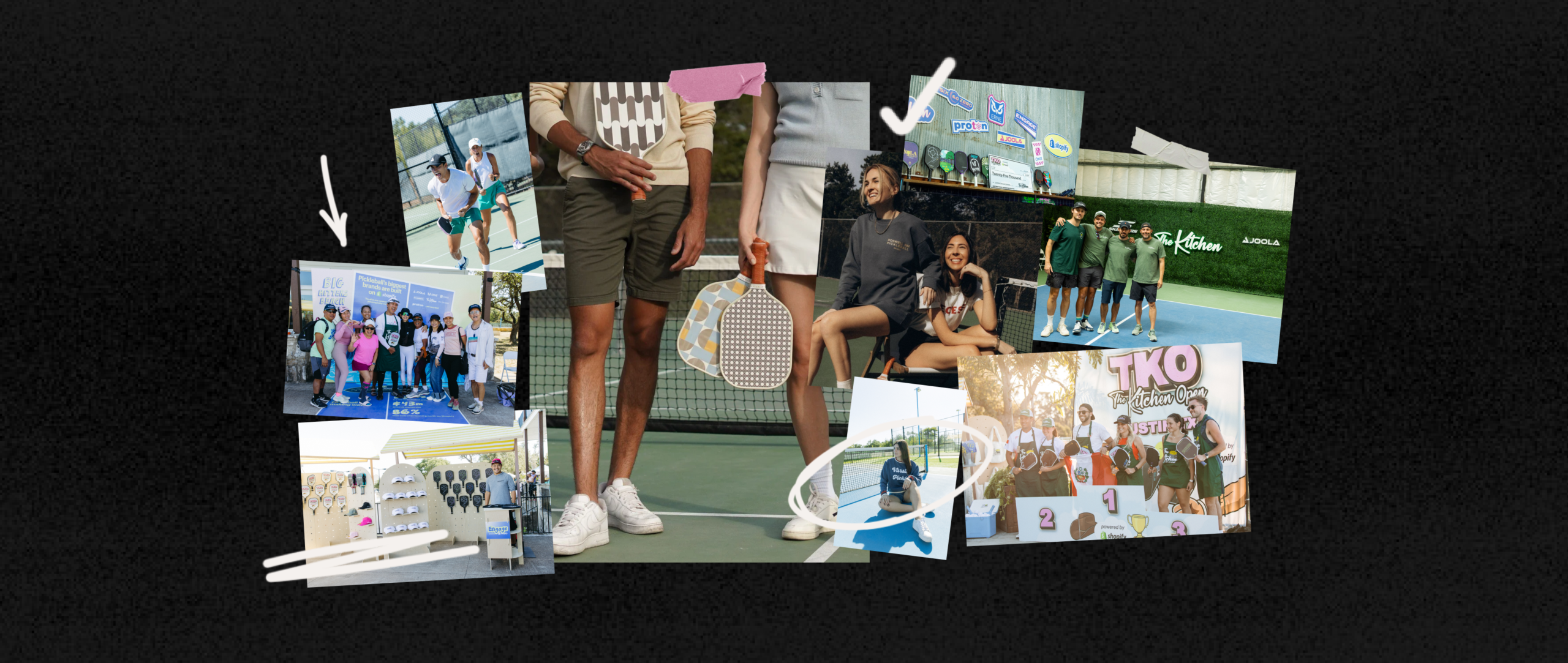
When Jared Paul picked up a pickleball paddle for the first time in 2020, he searched for an online community to help him learn the game and meet other players. Instead, he found a void. So he created The Kitchen, a Facebook group for fellow players. It has since grown to more than 180,000 members, making it the world’s largest pickleball community. What began as a place to swap serving tips is now a Shopify-powered store and community hub for the sport.

Paul and his co-founders, Dane Iliff, and Jason Aspes, are part of a new wave of pickleball fans building brands for the communities they play in. As the sport explodes in popularity, players are looking for better paddles, training tools, and apparel—and founders with insider knowledge are stepping up to meet that demand. By 2033, the global pickleball market is expected to reach $4.4 billion USD, up from $1.5 billion in 2023.

While major athletic brands account for some of that growth, a rising share is coming from independent brands on Shopify. Top brands like Enhance, Recess, JOOLA, 11SIX24, and Bison Paddles partner with Shopify to power their businesses on and off the court and that number is steadily rising. In 2024 alone, the number of pickleball brands on Shopify grew by 86% year over year and the trend continues to grow, so now is an excellent time to enter the market.
Whether you’re brainstorming ideas for a pickleball brand or in the midst of engineering a breakthrough paddle, this guide will show you how to turn your love of pickleball into a business on Shopify.
Start with players, not products
The best pickleball brands didn’t start by designing paddles. They started by connecting with their community on the court.
Jared Paul’s strategy with The Kitchen was simple: reach out to pro players, invite them to share content, and let their audiences follow. He prioritized building a real community first—people who genuinely loved the sport and trusted his perspective. After establishing this strong foundation, The Kitchen then launched products on Shopify.
Our Facebook community is our North Star. It informs everything—what content we create, which products we stock, who we partner with.
“Our Facebook community is our North Star,” Paul says. “It informs everything—what content we create, which products we stock, who we partner with.”
This approach works because pickleball players are intensely dedicated—they can spot inauthenticity from across the court.
Karen Alexander and Adele Hazan learned this when they founded Varsity Pickle in 2020. As childhood best friends who’d just discovered pickleball, they noticed something: no pickleball apparel brands existed that spoke to their aesthetic. So they set out to create simple, but stylish athleisure that could be worn on and off the court.

Varsity Pickle is beloved by the pickleball community for its stylish designs and recently served as a vendor at the 2024 Kitchen Open, powered by Shopify.
Instead of immediately launching a full collection, they shared their designs with fellow pickleball friends for feedback.
“We wanted to test out the idea first in a small-scale way and see if it resonated,” said Adele.
The Varsity team then launched on Shopify with a few designs—hats, shirts, sweatshirts. Gifts that players could buy for their court companions. Shopify made it easy to start lean, test the market, and expand their product line as demand grew.
Pickleball isn’t just a sport—it’s a social experience. It’s networking over volleys, friendships formed across the net. Build genuine relationships first, then, like Varsity Pickle, turn those insights into a business that delivers products your community actually wants via a Shopify store.
What you can do today:
- Engage with players authentically. Play regularly at local pickleball groups, start your own online community, and listen for what the community is missing and looking for
- Document your journey on social media. Start posting before you have anything to sell to develop an authentic community
- Build your store while you iterate. Sign up for Shopify’s free trial to start building your store while you’re building your community to get a headstart on your big launch.
Let the gaps guide your product
Once you’ve built relationships, you’ll start seeing gaps in the market. The question is: what problems are you solving?
In the spring of 2020, as the global pandemic raged on, Maggie Brown—like most people—found herself yearning for social connection. When outdoor activities finally opened back up, she gave pickleball a try. On the court, she found friendship—but she didn’t find many paddles that matched her vibe.
“I went online and all the paddles were black and neon and had dragons and fire. I literally could not find anything with design and aesthetic. This just felt like the lightbulb moment,” said Maggie, who co-founded the brand Recess with her childhood best friend, Grace Moore.

Recess founders crafted a line of playful paddles featuring chic prints after noticing a market gap. Recess Pickleball
Grace and Maggie dreamed up playful paddles with prints you’d expect to see on a chic scarf or designer tote: gingham stripes, checkerboard patterns, and whimsical illustrations of martini glasses and florals. Their artful, aesthetic paddles were a hit, and the two quickly branched into pickleball apparel, including moisture-wicking dresses and UV-protective snapbacks.
In addition to design, many founders focus on crafting products that raise the quality bar. David Groechel was playing pickleball four to six times a week when his $220 paddle cracked after just three months. Why was he paying premium prices for equipment that barely lasted a season?
That frustration became 11SIX24 Pickleball—a brand built on a simple promise: quality paddles that are fairly priced (starting at $143). David, who’d previously sold two tech startups, brought his finance background to the pickleball market. He launched on Shopify specifically because he wanted to control his margins and maintain a direct relationship with customers. He even packs every paddle himself, keeping costs low and staying connected to his community.
“We hit the sweet spot,” David says. “Approachable for newbies, but built to crush tournaments.”
But not every opportunity is about price. Connor Hance, a former UCLA tennis player and co-owner of Enhance, saw a different gap: a lack of solid training tools. His Dink Master Pro, a training board used to improve dinks and volleys became a hit from day one, proving that in a young sport like pickleball, you can still invent something new.
Connor also cracked the code on content marketing. As one of the internet’s most-watched pickleball coaches, he builds trust through free coaching videos on social media—most don’t even feature his products.
If you’re selling pickleball paddles, you shouldn’t have to know how to code.
When he launches something new through his Shopify store, his community already trusts him. The result is customer acquisition without ad spend, with margins that traditional retail could never match.
“If you’re selling pickleball paddles, you shouldn’t have to know how to code,” Connor says about choosing Shopify.
Shopify’s app ecosystem lets him integrate pricing tools, inventory management, and email marketing without a technical background, allowing him to focus on coaching and product development.
What you can do today:
- Track your own frustrations as a player. Then ask others if they have encountered similar issues—your challenges can support product development
- Use Shopify’s built-in analytics. Test ideas quickly and see what resonates.
- Explore the Shopify App Store. Look for tools that help you validate product ideas before investing in inventory
Sell wherever your community gathers
The strongest pickleball brands don’t wait for players to find them online—they show up where the game is being played. Tournaments, club nights, and local pop-ups give you something a website alone never can: real-time feedback, players physically trying your products, and face-to-face conversations that turn casual fans into loyal customers.
When someone tests a paddle on the next court over or feels the weight of a bag in person, they’re not just browsing—they’re making decisions with their friends, their doubles partners, and their wider community watching.
Those in-person moments become even more powerful when they’re connected to your online business. With Shopify, your online store, in-person sales, social channels, and customer data all live in one place. When you use Shopify POS at a tournament, every sale ties back to a customer profile in your Shopify admin. You can see which products sell best at events versus online, follow up with personalized emails, and invite those same players back for new drops or local meetups.

You could see this in action at The Kitchen Open tournament in 2024. There, Shopify and The Kitchen created The Big Hitters Beach—a retail zone powered by Shopify POS with merchants like JOOLA, Engage, Proton, Enhance, and Six Zero. Players tried paddles on nearby courts, asked founders questions in real time, and purchased products on the spot. Brands processed hundreds of transactions without friction, and every sale flowed back into a single customer view they could build on long after the event ended.

You can launch online first, then take the same Shopify store to local tournaments using the POS app on your phone or via POS hardware.
For new brands, this unified setup removes the admin burden that usually comes with “selling everywhere.”
You can launch online first, then take the same Shopify store to local tournaments using POS on a tablet or phone.
No separate systems. No manual reconciliation. Just one platform that lets you meet pickleball fans where they already gather—while keeping your margins, your data, and your customer relationships fully in your control.Being authentically connected to the community makes you better on the court and in the marketplace. It also opens up opportunities to network with other founders in the space, so you can swap insights, share resources, and grow together as the sport evolves.
What you can do today:
- Show up regularly to local tournaments. Network with organizers and research potential pop-up opportunities.
- Organize a pop and sell your products. Make sales at local tournaments, popups or meetups using Shopify POS hardware or your phone.
- Nurture your customer relationships. Create a newsletter, send care instructions, and send customers welcome messages after events.
The game just started: The time is now for pickleball brands

Pickleball is still in its early years, and the founders winning today are the ones closest to the community—players who see the gaps, listen between points, and build products that make the game better. You already have what they started with: a love for the sport and a network of players who trust you. Shopify gives you everything else: an online store, in-person selling with POS, built-in marketing, and the flexibility to grow from your first test run to your first tournament booth. If you’re ready to turn your court time into a business, start your Shopify store today.
