





Quick Decision Framework
- Who This Is For: Founders and operators at companies of any size who want to strengthen team culture, improve retention, and build community ties through a structured employee volunteer program.
- Skip If: Your team is fully remote with no interest in community engagement, or you are in a hiring freeze with no bandwidth to coordinate any new programs right now.
- Key Benefit: Companies with active volunteer programs see up to 52% higher employee retention and employees who are five times more engaged than those at companies without equivalent programs.
- What You’ll Need: A communication channel to share opportunities, at least one point person to coordinate logistics, and willingness to offer flexible scheduling or paid volunteer time.
- Time to Complete: 10 minutes to read. 2 to 4 weeks to launch a basic program. Ongoing to build a culture around it.
A 2024 Deloitte survey found that 87% of employees say workplace volunteer opportunities are crucial in deciding whether to stay with their current employer or pursue a new job. That number should stop every founder in their tracks.
What You’ll Learn
- Why employee volunteering is a measurable retention and engagement strategy, not just a feel-good initiative.
- How to create awareness around volunteer opportunities in a way that generates genuine enthusiasm rather than obligation.
- What structured volunteer days look like at small and mid-size companies, and how to run them without a dedicated HR team.
- How to recognize volunteer contributions in ways that actually motivate employees to participate again.
- When flexible scheduling and paid volunteer time off make the difference between a program that thrives and one that quietly dies.
Thirty-one percent of employees quit their last job because of a lack of meaningful work. Not pay. Not benefits. Meaning. That single data point has been sitting in research reports for years, and most companies still respond to it by adding a ping pong table or hosting another all-hands meeting.
There is a simpler, more durable answer. Companies that build genuine volunteer cultures give employees something that no compensation package can replicate: the experience of doing work that matters beyond the bottom line. According to Benevity’s State of Corporate Volunteering research, companies that actively promote volunteering see participation rates up to 12 times higher than those that simply make opportunities available without support. The difference is not the opportunity. It is the culture built around it.
Whether you are running a 10-person DTC brand or a 200-person operator, the principles are the same. Here is how to build a volunteer culture that sticks.
Why Volunteering Is a Business Decision, Not Just a Nice-to-Have
The business case for employee volunteering is no longer anecdotal. Benevity’s Talent Retention Study found that corporate volunteerism increases employee retention by 52%. A separate study found that employees at companies with volunteer programs are five times more engaged than those at companies without them. For a founder watching turnover costs eat into margin, those numbers are not soft metrics. They are operational leverage.
The mechanism is straightforward. Volunteering gives employees a shared experience outside their normal roles. It builds relationships across departments that would not otherwise form. It connects individual contributors to something larger than their daily task list. And it signals, in a concrete way, that the company they work for has values that extend beyond profit generation. That signal matters enormously to the workforce entering and moving through careers right now. Seventy-four percent of people say that when considering a job, they prefer to have the opportunity to do work that is meaningful to them. Nine out of ten say they would rather work at a company that shares their values than take a higher-paying job at one that does not.
For operators thinking through their corporate social responsibility strategy, volunteering is one of the highest-leverage levers available. It costs relatively little to organize, produces measurable improvements in morale and retention, and generates the kind of authentic community connection that no marketing campaign can manufacture. The brands that figure this out early build cultures that compound over time.
Create Awareness That Generates Momentum
The first failure mode in most volunteer programs is invisibility. A link buried in a company intranet or a single Slack message announcing an opportunity does not create a culture. It creates a checkbox. Awareness has to be active, repeated, and personal to generate real momentum.
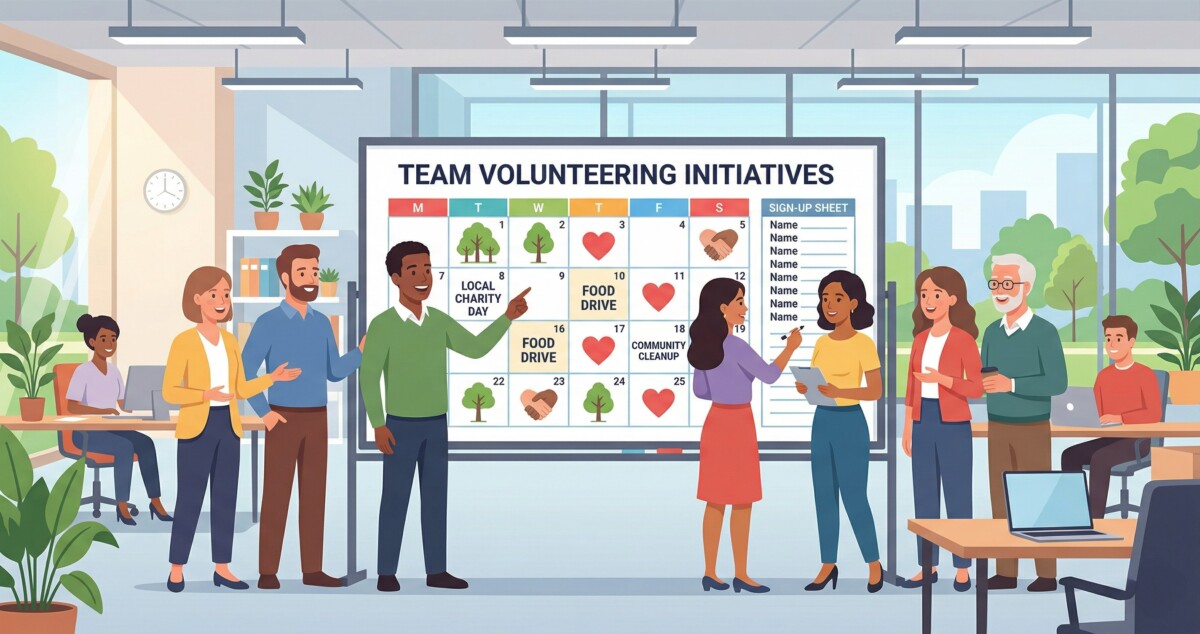
Start with a physical or digital bulletin board dedicated entirely to volunteer opportunities. Post upcoming events with specific details: what the organization does, who it serves, how many people they need, and what the experience will actually look like. Specificity matters. “Help sort donations at a local food bank on Saturday morning from 9am to noon, no experience required” generates more sign-ups than “volunteer opportunities available.”
Go further by inviting representatives from the organizations you partner with to speak directly to your team. A five-minute video from a food bank coordinator explaining the impact of a single volunteer shift lands differently than a flyer. Personal stories from the organizations themselves create the emotional connection that drives action. When employees can see the direct line between their Saturday morning and someone’s week improving, the decision to participate becomes much easier.
Make the logistics frictionless. The harder it is to sign up, the fewer people will do it. A shared calendar, a simple sign-up form, and a designated point person who can answer questions removes the friction that kills participation before it starts. When employees see clear, easy pathways to get involved, they are far more likely to take the first step.
Design Volunteer Days That People Actually Want to Attend
Structured volunteer days outperform individual volunteering in almost every measurable way. According to Benevity’s data, when team volunteering opportunities are part of a company’s volunteer engagement strategy, employee participation rates increase to an average of 7.5 times higher compared to companies without those opportunities. The social dimension is not incidental. It is the point.
Organizing a company-wide volunteer day or a small-team outing removes the biggest barrier most employees face: scheduling. When the day is on the calendar, communicated in advance, and treated as a legitimate use of work time, participation climbs. When employees have to carve time out of their personal lives and navigate their own logistics, most will not bother, not because they do not care, but because the friction is too high.
Partnering with local nonprofits for official volunteer days simplifies planning considerably. Organizations like food banks, habitat restoration groups, and educational nonprofits typically have structured volunteer programs designed for corporate groups. They handle the activity design. You handle the sign-up and transportation. The result is a structured, meaningful experience that requires minimal internal coordination once the partnership is in place. Whether it is planting trees, running a food drive, or supporting after-school programs, working on a shared mission creates bonds between teammates that carry back into the office in ways that are genuinely hard to replicate through any other team-building activity.
Offer Variety So Every Employee Can Find Their Entry Point
One of the most common mistakes companies make is building a volunteer program around a single type of activity and then wondering why participation is uneven. Not every employee wants to show up somewhere physically and do manual labor on a Saturday. Not every employee is comfortable with direct community interaction. A program that only offers one kind of experience will only ever reach one kind of employee.
Hands-on opportunities like tutoring students, serving meals at shelters, or helping with community clean-ups appeal to employees who want direct, visible impact. Behind-the-scenes roles like administrative support for nonprofits, data entry, graphic design, or social media management appeal to employees who prefer to contribute their professional skills. Virtual volunteering options, where employees can participate from home or during a lunch break, extend access to remote workers, caregivers, and anyone whose schedule makes in-person events difficult.
The goal is to give every employee at least one volunteer opportunity they can genuinely connect with. When employees feel personal alignment with the cause and format, they are far more likely to participate, and far more likely to come back. Variety is not about offering everything. It is about removing the excuse that there is nothing that fits.
Recognize Contributions in Ways That Actually Motivate
Recognition is not about making people feel good for its own sake. It is about signaling to the entire organization what the company values. When volunteer contributions go unacknowledged, the implicit message is that they do not really matter. When they are recognized publicly and specifically, the message is the opposite, and it invites others to participate.
Public acknowledgment does not have to be elaborate. A mention in the company newsletter, a post on internal Slack channels, or a shoutout during a team meeting takes two minutes and carries real weight. Sharing specific stories, not just names, amplifies the impact. “Sarah and the operations team spent Saturday morning at the food bank and helped distribute 800 meals” is more powerful than “thanks to everyone who volunteered last weekend.”
For companies that want to go further, a points-based recognition system tied to volunteer hours creates ongoing motivation. Simple rewards, like a gift card to a local business, an extra afternoon off, or a donation made in the employee’s name to a charity of their choice, provide tangible acknowledgment without requiring significant budget. The principle behind all of it is the same: make the contribution visible, make it specific, and make it clear that the company sees it as genuinely valuable. For more on how corporate social responsibility connects to employee morale and retention, the research is consistent and compelling.
Team Building Through Volunteering
The relationship between volunteering and team cohesion is one of the most well-documented benefits in the research. A survey of Fortune 1000 companies found that group volunteering helps employees bond and leads to more productive workplace relationships. Volunteering together creates stronger bonds within the organization, fostering teamwork and people skills for 92% of volunteers and building stronger relationships for 77%. Those numbers do not come from team dinners or escape rooms. They come from working alongside colleagues toward something that matters.
The mechanism is straightforward: shared challenge and shared purpose accelerate trust in ways that ordinary work interactions rarely do. An employee who has spent a morning alongside a colleague from a different department, doing something genuinely hard and genuinely meaningful, knows that person differently afterward. That knowledge translates into better collaboration, more honest communication, and stronger loyalty to the team.
Encouraging departments to volunteer together is one of the highest-leverage moves available when you are thinking about building a strong employee team. You can add a competitive element if the culture supports it: track volunteer hours by team, celebrate the team that logs the most hours in a quarter, or run a friendly challenge around the number of different causes teams engage with. The competitive framing should stay light. The goal is to make volunteering feel exciting and social, not obligatory.
Remove Barriers With Flexibility and Real Support
The most common reason employees do not volunteer through their employer is not lack of interest. It is lack of time and perceived permission. Sixty percent of companies now offer paid volunteer time off, according to America’s Charities, and the companies that do see meaningfully higher participation rates than those that rely on employees to use personal time.
If paid volunteer time off is not feasible right now, flexible scheduling during the workweek is the next best option. Allowing employees to shift their hours on a volunteer day, take a long lunch for a local event, or leave early on a Friday to participate signals that the company genuinely supports their desire to give back. That signal matters more than the hours themselves. Employees who feel that their organization is performatively supportive of volunteering while making it structurally difficult will see through the gap immediately.
Build the infrastructure that makes participation easy: a shared calendar of upcoming opportunities, a clear policy on volunteer time off, a point person who coordinates with partner organizations, and a simple way for employees to log their hours. None of this requires a large HR team. A founder or operator who dedicates a few hours a month to coordination can run a program that meaningfully improves culture, retention, and community connection. The investment is small. The compounding return, in engagement, loyalty, and the kind of workplace people genuinely want to be part of, is substantial.
Frequently Asked Questions
How do I start an employee volunteer program with a small team and no HR department?
Start with one partnership and one event. Identify a local nonprofit that needs volunteers, confirm a date, and send a simple sign-up message to your team. You do not need a formal program to begin. The structure builds over time as you learn what your team responds to. Designate one person, even if it is you, to own the coordination. Track who participates and what they enjoyed. Use that feedback to shape the next event. Most successful volunteer programs at small companies started exactly this way: one event, one partner, and a commitment to make it a recurring part of how the company operates.
What is the business case for offering paid volunteer time off?
The retention math is compelling. Benevity’s Talent Retention Study found that corporate volunteerism increases employee retention by 52%. A 2024 Deloitte survey found that 87% of employees say workplace volunteer opportunities are crucial in deciding whether to stay with their current employer. When you factor in the cost of replacing an employee, typically 50% to 200% of annual salary depending on the role, offering even four to eight hours of paid volunteer time per year is a remarkably low-cost retention investment. Beyond retention, employees at companies with volunteer programs are five times more engaged, which translates directly into productivity and quality of work.
How do I get employees who are skeptical or disengaged to participate in volunteering?
Do not lead with the volunteer ask. Lead with the story of the organization and the specific impact of a single shift. Skeptical employees often disengage because volunteering feels abstract or performative. When they can see exactly who benefits and how, and when the logistics are completely handled for them, participation becomes much easier to say yes to. Offering variety helps significantly. An employee who would never show up to a food bank might happily spend two hours doing pro bono design work for a local nonprofit. Find the format that matches the person, not the other way around.
How do I measure whether our volunteer program is actually working?
Track four things: participation rate (percentage of employees who volunteer at least once per year), repeat participation (percentage who volunteer more than once), qualitative feedback after each event, and retention data over time. For smaller companies, a simple post-event survey asking two or three questions is enough. Ask whether employees felt the experience was worthwhile, whether they would participate again, and what would make the next event better. Compare turnover rates among employees who participate regularly versus those who do not. Over 12 to 18 months, the pattern typically becomes clear. Companies with both giving and volunteer programs consistently see higher engagement levels than those offering only one, according to Blackbaud’s 2024 CSR Industry Review.
What types of volunteer opportunities work best for remote or hybrid teams?
Virtual volunteering has expanded significantly and now includes options that work well for distributed teams. Employees can tutor students online through platforms like iCouldBe or volunteer with organizations like Crisis Text Line from anywhere. Skills-based volunteering, where employees contribute professional expertise in areas like marketing, finance, or technology to nonprofits, is particularly well-suited to remote teams because it can happen asynchronously. For hybrid teams, a combination works best: virtual options available year-round for remote employees, and in-person team volunteer days when the team is together. The key is making sure remote employees have equal access to meaningful opportunities and are not excluded from the program by geography.
