




Key takeaways 
The way you close an email can significantly influence how your message is perceived and can prime recipients for the desired action.
Utilizing a structured closing hierarchy—comprising a closing line, sign-off phrase, and signature—enhances clarity and reinforces your email’s tone.
Tailor your email sign-offs to match the context and relationship dynamics, ensuring they align with your brand voice and the recipient’s expectations.
Avoid overly casual or tone-deaf sign-offs, as they can undermine professionalism and lead to miscommunication.
Knowing exactly how to end an email can completely change how your message is received. Most people think that the closing is just a sign of politeness and etiquette. Fortunately, that’s not all. A sign-off is also an opportunity for something called action priming.
Action priming is how your final phrase subconsciously prepares the recipient’s brain for a specific next step. Depending on what you want them to do (make a quick purchase, schedule a meeting, give feedback, or anything else), the right sign-off can gently nudge them toward that action.
We’ve prepared 100+ proven sign-off options that you can outright steal or use as inspiration. You’ll find a list of sections that are perfect for closing in most situations.
Get started with Omnisend for free to create professional emails with consistent, on-brand sign-offs
Quick sign up | No credit card required
How to end an email (Quick choice)
If you’re in a rush, we have selected the best and safest options for how to end an email. You can confidently take these endings and be sure your emails close in an effective way:
- Professional email sign-offs: Best regards, Sincerely
- Casual email sign-offs: Thanks, Cheers
- Creative email sign-offs: Stay curious, Happy creating
- How to end ecommerce emails that drive conversions: Your cart is waiting, Happy shopping
- Warm email sign-offs: Warmly, All the best
- Complimentary sign-offs: Excellent work, thank you for your effort
100 sign-offs for your inspiration (The master table)
For those needing more variety, here’s a list of exactly 100 alternative phrases for how to end an email, categorized by context. You can mix and match these to keep your communications fresh and relevant to your reader.
| # | Sign-off | Category |
|---|---|---|
| 1 | Sincerely | Professional |
| 2 | Yours sincerely | Professional |
| 3 | Regards | Professional |
| 4 | Best regards | Professional |
| 5 | Kind regards | Professional |
| 6 | Warm regards | Professional |
| 7 | Respectfully | Professional |
| 8 | Yours respectfully | Professional |
| 9 | With respect | Professional |
| 10 | With appreciation | Professional |
| 11 | Much appreciated | Professional |
| 12 | Appreciate your time | Professional |
| 13 | Thank you | Professional |
| 14 | Thank you for your time | Professional |
| 15 | Thank you for your consideration | Professional |
| 16 | Many thanks | Professional |
| 17 | Looking forward to hearing from you | Professional |
| 18 | Please let me know | Professional |
| 19 | Keep me posted | Professional |
| 20 | Best | Professional |
| 21 | Best wishes | Professional |
| 22 | Cordially | Professional |
| 23 | Yours truly | Professional |
| 24 | Hope this helps | Professional |
| 25 | Take care | Professional |
| 26 | Have a great day/week | Professional |
| 27 | Have a nice day/week | Professional |
| 28 | Have a productive day/week | Professional |
| 29 | Have a great weekend | Professional |
| 30 | Enjoy your weekend | Professional |
| 31 | Talk soon | Professional |
| 32 | Speak soon | Professional |
| 33 | Thanks again | Casual |
| 34 | Thanks a million | Casual |
| 35 | Thanks in advance | Casual |
| 36 | Many thanks | Casual |
| 37 | Catch you later | Casual |
| 38 | Later | Casual |
| 39 | Chat soon | Casual |
| 40 | Best of luck | Casual |
| 41 | Good luck | Casual |
| 42 | Keep up the good work | Casual |
| 43 | Great job | Casual |
| 44 | Awesome work | Casual |
| 45 | You’re the best | Casual |
| 46 | Thanks for everything | Casual |
| 47 | Enjoy the rest of your week | Casual |
| 48 | Shop now | Ecommerce |
| 49 | Don’t miss out | Ecommerce |
| 50 | Treat yourself | Ecommerce |
| 51 | Grab yours today | Ecommerce |
| 52 | Enjoy your new items | Ecommerce |
| 53 | Thanks for stopping by | Ecommerce |
| 54 | Thanks for choosing us | Ecommerce |
| 55 | Thanks for being our customer | Ecommerce |
| 56 | Glad to have you | Ecommerce |
| 57 | Welcome to the club | Ecommerce |
| 58 | Stay tuned | Ecommerce |
| 59 | Until next time | Ecommerce |
| 60 | Grateful you chose us | Ecommerce |
| 61 | We appreciate your trust | Ecommerce |
| 62 | Thanks for being part of our community | Ecommerce |
| 63 | Let me know if you need anything else | Support |
| 64 | Always here to help | Support |
| 65 | Happy to help | Support |
| 66 | Reach out with any questions | Support |
| 67 | Stay awesome | Friendly/creative |
| 68 | Stay golden | Friendly/creative |
| 69 | Keep growing | Friendly/creative |
| 70 | Onwards and upwards | Friendly/creative |
| 71 | May the force be with you | Friendly/creative |
| 72 | To infinity and beyond | Friendly/creative |
| 73 | Grateful for your input | Complimentary |
| 74 | Thanks for having my back | Complimentary |
| 75 | Couldn’t have done this without you | Complimentary |
| 76 | Your insight makes all the difference | Complimentary |
| 77 | Yours unfaithfully | Funny |
| 78 | I’ve already told you more than I know | Funny |
| 79 | Sincerely, despite the circumstances | Funny |
| 80 | With spite | Funny |
| 81 | Toodles | Funny |
| 82 | Life is short, eat the cookie | Funny |
| 83 | Until our inboxes meet again | Funny |
| 84 | Yours, if you’ll have me | Funny |
| 85 | Living on a prayer | Funny |
| 86 | Doing my best | Funny |
| 87 | Cheers, big ears | Funny |
| 88 | I aim to please, but usually miss | Funny |
| 89 | I just work here | Funny |
| 90 | Live, laugh, toaster bath | Funny |
| 91 | Beep boop, this was written by AI | Funny |
| 92 | One does not simply send just one email | Funny |
| 93 | On to the next email… wish me luck | Funny |
| 94 | Wubba lubba dub dub! I need a reply | Funny |
| 95 | With minimal effort, maximum gratitude | Funny |
| 96 | Wishing you zero bugs and infinite bandwidth | Funny |
| 97 | Have a karmic day | Funny |
| 98 | Cheers (because we both need a drink after this) | Funny |
| 99 | Until robots replace us | Funny |
| 100 | That’s all, folks! | Funny |
Examples of effective email sign-offs
Now that you’re properly overstimulated from reading 100 email-ending lines, we believe you’re ready for more. This time, we’ll show you real-world examples and briefly analyze them.
Professional email sign-offs
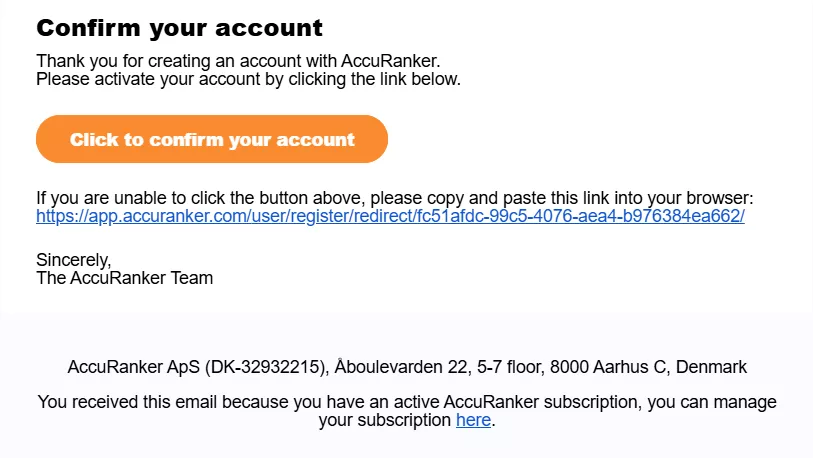
- AccuRanker: They don’t overthink it and use a simple “Sincerely, The AccuRanker Team” as their email sign-off. This is for a transactional account confirmation email, so there’s no need to confuse readers with unhinged email sign-offs. Also, they’re Danish. Scandinavians tend to be reserved people.
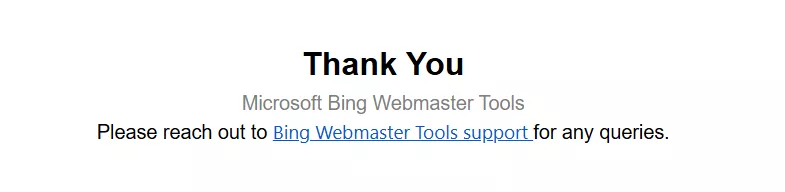
- Bing Webmaster Tools: This one ends with a simple “Thank You” email sign-off and provides a support link for any further queries. It’s the bread and butter of polite professionalism, which is perfect for support or confirmation messages.
Casual email sign-offs
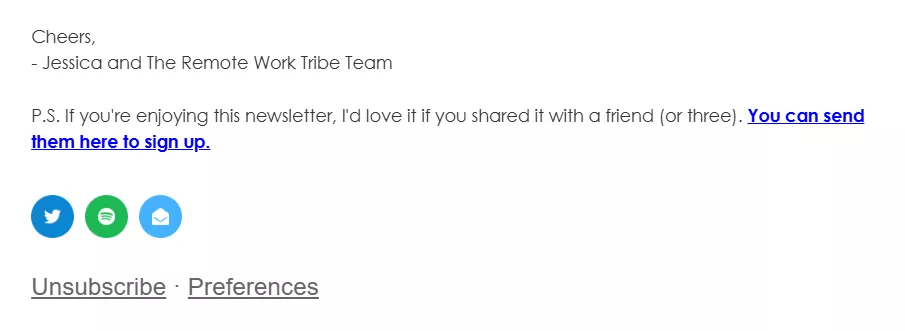
- The Remote Work Tribe: They close the newsletter with a friendly “Cheers” and leave their names there as well. It’s relaxed and community-focused, which matches the expectations of their readers.
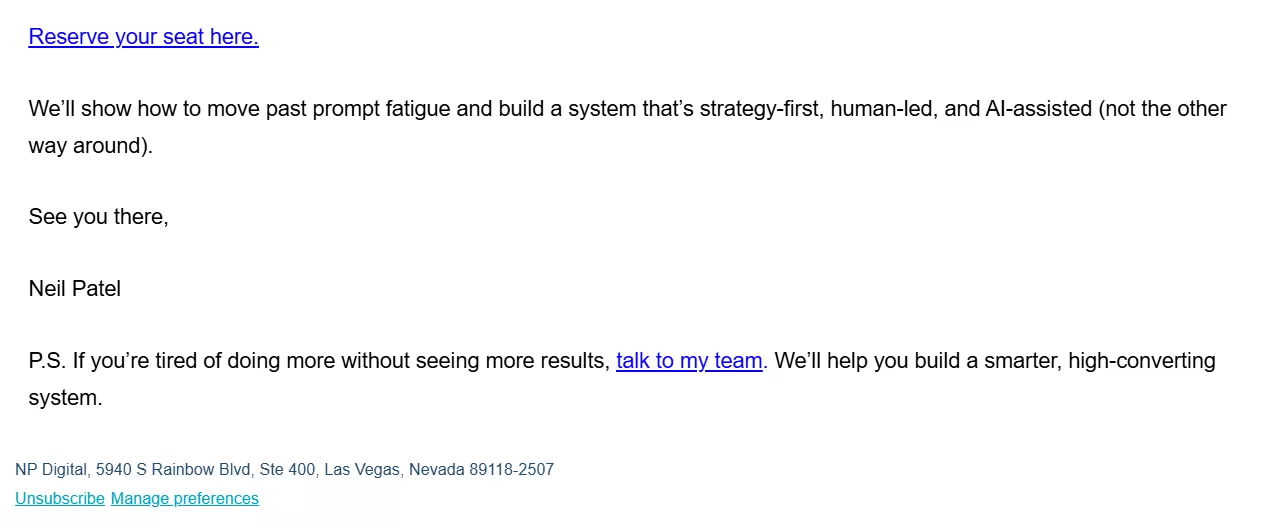
- Neil Patel: They’re encouraging recipients to reserve their seats at an event. It’s only logical they would top the email off with a “See you there”. It’s simple, clear, and conveys a certain expectation for the recipient to be there.
Creative email sign-offs
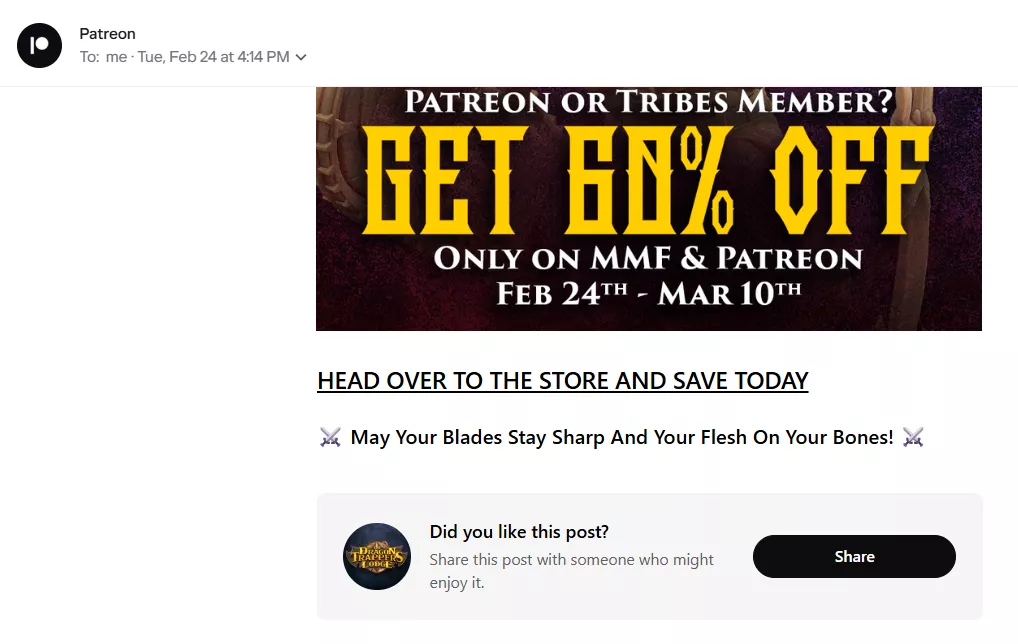
- The Dragon Trappers Lodge: They sign off with a “May Your Blades Stay Sharp And Your Flesh On Your Bones!”. It’s a masterclass in how to end an email, as it resonates 100% with their audience and is unique. They create 3D printable miniatures of RPGs, board games, and more, so the sign-off makes sense and, even though it is a mouthful, it’s memorable.
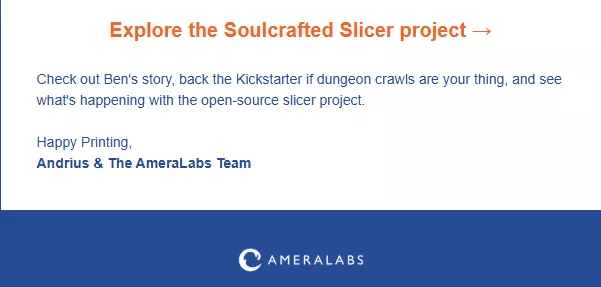
- AmeraLabs: While not as creative as the Dragon Trappers Lodge, the simple “Happy Printing” is an industry standard email sign-off in the 3D printing niche. It appeals directly to the recipient’s specific hobby (or profession), which can help build further rapport, and, quite frankly, just makes sense and fits.
Warm email sign-offs
- Statista: Their newsletter ends in a simple “Have a great week!”. Statista’s customer base is mostly businesses or entrepreneurs, so selecting a professional sign-off with a touch of warmth is what these recipients would expect, and there’s no need to look for other ways to end an email.

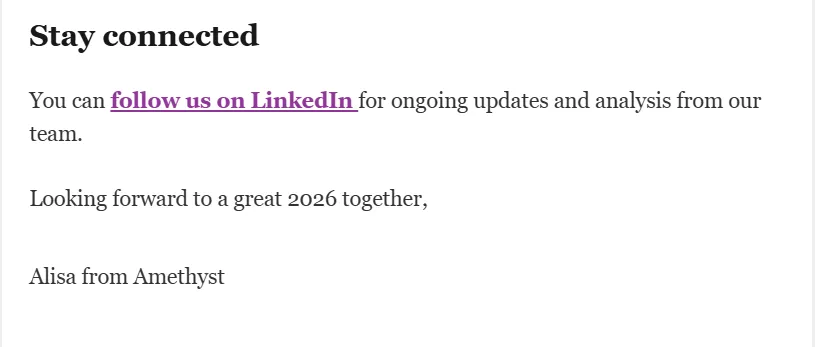
- Amethyst: Alisa uses a “Looking forward to a great 2026 together” sign-off to their email, which is a forward-thinking and partnership-driven type of communication. It sets up an expectation of a successful next year, which adds not only warmth to the email but also positivity.
Complimentary sign-offs
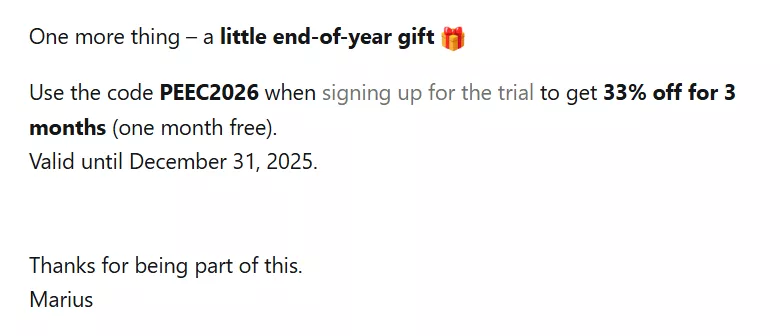
- Peec AI: They wrap up an end-of-year offer with “Thanks for being part of this”. It makes the subscriber feel valued and appreciated, and they receive a discount code as a thank-you.
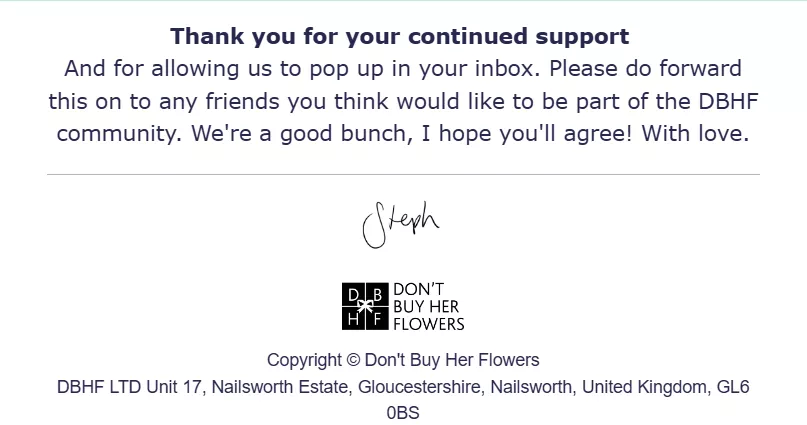
- Don’t Buy Her Flowers: They end the email using “With love, Steph”. It creates a personal and intimate connection that aligns perfectly with a gifting brand’s identity. Also, the handwritten font adds an even more personal touch to the email.
What makes an email sign-off effective?
The best email sign-offs do more than just signal the end of a message, as you know by now. They leave a positive (or negative, depending on your choices) impression, reinforce your brand’s voice, and guide the reader toward the action you want them to take.
If you want to truly understand how to end an email effectively, you need to look at something called the closing hierarchy. Instead of just slapping a word at the end of your email, think of it as a structured narrative.
A great closing hierarchy should connect three elements: your closing line, your sign-off phrase, and your signature.
Your closing line is a distinct element that bridges the body of your email and your final sign-off. The main purpose is to transition to the sign-off, not just go straight to it. For example, a closing line like “I’m looking forward to discussing this on Tuesday” flows more naturally into “Best regards” than “Best regards” alone.
What matters most within this hierarchy depends heavily on the tone you choose, and the general “feel” of your business:
- Professional ways to end an email: Clarity and respect are the key factors here. Your goal is to convey reliability without distracting the reader from the core message. Sticking to a formal tone and structure is recommended.
- Funny email sign-offs: Using humor is all about knowing your boundaries and the audience’s expectations. If you’ve been sending “Sincerely” for years, switching to “Wubba lubba dub dub” might come as a shock. But if your business is prone to a light tone, you can ease into it with “Sincerely, despite the circumstances.”
In short, if you’re a formal business with a serious clientele, you may want to stick to the tried-and-tested format. If your business allows space for experimenting, you can try easing into different structures and checking what works before going all-in.
How punctuation psychology works
Punctuation carries a surprising amount of emotional weight when it comes to digital communication. The comma remains the undeniable professional standard. Using a comma after your sign-off (“Thanks,”) feels grounded, calm, and respectful.
An exclamation mark, on the other hand, signals non-threatening enthusiasm, but keep in mind that some people are becoming less tolerant of exclamation marks since they’ve recently been heavily overused. If you want to show high energy and excitement, use the exclamation mark, but make sure it’s used appropriately and not excessively.
Three functions every sign-off must serve
The email sign-off isn’t there just for the sake of it. This part of the email comes with a purpose, and it includes three elements:
- Closure: Email, just like any other piece of content, needs to have an ending that signals “it’s over”. Without one, it can feel like it just ended abruptly, which may leave your recipients hanging. Ending the email with a proper sign-off message is basic email etiquette.
- Tone reinforcement: You need to make sure that the sign-off matches the tone and voice of your body text. Under no circumstances should you write a formal email and end it with “See ya later, alligator.”
- Action primer: As mentioned earlier, sign-offs can subconsciously push recipients towards a specific action. You can try this out yourself the next time you receive an email. See your reaction when a support team ends their email with “Best wishes” and “Let me know if you have any questions”. You would likely be more inclined to ask follow-up questions with the latter.
If you want your recipient to do something, you need to ask, both directly (CTAs) and indirectly (sign-offs). Expecting them to understand on their own is not always the best approach.
Sign-offs in the customer journey
For ecommerce brands, your sign-off strategy should adapt to where the buyer is in their customer journey. The most effective approach is to use your final words as an action primer.
To do this successfully, your closing phrase should end with a call to action. It ensures complete CTA clarity right before the reader decides what to do next. What’s more, it removes any leftover friction from their decision-making processes.
Here’s how you can map your email endings to different stages of the customer lifecycle:
| Journey stage | Goal | Recommended closing line | Recommended sign-off |
|---|---|---|---|
| Welcome emails | Build warmth and engagement | We are thrilled to share our story with you | Excited to have you here |
| Cart recovery | Balance urgency with support | Don’t leave your favorites behind | Your items are waiting |
| Promotional | Drive immediate action | This offer expires at midnight | Shop the sale now |
| Customer service | Emphasize availability and trust | Reply directly to this email if you need anything else | We’re always here to help |
| Post-purchase | Focus on loyalty and retention | We hope you love your new items | Thanks for your order |
Let’s move on from theory to practice, and see how it works out once you combine everything: the body, the sign-off line, the sign-off itself, and the signature. We’ve prepared two specific examples tailored to the ecommerce industry. If, by some miracle, that’s your niche, and your name is John, you can just copy-paste the entire thing. It’s on the house.
Example 1: Cart recovery email for shoes
Don’t let these slip away. Complete your purchase today before your size sells out.
Your cart is waiting,
John
Example 2: Thank-you email after purchase
Thank you for shopping with us. We hope you’ll come to love your new items.
Till next time,
John
Test before scaling:
Use Omnisend’s A/B testing to monitor creative sign-offs with small audience segments before rolling out broadly. Creative closings can increase engagement when they resonate, but they can also fall flat with the wrong audience.
 |
Success story
Pasignia, a jewelry brand, saw significant improvements after optimizing its email campaigns with Omnisend. By refining its email strategy, including strategic sign-offs that match customer journey stages, it achieved better engagement and stronger customer relationships. |
Tips for writing effective email sign-offs
Choosing the right email closing comes down to understanding your context, relationship dynamics, and communication goals. The best sign-off depends entirely on who you are writing to and what you want them to do:
- Analyze the relationship: If you’re contacting someone for the first time, it may be better to choose a more neutral or formal sign-off like “Best regards”
- Define the purpose: If your email is a request for feedback, for example, then it’d be smart to pair the request with an appreciative sign-off (like “Thank you for your time”)
- Align with brand voice: If you’re selling juice-flavored gummy bears, you can use a wide range of sign-offs, from neutral to friendly to casual to funny. If you’re a law firm, on the other hand, you should probably stick with a more formal email sign-off.
- Consider cultural norms: It’s easy to be misunderstood, especially on the internet, so if you’re emailing internationally, make sure you consider your audience’s cultural communication standards and etiquette.
Should you use a comma?
Yes. Standard email etiquette dictates placing a comma directly after your closing phrase. You should write “Warm regards,” instead of just “Warm regards” before dropping down your name.
The email sign-off best practice checklist
- Capitalize correctly: Only the first word gets capitalized. “Warm regards,” is correct, whereas “Warm Regards,” is not
- Add contact information: Ensure your signature includes your name, job title, and contact details to make it easy for recipients to reach you
- Vary your closings: Don’t use the same email sign-off in every message. Rotating options make your messages feel more personal rather than mass-driven.
Sign-offs to avoid (and why)
- Overly casual abbreviations: Skip “Thx,” “TTYL,” and similar abbreviations. They look lazy and suggest you couldn’t spare a few extra seconds to show basic professionalism.
- Tone-deaf closings: Avoid a cheerful “Cheers!” when dealing with upset customers or delivering bad news. Your sign-off should always be consistent with the message.
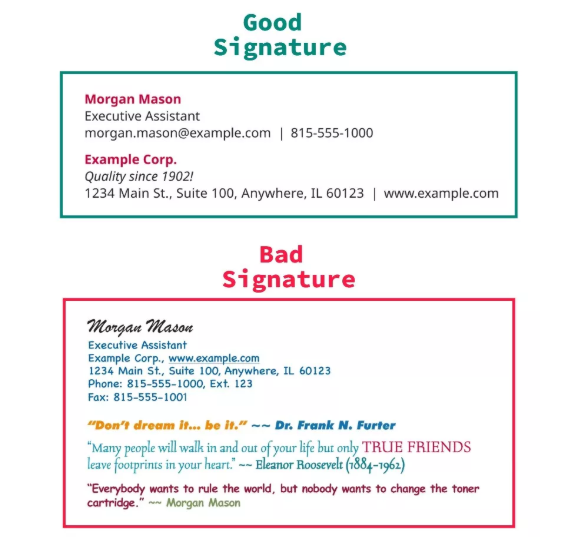
- Unprofessional signature clutter: Skip inspirational quotes, animated GIFs, or excessively long legal disclaimers unless they serve a clear, direct purpose for your role.
- “Sent from my iPhone” when at a desk: This looks lazy when you’re actually at a computer. Reserve it strictly for actual mobile use, so it properly sets expectations and excuses typos.
Email signatures vs sign-offs: What you need
To end an email properly, you need both a sign-off and a signature, but they serve different roles.
A sign-off is what you use directly before your name: “Best regards,” “Warm wishes,” “Have a nice day,” etc. A signature, on the other hand, is everything that goes below your name, and it’s usually a block of contact information.
Essential email signature components
It’s important not to go overboard with this part, as it can either enhance or downgrade the overall quality of your email. Keep it basic:
- Full name
- Job title and company
- Contact information
- Company website
How to design email signatures that look professional
Now you know what you need to add to your signature, but designing it is also important to maintain structure and clarity:
- Keep it clean and scannable: You don’t need any elaborate graphics there, as the sole purpose of the signature block is to provide contact information. Stick to four to five lines at most.
- Left-align your signature: It’s the best option for mobile devices, so just keep it that way. Otherwise, the design might break.
- Include only working links: Check your links regularly to ensure that all the contact information and linking destinations are up to date and operational.
- Keep file sizes small: If you want to add a headshot image or a logo, make sure you keep it under 50 KB.
It’s time to send better emails
Every email you send is an opportunity to connect with your audience. Choosing how to end and email should never be an afterthought. The right phrase may leave a lasting positive impression, prime your reader for action, and reinforce your brand voice.
Also, matching your sign-off to the customer journey could make a huge difference, so make sure you use different email sign-offs for welcoming new subscribers, recovering abandoned carts, handling customer support, sending thank-you messages, and more.
Now you know how to end an email, all that’s left is to pick the right tools that can deliver it. One of the best options in the market is Omnisend, which helps you automate personalized and high-converting messages to your audience. The free plan comes with unrestricted features, so you can try it out today without paying a penny.
Sign up with Omnisend for free today and start sending emails with sign-offs that convert
Quick sign up | No credit card required
FAQs
How to professionally end an email?
When deciding how to end an email professionally, stick to universally accepted closings. Phrases like “Best regards,” “Sincerely,” and “Thank you” are respectful and should be used in professional settings. While you could have a more friendly tone with long-term clients, new contacts should always be treated with formal language.
What is the best email sign-off?
There’s no such thing as “best”, but when in doubt, you can always fall back on “Best regards.” It’s a universal sign-off that fits nearly every situation and is neutral enough to function in both professional and laid-back emails.
What to say instead of signing off?
Any last words in your email will be considered a sign-off, it’s just a matter of making it functional. If you want to make it feel less like a traditional sign-off, you can come up with a unique phrase that only your business uses.
What is a polite ending of an email?
Politeness comes in many forms, so it depends on your audience. In formal industries, you could use “Respectfully” or “Sincerely”. In more relaxed industries, you can use “Warm regards” or “Best wishes”. It all depends on the context and the level of politeness you’re trying to achieve.
What is the best sign-off for a professional email?
“Best regards” remains the safest and most reliable choice for how to sign off an email professionally. It fits nearly all business contexts. Other alternatives could be “Sincerely,” “Kind regards,” or simply “Thank you.”
How do Gen Zs sign off on email?
Contrary to common beliefs, Gen Z typically keeps the humorous (or trendy) email sign-offs for internal use. At work, they will often use short endings like “Cheers,” “Thanks,” or “Best.” If they’re emailing important clients or senior colleagues, they may fall back to longer phrases like “Best regards” or “Looking forward to your response.”
