






Key Takeaways
- Win more attention with less effort by tailoring one core idea to each platform’s format and audience instead of reposting the same content everywhere.
- Build a simple multi-platform workflow by setting a central content plan, creating one “source” post, then adapting it into platform-specific versions before you schedule.
- Protect your team from burnout by choosing a posting rhythm you can sustain for months, even if it means doing fewer platforms better.
- Experiment with “one idea, many shapes” by turning a single topic into a Reel, a LinkedIn post, a short tweet thread, and a Facebook update in one focused session.
You know that moment when you finish creating what feels like the perfect Instagram post—great image, engaging caption, relevant hashtags—and then you stare at LinkedIn and realize you need to completely rethink the whole thing?
Maybe Twitter gets a condensed version. Facebook needs something else entirely. And suddenly, what should have taken 20 minutes has consumed your entire morning.
I’ve watched this pattern play out hundreds of times. A founder starts strong on one platform, decides they need to be “everywhere,” and within six weeks they’re either posting sporadically across all channels or they’ve quietly abandoned three of them. Neither approach builds the consistent presence that actually moves the needle.
The problem isn’t your work ethic or creativity. It’s that managing multiple social platforms genuinely requires different content strategies, posting rhythms, and engagement approaches. Instagram wants square visuals and Stories. LinkedIn rewards thoughtful commentary and professional insights. TikTok demands vertical video with specific pacing. What crushes it in one place often falls flat in another—not because the content is bad, but because each platform has fundamentally different rules of the game.
Here’s what that actually looks like in practice: a store doing $50K monthly might post daily to Instagram and three times weekly to Facebook, manually copying and reformatting between platforms. By the time they reach $200K monthly, they’re trying to maintain presence on five platforms, which means creating and scheduling 20+ posts weekly. At $1M monthly, many brands are publishing 40+ pieces of social content per week across six or seven channels. Without systematic workflows, that volume becomes unsustainable.
This guide walks through practical strategies to manage social content efficiently without sacrificing quality or burning out your team. We’ll cover how to centralize your workflow so you’re not constantly switching between apps, how to adapt content intelligently for each platform’s unique audience and algorithm, and how to maintain a sustainable publishing rhythm that actually fits your current stage and resources.
Why Multi-Platform Management Feels Harder Than It Should
Most businesses jump into multi-platform social assuming it scales linearly. Post to one platform? Easy. Post to five platforms? Just five times the work, right? Not quite.
Each social network operates with distinct content formats, audience expectations, and algorithmic preferences. Instagram built its entire platform around visual storytelling—those carefully curated grid layouts, Stories that disappear, and Reels that favor entertainment making it essential for brands to repurpose content thoughtfully to match how users engage on the platform. LinkedIn rewards professional insights, longer-form written content, and business commentary. Twitter demands brevity and real-time relevance. TikTok wants vertical video with quick hooks and specific editing patterns.
When I worked with a supplement brand scaling from $30K to $400K monthly, they initially tried posting identical content across all platforms. Their Instagram carousel about ingredient sourcing got decent engagement. That same carousel on LinkedIn? Crickets. Not because LinkedIn audiences don’t care about sourcing—they absolutely do—but because LinkedIn audiences expect different framing, more data-driven insights, and commentary that connects to business outcomes rather than lifestyle aspiration.
The volume challenge compounds this complexity. Maintaining visibility typically means daily activity on most platforms, which for a business managing five channels translates to creating, scheduling, and monitoring dozens of posts weekly. Your Instagram audience might expect daily Stories plus 3-4 feed posts. LinkedIn might be twice weekly. Facebook could be daily. Twitter might require multiple posts daily to stay relevant. You’re not just multiplying effort—you’re managing completely different editorial calendars.
Then there’s the cognitive overhead. Every time you switch from Instagram’s interface to LinkedIn’s Creator mode to Twitter’s scheduler to Facebook Business Suite, you’re burning mental energy. You’re trying to remember what you’ve already posted where, which version of the caption you used on which platform, whether that product link works in Instagram Stories or needs to go in bio. For solo founders or small teams, this context-switching might consume 30-40% of your social media time—time that produces zero content or engagement.
The result? Your brand voice starts shifting between platforms because you’re adapting on the fly. Posting schedules become unpredictable because maintaining consistency across five channels takes more time than you budgeted. Tracking performance turns into a spreadsheet nightmare because you’re pulling reports from six different analytics dashboards. And the whole operation feels fragile—miss a few days and you’re scrambling to catch up everywhere simultaneously.
The good news: there are systematic approaches to manage this complexity without requiring a dedicated social team or sacrificing your brand’s authentic voice across platforms. Let’s get into them.
Building a Centralized Content Strategy
Effective multi-platform management starts with a single source of truth for all your content. Rather than creating posts platform by platform, develop content themes and core messages that can be adapted across channels.
Establishing Content Pillars
Start by identifying your content pillars. These are three to five broad topics that align with your expertise and audience interests.
Every piece of content you create should connect to one of these pillars. This ensures thematic consistency regardless of where it appears. When your audience encounters your brand on any platform, they recognize the same core themes and messaging.
Creating Content Atoms
Create what some marketers call “content atoms.” These are substantial pieces like blog posts, videos, or detailed guides that can be broken into smaller platform-specific pieces.
One long-form article might generate ten social posts across different networks. A single video interview produces clips, quote graphics, and text summaries. This approach maximizes the value of every piece of content you create.
Using a Unified Dashboard
A dedicated social media content management platform helps execute this strategy by providing a unified dashboard for planning, creating, and scheduling content. Instead of logging into five separate apps, you manage everything from one interface.
Your content calendar becomes the operational backbone of this system. Map out themes by week or month, then assign specific content pieces to each platform based on what performs best there. This centralization eliminates duplicate effort and ensures nothing falls through the cracks.
Adapting Content Without Starting From Scratch
Platform adaptation does not mean creating entirely new content for each channel. Smart repurposing maintains your core message while respecting each platform’s unique characteristics.
The Content Repurposing Workflow
Consider how a single piece of content travels across platforms. A YouTube video becomes an Instagram Reel with captions added. The key points transform into a LinkedIn carousel. Pull quotes turn into Twitter posts.
According to Statista’s global social media research, over 5 billion people use social media worldwide. This massive audience fragments across platforms with different preferences and behaviors. Understanding these differences guides your adaptation strategy.
Platform-Specific Format Requirements
Format requirements vary significantly between platforms. Instagram favors square or vertical images with minimal text overlay. LinkedIn audiences engage with longer text posts and document carousels.
Twitter rewards concise, punchy statements that spark conversation. TikTok demands vertical video with strong hooks in the first three seconds. Batch your adaptation work by dedicating specific time blocks to converting content atoms into platform-ready pieces.
Adjusting Tone for Each Channel
Tone adjustments matter as much as format changes. Professional insights that resonate on LinkedIn might need a more casual, conversational spin for Instagram.
The same information, delivered differently, connects with each platform’s culture. Your audience on Facebook expects a different voice than your Twitter followers. Matching these expectations increases engagement without requiring entirely new content.
Creating a Sustainable Publishing Schedule
Consistency beats intensity in social media. Publishing daily for two weeks, then disappearing for a month, damages your algorithmic standing and audience trust more than posting less frequently but reliably.
Setting Realistic Frequencies
Determine realistic publishing frequencies for each platform based on your resources. If you can only manage three posts weekly per platform, commit to that schedule and maintain it.
Algorithms reward predictable activity patterns. A steady rhythm of quality content outperforms sporadic bursts of posting followed by long silences.
Strategic Timing
Time your posts strategically. Each platform has peak engagement windows that vary by industry and audience demographics.
Test different posting times and track results to find what works for your specific followers. Morning posts might perform best on LinkedIn while evening content wins on Instagram. Let data guide your scheduling decisions.
Building Buffer Content
Build buffer content into your workflow. Aim to stay at least one week ahead in your scheduling queue.
This buffer protects you from disruptions and prevents the panic of last-minute content creation. Scheduling tools handle the publishing logistics, freeing you to focus on engagement and community interaction.
Measuring Success Across All Channels
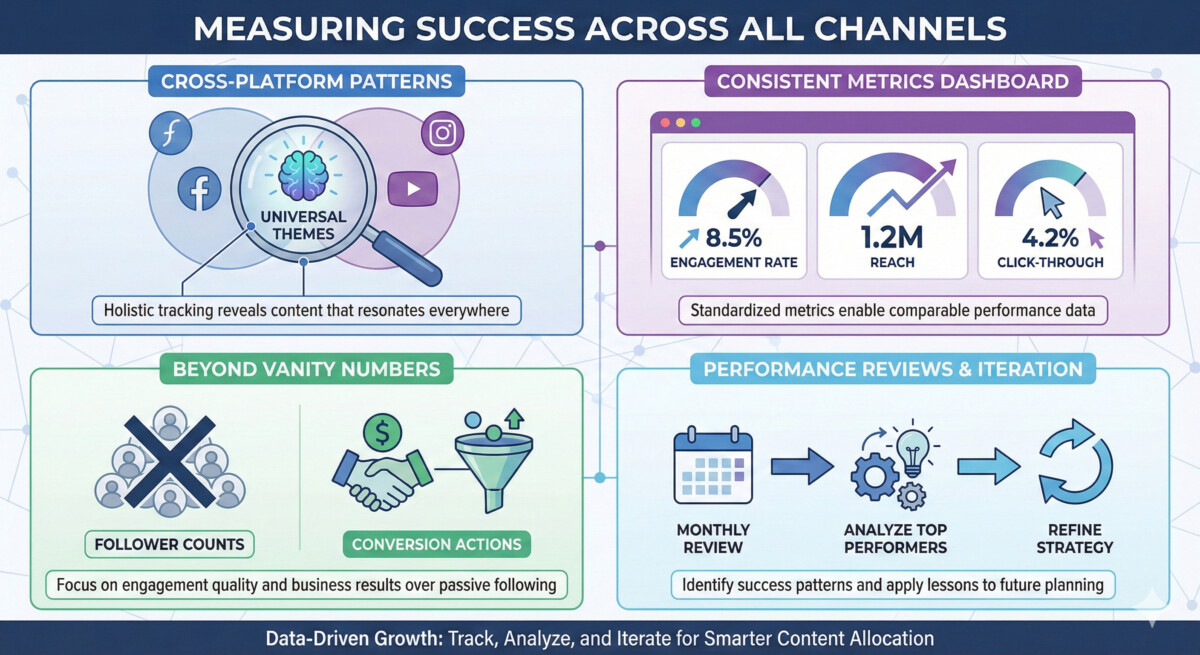
Cross-platform analytics reveal patterns that single-platform data misses. When you track performance holistically, you discover which content themes resonate universally and which work only on specific channels.
Defining Consistent Metrics
Define consistent metrics across platforms. Engagement rate, reach, and click-through provide comparable data points even when platform-specific terminology differs.
Create a simple dashboard that aggregates these metrics weekly. Standardized tracking makes it easier to compare performance and allocate resources effectively.
Looking Beyond Vanity Numbers
Look beyond vanity metrics. Follower counts matter less than engagement quality and conversion actions.
A smaller, highly engaged audience on LinkedIn might drive more business results than a large, passive following on Instagram. Track content performance by theme and format to identify what actually moves your business forward.
Performance Reviews and Iteration
Monthly reviews should examine both platform-specific and aggregate performance. Identify your top performers, analyze why they succeeded, and apply those lessons to future content planning.
Over time, patterns emerge showing which topics and presentation styles generate the strongest response. Use these insights to refine your content pillars and production priorities.
Moving Forward With Your Multi-Platform Strategy
Managing social media content across multiple platforms becomes manageable when you build the right systems. Centralize your planning, create adaptable content, maintain consistent schedules, and measure what matters.
Start with one improvement. Perhaps that means establishing content pillars this week or setting up a proper content calendar. Small systematic changes compound into significant efficiency gains over time.
The goal is not perfection on every platform. Focus on sustainable practices that let you show up consistently, provide value to your audiences, and build genuine connections without burning out.
