





Quick Decision Framework
- Who This Is For: Shopify merchants at any revenue stage who want to use AI to personalize the customer journey, automate marketing operations, reduce support costs, and make smarter inventory decisions without building a data team.
- Skip If: You are pre-revenue or still validating your first product. AI needs data to work. Come back once you have at least 90 days of order history and a basic customer list to learn from.
- Key Benefit: Replace guesswork with a connected AI marketing system that improves conversion rates, reduces customer acquisition cost, and generates measurable lifts in repeat purchase rate within 60 to 90 days of implementation.
- What You’ll Need: A Shopify store with at least 3 months of transaction data, access to your email platform (Klaviyo or Omnisend recommended), and a realistic monthly budget of $100 to $500 for AI tools depending on your store size. No developers required to get started.
- Time to Complete: 20 minutes to read. 2 to 6 hours to implement your first AI use case. 30 to 60 days to collect meaningful performance data from your initial setup.
Artificial intelligence is no longer a competitive advantage reserved for enterprise retailers. It is the infrastructure that separates stores growing predictably from stores guessing their way through every quarter.
What You’ll Learn
- What AI in eCommerce marketing actually means in practice, beyond the buzzwords, and why the opportunity is bigger right now than it has ever been.
- The key benefits of AI-driven systems, including smarter targeting, operational efficiency, enhanced personalization, and dynamic pricing and inventory management.
- How AI chatbots and virtual assistants are transforming customer service by handling routine inquiries automatically while freeing your team for high-value conversations.
- How machine learning, predictive analytics, and demand forecasting turn historical sales data into proactive marketing decisions.
- How to use AI for content creation, email marketing automation, visual and voice search, and SEO optimization on your Shopify store.
- The real challenges of AI implementation, including data quality, privacy compliance, and skill gaps, and how to navigate them without derailing your rollout.
- A practical six-step framework for getting started with AI in your eCommerce marketing strategy, from goal-setting to scaling.
Artificial intelligence is transforming online retail by making stores smarter, more personalized, and more efficient at every stage of the customer journey. Leading brands are partnering with an AI digital marketing agency to turn customer data into practical marketing systems that drive revenue. With AI for eCommerce marketing, merchants can uncover hidden patterns in sales and customer behavior, automate routine tasks, and tailor each interaction to customer intent. The result is a store that feels like it knows every customer individually, even when you are serving tens of thousands of them at once.
The Shopify ecosystem has matured to the point where these capabilities are no longer reserved for enterprise retailers with data science teams. They are available through apps that install in minutes, connect to your existing product catalog and customer data, and start generating value within weeks. The gap between stores using AI and stores that are not is widening every quarter. This guide covers everything you need to know to get on the right side of that gap.
What Is AI in eCommerce Marketing?
AI in eCommerce marketing means using machine learning, natural language processing (NLP), predictive analytics, and other algorithms to understand customer data and automate marketing tasks. In practice, this involves feeding customer and sales data into smart systems that uncover trends and personalize experiences at a scale no human team can match manually.
Shopify notes that AI marketing tools can “automate and optimize your marketing processes,” from generating content to segmenting customers. In short, AI for eCommerce marketing uses data to predict what customers want, segment them intelligently, and generate tailored content, including product descriptions, email copy, and ad creatives, with minimal manual effort. Every customer interaction becomes a data point that makes the next interaction smarter.
For Shopify merchants, this plays out across five high-impact areas: personalization and recommendations, customer service automation, email marketing and content creation, inventory and pricing optimization, and search and SEO. Each area compounds the others. A customer who receives a relevant product recommendation is more likely to open your next email. A customer whose support question is answered instantly is more likely to buy again. AI connects these moments into a coherent, revenue-generating system.
Key Benefits of AI in eCommerce
AI-driven systems offer major advantages for online retailers. The most immediate is predictive intelligence: AI’s predictive analytics highlight trends early, allowing you to act before competitors do. Machine learning models detect rising demand for specific products so you can restock fast-moving items before running out, adjust pricing before a competitor does, and launch promotions before demand peaks rather than after. Having accurate real-time forecasts means you can respond to market signals instantly, minimizing costs and maximizing sales at every turn.
Operational Efficiency
AI for eCommerce marketing automates repetitive tasks across marketing and supply chain operations. It can update thousands of SKUs, process orders, triage support tickets, and generate campaign copy automatically. Merchants using AI-based inventory planning report cutting excess stock by 30 to 50% and saving hundreds of thousands of dollars annually by eliminating the carrying costs of slow-moving products. When your team is no longer manually updating product listings or answering the same support questions 200 times a week, that time compounds into higher-value work that actually moves the business forward.
Smarter Targeting
By analyzing shopper behavior at scale, AI enables targeting precision that manual segmentation simply cannot achieve. AI can cluster customers by intent, purchase frequency, or lifetime value in minutes, allowing you to send each segment the right message at the right moment. Deloitte research shows that roughly 80% of consumers spend up to 50% more with brands that excel at personalization. Automated ad tools and AI-optimized email campaigns further sharpen spend: AI-written subject lines and dynamic content consistently boost open rates by 8 to 12%. For instance, AI can automatically identify and serve the highest-performing ad creatives to different audience segments when paired with AI driven personalization strategies that go beyond basic demographic targeting.
Enhanced Personalization
AI tailors the shopping experience at scale in ways that feel individual to each customer. Recommendation engines suggest products based on past purchases, browsing behavior, and the patterns of customers who look like them. Shoppers who receive personalized suggestions spend more per visit and return more often. When customers consistently see relevant products and offers, conversion rates and lifetime value both increase. Leading platforms use AI, including Shopify Magic, to auto-generate product descriptions targeted at specific customer segments, saving copywriting hours while improving relevance for different buyer types. The result is more meaningful interactions at every touchpoint, from the first product page view to the fifth repeat purchase.
Dynamic Pricing and Inventory
AI can adjust prices in real time based on competitor pricing, demand signals, and external market factors. AI tools continuously optimize your prices to stay competitive while protecting profit margins, shifting pricing from periodic manual updates to constant intelligent optimization. Early adopters already gain a measurable margin advantage by letting AI manage pricing dynamically. On the inventory side, AI-driven models monitor sales velocity and trigger restocks just-in-time, preventing both stockouts and the cash flow drag of excess inventory. This dual approach creates a more responsive, profitable supply chain without requiring a dedicated operations analyst.
AI-Powered Customer Service: Chatbots and Virtual Assistants
AI for eCommerce marketing is transforming customer service with chatbots and virtual assistants that deliver instant answers around the clock. Unlike traditional support models that scale linearly with headcount, AI chatbots handle growing support volume without growing your team. A well-configured chatbot handles 60 to 80% of routine inquiries automatically, including order status, return policies, shipping questions, and product recommendations, freeing your human agents for the complex, high-value conversations where empathy and judgment actually matter.
The benefits compound over time. Customers get immediate responses at 2am on a Sunday. Your support team wakes up to a queue containing only the conversations that require human involvement. Satisfaction scores improve because response time drops from hours to seconds. And every chatbot interaction feeds back into your CRM, enriching customer profiles for future targeting and personalization. As AI natural language processing continues to improve, these bots become more conversational and more accurate at understanding nuanced intent, making them increasingly effective at turning support interactions into sales opportunities. Common advantages include 24/7 availability, significant cost reduction, seamless lead capture, and a customer experience that scales without breaking.
Machine Learning Marketing: Predictive Analytics and Demand Forecasting
Machine learning is at the heart of predictive marketing for eCommerce. By analyzing vast datasets of past sales, web traffic, seasonal patterns, and external signals, ML models forecast future buying behavior with a precision that gut-feel decisions cannot approach. This allows eCommerce businesses to act proactively rather than reactively. Predictive analytics can alert you when a product’s demand is about to surge, prompting targeted promotions or restocking actions before the window closes. It can identify customers who are likely to churn before they stop buying, giving you the opportunity to re-engage them with a timely offer.
Rather than guessing which items to promote or which customers to target, ML tells you exactly what each segment is interested in next month, next week, and even tomorrow. This leads to more precise campaigns, optimized inventory positions, and marketing spend allocated to the highest-probability opportunities. Machine learning marketing turns gut-feel decisions into data-driven strategy, compressing the time between insight and action and boosting both efficiency and revenue in the process.
Dynamic Pricing and Inventory Optimization
AI for eCommerce marketing reshapes pricing and stock management through real-time intelligence that no human team can replicate at scale. Dynamic pricing tools use algorithms to adjust prices based on demand signals, competitive movements, and market conditions. When demand spikes or a competitor changes prices, AI automatically updates your prices to stay competitive while protecting profit margins. This shift from periodic price reviews to continuous optimization is already standard practice among the fastest-growing DTC brands and is predicted to become table stakes for competitive eCommerce within the next few years.
On the inventory side, AI-driven optimization ensures you have the right stock at the right time. Predictive models monitor sales velocity across your entire catalog and trigger restocks just-in-time, minimizing carrying costs and preventing the lost sales that come from stockouts on your best-performing SKUs. Merchants who implement AI-driven inventory planning at the $50K to $200K per month revenue level typically reduce excess stock by 20 to 35% and cut stockout events by 40 to 60% within the first 90 days. The cash flow impact is significant and compounds over time.
Benefits of AI Pricing and Inventory
Real-time price adjustments increase profit per transaction. Smarter inventory management lowers carrying costs and improves product availability. Customers find the products they want in stock more often, reducing frustration and lost sales. You avoid the margin-destroying markdowns that come from excess inventory. Together, dynamic pricing and smart inventory create a more responsive, profitable supply chain that gives your store a structural competitive advantage over merchants still managing these functions manually.
AI for Content Creation and Email Marketing Automation
AI for eCommerce marketing can drastically accelerate content creation across every channel. Generative AI tools like Jasper and ChatGPT draft blog posts, ad copy, and email text from simple prompts, giving your team a strong first draft to react to instead of a blank page. Design tools like Canva’s AI features and Shopify’s image generator produce on-brand visuals on demand. This means your creative team generates more variations in less time and spends their energy refining the best ideas rather than producing the first draft of every asset.
Email marketing sees some of the largest gains from AI. Modern platforms segment audiences, personalize content, and schedule sends automatically based on individual subscriber behavior. HubSpot’s AI email feature can take a marketing brief and deliver a complete email draft in minutes, then use your CRM data to tailor each recipient’s copy and predict engagement, suggesting optimal send times for each individual subscriber. The result is higher open rates, better click-through rates, and more revenue per email sent.
Key AI capabilities in email marketing include automated segmentation that builds dynamic mailing lists based on real-time behavior, personalized content generation that creates customized newsletters for each subscriber, and smart scheduling that sends each message at the moment each individual is most likely to engage. By leveraging these capabilities together, marketers deploy hyper-personalized campaigns at a scale that would require a team ten times larger to run manually. In practice, AI-triggered emails like abandoned cart sequences and post-purchase win-back flows recover a meaningful portion of potential lost revenue that would otherwise disappear. Every message becomes relevant and timely, improving ROI and freeing your team from the manual work that used to consume entire marketing calendars.
Visual and Voice Search Capabilities
AI for eCommerce marketing significantly improves search functionality on eCommerce sites in ways that meet modern shopper expectations. Visual search allows customers to upload a photo and instantly find matching products in your catalog. A shopper can photograph a pair of shoes they saw on Instagram, upload the image to your store’s search, and surface similar items across your entire catalog in seconds. This cuts search friction dramatically and improves the shopping experience for the growing segment of customers, particularly in fashion, home goods, and beauty, who think visually rather than in keywords.
Advantages of AI-Driven Search
Faster product discovery, more intuitive shopping, and higher conversion rates. Customers find what they are looking for without needing to articulate exact keywords, reducing frustration and exit rates. According to Shopify and industry analyses, implementing voice and visual search “meets user expectations” and drives measurable engagement improvements. Voice search optimization adds a parallel opportunity: voice queries tend to be conversational and question-based, so optimizing your product descriptions and FAQ content for natural language patterns improves visibility in voice search results and, increasingly, in AI-generated shopping recommendations from tools like ChatGPT and Perplexity. By adding these features, you create a seamless, modern shopping experience that helps customers find what they want and check out faster.
AI in SEO and Website Optimization
AI for eCommerce marketing plays a key role in SEO strategy and site optimization, compressing work that used to take weeks into hours. AI tools analyze search patterns to identify high-impact keywords, surface content gaps your competitors are filling, and prioritize the optimizations most likely to move rankings. Surfer SEO uses AI to compare your content with top-ranking pages for your target keywords and suggests specific improvements in word count, semantic keyword inclusion, and structural elements. Following these recommendations consistently produces measurable ranking improvements within 60 to 90 days on pages that were previously stagnant.
AI can also automate A/B testing at a scale and speed that traditional split-testing cannot match. Some platforms spin up multiple page variations simultaneously and use machine learning to identify winning variants in 10 to 14 days by dynamically allocating traffic toward better-performing options in real time, compared to the 4 to 6 weeks a traditional A/B test requires to reach statistical significance. On the site experience side, AI personalizes layouts and content for different visitor segments, adjusting page elements based on behavioral profiles to improve relevance and conversion without manual intervention. Overall, AI helps eCommerce businesses stay ahead in search visibility and site performance by making data-driven SEO and UX decisions continuously rather than in periodic campaigns.
Challenges and Considerations When Using AI
Implementing AI has real caveats that every merchant should understand before committing budget and time. The brands that succeed with AI are the ones who go in with clear expectations about the obstacles, not just the upside.
Initial investment. Deploying AI requires upfront spending on tools, data infrastructure, and in some cases expertise. Buying AI platforms or bringing in specialists costs money, and it takes time to see results. Budget realistically and plan for a 60 to 90 day ramp before performance data becomes reliable enough to act on with confidence.
Data quality and privacy. AI systems are only as good as the data you feed them. You must ensure your customer data, including sales history, behavioral data, and CRM records, is clean, complete, and compliant with privacy laws like GDPR and CCPA. Poor data leads to bad predictions, irrelevant recommendations, and wasted spend. Strong data quality is not a nice-to-have. It is the foundation of any AI strategy that actually works.
Skill gap. Many merchants lack the in-house expertise to configure AI tools properly and interpret the results intelligently. Without someone on your team who understands how these systems work, AI tools may not be fully utilized or may produce results you cannot act on. Investing in team training or working with a specialist consultant to get your initial setup right is often a better investment than months of trial and error.
Maintenance. AI models degrade if not regularly updated. A recommendation engine trained on your summer catalog data will not automatically know how to handle your winter product launch. Models require ongoing retraining with new data and regular monitoring to stay effective. Build review cycles into your AI tool management the same way you would with any other part of your marketing operation.
Ethical and security considerations. Over-reliance on AI without human oversight can backfire. Bias in models can lead to unfair targeting, and misuse of customer data carries both legal and reputational risk. Responsible use, transparent data practices, and regular human review of AI outputs are essential, not optional.
To navigate these challenges, start small and focus on high-impact use cases. Begin with clear business goals and clean data. Test one AI project at a time, measure it rigorously, learn from it, then expand. This iterative approach avoids the common pitfall of buying four tools, configuring none of them properly, and wondering why the results do not match the case studies.
How to Get Started with AI for eCommerce Marketing
Beginning your AI journey can feel overwhelming, but a structured approach removes the guesswork. Here is the six-step framework that works for Shopify merchants at every revenue stage.
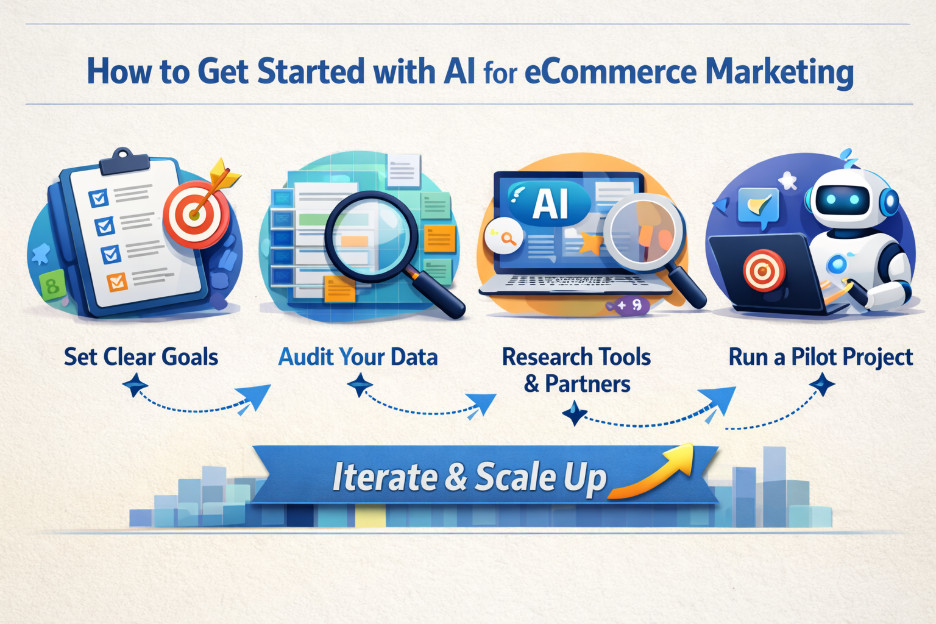
Step 1: Set clear goals. Define what you want to achieve before choosing any tools. Higher email open rates, better ad targeting, smoother inventory management, reduced support volume. Each goal points to a different AI use case, and starting with a specific outcome in mind ensures you can actually measure whether the investment is working.
Step 2: Audit your data. Ensure you have the right data for AI to work with. Audit your customer and sales data for accuracy and completeness. AI can only be as good as the data you feed it. Clean purchase histories, web analytics, and CRM records are the foundation. If your data is messy, clean it first. Two weeks spent on data quality will pay off more than two months of fighting with an AI tool working from bad inputs.
Step 3: Research tools and partners. Explore AI tools and platforms that fit your specific needs and tech stack. Shopify merchants have access to built-in AI features including Shopify Magic and Shopify Inbox, as well as a deep ecosystem of third-party apps. Compare options based on integration ease, cost, support quality, and the specific use case you are targeting. Do not buy more than you need to start.
Step 4: Run a pilot project. Start with a single, focused AI experiment. Add an AI chatbot to your site, or use an AI tool to personalize one email campaign. Measure the results, including engagement, conversions, and time saved, over 30 days. This test-and-learn approach proves value without large risk and gives you real data to justify expanding the investment.
Step 5: Iterate and scale. Analyze what worked and refine it. Adjust your models or segments based on what the data shows. Then expand AI to additional channels, including ads, personalization, and pricing. Monitor key metrics continuously so you can fine-tune the algorithms over time. The compounding returns come from connecting multiple AI use cases into a coherent system, not from running them in isolation.
Step 6: Consider expert help. If internal resources are limited, partner with AI consultants or agencies that specialize in eCommerce. They can accelerate implementation, guide strategy, and train your team, often recovering their cost within the first 60 days through faster, better-configured setups.
By following these steps, you move from a single pilot to a fully integrated AI marketing system. Successful AI adoption is iterative by nature. Starting with the right problems and clean data is the prerequisite. With each phase, AI provides faster campaign testing, smarter targeting, and deeper customer insights that compound into a durable competitive advantage.
Maximizing Success with AI in eCommerce Marketing
AI is transforming eCommerce marketing by giving merchants access to capabilities that were previously available only to enterprise retailers with large data teams. By integrating AI for eCommerce marketing, from personalized recommendations to predictive analytics and chatbots, retailers of every size can enhance customer experiences, reduce operational costs, and grow revenue more efficiently. The key is to adopt AI thoughtfully, starting with clear strategies, clean data, and measurable goals, then building out from there.
Those who leverage AI retail solutions and the right mix of AI marketing tools will see faster campaign testing, smarter targeting, and higher sales. The merchants who wait for AI to become more mature or more affordable are already falling behind the ones who started six months ago. Now is the time to implement AI in your eCommerce strategy, measure results rigorously, and iterate continuously, ensuring your store stays ahead of the curve and builds the kind of compounding growth advantage that is very difficult for competitors to close.
Frequently Asked Questions
What is AI in eCommerce marketing and why does it matter?
AI in eCommerce marketing refers to the use of machine learning, natural language processing, and predictive analytics to automate and personalize marketing tasks at scale. It matters because it allows merchants to make data-driven decisions faster than any manual process, personalize the customer experience for thousands of shoppers simultaneously, and optimize pricing, inventory, and campaigns in real time. The result is higher conversion rates, lower customer acquisition costs, and stronger repeat purchase rates, all without proportionally growing your team.
What are the biggest benefits of using AI for eCommerce?
The most impactful benefits are enhanced personalization, which increases average order value and repeat purchase rate; smarter targeting, which improves the efficiency of paid and email marketing; AI-powered customer service, which reduces support costs while improving response times; and dynamic inventory management, which prevents stockouts and excess inventory simultaneously. Together, these benefits create a compounding advantage: each improvement makes the others more effective over time.
How do AI chatbots improve eCommerce customer service?
AI chatbots handle routine support inquiries, including order status, return policies, shipping questions, and product recommendations, automatically and instantly, 24 hours a day. This deflects 60 to 80% of support ticket volume without human involvement, reducing costs and improving response times simultaneously. The conversations that do reach your human agents are the complex, high-value ones where empathy and judgment actually matter. Every chatbot interaction also feeds back into your CRM, enriching customer profiles for future personalization and marketing.
How does AI improve email marketing for Shopify stores?
AI improves email marketing in three primary ways. First, automated segmentation builds dynamic audience lists based on real-time behavioral signals rather than static demographic criteria. Second, personalized content generation tailors subject lines, body copy, and product recommendations to each individual subscriber. Third, predictive send-time optimization delivers each message at the moment each subscriber is most likely to engage, based on their historical open behavior. Together, these capabilities produce measurable improvements in open rates, click-through rates, and revenue per email sent, often within the first two to three campaign sends after implementation.
What are the main challenges of implementing AI in eCommerce marketing?
The five main challenges are initial investment costs, data quality requirements, internal skill gaps, ongoing model maintenance, and ethical and privacy considerations. The most common failure mode is implementing AI tools before data quality is addressed, which produces unreliable outputs and erodes confidence in the technology. The most effective mitigation is a sequential, test-and-learn approach: one use case at a time, measured rigorously, before expanding to the next. Starting with clean data and a specific business goal dramatically increases the probability of a successful outcome.
How do I get started with AI for eCommerce marketing on Shopify?
Start by defining one specific goal, such as reducing support ticket volume or improving email open rates. Audit your customer and sales data for completeness and accuracy. Research the AI tools that address your specific use case within the Shopify ecosystem, including built-in features like Shopify Magic and Shopify Inbox as well as third-party apps. Run a 30-day pilot on a single use case, measure the results, and refine before expanding. If internal expertise is limited, a brief engagement with a Shopify-specialized consultant to configure your initial setup properly will pay off faster than self-directed trial and error.
