Quick Decision Framework
- Who this is for: Shopify store owners generating $100K+ annually who want to scale customer acquisition without losing brand control or margin
- Skip if: You’re pre-product-market fit, have inconsistent inventory, or can’t maintain 30%+ margins after Amazon fees
- Key benefit: Acquire high-intent customers on Amazon at 2-3x higher conversion rates, then migrate them to your owned ecosystem for repeat purchases
- What you’ll need: Active Shopify store, consistent inventory, budget for Amazon Seller account ($39.99/month) and initial advertising ($500+ minimum)
- Time to complete: 30-45 days to launch on Amazon, 90-180 days to build a functioning hybrid acquisition system
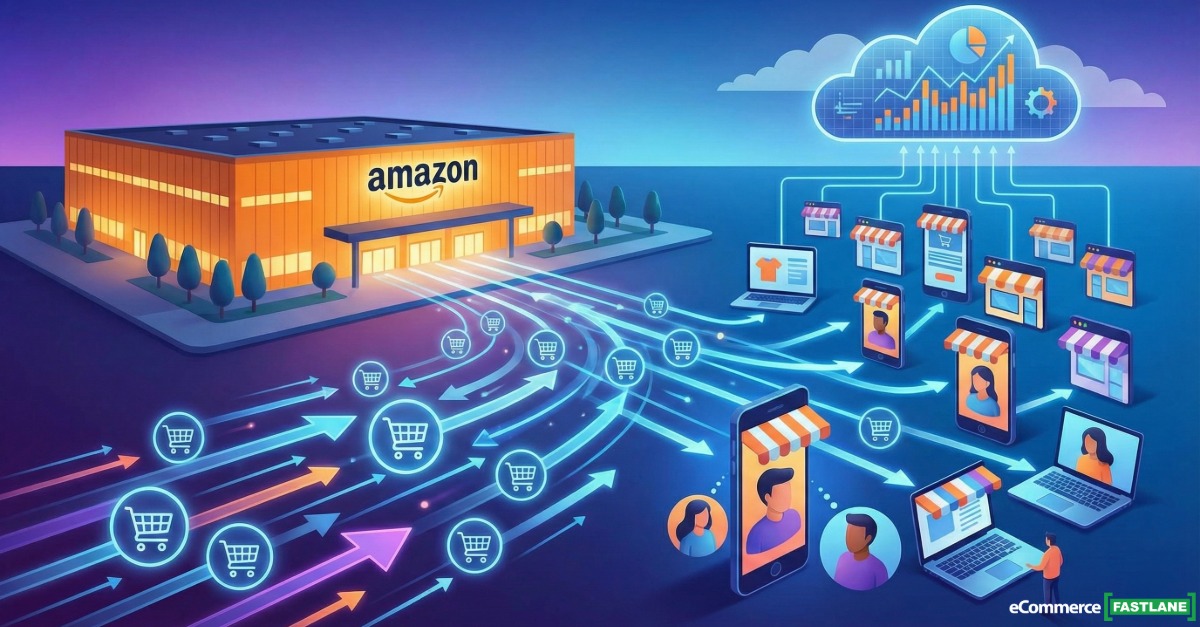
Most brands treat Amazon and Shopify as competitors. The smartest brands in 2026 use Amazon as their customer acquisition engine and Shopify as their profit center.
What You’ll Learn
- How to use Amazon DSP to retarget marketplace shoppers to your Shopify store with precision audience targeting
- The exact Multi-Channel Fulfillment setup that lets you deliver Prime-speed shipping from your DTC site
- Why Buy with Prime converts 10-50% higher than standard checkout and how to implement it strategically
- Advanced tactics for using Amazon search data to strengthen your Shopify SEO and content strategy
- The revenue threshold framework: what to prioritize at $100K, $1M, and $5M+ in annual sales
The most successful ecommerce brands in 2026 don’t choose between Amazon and Shopify. They engineer a system where Amazon handles customer acquisition and Shopify captures lifetime value. This isn’t theory. It’s the proven playbook from brands scaling past seven figures while maintaining control of their customer relationships and margins.
Here’s what changed: Amazon advertising costs jumped 15% year-over-year, with average CPCs hitting $1.12 in 2025. Meanwhile, Facebook ad costs rose 25% over the past year and 100% over two years. The old model of relying on a single acquisition channel is broken. Smart brands now use Amazon’s unmatched product discovery engine to acquire customers, then migrate those relationships to owned channels where margins are 30-40% higher.
Why Amazon Still Dominates Product Discovery
Amazon isn’t just a marketplace. It’s the world’s largest product search engine, with 55% of consumers starting their product searches there. When someone lands on Amazon, they’re not browsing casually. They’re ready to buy, which is why conversion rates on Amazon run 2-3x higher than standalone DTC sites.
But here’s the strategic insight most brands miss: Amazon’s strength in acquisition is also its weakness for retention. You get the sale, but Amazon owns the customer data, controls the post-purchase experience, and limits how you can build lasting relationships.
The solution isn’t to abandon Amazon. It’s to use Amazon strategically as your front door while building your living room on Shopify, where real relationships happen.
The Three-Part Framework: Acquire, Fulfill, Convert
This framework has been tested across hundreds of brands, from SNAP Mounts achieving a 60% conversion lift to BeautyGARDE scaling paid media with triple-digit ROI gains. It works because it addresses the complete customer journey, not just one channel.
Part 1: Amazon DSP – Your Precision Retargeting Engine
Amazon DSP (Demand-Side Platform) is dramatically misunderstood. Most brands think it’s display advertising. It’s actually one of the most powerful intent-based media platforms available to ecommerce.
Unlike Facebook or Google, DSP targets people based on actual Amazon shopping behavior. That means you can reach past purchasers, category browsers, people who viewed competitor products, and shoppers who abandoned specific items. You’re not guessing at intent. You’re targeting people who’ve already demonstrated it through their actions.
Here’s how to deploy it strategically:
Audience Segmentation That Actually Works: Build audiences around behavior, not demographics. Target people who bought from competitors in the past 30 days. Retarget your own Amazon customers who haven’t purchased in 60+ days. Reach category browsers who haven’t converted yet.
Traffic Routing That Converts: Don’t send DSP traffic to your homepage. Create dedicated landing pages that acknowledge where they came from and present a clear reason to buy direct. Exclusive bundles work exceptionally well. So do subscription offers, extended warranties, and educational content that positions you as the category expert.
When DSP Makes Financial Sense: This strategy typically works best once you’re generating $1M+ in annual Amazon revenue. At that scale, you have enough data volume to build meaningful audience segments and enough margin to support full-funnel testing.
For brands serious about running DSP as a performance channel, understanding Amazon Marketing Cloud becomes critical. It’s how advanced teams analyze shopper behavior patterns and build scalable audience strategies that compound over time.
Part 2: Multi-Channel Fulfillment – Break Free from FBA Lock-In
One of the biggest myths holding DTC brands back is the belief that Prime-speed delivery only works through Amazon’s marketplace. That’s simply not true anymore.
Multi-Channel Fulfillment (MCF) lets you use Amazon’s logistics network to ship orders from your Shopify store, social commerce platforms, and any other channel. Orders ship in unbranded packaging, maintaining your brand experience while delivering the speed customers expect.
This removes the primary operational excuse for staying Amazon-dependent. You no longer have to choose between fast delivery and channel independence.
When MCF Makes Strategic Sense: MCF is particularly valuable if you’re scaling faster than your logistics infrastructure can support, dealing with unreliable 3PLs, or need consistent delivery performance across multiple channels. While it’s not always cheaper than a best-in-class 3PL, it’s typically faster to implement and easier to scale during demand spikes.
For many brands, MCF functions as a bridge technology. It enables true omnichannel operations while you evaluate long-term fulfillment strategies. The key benefit is optionality. You’re no longer locked into Amazon’s ecosystem just because of logistics.
Part 3: Buy with Prime – Convert DTC Traffic with Amazon’s Trust
Buy with Prime closes the loop. It brings Prime checkout and fast delivery directly to your Shopify site, giving customers the speed and reliability they expect from Amazon while keeping the transaction on your domain.
This matters because checkout friction kills DTC conversions. Uncertainty about shipping speed, delivery reliability, and return policies causes shoppers to abandon carts. Buy with Prime eliminates those concerns by providing a familiar, trusted purchasing experience.
The strategic advantage: you retain customer data, control the post-purchase journey, and can integrate buyers into your retention ecosystem. You get Amazon’s conversion power without giving up ownership of the relationship.
Implementation Best Practices: Focus Buy with Prime on high-volume, low-return SKUs first. Deploy it on high-intent landing pages where traffic is already warm. Use it for products with strong repeat purchase potential. Pair it with exclusive DTC offers that create clear value for buying direct instead of through the marketplace.
The conversion lift can be substantial. Shop Pay, for example, increases conversion by up to 50% compared with guest checkout. Buy with Prime delivers similar results by reducing friction at the exact moment purchase decisions are made.
Off-Amazon SEO: The Hidden Growth Lever
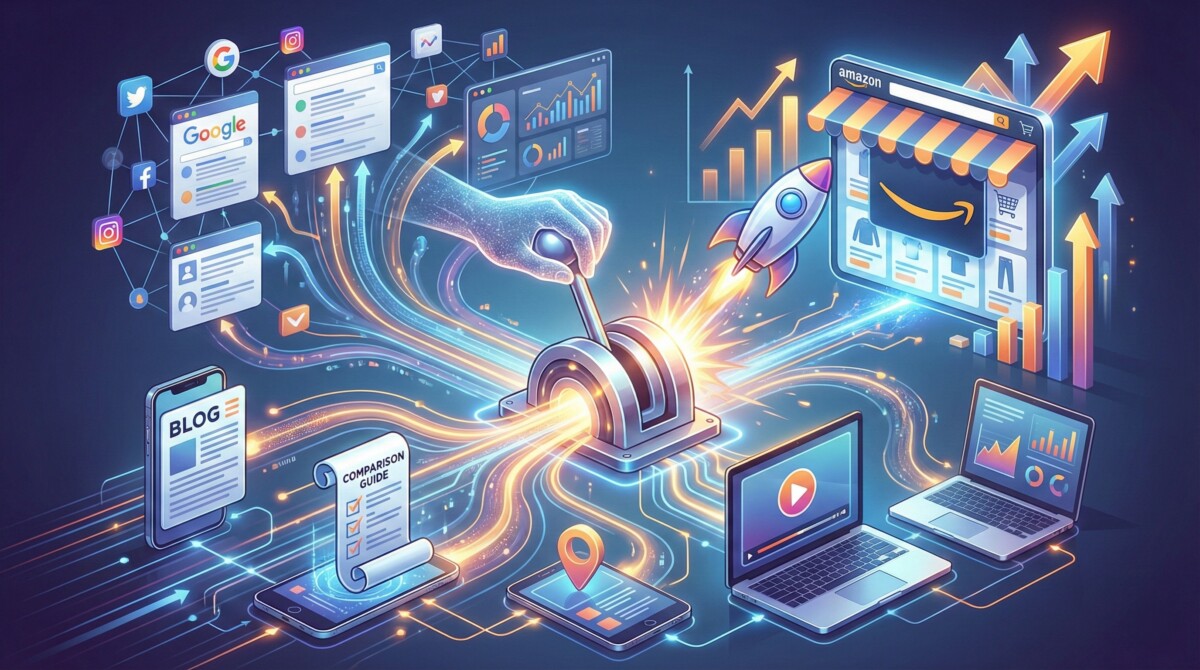
Here’s a counterintuitive insight: your DTC content strategy can directly improve your Amazon organic rankings. Most brands miss this entirely.
When you create high-quality blog posts, comparison guides, and educational content that naturally link to your Amazon listings, you’re meeting shoppers wherever they are in the research process. Some will prefer to buy direct. Others will always choose Amazon. Smart brands monetize both without losing control of the narrative.
Even more powerful: well-optimized Amazon listings start ranking on Google for product-specific queries. These shoppers land on your Amazon page from Google already warmed up, more informed, and ready to buy. This leads to higher conversion rates and stronger engagement signals inside the marketplace, which further improves your organic visibility.
Measurement That Matters: Amazon Attribution and Brand Referral Bonus programs let you connect off-platform activity to marketplace performance. You can see exactly how paid search, organic content, email campaigns, and social traffic influence Amazon revenue.
Building high-quality backlinks to your Amazon listings from reputable, high-domain authority sources is what separates brands that treat off-Amazon SEO as a brand exercise from those using it as a performance lever. For deeper insights, explore improving SEO visibility and competitor backlink analysis strategies.
Building Brand Search Demand Through Content
Search demand is one of the strongest signals of legitimacy in ecommerce. When more consumers actively search for your brand by name, both Google and Amazon interpret that as relevance. This improves organic visibility, protects branded keywords, and reduces dependence on expensive generic terms.
This is why podcasts, PR, founder-led content, creator partnerships, and community building matter operationally, not just aesthetically. They generate demand that paid media cannot sustainably manufacture.
As global competition on Amazon intensifies (over 70% of sellers now operate from overseas), brand-driven demand becomes one of the few defensible advantages. Price competition is relentless. Brand loyalty is durable.
Strategic External Traffic to Amazon Listings
External traffic improves Amazon performance when treated as a system, not a campaign. High-performing brands drive qualified traffic from Google search, shopping ads, influencer review pages, and segmented email lists to optimized Amazon listings.
These listings are engineered for conversion: strong imagery, A+ content, social proof, competitive pricing. Performance is tracked using Amazon Attribution links and referral bonus programs. Over time, teams develop clear models connecting audience, offer, destination, and outcome.
This transforms external traffic from an experiment into a repeatable asset. The organic snowball effect kicks in when higher engagement and conversion rates feed back into stronger organic rankings.
The Data Flywheel: Intelligence That Compounds
The strongest advantage of a hybrid Amazon-DTC strategy isn’t reach or conversion. It’s intelligence.
Amazon reveals what customers are already searching for and buying. Shopify reveals how customers behave after purchase. When these insights are shared intentionally, both channels improve.
Search term data informs SEO and product positioning. Customer feedback and support data refine listings. Attribution models clarify which channels excel at acquisition and which generate lifetime value.
High-performing brands use Amazon keyword data to shape Shopify product pages and content, while using DTC reviews and customer support insights to improve Amazon listings. This creates a self-reinforcing system, not a collection of tactics.
What to Prioritize Based on Your Revenue Stage
- Under $1M Annual Amazon Revenue: Focus on validation. Optimize your Amazon listings for conversion. Run controlled external traffic tests (including channels like TikTok Shop paired with Amazon fulfillment). Build a minimal DTC foundation with email capture and one or two compelling direct offers. At this stage, the highest ROI comes from tightening conversion fundamentals and making your owned channel purchase-ready. For specific optimization tactics, review this CRO guide.
- $1M to $5M Annual Revenue: Shift to ownership. Invest in retention assets like email and SMS programs. Experiment with Multi-Channel Fulfillment to test DTC delivery performance. Explore DSP when you have sufficient data volume to build meaningful audience segments. This is the stage where you’re proving the hybrid model works before scaling it aggressively.
- $5M+ Annual Revenue: Focus on systematization. The entire framework should be operational. DSP should feed high-intent traffic to DTC experiences. Buy with Prime should be deployed strategically on key landing pages. Fulfillment should support true omnichannel growth. Amazon and DTC teams should share insights on a structured cadence, with clear attribution models showing contribution from each channel.
The 2026 Landscape: What’s Changing
Several trends are accelerating the need for hybrid strategies:
AI-Generated Creative: AI creative tools are reaching “good enough” quality, allowing brands to dramatically increase creative volume and test more angles across platforms. This doesn’t necessarily improve ROAS on top performers, but it enables faster testing and broader persona targeting.
Catalog Ads on Meta: Dynamic catalog ads are becoming a larger portion of Meta ad spend, with AI optimizing which products to show each user. This shift toward product feed-driven advertising aligns with how Amazon already operates, making cross-platform strategies more cohesive.
Cash Flow vs. Profitability: Finance teams are increasingly setting cash flow targets alongside profit targets, changing how marketing and sales teams operate. This makes the Amazon-to-DTC migration even more valuable, as DTC channels typically offer better cash conversion cycles.
First-Party Data Imperative: With data privacy regulations tightening and third-party tracking becoming less reliable, owning your customer data through DTC channels isn’t just nice to have. It’s becoming essential for sustainable growth.
Why This Strategy Works
Trying to “escape Amazon” is the wrong objective. Demand lives there. The winning strategy is controlling what happens after discovery.
Use Amazon as your front door where high-intent shoppers discover you. Use Shopify as your living room where genuine relationships are built. Engineer a system where acquisition happens on Amazon’s dime and lifetime value accrues to your owned channels.
This isn’t about choosing platforms. It’s about building a system where growth compounds instead of depending on any single channel’s policies, fees, or algorithms. When you control the customer relationship, you control your business’s future.
Frequently Asked Questions
How much does it cost to start selling on Amazon alongside my Shopify store?
The Amazon Professional Seller account costs $39.99 per month. Beyond that, expect referral fees of 8-15% per sale (category-dependent), FBA fees if using Fulfillment by Amazon (varies by size/weight), and an initial advertising budget of at least $500-1,000 monthly to gain traction. Most brands should budget $2,000-5,000 for the first 90 days including inventory, fees, and advertising.
Will selling on Amazon hurt my Shopify store’s performance?
Not if executed strategically. The key is treating Amazon as an acquisition channel, not a replacement. Use Amazon to reach new customers, then migrate them to your Shopify store through package inserts, exclusive offers, email capture, and retargeting. Brands using this hybrid approach typically see overall revenue increase 40-60% while maintaining higher margins on DTC sales.
How do I prevent Amazon customers from only buying on Amazon?
Create clear incentives for direct purchases: exclusive product bundles, subscription discounts, loyalty programs, extended warranties, or early access to new products. Include QR codes or URLs in your Amazon packaging directing customers to exclusive offers on your site. Use Amazon DSP to retarget past Amazon customers with DTC-specific offers. The goal is making direct purchase objectively more valuable, not just hoping customers prefer it.
What’s the minimum revenue needed to make Amazon DSP worthwhile?
DSP typically makes financial sense once you’re generating $1M+ in annual Amazon revenue. At that scale, you have sufficient data volume to build meaningful audience segments and enough margin to support full-funnel testing. Below $1M, focus on optimizing your core Amazon listings and building your DTC foundation before investing in advanced retargeting.
Can I use the same product descriptions and images on both Amazon and Shopify?
You can, but you shouldn’t. Amazon shoppers are in high-intent buying mode and respond to feature-focused, scannable content with strong social proof. Shopify visitors often need more education and brand storytelling. Optimize each platform for its audience behavior. Use Amazon search term reports to identify high-converting keywords, then incorporate those insights into more comprehensive Shopify content that builds brand affinity alongside conversion.