




Quick Decision Framework
- Who This Is For: Founders and operations leads at SaaS, accounting, or tech-driven companies with 5 to 100 employees who are hiring faster than their onboarding process can support and losing new hires to confusion, inconsistency, or slow time-to-productivity.
- Skip If: You have fewer than 5 employees and onboard one person at a time through direct mentorship. Come back when you are hiring more than 3 people per quarter and the manual process is starting to crack.
- Key Benefit: Build a structured, portal-based onboarding system that cuts time-to-productivity by 30 to 60 days and reduces early-stage turnover by removing the information chaos that drives new hires out the door in the first 45 days.
- What You’ll Need: An intranet or people portal platform (Confluence, Notion, Guru, or a dedicated HR system like BambooHR or Rippling), existing SOPs or documentation to migrate, and a clear owner responsible for maintaining the onboarding hub after launch.
- Time to Complete: 15 to 20 minutes to read. 2 to 4 weeks to build the initial onboarding hub and automate core checklists. 60 to 90 days to see measurable improvement in new hire productivity and satisfaction scores.
Most companies think their onboarding problem is a content problem. It isn’t. It’s a structure problem. The information exists. It’s just scattered across Slack threads, shared drives, and the memory of whoever has been there the longest.
What You’ll Learn
- Why traditional onboarding breaks at scale and what specific operational bottlenecks signal that your current process is costing you productivity and retention before you even realize it.
- How a people portal functions as an onboarding engine, centralizing documentation, automating task sequences, and delivering role-specific experiences without adding manual overhead to your HR team.
- What a four-step onboarding workflow design looks like in practice, from journey mapping through automated checklists, so you can build it once and run it consistently across every new hire.
- How to tailor onboarding for SaaS, accounting, and sales teams by function, so each role gets the specific access, training, and documentation they need from day one rather than a generic orientation.
- When to measure onboarding success and which data points inside your portal reveal where new hires are stalling, so you can iterate before the problem becomes a retention issue.
Why Traditional Onboarding Breaks at Scale
Twenty percent of employees quit within the first 45 days of a new job. Not because the role was wrong for them. Because no one gave them a clear path forward. According to research from Digitate, that early departure rate is almost entirely driven by disorganized, reactive onboarding processes that leave new hires piecing together information from wherever they can find it.
The pattern is consistent across SaaS companies, accounting firms, and tech-driven operators: onboarding starts with good intentions and falls apart under operational pressure. A founder or operations lead handles the first few hires personally. The process works because it’s relationship-driven. Then the team grows, the personal touch becomes impossible to scale, and suddenly every new hire is getting a slightly different version of the same orientation. Some get it right. Most don’t.
The hidden cost is real. Two in five HR managers who collect onboarding information manually spend three or more hours per new hire just on administrative processing. That’s time that scales linearly with headcount. At 10 hires a quarter, it’s manageable. At 30, it becomes a full-time job that no one budgeted for. The operational debt compounds when you factor in the downstream effect: organizations without a structured onboarding process report 16% lower productivity, 12% higher turnover, and 11% lower morale among new hires compared to those with a formal system in place. If you are doing $2M to $10M in revenue and scaling a team, those numbers are not abstract. They show up in missed deadlines, customer escalations, and the quiet cost of a hire who never reached full contribution before they left.
The fix is not more documentation. It’s structure. A people portal transforms onboarding from a series of ad hoc conversations into a repeatable system that delivers a consistent experience regardless of who is doing the hiring or how fast the team is growing.
What an Intranet and People Portal Actually Does
There is a version of an intranet that most people picture when they hear the word: a static internal website with outdated policies and a directory no one updates. That is not what we are talking about here. Modern people portals are active onboarding engines. The distinction matters because the decision to invest in one should be based on what it actually does, not what the category used to mean.
At the foundation, a people portal acts as a single source of truth. New hires access everything they need from one place: policies, training materials, team directories, role-specific documentation, and onboarding checklists. No hunting through Slack. No waiting for someone to forward the right Google Doc. The information is there on day one, organized by role, department, or location, and accessible without asking anyone for help.
Beyond storage, modern portals automate the onboarding workflow itself. Document acknowledgments get triggered automatically. Task assignments route to the right people. Approval flows run without manual follow-up. Progress tracking gives HR and operations leads visibility into exactly where each new hire stands at any point in the process. This removes the single biggest failure mode in manual onboarding: things falling through the cracks because no one was watching.
The third capability is personalization through role-based access. A developer, an accountant, and a sales hire should not receive the same onboarding experience. The tools they need, the systems they access, the documentation they read, and the training they complete are fundamentally different. A people portal lets you configure those paths by role, seniority, or department so that each hire gets a relevant, focused experience rather than a generic orientation that wastes their time and yours. Whether you are onboarding your first finance hire or your fiftieth engineer, the system delivers the right experience without requiring a human to customize it manually each time.
Designing an Optimized Onboarding Workflow
The most common mistake in portal-based onboarding is migrating the chaos. Companies take their existing scattered process, dump it into a new tool, and wonder why nothing improved. The portal is not the solution. The structure you build inside it is. Before you configure anything, you need to map what an ideal onboarding experience actually looks like for your organization.
Start by defining success at each stage. What should a new hire accomplish in their first week? What systems should they have access to on day one? When should compliance training happen, and when should team introductions occur? For a SaaS company, this often means product access and security training in week one, sprint rituals and roadmap context in week two, and independent contribution by week four. For an accounting firm, it might mean compliance documentation and software credentials on day one, internal review processes in week one, and client-facing work with supervision by week three. The specific milestones differ by function. The discipline of mapping them does not.
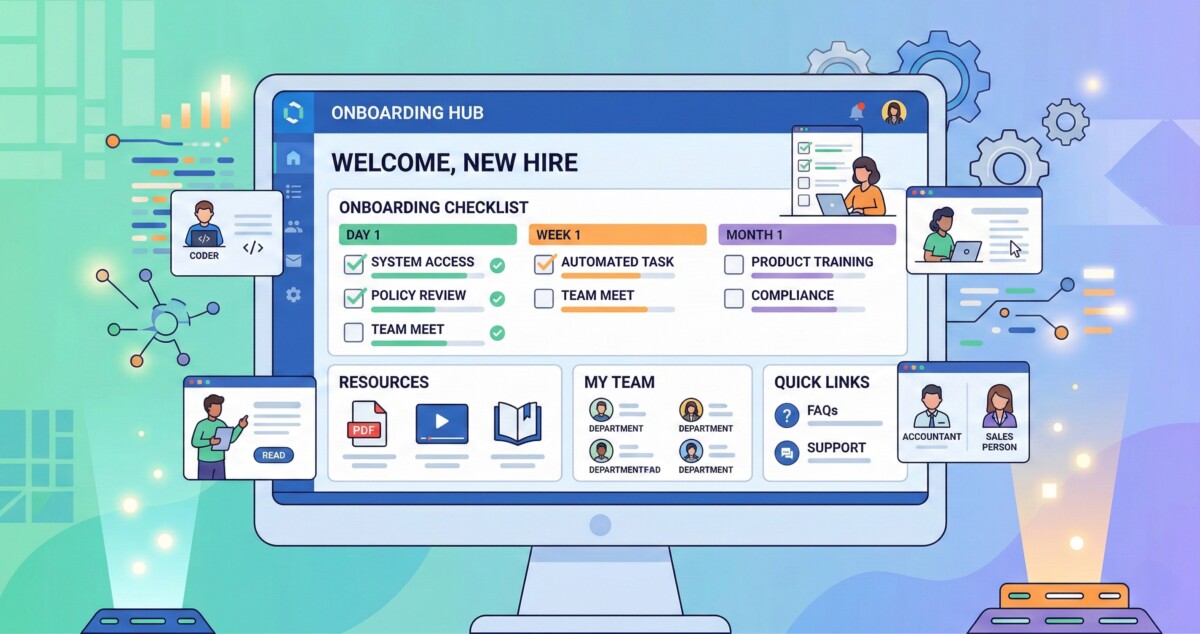
Once the journey is mapped, build a centralized onboarding hub inside your portal. This is the landing page every new hire sees on day one. It should include a welcome message, a clear onboarding timeline, company values, and links to role-specific resources. It also serves as the launch point for every task and required action. Instead of sending five separate emails with attachments, everything lives in one structured location that the hire can navigate at their own pace.
From there, automate the checklist. Manual onboarding checklists do not scale. They depend on someone remembering to send the right thing at the right time. A portal-based checklist updates automatically based on role, department, and progress. System access requests trigger when the hire is created. Policy acknowledgments route to the hire and track completion. Training modules unlock in sequence. Team introductions get scheduled without HR intervention. Tools like BambooHR, Rippling, and Notion automate these sequences without requiring technical setup. If you are already using a project management tool to manage hiring workflows, it is worth reading how to use Trello to manage hiring and onboarding workflows before deciding whether a dedicated portal is the right next step or whether your current stack can be extended.
The last step before launch is integrating training content directly into the onboarding flow. This is where most portals underdeliver. Training materials exist. They are just not connected to the onboarding sequence. The hire has to go find them, which means many never do. Embedding videos, SOPs, internal wikis, and recorded demos directly into the onboarding checklist removes that friction. The hire encounters the right training at the exact moment they need it, not as a separate task to complete later.
Role-Based Onboarding for SaaS, Accounting, and Sales Teams
Generic onboarding is a trust problem. When a new hire receives orientation materials that clearly were not built for their role, it signals that the company did not think carefully about their experience. That signal lands early and hard. The research from BambooHR confirms it: employees who feel their onboarding was effective are 18 times more committed to their employer. The inverse is also true. Role-based onboarding is not a nice-to-have. It is the difference between a hire who feels set up to succeed and one who starts quietly looking for the exit.
For SaaS and product teams, onboarding must quickly connect new hires to product architecture, development cycles, and the user problems the team is solving. A well-structured portal guides them through product overviews, roadmap documentation, sprint rituals, and internal tooling in a sequenced path that reduces dependency on live walkthroughs. At a company doing $1M to $5M ARR, every hour an engineer spends waiting to be walked through a system is an hour not spent building. The portal removes that bottleneck. It also creates a consistent baseline that matters when you are hiring multiple engineers in the same quarter. For SaaS founders who want to go deeper on how portal-based onboarding connects to user experience design, converting free trial users through effective app onboarding offers a useful parallel framework for thinking about the first-time experience.
For accounting and finance teams, onboarding carries compliance risk that other functions do not. A new hire who misunderstands an internal review process or accesses the wrong client data creates exposure that takes weeks to untangle. People portals centralize accounting policies, software access protocols, internal controls, and audit documentation so that every finance hire reviews the same materials in the same sequence. This consistency is not bureaucracy. It is risk management. Finance teams that operate across multiple tax incentive structures, for example, benefit from having onboarding documentation that connects directly to the underlying frameworks their work depends on. The R&D tax credit ultimate guide is one example of the kind of structured reference documentation that belongs inside an accounting team’s onboarding hub, particularly for firms supporting clients with qualifying research activities.
For sales and customer success teams, the onboarding failure mode is information overload in week one followed by a knowledge desert in weeks two and three. Portals solve this by sequencing access to scripts, CRM guides, objection handling resources, and product training in a structured path rather than dropping everything on the hire at once. A sales hire who completes a sequenced portal-based onboarding ramps to first deal faster and carries more confidence into early customer conversations. Illustrative benchmark: teams using structured portal-based sales onboarding typically report a 20 to 30% reduction in ramp time compared to unstructured orientation programs.
Measuring Onboarding Success with Portal Data
One of the most underutilized advantages of portal-based onboarding is the data it generates. Every task completion, every training module accessed, every checklist item left incomplete is a signal. Most companies build the portal and then stop paying attention to what it tells them. That is a missed opportunity.
Modern intranet platforms provide analytics on task completion rates, content engagement, and training progress by cohort, role, and department. This gives HR and operations leads the ability to identify bottlenecks before they become retention problems. If new hires in one department consistently stall at a specific step, that step is broken. It might be unclear instructions, missing access, or a training module that is too long. The data tells you where to look. Without it, you are waiting for exit interview feedback that arrives too late to matter.
The feedback loop matters as much as the metrics. Short surveys embedded directly into the portal at the end of week one, week four, and the 90-day mark give you qualitative signal alongside the quantitative data. Ask specific questions: What was the most confusing part of your first week? What information did you have to search for that should have been easier to find? What would have made your first 30 days more productive? The answers tell you exactly what to fix in the next iteration. Onboarding is never a finished product. The best operators treat it as a system under continuous improvement, not a one-time build.
Common Mistakes That Undermine Portal-Based Onboarding
The most expensive mistake is content overload. Founders and HR leads who have been carrying onboarding in their heads for years tend to dump everything into the portal at once. The result is a new hire who opens their onboarding hub on day one and sees 47 tasks, 12 required readings, and 6 training modules. That experience does not feel supportive. It feels overwhelming. Focus the first 30 days on what is essential for the hire to be functional and safe in their role. Everything else can be staged into weeks 5 through 12 as their context expands.
The second mistake is unclear ownership. Someone has to be responsible for keeping the portal current. Outdated documentation is worse than no documentation because it erodes trust. A new hire who follows a process that no longer reflects reality and then gets corrected by a colleague learns quickly that the portal cannot be trusted. Assign a named owner for each section of the onboarding hub and build a quarterly review into the operations calendar. This is especially important for fast-moving SaaS companies where processes change frequently.
The third mistake is treating the portal as static after launch. The companies that get the most value from portal-based onboarding are the ones that iterate continuously based on data and feedback. If you build it and walk away, it degrades. If you treat it as a living system and improve it every quarter, it compounds. The operational leverage from a well-maintained onboarding portal grows over time. For operators who want to understand how this connects to the broader case for systematizing operations across the business, the breakdown of how small businesses streamline operations without adding headcount is worth reading alongside this guide.
The Business Case for Treating Onboarding as Infrastructure
Onboarding is not an HR function. It is a business performance lever. The data is unambiguous: organizations with a structured onboarding process see new hire retention improve by 82% and new hire productivity improve by 70%, according to the Brandon Hall Group. Those are not marginal gains. They are the difference between a hire who reaches full contribution in 60 days and one who is still finding their footing at 120 days, or who leaves before they ever get there.
For founders and operators running teams of 10 to 100 people, the math is straightforward. The average cost to hire a new employee now reaches $4,700 to $20,000 depending on the role. If a broken onboarding process costs you even one hire per quarter to early attrition, the investment in a properly built people portal pays for itself in a single cycle. The upside is not just retention. It is the compounding productivity gain from every hire who reaches full contribution faster because they had a clear path from day one.
Whether you are doing $500K in revenue or $10M, the principle is the same: onboarding is infrastructure. Build it once, maintain it consistently, and it scales with your team without requiring proportional investment in HR headcount. That is the kind of operational leverage that separates the companies that grow smoothly from the ones that keep reinventing the wheel every time they hire.
Frequently Asked Questions
What is the difference between an intranet and a people portal for onboarding?
An intranet is a general-purpose internal platform for storing and sharing company information. A people portal is a more focused application designed around the employee experience, including onboarding workflows, role-based access, task automation, and HR integrations. In practice, many modern tools blur the line between the two. Platforms like Notion, Confluence, and Guru can function as intranets. Dedicated HR platforms like BambooHR, Rippling, and Workday include people portal functionality. For onboarding specifically, what matters is whether the platform supports automated checklists, role-based content delivery, and progress tracking. If your current intranet does not do those three things, it is functioning as a document repository, not an onboarding engine.
How long does it take to build an onboarding portal that actually works?
A functional onboarding hub can be built in two to four weeks if you have existing documentation to migrate and a clear owner driving the project. The first week is typically spent mapping the onboarding journey by role and auditing what documentation already exists. Week two involves building the hub structure and populating it with core content. Weeks three and four are for configuring automated checklists, testing the experience with a pilot hire or internal reviewer, and refining based on feedback. The 90-day mark is when you should expect to see measurable improvement in new hire productivity and satisfaction scores. Avoid the temptation to build everything at once. A focused, well-maintained hub for the first 30 days is more valuable than a comprehensive but overwhelming portal that no one navigates confidently.
What onboarding tasks should be automated first in a people portal?
Start with the tasks that are most repetitive and most likely to fall through the cracks manually. System access requests are the highest-priority automation because delayed access is the single most common complaint from new hires in their first week. Policy acknowledgments are a close second because they carry compliance risk if not tracked. Training module assignments should be automated and sequenced by role so hires encounter the right content at the right time without having to search for it. Manager notification triggers are also worth automating early: the portal should alert a manager when their new hire completes week-one milestones or stalls on a required step. These four automations alone eliminate the majority of manual follow-up that HR teams spend time on during onboarding.
How do you measure whether your onboarding portal is actually working?
Track four metrics from day one. First, task completion rate by cohort: what percentage of new hires complete each onboarding step within the expected timeframe? Second, time-to-productivity: how long does it take a new hire in each role to reach their first defined performance milestone? Third, 30-day and 90-day retention: are early attrition rates improving since you launched the portal? Fourth, new hire satisfaction scores from embedded surveys at the end of week one and week four. If task completion is high but satisfaction scores are low, the content is there but the experience is still confusing. If satisfaction is high but time-to-productivity is unchanged, the portal is making hires feel welcome but not actually accelerating their ramp. Use all four metrics together to diagnose what to improve next.
Can a small business with fewer than 20 employees benefit from a people portal for onboarding?
Yes, and often more than they expect. The common assumption is that portals are enterprise tools. The reality is that small teams are disproportionately harmed by inconsistent onboarding because there is no redundancy. When a 12-person company loses a hire in the first 60 days, it represents a larger percentage of team capacity than the same attrition at a 200-person company. Platforms like Notion and Guru offer free or low-cost tiers that are fully capable of supporting structured onboarding for teams of 5 to 25. The investment is not primarily financial. It is the time to build the structure once. For a small business hiring 4 to 8 people per year, a well-built onboarding hub that takes 20 hours to create will save more time than it cost within the first two hiring cycles.
