






Quick Decision Framework
- Who This Is For: Shopify merchants, DTC brand operators, product designers, and creative directors who produce 3D assets for product visualization, marketing, gaming, AR/VR, or animation and want to understand how AI-powered generation tools are changing the speed and economics of that workflow.
- Skip If: Your creative pipeline does not involve 3D assets in any form and you have no near-term plans to add product visualization, immersive commerce, or interactive content to your brand experience. Return to this when 3D becomes a relevant channel for your business.
- Key Insight: The bottleneck in most creative workflows is not talent. It is the gap between having an idea and being able to visualize it quickly enough to make decisions about it. Tripo Studio is built specifically to close that gap.
- What You’ll Need: A creative brief, concept art, a reference image, or even a text description of what you want to build. Tripo Studio accepts all of these as starting points and returns production-relevant 3D geometry within minutes.
- Time to Read: 6 minutes.
The bottleneck in creative work has never been imagination. It has always been the distance between an idea and a version of it you can actually look at, react to, and improve. Tripo Studio is built to shrink that distance to near zero.
What You’ll Learn
- Why the traditional 3D modeling workflow creates a creativity bottleneck that forces teams to commit to concepts before they are fully explored, and how AI generation changes that dynamic.
- How Tripo Studio’s text-to-3D and image-to-3D entry points meet creative teams where their ideas actually live, rather than requiring a translation step into technical software first.
- What segmentation, retopology, AI texturing, and automated rigging actually do in a production context, and why each one matters for teams that need assets that work inside real pipelines.
- How the same platform serves meaningfully different use cases across gaming, product design, animation, AR/VR, 3D printing, and architecture without requiring separate tools for each.
- Why the AI augmentation framing, rather than the AI replacement framing, is the more accurate and more useful way to think about what Tripo Studio does for creative teams.
The Problem That Tripo Studio Is Actually Solving
A creative director describes a scene: a derelict Art Deco spaceship, oxidized copper hull, glowing neon accents. Under the traditional 3D pipeline, that description travels through a brief, a concept sketch, a modeling queue, and several rounds of revision before anyone can look at something close to what was imagined. By the time the first model comes back, the creative direction has often already moved on. The team commits to a direction not because it was the best one, but because it was the only one they had time to build.
This is the core problem that Tripo Studio is designed to solve. Not by replacing the creative team or automating away the craft, but by removing the technical weight that sits between an idea and a visual representation of it. When a creative director can generate a rough 3D asset from a text description in seconds, the decision about whether that direction is worth pursuing can happen in the same meeting where the idea was proposed. Iteration becomes part of the creative process rather than a separate, expensive production phase that happens after the creative process has already closed.
For ecommerce brands specifically, this speed has direct commercial implications. Product visualization, AR try-on experiences, 3D configurators, and immersive marketing assets all require 3D geometry. The faster and cheaper that geometry can be produced and iterated on, the more accessible these formats become to brands at every revenue level, not just the ones with dedicated 3D production studios.
Text to 3D: Starting from a Description
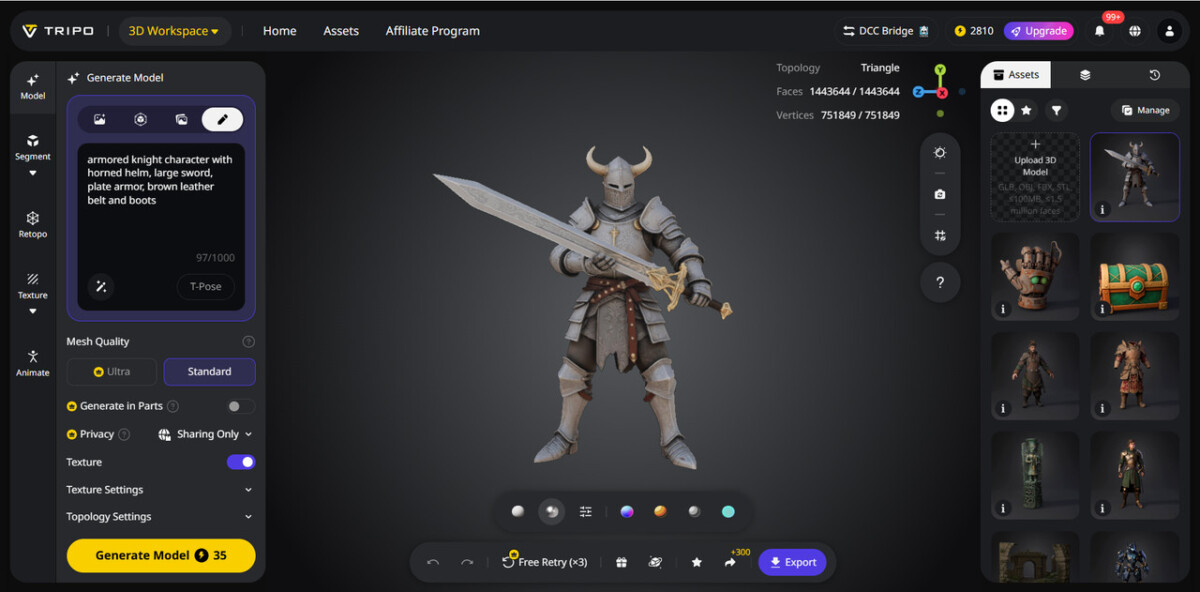
For directors, writers, and brand strategists, describing an asset in words is the most natural starting point. The Text to 3D model capability translates that linguistic fluency directly into visual geometry. A prompt describing a specific aesthetic, material, or structural concept returns a tangible 3D asset in seconds rather than days. That asset is not a final deliverable. It is a starting point for a conversation about whether the direction is right, which is exactly what the early stage of any creative project requires.
The practical value for ecommerce teams is in the speed of alignment. When a brand manager, a designer, and a developer can all look at a rough 3D representation of a product concept in the same session, the feedback loop that normally spans days of back-and-forth collapses into minutes. Decisions get made faster, with more visual information to inform them, and with less risk of expensive misalignment downstream in the production process.
Image to 3D: Closing the 2D to 3D Gap
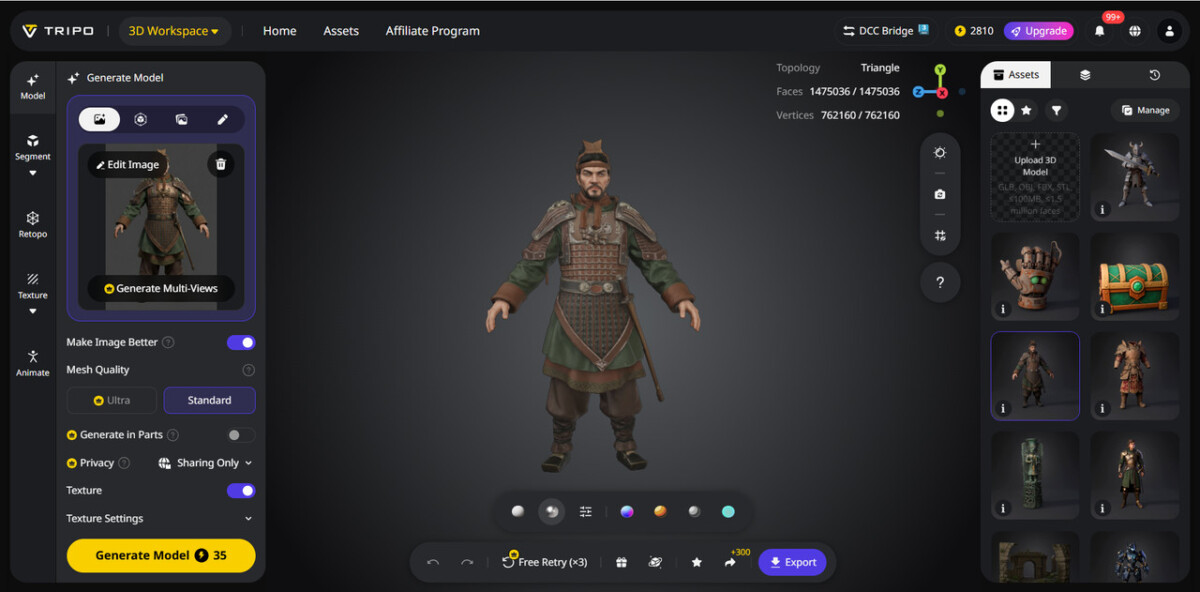
Product design and architecture have always worked in 2D first. Designers sketch, and then modelers build. That handoff is where a significant amount of time and fidelity is traditionally lost. The Image to 3D model pipeline compresses that handoff by generating a base mesh directly from concept art or reference images, capturing the proportions and design language of the original sketch rather than requiring a modeler to interpret it from scratch.
What makes this more than a simple conversion tool is the supporting AI layer that refines the process. Enhancement models clean up noisy or low-resolution source images before the geometry is generated. Stylistic consistency tools ensure that when a designer is working on a family of products, the 3D assets produced from multiple sketches maintain a coherent aesthetic across the entire set. A designer can sketch a complete furniture collection and generate a cohesive 3D library from those sketches, with the designer’s visual language preserved across every piece rather than being reinterpreted by a different modeler for each one.
Segmentation: Making Complex Models Manageable
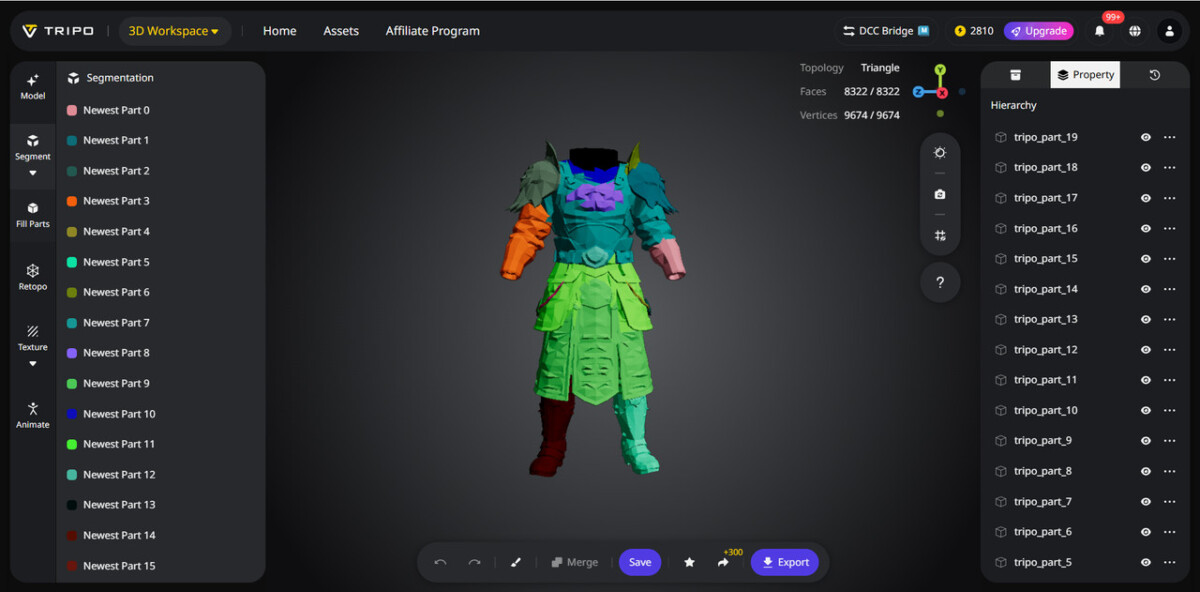
AI-generated geometry can be impressive at the macro level and difficult to work with at the detail level if the resulting mesh is a single, undifferentiated object. Tripo’s segmentation capability addresses this by intelligently identifying structural boundaries within a generated model and separating the mesh into meaningful, individually editable components. A vehicle model becomes a chassis, doors, wheels, and interior elements. A character becomes a body, clothing layers, and accessories. Each component can then be refined, replaced, or optimized independently.
For ecommerce product visualization specifically, this matters because different parts of a product often need different treatment. The texture on a bag’s hardware requires different handling than the texture on its leather body. The lighting response of a shoe’s sole is different from that of its upper. Segmentation makes it possible to apply that differentiated treatment without rebuilding the entire model from scratch, which is the kind of efficiency that makes AI-generated assets genuinely usable in production rather than just impressive in a demo.
Retopology: Geometry That Works in Real Pipelines
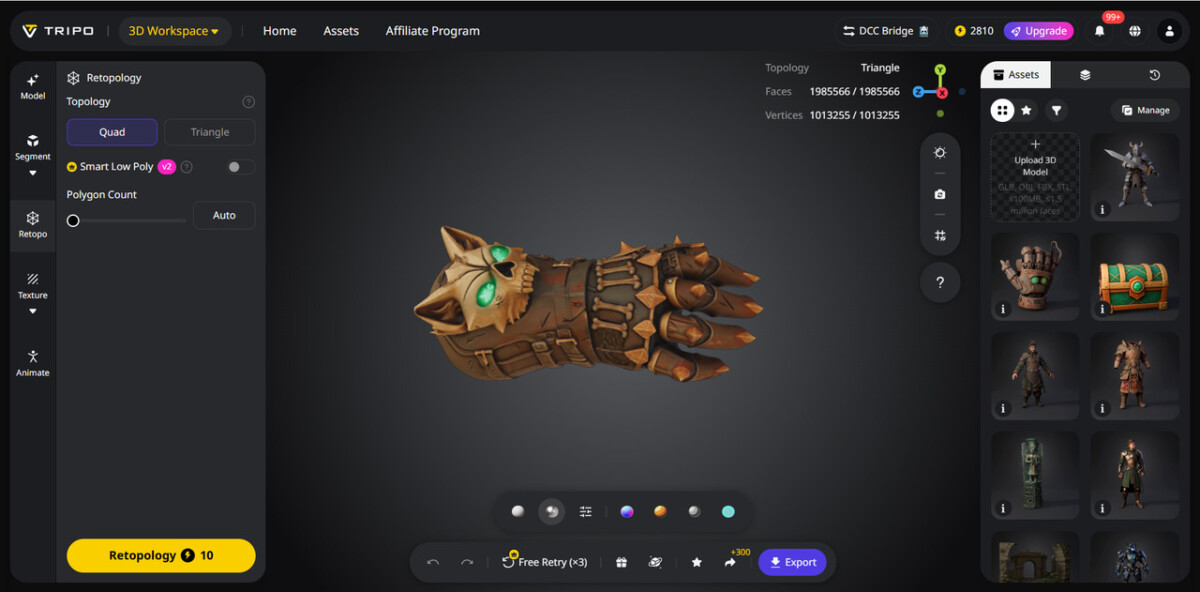
Raw AI-generated geometry is often high-density and structurally irregular, which makes it visually detailed but practically difficult to use in real production environments. Game engines have polygon budgets. Animation rigs require clean edge flow. Real-time rendering systems perform better with optimized mesh structures. Retopology converts the raw output of AI generation into clean, structured geometry with balanced edge flow and reduced polygon counts that meet the actual requirements of the pipeline the asset is heading into.
The practical effect is that assets generated by Tripo Studio do not require a separate manual retopology pass before they can be used in downstream tools. The geometry comes out in a form that is already suitable for texturing, rigging, rendering, and export. For teams that produce high volumes of assets, eliminating that manual step from every single asset in the pipeline represents a meaningful reduction in total production time.
AI Texturing and the Magic Brush: Surface Detail Without Starting Over
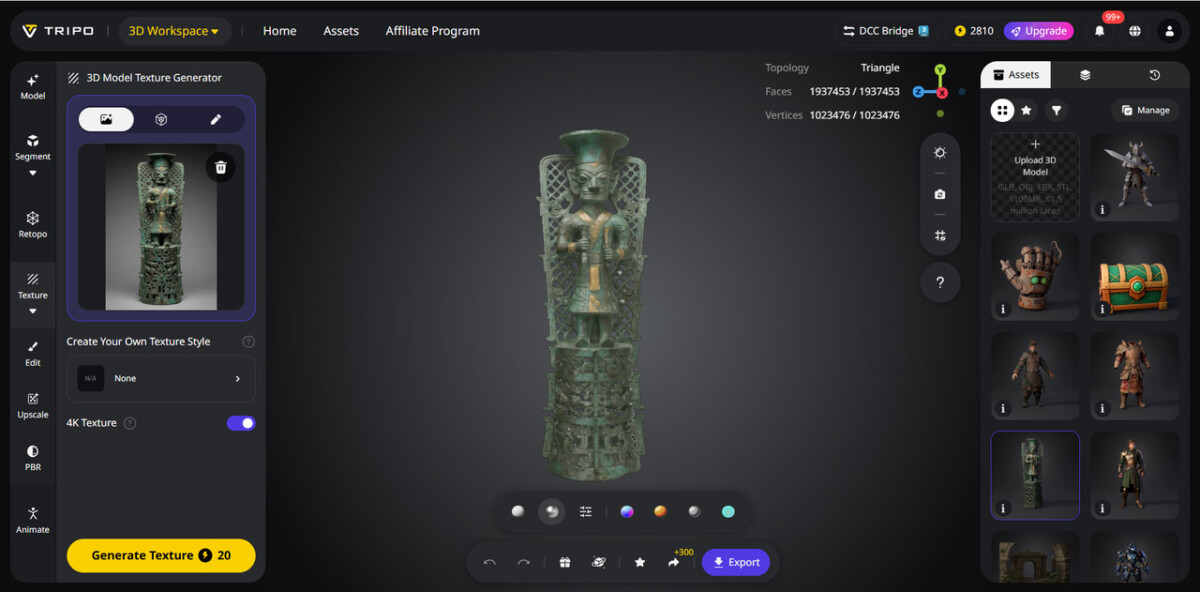
Texturing is where 3D assets gain the surface detail that makes them believable. Tripo’s AI Texturing system generates detailed, coherent surface textures that align with the model’s geometry and structure, producing material definition and visual depth that brings assets to production-ready appearance without requiring manual texture setup for every surface.
The more significant capability is the Magic Brush, which restores localized creative control in a way that most AI generation tools do not offer. A common limitation of AI-generated assets is that fixing a small detail requires regenerating the entire asset and hoping the new version is better in the specific area you wanted to change while remaining acceptable everywhere else. The Magic Brush allows artists to make targeted edits to specific regions of a texture without touching the rest of the model. If a product’s surface generates with the right material quality but the wrong finish in one area, that area can be adjusted directly. For marketing and product visualization work where accuracy to the physical product is a requirement, this granular control is what makes AI texturing practically usable rather than theoretically impressive.
Rigging and Animation: From Static Asset to Moving Character
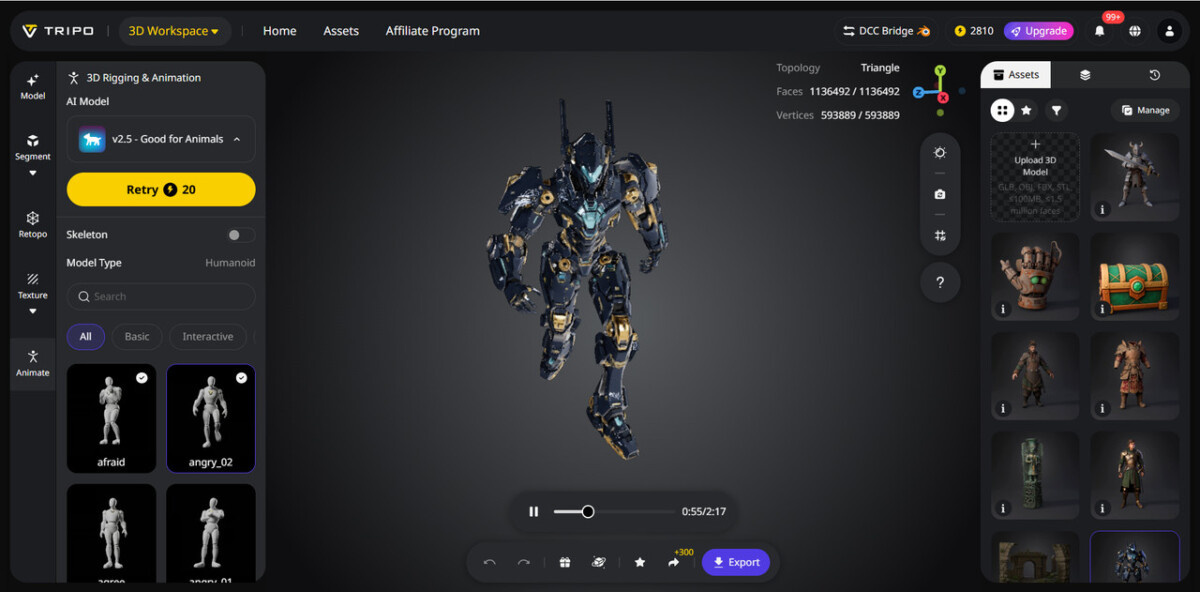
A 3D model that cannot move has limited applications. Rigging, the process of adding a skeletal structure that allows a model to be posed and animated, has traditionally been one of the most technically demanding steps in the 3D production pipeline. Tripo’s automated rigging system generates clean skeletal structures and smooth skin weighting from the model geometry, with two distinct modes: one optimized for humanoid characters and one optimized for animal anatomy and movement.
Once rigged, models can be paired with ready-made animations from Tripo’s library, converting a static asset into an expressive, animated character without requiring a separate animation production pass. For ecommerce brands exploring AR experiences, social media content, or interactive product demonstrations, this capability significantly lowers the barrier to producing animated 3D content. A product mascot, a lifestyle character, or an animated version of a physical product can move from generated geometry to animated asset within a single workflow rather than requiring a handoff to a specialized animation team.
Where Tripo Studio Delivers Value Across Creative Sectors
The same underlying capabilities apply differently depending on the production context. In gaming, clean topology and animation-ready outputs enable faster prototyping and smoother integration into real-time engines, reducing the iteration time between concept and playable asset. In 3D printing, structured geometry and segmented components make models easier to inspect, modify, and prepare for physical fabrication. In animation and film, rigging and animation-ready outputs accelerate previsualization and short-form production. In product design, rapid 3D generation enables designers to explore form, proportion, and material variations early in the process, improving both iteration speed and cross-team alignment. In AR and VR, optimized geometry and lightweight assets ensure stable performance in real-time immersive environments. In architecture and interior design, editable segmented models support fast spatial visualization and client-facing presentations.
The consistency across these sectors is not accidental. Each use case benefits from the same core value: the ability to generate production-relevant geometry quickly, refine it with precision, and export it in a form that works inside the tools and pipelines the team is already using. The specific application changes. The underlying efficiency gain is the same.
Augmentation, Not Replacement
The conversation about AI in creative fields tends to default to a replacement narrative. Tools like Tripo Studio are more accurately understood through an augmentation frame. The art director still directs. The designer still designs. The storyteller still tells stories. What changes is the distance between having an idea and being able to see it, react to it, and improve it.
Tripo Studio compresses the timeline from imagination to iteration. It does not produce final assets that bypass the creative process. It produces starting points that accelerate the creative process by giving teams something visual to respond to earlier, more often, and at lower cost than was previously possible. The teams that benefit most are not the ones that use it to replace creative judgment. They are the ones that use it to exercise creative judgment more frequently, with more visual information, and with less time lost to technical production queues. In an environment where speed of iteration is a competitive advantage, that is a meaningful operational shift regardless of which creative sector you are operating in.
Frequently Asked Questions
What is Tripo Studio and who is it designed for?
Tripo Studio is an AI-powered 3D asset generation platform that allows creative teams to produce, refine, and export 3D models from text descriptions, images, or concept art. It is designed for anyone who works with 3D assets in a professional context, including product designers, game developers, marketing teams, animators, architects, and ecommerce brands that use 3D for product visualization or immersive commerce experiences. The platform is built around the idea that the primary barrier to creative exploration in 3D is not talent but the technical friction between having an idea and being able to visualize it. Tripo Studio removes that friction by generating production-relevant geometry in seconds rather than days, allowing teams to explore more directions, make decisions earlier, and iterate faster than traditional 3D pipelines allow.
How does text-to-3D generation actually work and how accurate is the output?
Text-to-3D generation in Tripo Studio works by interpreting a natural language description and generating 3D geometry that reflects the described form, material, and aesthetic. The accuracy of the output depends on the specificity and clarity of the prompt. Detailed descriptions that include structural characteristics, material references, and stylistic context produce more accurate results than vague or abstract prompts. The output is best understood as a high-quality starting point rather than a final deliverable. It captures the general form and aesthetic of the described asset and provides a visual reference that creative teams can react to, refine using Tripo’s segmentation and texturing tools, or use as a brief for further development. The value is in the speed of getting to that first visual reference, not in the expectation that the generated output will require no further work.
What is the difference between segmentation and retopology in Tripo Studio?
Segmentation and retopology address different problems in the 3D production workflow. Segmentation is about dividing a complex model into individually editable components. It takes a single mesh and separates it into meaningful parts, such as the body, hardware, and lining of a bag, or the chassis, wheels, and interior of a vehicle. This makes the model easier to refine, texture, and optimize at the component level rather than treating the entire asset as a single undifferentiated object. Retopology is about the structure of the geometry itself. AI-generated meshes are often high-density and irregular, which makes them visually detailed but difficult to use in pipelines that have polygon budgets or require clean edge flow for animation. Retopology restructures that geometry into a cleaner, more efficient form that works inside game engines, animation rigs, and real-time rendering systems without requiring a separate manual pass.
Can Tripo Studio assets be used directly in game engines or does additional work always be required?
Tripo Studio’s retopology and texturing outputs are designed to be compatible with standard real-time engines and production pipelines. The retopology feature specifically produces geometry with balanced edge flow and reduced polygon counts that meet the requirements of real-time environments. Whether additional work is required depends on the complexity of the specific asset and the technical requirements of the target engine or pipeline. For many use cases, particularly rapid prototyping, previsualization, and early-stage development, Tripo Studio assets can be brought directly into a game engine or rendering environment with minimal additional preparation. For final production assets that need to meet strict technical specifications, some additional optimization may be required, but the starting point is significantly closer to production-ready than raw AI-generated geometry typically is.
How does Tripo Studio fit into an ecommerce brand’s creative workflow?
For ecommerce brands, the most immediate applications are product visualization, AR commerce experiences, and marketing asset production. On the product visualization side, Tripo Studio allows brands to generate 3D representations of products from reference images or design files, which can then be used for interactive product pages, 360-degree viewers, and configurators without requiring a full photographic or manual 3D modeling production run for every SKU. For AR commerce, the platform’s optimized geometry and texturing outputs produce assets that perform well in real-time mobile environments, which is a requirement for AR try-on and placement experiences. For marketing, the text-to-3D and image-to-3D capabilities allow creative teams to explore visual directions and produce campaign assets at a speed that was previously only accessible to brands with dedicated 3D production resources. The practical effect is that 3D as a creative format becomes accessible at earlier revenue stages and across more use cases than the traditional production cost structure allowed.
