





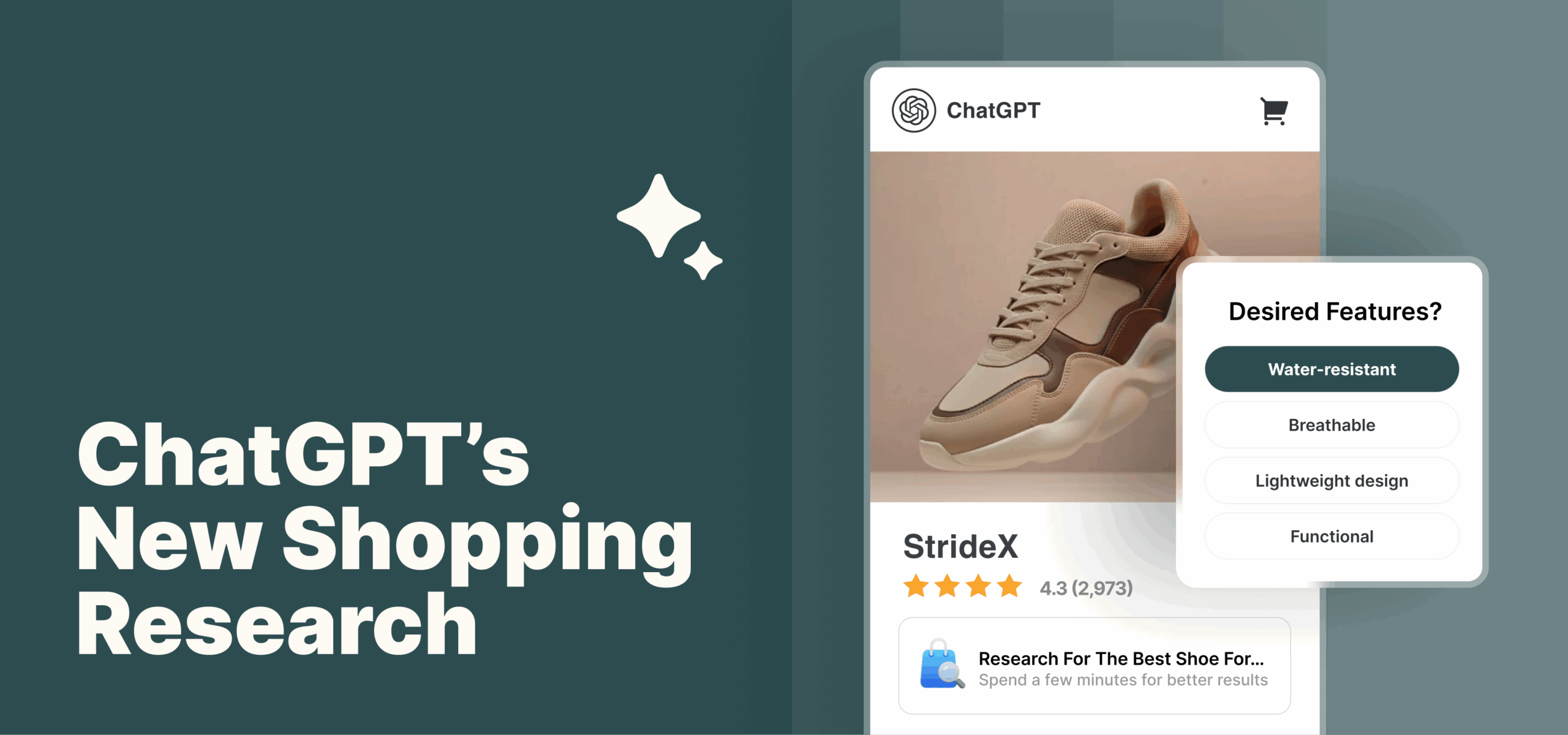
OpenAI’s new Shopping Research experience fundamentally changes how people ask product questions.
Instead of casual chats, shoppers are now pulled into a guided, wizard-style discovery flow that gathers parameters before showing recommendations. The result is a long-tail expansion, dramatically expanded citation graphs, and a highly personalized product universe shaped by memory, persona, and context.
This has major AEO implications:
- Top-of-funnel discovery questions change the most (e.g., “best running shoes,” “ideas for a winter jacket,” “what laptop should I buy?”)
- Citations jump from ~10 to 100+, meaning far more opportunities for brands to surface – but far more variation across sources
- ChatGPT now creates the long tail for shoppers, not the other way around
- Memory profiles alter recommendations, making visibility deeply personalized
- Personas, tones, geos, and UI states multiply variation, turning AEO into a combinatorial problem
- Brands without AEO visibility tools have no way to track or influence these new surfaces
A few days before Black Friday-Cyber Monday, OpenAI quietly launched its new Shopping Research experience, and I tested it the moment it appeared.
This is not a small UX improvement.
It is a completely different way of interacting with ChatGPT when shopping.
The moment you ask a product question, the entire interface transforms:
- You’re taken into a wizard-style flow that asks targeted questions
- The assistant guides you through fit, use case, budget, support level, and style
- It feels more like a shopping questionnaire than a free-form chat
- When results load, you see a hero image of the top recommended product
- Below it is a comparison table of the entire recommended lineup
- And under that, listicle-style product breakdowns with pros, cons, usage tips, and citations
This isn’t “chatting with an AI” anymore. It’s a structured, visual shopping analyst.

What This New Experience Offers Shoppers
OpenAI describes the Shopping Research experience as a more transparent, more personalized, and more evidence-driven way to shop, without juggling multiple tabs.
It introduces:
- Conversational, needs-based research – the assistant asks clarifying questions like a trained specialist.

- Evidence-backed recommendations – each recommendation draws from:
- Expert testers
- Brand/retailer PDPs
- Editorial reviews
- Forums and community threads
- Long-form video reviews
- Clear explanations and tradeoffs – the assistant clearly explains why something is recommended.
- A unified research environment – parameters, comparisons, citations, and final picks, live in one structured flow.
The changes through ChatGPT’s three modes
To test consistency on all the Chat’s modes, I asked the same question three ways across Normal ChatGPT, the new Shopping Research experience, and a structured parameter-rich prompt. The question?
“What are the best basketball shoes for me?”
The three modes returned entirely different product universes.
Normal ChatGPT generated a broad, popularity-driven list of roughly eight models, generalist and non-personalized.
The Shopping Research experience narrowed the field to about six targeted, stability-focused premium options shaped directly by its guided wizard.
And the parameter-rich prompt in standard chat? It surfaced nearly ten models influenced heavily by performance-testing sites and niche review sources.
Across all three runs, only one or two shoes appeared consistently, usually top-tier signature models that perform well across categories. Everything else diverged.
Some options appeared only in the broad generalist list, others only in the structured wizard, and several niche models showed up only when parameters were explicitly supplied.
Altogether, the system surfaced 22 unique models across the three conversations.
And uniquely in the Shopping Research UI, ChatGPT shows just a few final recommendations, but then allows you to open the full explored set, which often contains dozens of models.
In multiple tests, that expanded set even included hallucinations, such as an Apple Watch being listed as one of the “basketball shoes evaluated.”

The citation Behavior also shows a massive expansion in Shopping Research Mode – the Shopping Research flow exceeded 100 citations (Normal ChatGPT relied on 8-12 citations and the structured prompt leaned on ~38 sources), pulling in PDPs, expert testers, retailers, community discussions, videos, social media and more.
This is the largest citation footprint I’ve seen for a consumer-product query without using the old “deep research” mode that is not tailored for shopping.
When citations expand from ~10 to 100+ sources, brands gain more paths to appear, but the narratives become more fragmented, harder to control, and more dependent on off-site content quality.
Bonus Test: Memory Personalization Changes the Journey
To test personalization, I previously asked ChatGPT to remember that I prefer pink basketball shoes.
In a fresh Shopping Research session, I asked the exact same question “What are the best basketball shoes for me?” without mentioning color, the system:
- Immediately asked whether color matters
- Recommended a pink model first
- Shifted tone toward aesthetic preferences
This shows:
Long-term memory can shape the product funnel before the shopper explicitly mentions their preferences.

Why This Matters for AEO
In From SEO to AEO, we explored how AI transforms product visibility from a single SERP into a dynamic, multi-surface answer ecosystem.
The Shopping Research experience accelerates that transformation.
Here’s why it matters:
ChatGPT now actively guides shoppers into long-tail questions
Historically, long-tail visibility depended on two things: whether a user naturally knew how to ask a detailed question, or whether ChatGPT prompted clarifying questions after initial recommendations.
The new Shopping Research flow flips this entirely.
The assistant now collects long-tail parameters before showing any results. It structures the decision space upfront, prompting shoppers into deeper and narrower needs by default. This has the strongest impact at the top of the funnel/Discovery phase, where shoppers are exploring rather than deciding.
For brands, this is a powerful opportunity.
If your product excels in specific attributes like ankle stability, cushioning profile, foot shape compatibility, surface suitability, you can win dozens of micro-intents the shopper may not have articulated on their own. The long tail becomes not just a discovery surface, but a guided path shaped by ChatGPT itself.

Memory makes visibility personal, and harder to predict
The role of memory introduces a new class of ranking factor: persistent personal preference.
A shopper with stored preferences sees a different product universe than one without memory. The assistant asks different clarifying questions, weighs attributes differently, and often leads the shopper down an entirely different reasoning path. Two users with identical queries can receive fundamentally different recommendations, not due to intent or parameters, but due to their personal history.
From an AEO perspective, this is the beginning of individualized visibility. Brands may be highly present for one memory profile and absent for another.
More citations, more ways to surface, more variation in how your brand is described
As an AEO practitioner, I consider the citation expansion one of the most consequential changes. When ChatGPT pulls from over a hundred sources instead of the ten or so we were accustomed to in the normal mode, the entire center of gravity shifts. Your brand is suddenly shaped by a much broader ecosystem of voices, expert testers, retailers, long-form reviewers, user communities, social creators, each telling a slightly different story about your product. And because these sources rarely describe things consistently, the narrative becomes inherently fragmented: expert reviewers focus on performance, retailers emphasize colorways and availability, communities talk about sizing and durability, and video creators hone in on traction, materials, or real-world feel.
With a ten-source footprint, the model’s understanding of your product was relatively contained. With a hundred-source footprint, every discrepancy becomes part of the model’s reasoning. ChatGPT synthesizes these conflicting narratives into a single answer, meaning your brand’s “story” is no longer anchored to your PDP or even a handful of authoritative reviews, it is now distributed across an entire network of external domains beyond your website. This expansion dramatically increases both the number of ways your brand can surface and the number of ways it can be misrepresented or diluted. The more the model sees, the more important citation monitoring, evidence readiness, and the overall quality and alignment of off-site content become.
Personas, memories, geos, tones, and UI states multiply the answer space
The shopping journey is now shaped by context. A beginner sees different questions and weighting than an expert. A premium-oriented shopper receives different reasoning than a budget-focused one. A US user may see different product availability and evidence than someone in Japan or the UK. Even subtle differences, such as conversational tone, whether the Shopping Research mode was activated, or whether memory was enabled, can generate distinct product universes.
I see this as one of the structural challenges of AI-era discovery: we are no longer optimising for a single answer. We are optimising for a multi-dimensional answer space, where visibility fluctuates based on persona, location, preference history, tone, and interface mode.
This combinatorial nature is precisely what makes modern AEO fundamentally different from SEO.
OpenAI’s Shopping Research experience marks one of the largest shifts in AI-assisted product discovery since ChatGPT launched.
It changes how shoppers express intent, how the assistant shapes that intent, how evidence is collected, how products surface, how personal history affects rankings, and how entire product universes are constructed behind the scenes. Discovery becomes guided. The long tail becomes the default. Citations become extensive. Memory becomes influential. Personas create parallel worlds.
AEO becomes the discipline that helps brands understand and shape their presence across this new landscape of fluid, contextual, personalized AI answers.
FAQ
Does the new Shopping Research experience change all types of queries?
It primarily reshapes discovery-style questions, where ChatGPT pulls shoppers into the guided, long-tail flow before showing results. Consideration and decision questions still behave closer to traditional Q&A.
Why did the recommendations differ between the three modes?
Because each mode processes intent differently: normal chat stays broad, the structured prompt leans on testing sources, and the Shopping Research experience builds its own reasoning path based on the questions it asks upfront.
Why were there so many more citations in the new flow?
The Shopping Research experience draws from a far wider evidence graph. Instead of a dozen sources, it pulls from more than a hundred across PDPs, experts, videos, and communities, which reshapes how the brand is understood.
Can memory really change product visibility?
Yes. Stored preferences influence the questions ChatGPT asks and the attributes it prioritizes, which means two shoppers with the same query can see different products based on their history.
Why is this shift so important for AEO?
Because visibility is no longer anchored to a single PDP or a single answer. It is shaped by guided long-tail questions, personalized memory profiles, expanded citation surfaces, and the evolving context of each conversation.
Do these changes create opportunities for brands?
They do. By aligning with the attributes the assistant now asks about upfront, stability, cushioning, materials, surface, fit, brands can win moments of early inclusion in dozens of emerging long-tail micro-intents.
