





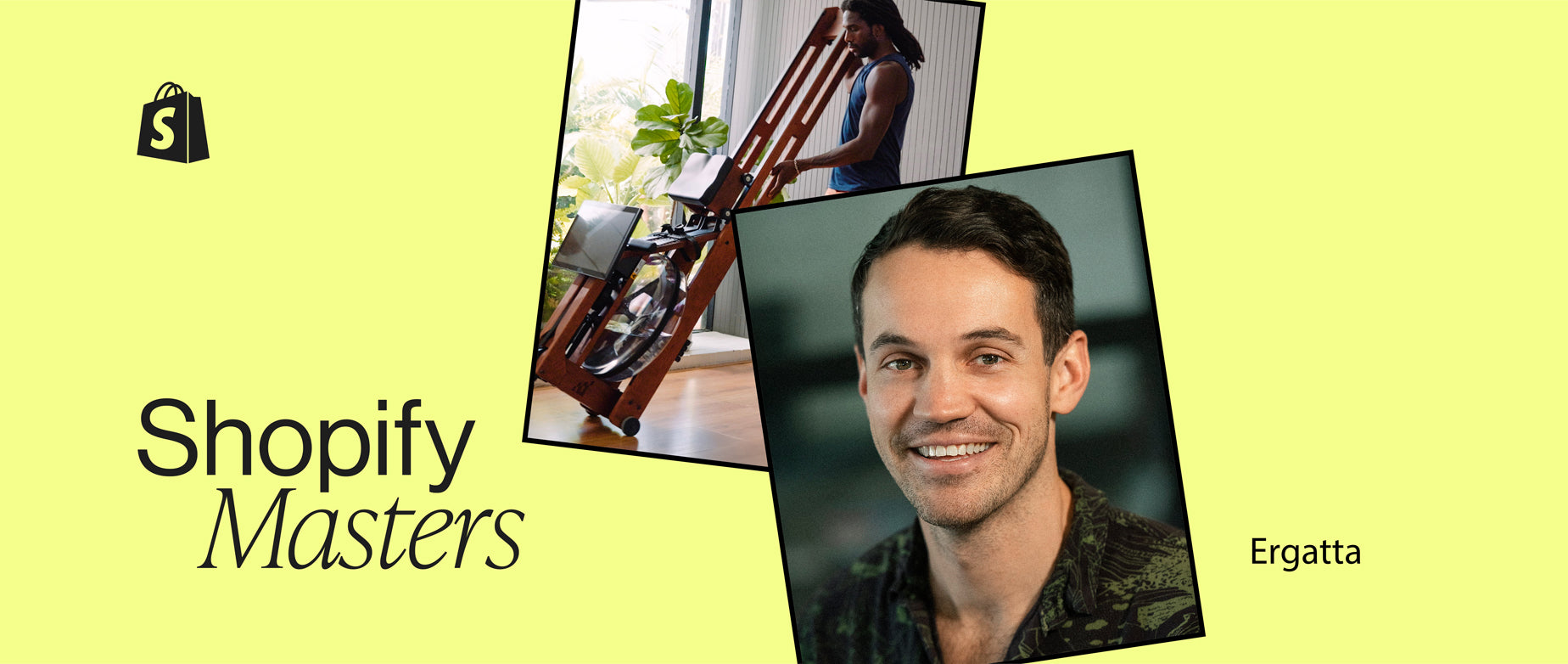
Tom Aulet launched Ergatta not to chase a fitness trend, but rather to solve his own problem. After years of struggling to maintain a cardio habit, he built a product that turned boring workouts into something habit-forming and even fun.
Today, Ergatta is a connected rowing machine powered by game-based workouts. The company has raised $35 million, stayed profitable for eight straight quarters, and licensed its gaming content to partners like iFit. Tom shares how personal pain points, strategic focus, and scalable design helped Ergatta carve out a sustainable path in a crowded market.


Solving a personal problem while uncovering a market gap
Ergatta began with Tom’s own fitness friction. “The gym was inconvenient and boring. I wasn’t a fitness class person,” he explains. Running worked until his knees gave out. Rowing seemed like a good at-home alternative, but it quickly became “30 excruciating minutes in the morning” and hard to stick with. That boredom became the spark for a new kind of connected fitness experience—one built around gaming instead of instructors.
Tom and his cofounders spent six months doing deep primary market research. They interviewed would-be customers and discovered a segment that skewed introverted, competitive, and underserved by instructor-led models. “We figured out that we could address their needs with the tools of gaming. That was the aha moment,” Tom says.
Rather than guess what people wanted, the team listened, learned, and designed an experience that felt more like playing a sport than taking a class. That clarity would become Ergatta’s differentiator.

Regatta
Staying focused on core strengths instead of reinventing the wheel
From the beginning, Tom knew where the company could add the most value: content and experience. Instead of pouring capital into manufacturing R&D, Ergatta partnered with WaterRower, a Rhode Island–based company that produced beautiful, durable wooden rowing machines. The goal wasn’t to reinvent hardware—it was to avoid it becoming a distraction.
“We weren’t trying to innovate massively on the hardware front … we just wanted that to not break,” Tom says. Their approach was pragmatic: Find a partner whose machines matched their aesthetic ambitions, and structure a deal that de-risked capital requirements. “They were open to a non-standard manufacturing agreement,” he explains. “We solved some of their problems, they solved some of ours.” The domestic manufacturing location also made collaboration easier—just a three-hour drive from Ergatta’s team—allowing them to build trust and iterate more closely.
Rather than becoming hardware experts, Tom plugged knowledge gaps with advisers and focused the internal team on what mattered most: software development, gamification, and go-to-market execution. “If we were trying to innovate from a hardware perspective, we did not have the right founding team,” he says.
That same logic guided Ergatta’s approach to expansion. When the company wanted to grow beyond rowing, it chose to license its software to iFit, the world’s largest connected treadmill provider, rather than build a new machine from scratch. The result: Ergatta content went from tens of thousands to hundreds of thousands of homes “overnight”—without needing to raise new capital or build new hardware.
Designing a retention engine that scales like SaaS
Unlike brands such as Peloton, Ergatta doesn’t rely on live instructors or recurring content production. Instead, its workouts are structured as games that scale efficiently and cost little to replicate. “Games cost a lot of money to build, but once they’re built, they scale like SaaS [software as a service],” Tom says. “We can release 10 new workouts a week and it’s basically free for us.”
That model contributes to strong retention. Tom notes that Ergatta’s monthly net retention often matches or exceeds Peloton’s—around 98.5%. He attributes that to both the content and the psychology of ownership. “There’s a virtue element at play,” he says. “People want to work out more than they actually do, so they don’t cancel.”
What Ergatta built wasn’t just hardware or content. It was a system of behavioral incentives that helped people follow through on their best intentions. The company’s gamified environment uses social comparison, progress tracking, and avatar-based interaction to make workouts feel rewarding—a product experience that gets stronger over time.

Ergatta
Scaling with capital efficiency and long-term flexibility
While Ergatta has raised $35 million, Tom remains skeptical of the “raise as much as you can” mantra. “In retrospect, it probably would have been advisable to raise a little less money,” he says. Taking on large amounts of capital comes with expectations and limits flexibility. “People are buying into a certain financial trajectory that’s hard to change after the fact.”
Instead of racing toward headcount or product expansion, Ergatta focused on unit economics and profitability. That discipline has paid off: The company has stayed profitable for eight straight quarters. The focus on habit-building over hype, and efficiency over flash, gave the business staying power.
Tom’s advice to founders is to know what you’re good at, build a product that solves a real problem, and not chase trends unless they align with your mission. If your content scales and your users stay, you don’t have to outspend your competitors to win.
Tom didn’t build Ergatta to be the loudest brand in connected fitness. He built it to solve a real problem for real users, starting with himself. By staying focused on what mattered, partnering where it counted, and designing a scalable experience, Ergatta became a rare combination in consumer hardware: profitable, sticky, and growing. For more on Tom’s strategies, check out his full interview on Shopify Masters.
