






Quick Decision Framework
- Who This Is For: Shopify merchants doing $500K to $10M+ in annual revenue who are already running Meta ads and want to understand how the new affiliate commerce rollout changes their channel strategy.
- Skip If: You have not yet set up the Facebook and Instagram sales channel in Shopify and are not actively running Meta ads. Get the basics in place first, then come back to this.
- Key Benefit: Understand exactly what Meta announced at Shoptalk 2026, what it means for your paid media strategy, and the three infrastructure steps you need to take before Q2 2026 to stay ahead of brands that are still waiting to see how this plays out.
- What You’ll Need: An active Shopify store with the Facebook and Instagram sales channel installed, a Meta Commerce Manager account, and the Meta Pixel or Conversions API configured for your store.
- Time to Complete: 12 minutes to read. 2 to 4 hours to audit and fix catalog setup. 1 to 2 weeks to launch your first creator affiliate test.
Instagram spent years as a traffic driver. As of March 2026, it is a sales channel. The brands that treat it like one first will have an advantage that compounds for the rest of the year.
What You’ll Learn
- Why Meta’s Shoptalk 2026 announcement is a fundamentally different bet than its failed Instagram Checkout experiment, and why this one is more likely to stick.
- How the product tagging mechanics work on Instagram versus Facebook, and what the eligibility requirements mean for which creators can actually drive sales for your brand.
- Why the attribution problem that has made influencer marketing feel like a guessing game is finally being solved, and how to run creator partnerships with the same rigor as paid media.
- How Meta’s affiliate commerce environment compares to TikTok Shop by price point, audience demographics, and checkout experience, so you can make a smart allocation decision rather than a reactive one.
- The three infrastructure steps Shopify merchants need to take right now to be ready when this rolls out at scale in Q2 2026.
For the last three years, the most common question I have heard from Shopify merchants about Instagram is some version of: “We know we need to be there, but how do we actually prove it’s working?” The platform drove awareness. It drove clicks. It drove traffic that sometimes converted and sometimes disappeared. But the line between a creator’s Reel and a purchase on your site was always blurry, always dependent on UTM parameters and discount code redemptions and a lot of squinting at dashboards.
That question has a different answer now. At Shoptalk 2026 in late March, Meta announced native affiliate product tagging across both Instagram and Facebook, turning creator Reels into trackable sales events for the first time at scale. This is not a minor feature update. It is a structural change in how Meta fits into a Shopify brand’s channel mix, and the merchants who understand it now will be positioned very differently from those who wait until the rest of the market catches up.
What Meta Actually Announced (and Why the Timing Matters)
Meta is expanding affiliate commerce across both of its major platforms simultaneously, and the timing is not accidental. TikTok Shop hit $15.82 billion in US sales in 2025, growing 108% year over year. That number proved something Meta had been watching for two years: social commerce works when the infrastructure is right. The discovery plus checkout model, where content and transaction happen in the same session, is not a niche behavior. It is a mainstream buying pattern, and it is accelerating.
What Meta announced at Shoptalk is its answer to that proof point. The company is not building a proprietary marketplace to compete with Amazon or TikTok’s in-app shop. Instead, it is layering affiliate commerce on top of the creator content and paid media infrastructure that Shopify brands already use. That is a meaningfully different bet than the Instagram Checkout experiment that launched in 2019 and quietly faded. That version tried to own the transaction. This version integrates with the commerce infrastructure that already exists.
The rollout is phased through spring 2026, with Reels product linking expanding to businesses in 22 countries. The affiliate partner network launching on Facebook includes Amazon and Shopee at launch, with Temu, eBay, and Mercado Libre following. Instagram’s rollout is broader in flexibility but narrower in its initial creator eligibility window.
How Product Tagging Works on Instagram vs. Facebook
The mechanics differ between the two platforms in ways that matter for Shopify merchants. On Instagram, eligible creators get an “add products” option directly in the Reels creation flow. They can tag up to 30 products per Reel, pulling items from a brand’s Meta Commerce catalog or adding third-party affiliate links from platforms like LTK and ShopMy, as long as the product already exists in Meta’s catalog. Each link must point to a single product, not a collection. Creators must be at least 18 years old and have at least 1,000 followers to access the feature. When a viewer taps a tagged product, they are currently sent to the brand’s own checkout, which for Shopify merchants means the existing Shopify checkout flow.
Facebook operates differently. The affiliate partnerships program launches with major marketplace integrations first, meaning creators connect their affiliate accounts to Amazon, Shopee, and the expanding partner network, then tag products in Reels and photo posts. The commission rate is set by the brand or marketplace partner, not by Meta. Meta does not take a cut of affiliate sales through this program.
The checkout distinction matters strategically. Instagram currently sends buyers to the brand’s site, which preserves the merchant’s customer relationship, retargeting pixel data, and post-purchase email sequence. Meta’s new Stripe and PayPal one-tap checkout is being tested and is moving toward keeping transactions in-app, with a Shopify integration confirmed as coming. Merchants should watch for that integration closely, because the move to in-app checkout will change how conversion data flows back into your attribution stack.
The Creator Insights Layer
The attribution piece is what makes this announcement more than just another shopping feature. Meta is rolling out new creator analytics that surface which posts generate clicks and which generate actual sales, at the post level, inside the platform. For the first time, brands running creator programs on Instagram can see a direct line between a specific Reel and a specific purchase outcome, without relying on discount codes or UTM parameters as proxies.
This changes the economics of influencer marketing in a concrete way. Brands that have been running flat-fee creator deals, paying $2,000 to $20,000 per post and then trying to figure out what it drove, can now run those same partnerships on a commission basis with clear performance data. Creators who perform get more work. Creators who do not perform get optimized out. The same logic that governs paid media can now govern creator commerce on Meta, and that is a significant shift for any brand that has been treating Instagram as a brand awareness channel rather than a performance channel.
Why This Is Bigger Than Another Shopping Feature
Meta already has 3.5 billion daily active users across its apps. Most Shopify brands doing meaningful revenue are already spending on Meta ads. The affiliate commerce rollout does not require building a new audience or learning a new platform. It layers a new conversion mechanism on top of infrastructure that is already in place, and that compounding effect is what makes this announcement worth taking seriously.
The three layers of strategic significance are distinct. First, Meta is where most Shopify brands already concentrate their paid media spend, so adding native affiliate commerce creates a flywheel between organic creator content and paid amplification that did not exist before. Second, the attribution gap that has made influencer marketing feel like a faith-based investment is being closed, which means creator spend can now be evaluated with the same rigor as any other performance channel. Third, a single Reel can now function as both a discovery asset and a conversion asset simultaneously, collapsing the funnel in a way that was previously only possible on TikTok Shop.
From Traffic Driver to Sales Channel
The mental model most Shopify brands have used for Instagram is: run ads, send traffic to the site, convert there. That model made sense when Instagram’s shopping features were clunky and adoption was low. It no longer captures what the platform can do. A creator Reel with affiliate product tags is not a top-of-funnel awareness asset. It is a full-funnel conversion unit that can drive discovery and purchase in the same session, with attribution data attached.
For merchants doing $500K to $2M, this means rethinking how Instagram fits into the channel mix. The question is no longer “how do we use Instagram to drive traffic to our site?” It is “how do we use Instagram to drive purchases, and how do we integrate that with our existing paid media strategy?” Those are different questions that lead to different decisions about creator selection, content strategy, and budget allocation. For merchants doing $5M and above, the question is even more pointed: if you are not building a creator affiliate program on Meta right now, you are building one six months late.
The Attribution Problem Finally Has an Answer
The biggest headache in influencer marketing has always been proving that it worked. Brands spend $5,000 to $50,000 on a creator campaign and then piece together evidence from UTM click data, discount code redemptions, and post-campaign sales lifts that may or may not be causally connected to the content. The honest version of most influencer ROI calculations is: we think it worked, but we cannot prove it.
TikTok Shop solved this problem by making every creator post a trackable sales event with native checkout. Meta is now doing the same thing, but with a broader and often more established audience. The new creator insights tools surface clicks and sales data at the post level, which means you can calculate ROAS on creator content the same way you calculate ROAS on a paid ad set. That changes the conversation about creator budgets from “how much brand awareness are we buying?” to “what is our cost per acquisition through this creator, and how does it compare to our other channels?”
For brands that have been doing affiliate influencer marketing with third-party tracking tools and discount codes, this is a meaningful upgrade. The data lives inside Meta, alongside your ad account data, which makes optimization decisions much cleaner. For brands that have avoided creator partnerships because the ROI was too murky, this removes the primary objection.
Meta vs. TikTok Shop: Where Each Platform Wins
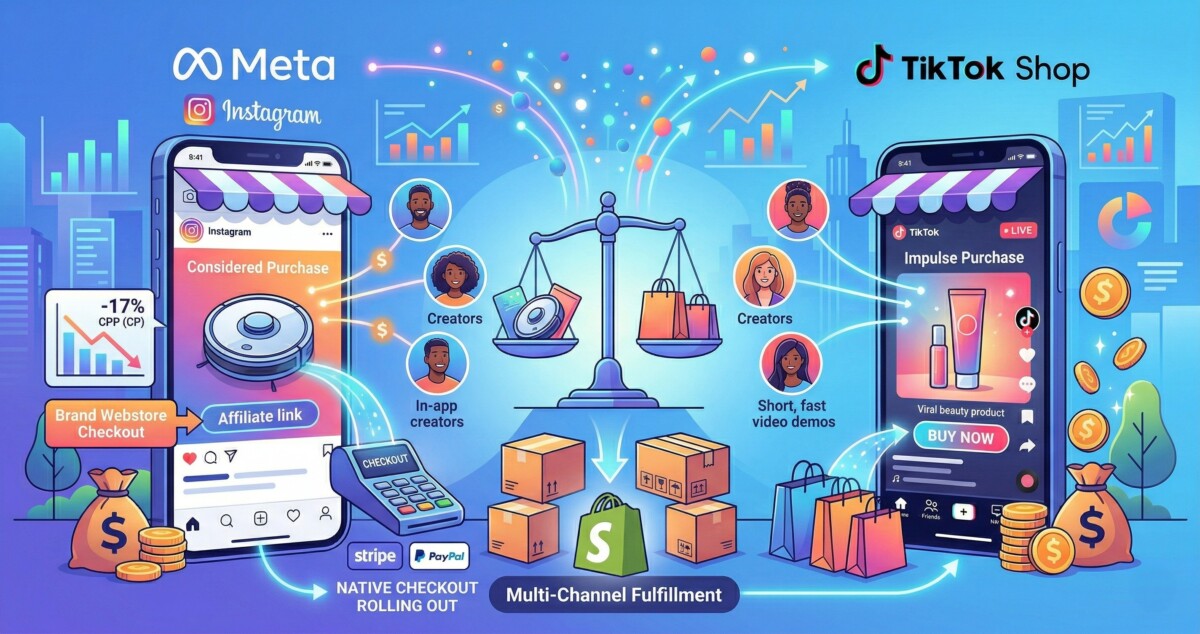
This is not a winner-takes-all situation. The right answer for most Shopify brands is not “choose Meta or TikTok” but rather “understand which products, price points, and audiences perform better on each platform, then allocate accordingly.” The platforms have genuinely different strengths, and pretending otherwise does not serve merchants who need to make real budget decisions.
The checkout experience gap is real but narrowing. TikTok has fully native in-app checkout, which removes friction and keeps the entire transaction inside the platform. Meta’s affiliate commerce currently sends buyers to the brand’s site on Instagram, with in-app checkout coming as the Stripe and PayPal integration rolls out. That friction difference matters for impulse purchases but matters less for considered purchases where the buyer is already motivated. The Product Set Optimization data Meta shared internally, showing 17% lower median cost per purchase versus standard campaigns, suggests the platform is already closing that gap in conversion efficiency even before in-app checkout is universal.
The Price Point and Audience Gap
TikTok Shop has proven extraordinarily effective for impulse purchases under $50 with younger audiences. The platform’s conversion rates in that category are genuinely impressive: some estimates put TikTok Shop conversion rates at 8% to 12%, compared to 2% to 4% for traditional ecommerce. But TikTok has been a consistently difficult environment for products above $75 to $100 and for brands targeting consumers over 35. The audience skews younger, the buying behavior skews impulsive, and the trust signals that support considered purchases are harder to build in a short-form video format.
Meta’s audience composition is fundamentally different. Older, higher purchasing power, more geographically diverse, and more accustomed to researching purchases before committing. That means the products and price points that can succeed in social commerce expand meaningfully on Meta. A $150 skincare set, a $200 kitchen appliance, a premium supplement subscription, a considered fashion purchase: these categories have struggled on TikTok Shop not because social commerce does not work for them, but because TikTok’s audience and format are not well-matched to the purchase journey they require. Meta’s affiliate commerce environment may be significantly more receptive to exactly these categories.
The Amazon Seller Angle
One group of merchants who should pay particular attention to this rollout is Amazon sellers who have been expanding to social commerce using Multi-Channel Fulfillment. Previously, Meta did not make practical sense for Amazon-native sellers unless they had a strong DTC site to send traffic to. The affiliate product tagging on Facebook changes that calculation. Amazon is a launch partner for Facebook’s affiliate program, meaning creators can tag Amazon product listings directly. For sellers who have built their business on Amazon and want social commerce exposure without building out a full Shopify store and catalog, this opens a path that did not exist before.
For merchants who operate both a Shopify store and an Amazon presence, the strategic question becomes more nuanced. Meta’s affiliate commerce on Instagram sends buyers to the brand’s Shopify checkout, preserving the customer relationship and first-party data. Facebook’s affiliate program with Amazon sends buyers to Amazon, which means the transaction happens inside Amazon’s ecosystem. The right approach depends on where you want to build the customer relationship and which fulfillment infrastructure you want to lean on. There is no universal answer, but understanding the distinction is essential for making an intentional choice rather than a default one.
What Shopify Merchants Should Do Right Now
The brands that win with any platform shift are the ones that build infrastructure before the market gets crowded. When TikTok Shop launched in the US in September 2023, the merchants who moved in the first 90 days got algorithmic advantages, better creator relationships, and lower customer acquisition costs that compounded for months. The same dynamic will play out here. Q2 2026 is the window. Here is what needs to be in place.
Get Your Product Catalog Ready
The single biggest blocker for most Shopify merchants is catalog setup. Products must be listed and approved in Meta’s Commerce Manager before creators can tag them. For merchants who have been treating Instagram purely as an ad platform and never completed the full Shop setup, this is the first and most urgent fix. The Shopify Facebook and Instagram sales channel handles the catalog sync, but the setup has several common failure points that block products from being taggable.
The most frequent issues are domain verification failures, catalog review holds triggered by pricing or policy flags, and product syncing errors caused by missing required fields. If you have not logged into Meta Commerce Manager recently and verified that your catalog is approved and syncing correctly, do that today. Merchants who already have a clean, approved catalog through the Shopify sales channel are ahead of the curve. Those who have not completed this step will find it is a 2 to 4 hour project to audit and fix, and it is the prerequisite for everything else in this rollout.
Align Your Creator Strategy with Paid Media
The biggest opportunity in Meta’s affiliate commerce rollout is not just turning on product tagging. It is integrating creator content with your existing Meta ad strategy through Partnership Ads, formerly known as Branded Content Ads. When a creator’s Reel performs well organically with affiliate tags, you can amplify that content with paid spend directly from the creator’s handle. The combined signal, organic creator content driving affiliate sales plus paid amplification feeding stronger conversion data back to Meta’s algorithm, creates a compounding effect that neither approach achieves alone.
For merchants doing $500K to $1M, the practical starting point is two to three micro-creators with genuine audience alignment to your product category. Commission rates typically run 10% to 20% for soft goods and 5% to 10% for harder categories, though you have full control over what you offer. Start with a 60-day test, evaluate the post-level attribution data Meta provides, and scale the creators who are driving actual purchases. For merchants doing $5M and above, the right move is building a dedicated affiliate program with performance tiers, where top-performing creators get higher commissions, early product access, and paid amplification of their best-performing content. The framework for structuring affiliate influencer programs applies directly here, with Meta’s new attribution layer making the performance measurement significantly cleaner than it has been historically.
Tracking and Attribution Setup
Clean attribution is more important now than it was six months ago, because affiliate commerce adds a new conversion path that will intersect with your existing paid media data. The technical requirements are the Meta Pixel, the Conversions API (CAPI), and Shopify’s data sharing settings configured to Enhanced or Maximum. If you are running Meta ads without CAPI, you are already losing conversion signal due to browser privacy changes. Adding affiliate commerce on top of an incomplete tracking setup will make your attribution data worse, not better.
The practical fix is straightforward for most Shopify merchants. In your Shopify admin, navigate to the Facebook and Instagram sales channel, then to the data sharing settings. Set data sharing to Maximum. This enables server-side event matching through CAPI, which sends conversion data directly from Shopify’s servers to Meta rather than relying on browser-based pixel events. The difference in match quality is significant, and it directly affects how Meta’s algorithm optimizes both your paid campaigns and the affiliate commerce attribution. When Meta’s in-app checkout integration with Shopify launches, merchants with clean CAPI setup will have a much smoother transition than those who are still running pixel-only attribution.
The Brands That Win Will Move Early
Every major platform shift in ecommerce has rewarded early movers disproportionately. The brands that built TikTok Shop infrastructure in Q4 2023 were not just ahead of the curve. They were building creator relationships and algorithm advantages while their competitors were still deciding whether to take the platform seriously. By the time the market consensus shifted, those early movers had six months of compounding data, creator relationships, and lower CAC that late entrants could not buy their way into.
The same dynamic is about to play out on Meta. The brands that get their catalogs verified, start testing creator affiliate partnerships, and integrate this into their paid media strategy in Q2 2026 will have a meaningful edge over those who wait until the rollout is complete and the playbook is obvious. At that point, the creator relationships will be more expensive, the algorithmic advantages will be harder to build, and the CAC will be higher because more brands are competing for the same audience.
The forward-looking view is even more compelling. Meta’s Stripe and PayPal checkout integration, the AI product overlays that surface reviews and details post-ad-click, and the Product Showcase feature that auto-includes catalog products in carousels across Reels, Stories, and app optimization campaigns are all signals of a much larger commerce infrastructure buildout. Instagram is not adding a shopping feature. It is becoming a full-stack sales channel, and the brands that treat it that way starting now will look very smart in twelve months.
Frequently Asked Questions
How do I set up my Shopify product catalog for Instagram affiliate tagging?
Start in your Shopify admin by installing the Facebook and Instagram sales channel if you have not already. Once connected, your products sync to Meta Commerce Manager automatically, but you need to verify the sync is working correctly and that your catalog has passed Meta’s review. Log into Meta Commerce Manager, navigate to your catalog, and check for any items flagged with policy holds or missing required fields. Common issues include missing product descriptions, images that do not meet Meta’s specs, or domain verification problems. Fix any flagged items, then confirm your catalog status shows as approved. This process typically takes 2 to 4 hours for merchants who have never fully completed the setup, and it is the prerequisite before any creator can tag your products in their Reels.
What is the difference between Instagram affiliate commerce and TikTok Shop for Shopify merchants?
The core difference is checkout location and audience demographics. TikTok Shop uses fully native in-app checkout, meaning the entire transaction happens inside TikTok. Instagram’s affiliate tagging currently sends buyers to the brand’s Shopify checkout, preserving your customer relationship and first-party data, though Meta’s in-app checkout integration is coming. On audience, TikTok skews younger and performs best for impulse purchases under $50. Meta’s audience is older, has higher purchasing power, and is better suited to considered purchases in the $75 to $200 range. The right answer for most Shopify brands is not choosing one over the other but understanding which product categories and price points perform better on each platform and allocating creator spend accordingly.
Do I need a minimum follower count for creators to tag my products on Instagram?
Yes. Creators must be at least 18 years old and have at least 1,000 followers to access the affiliate product tagging feature on Instagram. This is a lower threshold than many brands expect, which means micro-creators with engaged niche audiences qualify. A creator with 3,000 highly engaged followers in your product category can tag your products and drive trackable affiliate sales. This is actually an advantage for Shopify brands that have been working with smaller creators, because those relationships are often more authentic and more cost-effective than partnerships with macro-influencers. The eligibility requirement is about creator access to the feature, not about which creators are worth working with. Commission rates and creator selection should still be driven by audience alignment and conversion data, not follower count alone.
How does Meta’s new one-tap checkout work with Shopify stores?
Meta’s new one-tap checkout, powered by Stripe and PayPal, is currently in testing and is not yet live for all merchants. When it rolls out, it will allow buyers to complete a purchase inside the Meta app without being redirected to an external site. A Shopify integration is confirmed as coming, which means Shopify merchants will be able to participate in the in-app checkout experience without rebuilding their checkout infrastructure. Until that integration launches, Instagram affiliate tags send buyers to your existing Shopify checkout. The practical implication is that your current Shopify checkout, including any post-purchase flows, upsells, and email sequences, will continue to work for affiliate-driven purchases in the near term. Watch for the Shopify integration announcement and plan to enable it quickly, as in-app checkout will reduce friction and likely improve conversion rates for affiliate-driven traffic.
What commission structure should I offer creators for Instagram affiliate partnerships?
Commission rates for Instagram affiliate partnerships are set by the brand, not by Meta. Meta does not take a percentage of affiliate sales through this program. Standard commission rates in the Shopify ecosystem run 10% to 20% for soft goods like apparel, beauty, and supplements, and 5% to 10% for harder categories like electronics or home goods. For a new program, start at the lower end of your category’s range and add performance bonuses for creators who exceed a monthly sales threshold. A tiered structure works well: a base commission for all sales, plus a bonus rate for creators who drive more than a set number of purchases per month. This structure rewards performance without locking you into high commissions for creators who are not converting. Use Meta’s post-level attribution data to evaluate which creators are actually driving purchases, not just clicks, and adjust commission tiers accordingly after your first 60 days of data.
