





The online learning market is crowded.
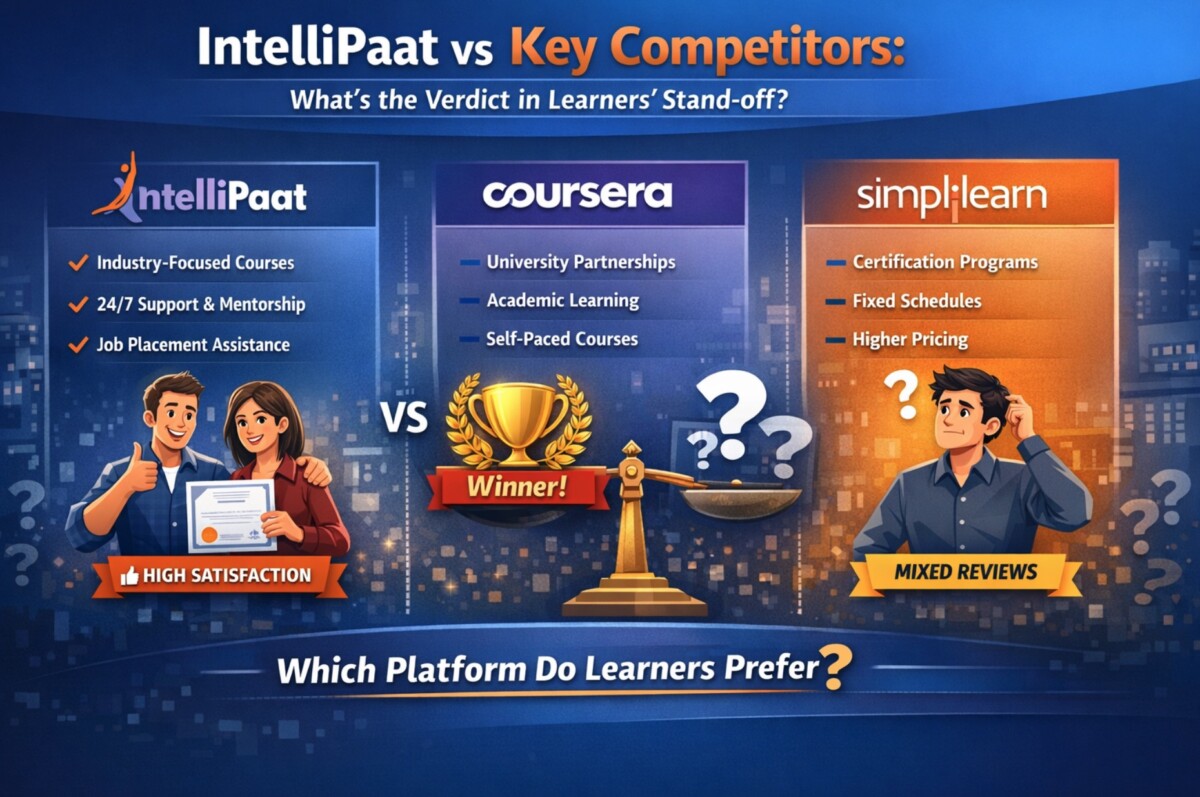
Three names that frequently appear in professional, career-oriented tech training are Intellipaat, Coursera, and Simplilearn. Each brand targets learners with slightly different priorities, academic credibility, breadth of content, job readiness, pricing models, or instructor style, and choosing the right one depends on your needs.
This guide gives a clear, practical comparison you can use to decide: what each platform actually delivers, where it shines, where it falls short, and which learner types will benefit most.
The Real Question Learners Are Asking Today
When learners compare platforms such as Intellipaat, Coursera, and Simplilearn, the actual question being asked is not:
“Which platform has the best brand name?”
Instead, they are asking:
- Which platform will really assist me in making myself employable?
- Where will I learn by doing and not just watching?
- Who will help me when I am stuck?
- Who is the platform that knows the realities of the hiring process?
This comparison answers those questions honestly.
Intellipaat vs Key Competitors
The ed-tech industry has expanded significantly, and players such as Intellipaat, Coursera, and Simplilearn have emerged as strong competitors for those looking to enhance their knowledge and skills in technology and advance their careers. However, when deciding where to dedicate time and money, it is critical to understand how these services and products differ from one another.
1. Learning Philosophy: Academic Knowledge vs Industry Readiness
Intellipaat: Outcome-Driven Learning
At Intellipaat, their learning philosophy is not just about content delivery; it is a job-based outcome, and their courses are designed around:
- Real industry tools
- Practical workflows
- Interview-relevant skills
- End-to-end projects that mimic production environments
The platform assumes that learners seek to acquire skills that can be applied immediately.
Coursera: Knowledge-First, Outcome-Second
Coursera’s strength lies in academic rigor. Courses are often designed by universities and emphasize:
- Theoretical foundations
- Structured academic progression
- Assessments similar to college coursework
However, most learners have come to realize that while Coursera enhances knowledge, there is a disconnect between knowledge and application in a working environment.
Simplilearn: Structured but Tool-Heavy
Simplilearn sits between the two. It emphasizes:
- Live bootcamp sessions
- Tool-centric training
- Predefined curriculum pacing
While this works well for some professionals, beginners may feel overwhelmed by tools before fully understanding why those tools exist.
Verdict: Learners who want to apply skills in real jobs tend to resonate more with Intellipaat’s outcome-first approach.
2. Curriculum Depth: Breadth vs Practical Relevance
Intellipaat
Intellipaat courses are designed backward from job descriptions. Instead of asking “What topics should we teach?”, the curriculum answers:
- What does an entry-level DevOps/Data/AI engineer actually do daily?
- What tools appear repeatedly in interviews?
- What mistakes do freshers commonly make in production environments?
This results in focused depth, not unnecessary breadth.
Coursera
Coursera offers massive breadth. You can learn almost anything — AI theory, ethics, algorithms, business analytics, research concepts.
However, this breadth can work against beginners:
- Courses often assume self-direction
- Practical gaps are common
- Learners must stitch multiple courses together to become job-ready
Simplilearn
Simplilearn’s curriculum is comprehensive but sometimes overloaded:
- Many tools were covered quickly
- Less time for deep mastery
- Strong dependence on instructor quality
3. Hands-On Learning: Where the Real Difference Appears
This is where most learners change their minds.
Intellipaat: Learning by Building
Intellipaat emphasizes:
- Real-world projects
- Guided implementation
- End-to-end workflows
- Mentored execution
Projects are not “demo-level”; they are designed to simulate real workplace problems, which helps learners:
- Talk confidently in interviews
- Build GitHub portfolios
- Understand failure scenarios
Coursera: Assignments, Not Environments
Coursera assignments are often:
- Quiz-based
- Notebook-driven
- Isolated from production setups
They test understanding, but not operational readiness.
Simplilearn: Labs with Constraints
Simplilearn provides labs and capstone projects, but:
- Labs may feel sandboxed
- Execution depends heavily on batch pacing
- Less room for exploration outside the syllabus
4. Instructor & Mentorship Model
Intellipaat
- Trainers are industry practitioners
- Sessions include real troubleshooting discussions
- Mentorship extends beyond lectures
- Doubts are treated as learning moments, not interruptions
This creates a guided learning environment, which is critical for beginners and career switchers.
Coursera
- Instructors are professors or researchers
- Teaching quality is high, but interaction is minimal
- Learners are largely on their own
This works well for self-motivated learners but not for those who need guidance.
Simplilearn
- Instructor quality varies by cohort
- Live interaction exists, but is time-bound
- Limited personalization at scale
5. Career Support: The Deciding Factor for Most Learners
Intellipaat
Career support is embedded into the learning journey:
- Resume building aligned with job roles
- Interview preparation
- Placement assistance programs
- Career mentoring
This signals that Intellipaat views success as employment, not just course completion.
Coursera
Career services are:
- Program-specific
- Limited in scope
- Often indirect
Learners are expected to leverage credentials independently.
Simplilearn
Simplilearn provides career assistance tools, but:
- Support is structured and limited
- Outcomes vary by program and location
6. Pricing vs Value Perceived
Intellipaat
- Mid-range pricing
- Value comes from mentorship, projects, and support
- ROI is clearer for job-oriented learners
Coursera
- Flexible pricing
- Excellent value for academic learning
- Lower cost, but also lower guidance
Simplilearn
- Higher pricing
- Value depends on learner engagement and batch experience
Learner Profiles: Who Should Choose What?
Choose Intellipaat if you:
- Want to switch careers
- Need structured guidance
- Value hands-on projects
- Want interview and placement support
- Prefer learning by doing
Choose Coursera if you:
- Want university credentials
- Prefer self-paced academic learning
- Are already disciplined and self-driven
Choose Simplilearn if you:
- Prefer bootcamp pacing
- Are comfortable with rigid schedules
- Want certification-focused learning
How to Choose – A Straightforward Decision Flow
- Define your final goal: Job in X role, certification, academic credit, or skills for internal promotion?
- Check program outcomes: Does the course list real projects, partner companies, and placement stats? (Ask for placement grads/references.)
- Validate hands-on content: Look for capstones, labs, and cloud credits.
- Compare credentials: University partner vs. industry badge vs. platform certificate. Which matters more to your target employers?
- Read recent learner reviews for that exact course/cohort (not generic platform praise). Look for comments about project quality and placement follow-through.
Final thoughts
All three platforms, Intellipaat, Coursera, and Simplilearn, have earned places in the modern learner’s toolkit. They simply solve slightly different problems:
- Coursera is for recognition and academic depth.
- Simplilearn is for structured bootcamps and rapid upskilling.
- Intellipaat is for hands-on, placement-oriented learners who want a guided path into specific tech roles.
If you want a single recommendation: choose by outcome, not brand. If your priority is getting a job quickly with a portfolio of real projects and active interview support, a job-oriented Intellipaat program may be the fastest route.
