





Is Jumpstart Commerce Right for You?
- Best fit for: Mid-market to enterprise Shopify merchants in the Asia Pacific region – or global brands expanding into Southeast Asia – who need complex migrations, custom development, or performance optimization on Shopify Plus
- Not the right fit if: You are pre-revenue, running a simple Shopify store that doesn’t require Plus-level features, or looking for a low-cost theme customization. Jumpstart works with ambitious, growth-stage brands – not entry-level builds
- What they’re known for: Being the only Shopify Platinum Partner in Southeast Asia, with 800+ stores built across Singapore, Thailand, Malaysia, Indonesia, and the Philippines and a 5.0 rating across 92 Shopify Partner Directory reviews
- What you’ll need to bring: Clear business requirements, internal stakeholder alignment, and access to your existing platform data. The more complex your migration or build, the more preparation on your side determines how fast they can move
- Typical engagement: Project-based for migrations and redesigns; ongoing retainer for store maintenance and marketing automation. Contact directly for investment range – no public pricing
Xavier and the team at Jumpstart have been a central pillar to our continued growth in Singapore and Southeast Asia. – Rhys Furner, Head of Partnerships APAC, Shopify Plus
What You’ll Learn
- Why Shopify Plus migrations in Southeast Asia are fundamentally more complex than Western markets – and what Jumpstart built to solve that
- How the methodology behind their 800+ store track record works, from luxury brands like Dior to fast-growing DTC brands like Coco & Eve
- What a real engagement with Jumpstart looks like from the first conversation to a live, optimized store
- What questions to ask any Shopify Plus development agency before signing – and what a strong answer actually sounds like
- Whether your brand is at the right stage and in the right market to get maximum value from this partnership
Most Shopify merchants who outgrow their current setup make the same mistake: they think migration is a technical problem. Move the products, transfer the customer data, rebuild the theme. They hand it to a developer, set a deadline, and assume the hard part is the code. Three months later, they’re live – but their checkout doesn’t support the local payment methods their customers expect, their loyalty program didn’t carry over correctly, and their regional expansion plans are stalled because the architecture wasn’t built to scale across multiple markets.
If you are running a Shopify store at the mid-market or enterprise level and you are planning a migration, an upgrade to Shopify Plus, or a regional expansion into Southeast Asia, this piece is for you. If you are pre-revenue or looking for a basic theme build, this is not the right read right now – and Jumpstart Commerce would likely tell you the same.
What earned Jumpstart Commerce this spotlight is not the number of stores they have built – though 800+ over a decade is a significant proof point. It is the caliber of brands they have built for and the specific problem they have figured out how to solve: helping ambitious brands navigate the complexity of Shopify Plus in one of the most diverse and demanding ecommerce markets in the world.
The Problem They Were Built to Solve
Southeast Asia is not a single market. It is five distinct consumer cultures, multiple languages, fragmented payment infrastructure, and wildly different logistics realities – all operating simultaneously across a region where mobile commerce adoption has outpaced desktop in ways that Western-centric agencies are still catching up to.
When Xavier Lee and Jeanette Lau founded Jumpstart Commerce in Singapore in 2014, they came from the advertising industry rather than a software development background. That origin matters. They understood brand before they understood code, which shaped how they approach every build. A Shopify Plus store is not just a technical deployment. It is a brand experience that has to perform across devices, across borders, and across the specific expectations of consumers in markets where UX conventions differ from what most Western agencies have been trained to build for.
The conventional approach to Shopify development in the region at the time was to treat it like a Western build – take a global theme, localize the copy, and call it done. The results were predictably mediocre: stores that looked fine but converted poorly because they hadn’t been built for how consumers in Singapore, Thailand, or Malaysia actually shop. Payment methods were wrong. Mobile performance was an afterthought. Regional inventory and multi-currency support were bolted on rather than architected in.
Jumpstart’s founding insight was that Southeast Asian ecommerce needed a Shopify practice built specifically for the region, not adapted from elsewhere. That decision to go deep in one geography rather than broad across many has produced something rare: a team that understands both the technical requirements of Shopify Plus and the commercial realities of the markets their clients are trying to win.
What They Do Differently
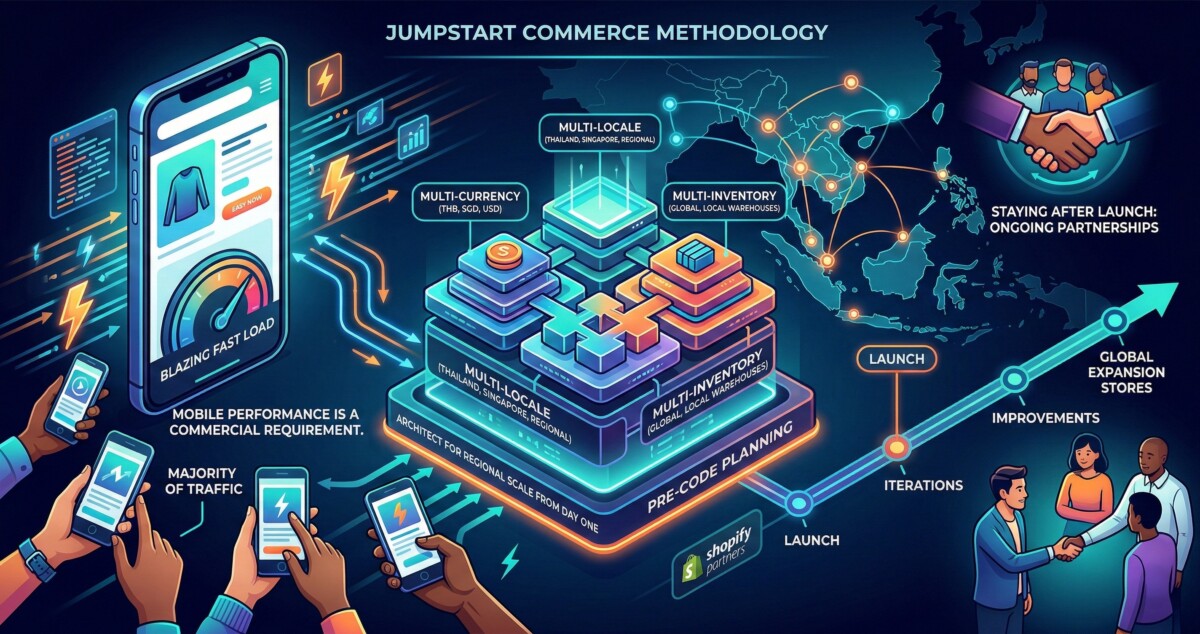
The most revealing thing about Jumpstart Commerce’s methodology is what they prioritize before a single line of code is written. Based on their Shopify Partners profile and client work, three things stand out as consistent across their engagements.
They architect for regional scale from day one. The brands in their portfolio – Dior Thailand, Paula’s Choice Singapore, Coco & Eve, FitFlop Thailand, MLB Thailand – are not single-market builds. They are multi-locale, multi-currency, multi-inventory operations. Jumpstart’s approach to these projects is to build the infrastructure for regional expansion into the initial architecture rather than retrofit it later. For Moom Health, this meant unlocking multi-currency support and global subscription workflows as part of the Shopify Plus migration, not as a phase two project. For Coco & Eve, it meant building backend operations to support international sales at scale from launch.
They treat mobile performance as a commercial requirement, not a technical checkbox. Across their featured work, the language is consistent: mobile-first speed, blazing-fast page loads, lightning-fast performance. In a region where the majority of ecommerce traffic arrives on mobile and where consumers will abandon a slow checkout without hesitation, this is not marketing language – it is the actual brief. Their work with Paula’s Choice Singapore specifically called out boosting mobile-first speed as a primary deliverable, not a secondary optimization.
They stay after launch. The testimonials across their Shopify Partners profile and their own site reveal a pattern that separates them from project-only agencies: clients describe ongoing relationships, not completed projects. Benjamin Huang of The Omnidesk noted they are “very involved in further iterations of changes, improvements, and also developing our expansion stores globally.” Bynd Artisan’s founders described a team that “always goes above and beyond.” This is not accidental – it reflects a deliberate engagement model where the initial build is the beginning of the relationship, not the end of it.
Three Things Jumpstart Consistently Delivers
- Regional architecture built for multi-market expansion from the start – not retrofitted after launch
- Mobile-first performance optimization as a primary deliverable, not a post-launch afterthought
- Ongoing partnership model – clients describe multi-year relationships, not completed handoffs
The Proof of Work: Robinsons Department Store
The case study that best illustrates Jumpstart Commerce’s methodology under pressure is not one of their luxury brand builds – it is an older one that Shopify itself documented: the Robinsons Department Store launch in 2016.
Robinsons was a 160-year-old Singapore institution. One of the country’s most recognized retailers. And they came to Jumpstart Commerce with a request that would make most agencies nervous: they were ready to launch ecommerce for the first time, and they needed to be live in three months.
The situation was not just a tight timeline. It was a legacy brand with no existing ecommerce infrastructure, a complex product catalog, and the institutional weight of a 160-year reputation that could not afford a public stumble. The conventional response would have been to push back on the timeline, scope down the build, or propose a phased launch that reduced risk by reducing ambition.
Jumpstart’s response, as Xavier later described it to Shopify: “We thought, that was quite easy.” That confidence was not bravado. It was the product of a team that had spent two years building its Shopify practice specifically for complex, high-stakes builds in the Singapore market. They delivered the launch on time. The project became one of the foundational proof points that established Jumpstart Commerce as the agency of record for enterprise-level Shopify builds in the region.
Since Robinsons, the client roster has expanded to include global luxury and beauty brands operating in Southeast Asia, such as Dior Thailand, Paula’s Choice Singapore, FitFlop Thailand, and Coco & Eve, alongside fast-growing regional DTC brands like The Omnidesk, Bynd Artisan, and The Golden Duck. The common thread across all of them is complexity: these are not simple builds, and the brands chose Jumpstart specifically because the project required more than a standard agency could deliver.
What a Real Engagement Looks Like
The first conversation with Jumpstart Commerce is a scoping call, not a sales pitch. Based on client accounts, they invest significant time upfront understanding the specific business requirements before proposing a solution. Han’s F&B described their experience this way: “Jumpstart took the time to listen to our pain points and understood our challenges.” That listening phase is not courtesy – it is how they determine whether a project is the right fit and what the architecture needs to support.
For a typical Shopify Plus migration or redesign, the engagement moves through three phases. The first is discovery and architecture: understanding the existing platform, the data that needs to transfer, the regional requirements, and the performance targets. The second is build and integration: custom development, third-party integrations, and QA against the specific market requirements the brand is operating in. The third is launch and iteration: going live, monitoring performance, and staying engaged as the brand grows.
What clients consistently describe is that Jumpstart does not disappear after launch. Far Ocean’s COO Jerrold Quek noted that “whenever they might have given them, they could complete it within two or three days” – that responsiveness in the ongoing relationship is as much a part of the engagement as the initial build.
What you will need to bring to this partnership: clear business requirements before the first call, internal alignment on what the migration or build needs to accomplish, and access to your existing platform data. The brands that get the most from Jumpstart are the ones that show up prepared. Complex builds move faster when the client side is organized. If you are still figuring out your regional expansion strategy or your product catalog architecture, resolve those questions internally before engaging – you will get more from the scoping conversation.
The Questions to Ask Before You Sign
These questions apply to any Shopify Plus development agency you are evaluating, not just Jumpstart Commerce. A credible agency should answer all of them without hesitation.
Jumpstart Commerce’s Shopify Partners Directory profile and Clutch presence give you a strong starting point for due diligence before you reach out. With 92 reviews at a 5.0 rating on the Shopify Partners Directory and recognition as the only Shopify Platinum Partner in Southeast Asia, the third-party validation is unusually strong for a regional agency. Read the reviews for patterns, not just scores – the consistent themes around communication speed and post-launch support are as informative as the ratings themselves.
If you are a brand operating in or expanding into Southeast Asia, or a global brand that needs a Shopify Plus partner with genuine enterprise-level experience in the APAC market, Jumpstart Commerce has built the track record that earns serious consideration. The combination of Platinum Partner status, a decade of regional expertise, and a client roster that spans luxury, beauty, and DTC makes them one of the few agencies in the region where the proof of work matches the positioning. If this is the problem you are sitting with, the conversation is worth having.
Start at Jumpstartcommerce.com
Frequently Asked Questions
What is Jumpstart Commerce, and what do they specialize in?
Jumpstart Commerce is a Shopify Plus development and design agency headquartered in Singapore, with offices across Southeast Asia, including Thailand, Malaysia, and Indonesia. Founded in 2014 by Xavier Lee and Jeanette Lau, they specialize in Shopify Plus migrations, custom store builds, performance optimization, and ecommerce marketing automation. They hold Shopify Platinum Partner status – the only agency in Southeast Asia to do so – and have built over 800 Shopify stores for brands ranging from luxury names like Dior Thailand to fast-growing DTC brands like Coco & Eve and The Omnidesk.
How much does it cost to work with Jumpstart Commerce?
Jumpstart Commerce does not publish pricing publicly, which is standard for agencies working on complex, custom Shopify Plus projects where scope varies significantly by client. Investment will depend on the complexity of your migration or build, the number of markets you are operating in, the level of custom development required, and whether you need ongoing retainer support post-launch. The best approach is to prepare a clear brief of your requirements before reaching out – the more specific you can be about your platform, catalog size, regional requirements, and timeline, the more accurate the initial scoping conversation will be.
Is Jumpstart Commerce the right fit if I am not based in Southeast Asia?
Jumpstart Commerce’s primary market is Southeast Asia, and their deepest expertise is in building Shopify Plus stores for the specific commercial and technical requirements of that region. That said, they have worked with global brands expanding into APAC – including brands based outside the region that needed a local partner with regional expertise. If you are a global brand planning expansion into Singapore, Thailand, Malaysia, or surrounding markets, their regional knowledge is a genuine asset. If you are based entirely outside APAC with no regional expansion plans, there are likely Shopify Plus agencies in your own market better positioned to serve you.
What makes Jumpstart Commerce different from other Shopify Plus agencies?
Three things stand out from their track record. First, their Platinum Partner status is the only one in Southeast Asia – a designation Shopify awards based on project volume, client outcomes, and platform expertise. Second, their client roster includes brands with genuinely complex requirements: multi-locale luxury builds for Dior Thailand, global beauty platforms for Paula’s Choice and Coco & Eve, and enterprise-level builds for brands like The Omnidesk. Third, the pattern across client testimonials is consistent long-term partnerships rather than completed handoffs – clients describe multi-year relationships where Jumpstart stays involved through ongoing iterations and expansion builds.
How do I evaluate whether a Shopify Plus agency is the right fit before signing?
Start with the Shopify Partners Directory and Clutch for third-party verified reviews – look for patterns in the feedback, not just overall scores. Ask for comparable project examples: if your migration is from Magento with a 10,000 SKU catalog, ask specifically for a Magento migration at similar scale. Get clarity on their post-launch support model before you sign – the ongoing relationship is often where agencies differentiate more than on the initial build. Finally, ask what they need from your team to hit the timeline. A strong agency will give you a specific list of dependencies. An agency that says they need very little from you is either not thinking through the project carefully or is setting you up for timeline problems later.
