





TL;DR
- Backlinks are still critical, not just for Google rankings, but because they help you reach page one, where LLMs source content
- “Just create great content” doesn’t work for new sites (with one exception: statistics-based content)
- The highest ROI strategies today:
- Listicle outreach (12% vs 3% response rates)
- ABC link exchanges using donor domains
- Offline networking (massively underrated)
- For AI visibility, brand mentions with context matter, not just links
- Tools like Rankchase (~$19/month) can reduce link building costs from ~$300 per link to just a few dollars by automating partner discovery and outreach
For most new sites and small businesses, link building is too expensive
In 2026, SEO has a hard entry requirement: authority.
According to Internet Marketing Ninjas, 96.3% of pages ranking at the top of Google have over 1,000 referring domains and in practice, it’s extremely difficult to compete with fewer than 50.
For most people the problem is economic.
According to most link marketplaces, the average cost of a decent backlink sits around:
- ~$300 per link
- $1,000+ in competitive niches like SaaS, finance, or tech
And that doesn’t include hidden costs:
- Outreach time
- Content creation (time to write a guest post, if it requires one)
- Agency markups (often 40%+)
For small businesses, this quickly becomes unsustainable.
So the real question becomes:
How do you build authority without a five-figure budget?
The myth of passive growth
The advice to “just create great content” is still everywhere, and still mostly wrong for new sites.
Without authority, content doesn’t get distribution. Without distribution, it doesn’t get links.
Even good content struggles to attract links when it’s invisible.
There is, however, one notable exception.
The exception: statistics content
Content that aggregates statistics, benchmarks, or market data tends to attract links more easily.
Why?
- It lets you target very specific long-tail keywords like “X stats 2026,” which is especially helpful for new and smaller websites.
- Other sites prefer linking to a single organized source rather than multiple primary sources
This creates a small asymmetry:
Even new sites can earn backlinks if they position themselves as the aggregator of information.
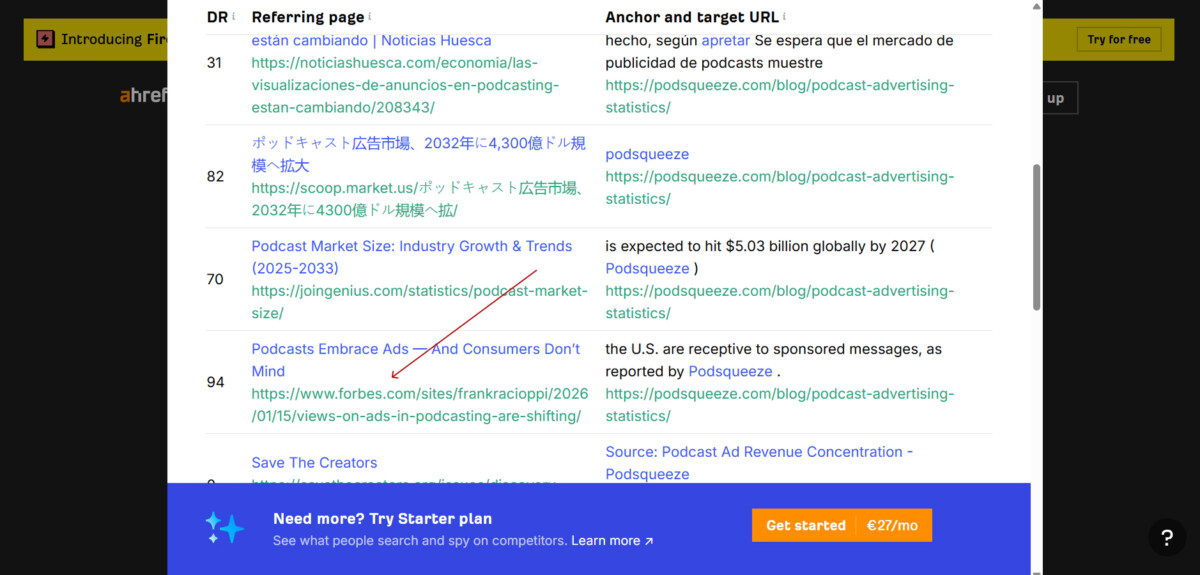
For example, this article about podcast advertising statistics even got a backlink from Forbes.
Outside of this, though, relying on passive link acquisition is rarely effective. No one is linking to guides and informational content in general anymore.
Strategy 1: The listicle “value-first” hack (12% conversion)
Traditional outreach, where you contact people asking for a guest post or link exchange, has a fundamental problem:
Response rates hover around 3%.
A simple way to improve this is to flip the dynamic. Instead of reaching out and asking for a link, start by offering something first.
One easy approach is to create a listicle, something like “Best tools for [your niche]”, and feature the websites you’d be interested in partnering with.
Something like this:
- Create a listicle
→ “Best tools for [your niche]” - Mention 10–15 relevant companies (without linking initially)
- Reach out with a simple message:
→ “We featured you in our article here (insert link) — happy to include a link if you’d like to collaborate”
This shifts the interaction from a cold request to a mutual opportunity.
This approach pushed conversion rates up to ~12%.
Strategy 2: ABC link exchanges and donor domains
For new sites, direct link exchanges often don’t work.
Low-authority domains have little to offer.
That’s where ABC exchanges come in.
Instead of:
- Site A ↔ Site B
You structure it as:
- Site A → Site B
- Site B → Site C
In practice:
- You use a stronger “donor” site
- And redirect the value toward your newer site
This helps:
- Avoid obvious reciprocal patterns
- Inject authority into new domains
- Scale link building across a portfolio
If you run multiple sites, this becomes one of the most effective tactics available.
Strategy 3: Link building tools (Rankchase)
Even though link exchanges, and especially ABC exchanges, can be very effective, they still require a fair amount of manual work:
- Finding partners
- Qualifying sites
- Sending outreach
- Following up
That’s where tools like Rankchase come in to automate this process.
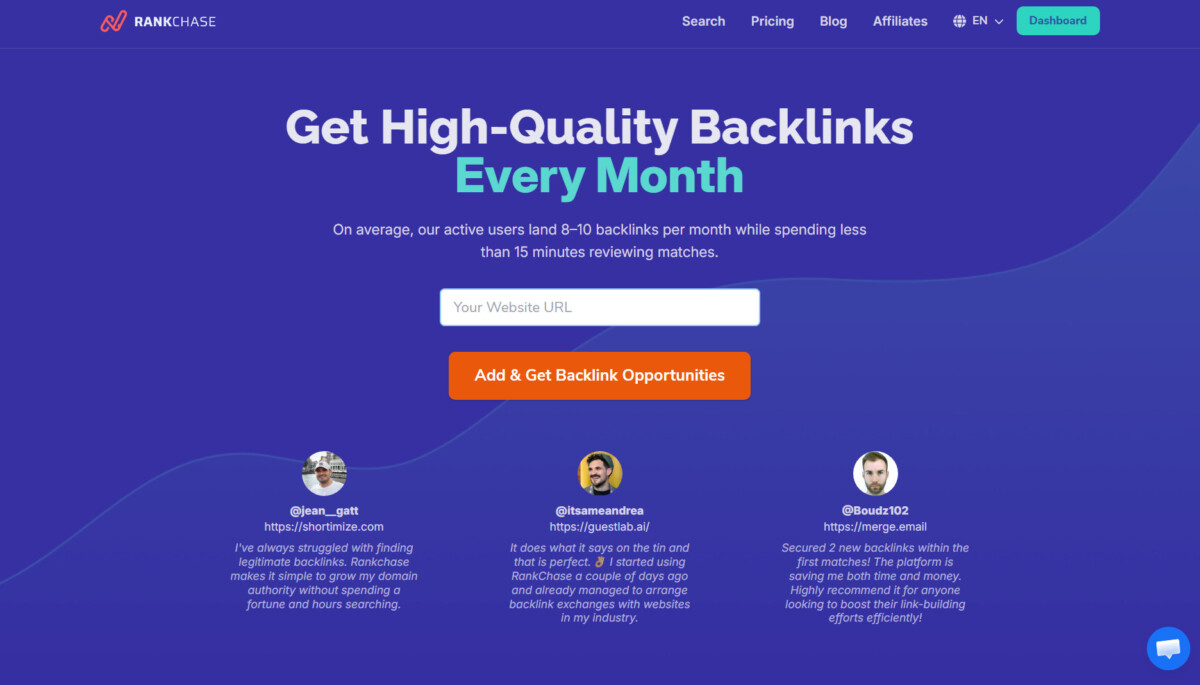
At a high level, it works like this:
- You add your domain
- The platform finds relevant sites in your niche and lets you evaluate all relevant website metrics
- These sites are already open to link exchanges
- You can send requests with one click
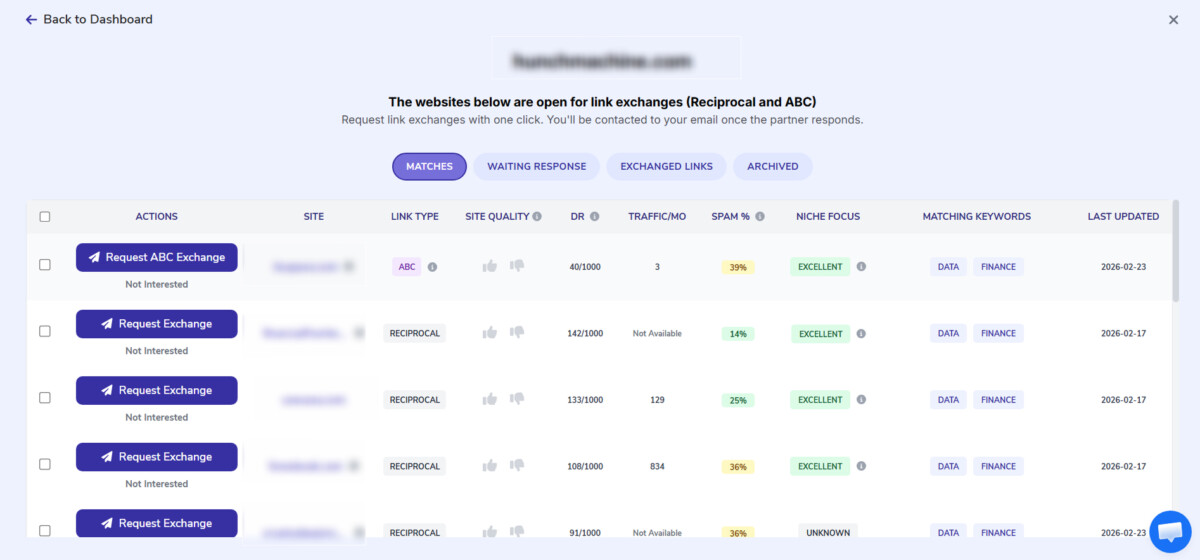
The result is a significant cost reduction.
Compared to ~$300 per link in marketplaces, the effective cost can drop to $2–$3 per link, especially when replacing manual work.
It’s not a magic solution, but it turns link building into a repeatable system instead of a chaotic, expensive process.
Strategy 4: Offline networking (high leverage, low competition)
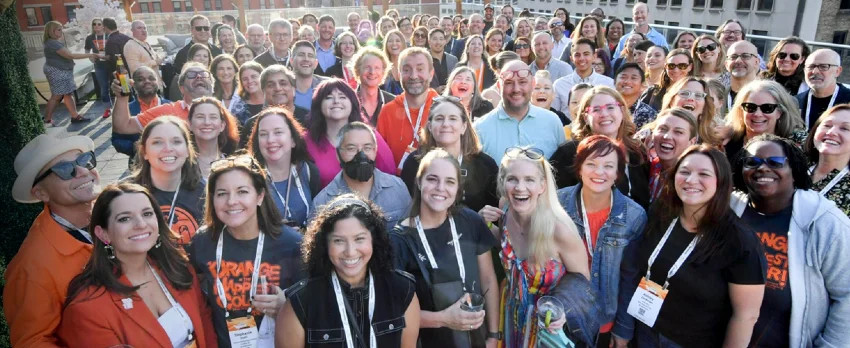
Digital outreach is saturated.
Offline, though, it’s a different story.
Events, meetups, and small niche gatherings still work surprisingly well. A quick, genuine conversation in person can do more than dozens of cold emails that never get a reply.
You don’t need to fly to something like WebSummit either. In the US, there are plenty of smaller, more targeted ways to meet relevant people:
- Check Meetup.com for local founder, marketing, or niche-specific groups
- Look at industry conferences (even smaller regional ones tend to be more approachable)
- Browse platforms like Eventbrite or even LinkedIn Events for niche gatherings
If you’re in SaaS, marketing, ecommerce, etc., there’s almost always something happening nearby.
And when these connections turn into link opportunities, they’re usually better:
- higher trust
- more natural placements
- and often the start of longer-term collaborations
It’s less transactional, and that’s exactly why it works.
Strategy 5: Don’t just build links, build mentions
In 2026, backlinks are still important, but not for the reason most people think.
LLMs like ChatGPT and Gemini don’t “use backlinks” the same way Google does.
Instead, the process looks like this:
- Backlinks help your content rank on page one (first 10 results or so)
- LLMs pull sources from those top-ranking pages
- The model reads and interprets the content
When LLMs read a page, they’re not just looking at links.
They’re identifying:
- Brand names
- Context
- Descriptions of products and services
This means that brand mentions with clear context are increasingly valuable.
Instead of focusing only on anchor text like:
- “best link building tool”
It’s often more effective to include:
- Your brand name
- A short explanation of what it does
- A natural mention within the content
For example:
“Tools like XYZ help automate finding link exchange partners…”
This gives both users and models a clearer signal.
Conclusion
In 2026, link building for new sites comes down to sticking with a few strategies that actually move the needle:
- Value-first outreach (listicles)
- Smart exchanges (especially ABC)
- Real-world networking
- Strategic content (like statistics pages)
- And tools that reduce execution friction
The biggest mistake new sites make is waiting for links to come naturally.
The sites that grow are the ones that treat link building as an active process, even a simple one.
Because at the end of the day, authority has to be actively built.
Frequently Asked Questions
Do I need to buy backlinks to rank?
Not necessarily.
Buying links can accelerate results, but it’s expensive and often inefficient for small teams.
Many sites grow using exchanges, outreach, and partnerships instead.
Are link exchanges still safe?
Yes, when done properly.
Focus on:
- Relevant sites
- Natural placements
- Avoiding obvious spam patterns
ABC exchanges can also help reduce direct reciprocity signals.
How long does it take to see results from link building?
Typically:
- 4–8 weeks for initial movement
- 2–4 months for meaningful impact
It depends on competition and consistency.
What’s the fastest way to get backlinks as a new site?
A combination of:
- Listicle outreach
- Link exchanges
- Statistics-based content
These tend to produce the quickest early results.
Are backlinks still important for AI search?
Yes, but indirectly.
Backlinks help you rank on Google, and LLMs often pull sources from top-ranking pages.
However, once your content is surfaced, clear brand mentions and context become just as important.
Is Rankchase worth it for small teams?
If your main bottleneck is:
- finding partners
- and doing outreach
Then yes, it can significantly reduce time and cost.
Especially compared to agencies or manual workflows.
