Key Takeaways
- Outrank feed-first rivals by tightening your Google Merchant Center product feed with rich attributes so your items can win the visual Shopping results that now push blue links down.
- Audit your catalog for missing Product Schema, weak feed data, and “zombie” URLs, then fix them with page-level markup and clean 301 redirects to regain lost search visibility.
- Reduce team stress by focusing on execution you control (clean product data, clear pages, and fewer broken URLs) instead of chasing every new Google change with more content.
- Embrace the shift from “ranking pages” to “ranking products” by treating your product feed and structured data like your new storefront sign in AI Overviews and shopping grids.
Fashion retailers lost 27% of their search visibility over the past year to AI Overviews and Shopping Graph feeds.
Optimize Merchant Center feeds with granular attributes, implement Product Schema markup on every page, and fix zombie pages via 301 redirects. Brands executing these reclaim top SERPs and stabilize ROAS across stages.
Are you watching organic traffic to your fashion store plummet as Google prioritizes feeds and AI summaries over traditional listings? Apparel retailers have lost 27% of their search visibility in the past year alone, per the latest benchmarks. This EcommerceFastlane analysis uncovers why it’s happening and delivers the exact playbook to fight back and win top SERP real estate.
This guide explains why fashion retailers are seeing a dramatic shift in organic search visibility in 2026 and provides a technical roadmap to reclaim lost ground. Drawing on patterns identified in 450+ interviews with DTC founders and my experience at Shopify, this analysis shows that traditional SEO strategies are no longer sufficient against AI-driven SERPs and feed-based competitors.
Whether you’re a boutique brand fighting for your first 10,000 visitors or an established retailer optimizing a massive catalog, the rules of engagement have changed. The “blue link” era is over; we are now in the age of the visual, feed-driven answer engine.
Here is the reality I’m seeing across the industry: brands that cling to 2024 SEO playbooks are losing 15-20% of their top-of-funnel traffic, while those embracing structured data and merchant feeds are capturing the new “position zero.”
What the Latest Apparel Search Visibility Benchmarks Reveal
The data is sobering: organic real estate for fashion keywords has shrunk by nearly 30% over the last 18 months. Here’s what I’ve found analyzing the landscape:
- Visual dominance: On mobile, “Shopping Graph” grids now push the first organic text result below the third scroll depth.
- Zero-click increase: AI Overviews (formerly SGE) are answering query intent directly on the SERP, reducing click-through rates for informational queries like “how to style oversized blazers.”
- Brand erosion: Generic queries (“men’s leather boots”) are increasingly dominated by marketplaces and aggregators, squeezing out individual DTC brands.
If you are seeing flat traffic despite consistent content output, this is why. The goalpost hasn’t just moved; the game has changed from “ranking links” to “ranking entities.”
Why Fashion Retailers Are Losing Ground in Google SERPs
The decline isn’t about penalty algorithms; it’s about SERP architecture. Google has evolved into a transactional marketplace. If you aren’t feeding Google’s Shopping Graph with pristine data, you are invisible.
Most fashion brands I audit are still optimizing for keywords when they should be optimizing for context. Google wants to know:
- Is this product in stock?
- What is the return policy?
- Does the image match the query intent visually?
When your site lacks this structured clarity, Google bypasses you for retailers who provide it. It’s not that your SEO is “bad”—it’s that your data is unstructured. You are speaking English while the search engine is listening for Schema.
The Rise of Feed-Driven Challengers Like Shein
We need to talk about the elephant in the room. Ultra-fast fashion giants like Shein and Temu aren’t just winning on price; they are winning on data velocity. They treat their product feeds as their primary marketing channel, updating thousands of SKUs daily with aggressive attribute tagging.
This floods the Shopping Graph. When a user searches for “floral summer dress,” these challengers occupy the visual carousel because their feed data is granular, fresh, and massive.
The lesson for independent brands: You cannot out-spend them, but you can out-execute them on quality. Your advantage is brand authority and specific, high-quality data attributes that these mass-aggregators often miss. You win by being the “best answer,” not just the cheapest option.
How AI Overviews and Shopping Updates Are Reshaping Fashion Discovery
AI Overviews have fundamentally altered discovery. In 2026, a user might ask, “What are the best sustainable sneakers for wide feet?” and receive a synthesized answer referencing three different brands without ever visiting a blog post.
To appear in these AI snapshots, your content must shift from “marketing fluff” to “information gain.”
- Direct Answers: Your product pages need clear, concise descriptions.
- Third-Party Validation: AI trusts reviews and external citations.
- Buying Guides: Long-form content must provide genuine utility, not just keyword stuffing.
If you’re a scaling brand, this is actually good news. You don’t need high domain authority to rank in an AI snapshot; you just need the most relevant, well-structured answer.
Execution Quality Over Ad Spend: The Q4 2025 Shift
Looking back at the Q4 2025 data, a clear pattern emerged among the winners: operational SEO efficiency beat raw ad spend.
Brands that relied solely on paid acquisition saw customer acquisition costs (CAC) spike to unsustainable levels. Meanwhile, brands that had invested in “technical debt” cleanup—fixing broken links, optimizing crawl budgets, and refining collection page architecture—saw their Return on Ad Spend (ROAS) stabilize.
Why? Because organic and paid are symbiotic. High-quality landing pages with strong organic signals improve your Quality Score, lowering your CPC. If you are ignoring your technical SEO foundation, you are effectively paying a “sloppy tax” on every ad dollar you spend.
Key Challenges in Fashion Ecommerce SEO
Fashion SEO is uniquely difficult due to the nature of the product. Unlike selling software or supplements, fashion involves high SKU counts, constant turnover, and heavy visual reliance.
Managing Massive Catalogs and Seasonal Inventory Volatility
The biggest headache I see is “zombie pages.” Fashion brands launch hundreds of products per season, then discontinue them. This creates thousands of 404 errors or “out of stock” pages that dilute your site’s authority.
The Fix: Never just delete a product page.
- Redirect (301): Send discontinued items to the closest relevant parent category (e.g., “Red Summer Dress” -> “Summer Dresses Collection”).
- Soft 404s: If a product is temporarily out of stock, keep the page live but remove it from the XML sitemap to preserve ranking equity while pausing crawl priority.
Overcoming Duplicate Content and Slow Product Onboarding
If you are selling multi-brand inventory or using standard manufacturer descriptions, you are fighting a losing battle. Google filters out duplicate content aggressively.
- The Trap: Copy-pasting descriptions from a supplier feed.
- The Solution: Use programmatic SEO templates to inject unique modifiers (brand voice, specific specs) into product descriptions at scale.
- Speed: Slow onboarding means you miss the “freshness” boost. Your workflow from “warehouse receipt” to “live on site” needs to be under 24 hours.
Adapting to Visual, Voice, and Zero-Click Searches
Consumers are searching with their cameras via Google Lens and asking voice assistants for recommendations. Text-only optimization is obsolete.
- Visual Search: Your image filenames cannot be
IMG_5920.jpg. They must bewomens-black-leather-biker-jacket-front.jpg. - Alt Text: This is for accessibility and visual SEO. Describe the item specifically (color, material, cut).
- Zero-Click: Optimize for “Featured Snippets” by answering common questions (sizing, materials, care) directly on the product page in a list format.
Best Practices to Boost Your Search Visibility
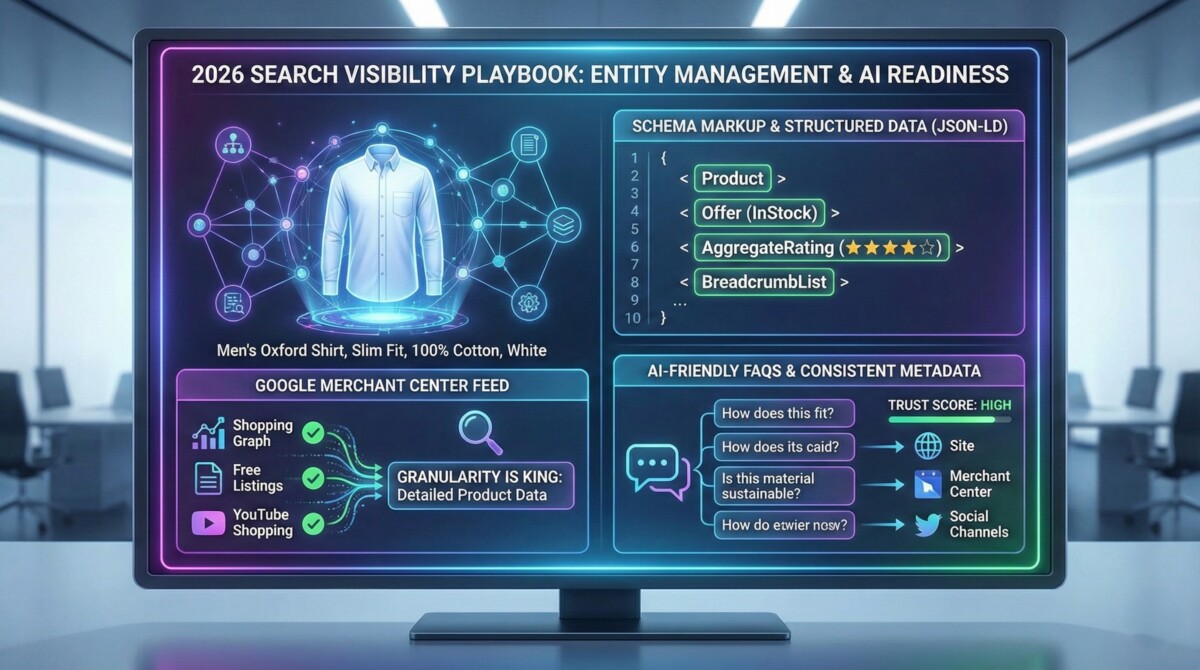
To win in this environment, you must pivot from “keyword matching” to “entity management.” Here is your playbook for 2026.
Optimize Product Feeds and Merchant Listings for Top SERP Real Estate
Your Google Merchant Center feed is now your most important SEO asset. It powers the Shopping Graph, free listings, and even YouTube Shopping.
- Granularity is King: Don’t just list “Shirt.” List “Men’s Oxford Shirt, Slim Fit, 100% Cotton, White.”
- Custom Labels: Use custom labels to segment products by margin or seasonality for better bidding strategies.
- Error Resolution: Check Merchant Center weekly. Disapproved products are invisible revenue.
Implement Schema Markup and Structured Data for AI Readiness
You need to speak the robot’s language. Schema markup tells search engines exactly what your content is.
Must-Have Schemas for Fashion:
- Product: Name, image, description, SKU.
- Offer: Price, currency, availability (InStock/OutOfStock).
- AggregateRating: Stars and review counts (critical for CTR).
- BreadcrumbList: Helps Google understand your site structure.
If you aren’t using JSON-LD structured data on every product page, you are voluntarily handing traffic to competitors who do.
Build AI-Friendly FAQs and Consistent Metadata Across Channels
AI engines love direct answers. Every collection page should have a “Frequently Asked Questions” section at the bottom.
- Structure: Use
FAQPageschema. - Content: “How does this fit?” “Is this material sustainable?” “How do I care for this fabric?”
- Consistency: Ensure your return policy and shipping times match exactly across your site, Merchant Center, and social channels. Discrepancies hurt your “Trust” score.
Common Mistakes Fashion Brands Make—and How to Fix Them
I’ve audited hundreds of stores, and the same mistakes keep popping up.
- Ignoring Site Speed: High-res lookbooks are great, but if they take 4 seconds to load on 5G, you’ve lost the user. Compress images to WebP format automatically.
- Tag Bloat: Using thousands of tag pages (e.g., /collections/all/blue, /collections/all/cotton) creates massive duplicate content issues. Canonicalize these to the main collection page.
- Neglecting Mobile UX: 80% of fashion discovery happens on mobile. If your pop-ups cover the “Add to Cart” button, Google notices the “rage clicks” and bounces.
Next Steps: Audit Your Visibility and Start Winning Back Traffic
The landscape has changed, but the opportunity for agile brands is massive. The giants are slow to adapt to technical nuance, which is where you can win.
Your 30-Day Action Plan:
- Audit your Merchant Center feed: Fix all critical errors and warnings.
- Implement Product Schema: Ensure every PDP has valid JSON-LD markup.
- Clean up your index: 301 redirect 404s and canonicalize tag pages.
This technical work is heavy lifting. It requires a blend of developer skill and marketing strategy. If you don’t have the in-house bandwidth to tackle this technical debt, looking into specialized fashion SEO services can bridge that gap and fast-track your recovery.
Don’t wait for the next algorithm update. Start optimizing your data today.
Quick question: Check your Google Search Console. What is your ratio of “Indexed” pages to “Not Indexed”? If “Not Indexed” is higher, that is your first priority.
Frequently Asked Questions
How much has organic search traffic declined for fashion retailers in 2026?
Organic search visibility for fashion keywords has dropped 30% over the last 18 months due to visual Shopping Graph grids and AI Overviews pushing results below the fold.
What is the most important Schema markup for fashion product pages?
Product Schema with Offer, AggregateRating, and availability details is essential, as it feeds Google’s Shopping Graph and boosts free listings by making your data machine-readable.
How quickly should fashion brands onboard new products to Google Merchant Center?
Aim for under 24 hours from warehouse receipt to live listing to capture Google’s freshness boost and compete with fast-fashion feeds like Shein.
Why are Shein and Temu dominating fashion search results?
They update thousands of SKUs daily with granular attributes, flooding the Shopping Graph and occupying visual carousels for queries like “floral summer dress.”
What is a quick fix for zombie pages from discontinued fashion products?
Use 301 redirects to the closest parent category instead of deleting, preserving ranking equity while avoiding 404 errors that dilute site authority.