





Quick Decision Framework
- Who This Is For: Shopify brands at any revenue stage that are running paid ads, reviewing monthly P&Ls, and still not sure if they’re actually making money after all the costs are accounted for.
- Skip If: You’re pre-revenue or under $5K/month in sales and haven’t yet established a cost structure worth modeling. Pentane’s guidance system needs real expense and revenue data to generate meaningful direction.
- Key Benefit: Pentane is the only platform in this category that doesn’t just show you what happened — it tells you the exact four actions you can take today to hit your net margin goal.
- What You’ll Need: Active Shopify store, at least one connected ad platform (Meta, Google, or TikTok), and an accounting tool like QuickBooks. Budget for $179 to $199/month. Minimal technical setup required.
- Time to Complete: About 12 minutes to read this review; under 10 minutes to connect Pentane to your Shopify store; immediate Mission Control guidance upon setup – Pentane automatically pulls your last 60 days of data in the background when each API is connected, so profit math and direction are ready as soon as you’re onboarded.
If you’re evaluating Pentane, you’re almost certainly also looking at Triple Whale and Lifetimely. These three dominate the eCommerce analytics and profit visibility conversation for Shopify merchants, and they each solve the core problem differently. Pentane takes the approach of a profit operating system — it ingests your expenses, revenue, and ad data, then works backwards from a net margin goal to tell you exactly what to change. Triple Whale is built around paid media attribution — it tracks where your customers come from and helps you optimize creative and channel spend. Lifetimely focuses on customer lifetime value and cohort behavior — it tells you how much a customer is worth over time. By the end of this review, you’ll know exactly which one fits where you are today.
Is Pentane Actually Worth It for Your Shopify Store?
Most Shopify analytics tools show you more numbers. Pentane shows you fewer numbers and tells you what to do with them. That distinction sounds small until you’ve stared at a 3.2 ROAS dashboard thinking you’re profitable, then opened your accountant’s year-end report and discovered you lost $40,000. That scenario — pulled directly from a real Reddit founder post that Pentane uses on their homepage — is not an edge case. It is the default experience for a significant percentage of growing Shopify brands.
I had the chance to sit down with Adam Callinan, founder and CEO of Pentane, on the eCommerce Fastlane podcast. What came through clearly in that conversation is that Pentane was not built by a product manager who studied the eCommerce analytics market. It was built by a founder who bootstrapped BottleKeeper from a $10K investment to $60M in total sales with four employees and zero outside investors, appeared on Shark Tank in 2018, and then — after the acquisition — started applying the same financial operating system he’d used internally to other consumer brands he invested in. When it increased one of those brands’ net profit by 50% in a single year, he stopped keeping it in spreadsheets and built it into software.
This review is based on direct analysis of Pentane’s current feature set as of March 2026, Adam’s podcast interview on eCommerce Fastlane, multiple published case studies from Pentane’s brand portfolio, evaluation of Pentane’s positioning against Triple Whale and Lifetimely across the use cases that matter most to Shopify merchants, and review of Adam’s published content across multiple podcast appearances and the Growth Mavericks platform.
Who Is Pentane Actually For?
Emerging Stage ($0 to $50K Monthly)
The Promise: Even at early stage, Pentane gives you a real-time view of whether you’re actually making money — not just generating revenue — and a Mission Control target to work toward.
The Reality: The guidance system is most powerful when you have a stable cost structure to model against. If your expenses are changing week to week as you stand up the business, the directional outputs will shift frequently. That’s not a flaw — it’s accurate — but it requires you to engage with the data actively rather than set it and forget it.
The Trigger: You’re running paid ads on at least one channel, you have a rough sense of your fixed and variable costs, and you’ve had at least one month where you thought you were profitable but weren’t sure.
Skip If: You haven’t launched yet or are still in pre-revenue product validation. Pentane needs real data to generate real direction.
Growth Stage ($50K to $500K Monthly)
The Promise: This is Pentane’s sweet spot. At this stage, the gap between what your ad platforms report and what you actually net is widest — and most dangerous. Pentane closes that gap and gives your team a shared language around profitability that ad managers, operators, and founders can all work from.
The Reality: You’ll get the most out of Pentane if you also connect your accounting platform (QuickBooks or equivalent). Without it, you’re working from manually entered cost data, which reduces accuracy. The integration setup takes under 10 minutes, but it does require you to have clean accounting in place.
The Trigger: You’ve hired or are about to hire an ad agency or media buyer, and you realize you have no shared benchmark for what “good” looks like beyond ROAS. Or you’ve had a month where you scaled revenue and margin got worse, not better.
Skip If: You’re primarily running organic channels with minimal ad spend. The ROAS floor and ad budget guidance features — which are among Pentane’s most powerful — won’t have much to work with.
Established Stage ($500K to $2M+ Monthly)
The Promise: At this stage, Pentane functions as a real-time executive dashboard that keeps the entire team — founder, CMO, media buyer, and CFO — aligned on the same profitability metrics without waiting for a monthly P&L.
The Reality: Pentane is explicitly designed for consumer brands under approximately $20M in revenue. At the upper end of the established stage and beyond, brands with complex multi-channel structures, large SKU catalogs, or sophisticated attribution needs may find they need to layer Pentane alongside a more specialized attribution tool rather than use it as a replacement.
The Trigger: You’re scaling ad spend aggressively, your agency is optimizing for ROAS targets you set months ago, and you haven’t revisited whether those targets still reflect your actual cost structure.
Skip If: You already have a dedicated finance team running real-time P&L dashboards and a sophisticated attribution stack. Pentane’s value is highest where that infrastructure doesn’t yet exist.
Stage-to-Recommendation at a Glance
What Pentane Actually Does Well
Capability 1: Mission Control — Goal-Based Profit Guidance
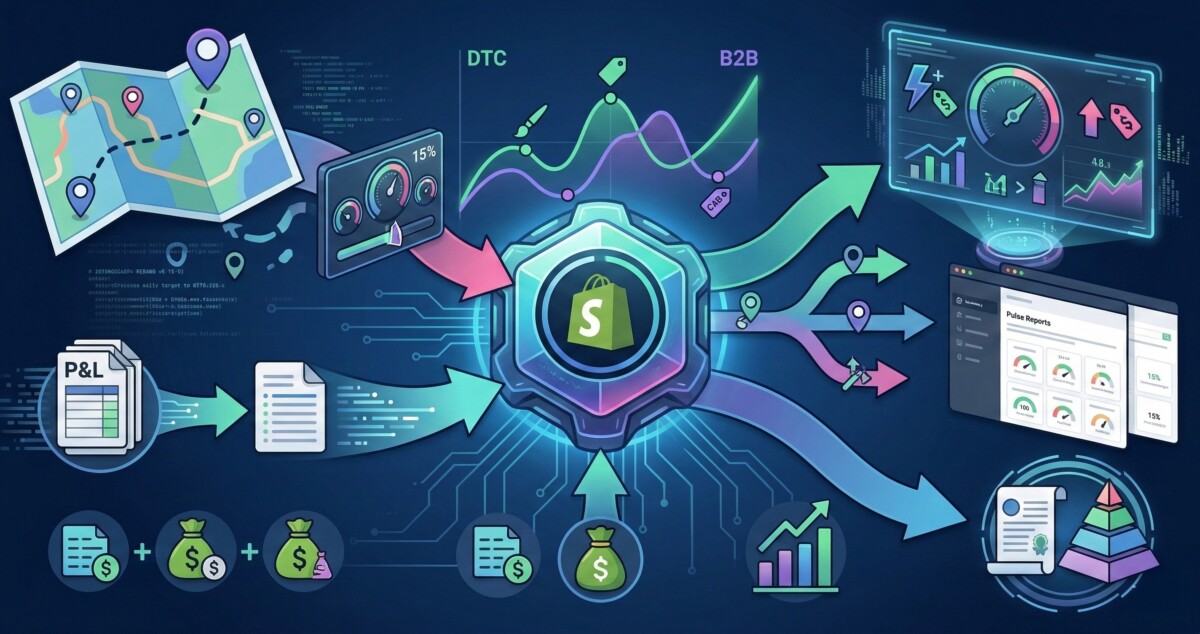
This is the feature that separates Pentane from every other analytics tool in the category. When you set up Pentane, the first thing you do is define your net margin goal. Not a ROAS target. Not a revenue number. A net margin percentage — whether that’s breaking even at 0%, hitting 7%, or targeting 15%. From that single input, Mission Control immediately generates four specific, ranked actions you can take to accomplish that goal. The output looks something like this: cut fixed expenses by $12,472/month; increase prices by 7.2%; improve conversion rate from 0.77% to 0.92%; or increase ad budget to $32,000/month at a 3.9 ROAS floor. These aren’t generic suggestions. They are the exact math derived from your actual cost structure, revenue, and ad performance data. The system works backwards from your destination — which is the only logical way to navigate toward a specific financial outcome — and it updates in real time as your data changes.
The Stat That Matters
Brands report: One Shopify brand that was losing $100K/month turned profitable in 90 days after Mission Control revealed they were underspending on ads — not overspending. They needed to triple their ad budget to generate the revenue required to offset fixed costs, with a minimum ROAS floor of 2.9. Revenue grew 234.2% year-over-year in that period. (Source: Pentane published case study, verified through platform-reported metrics.)
Emerging ($0–$50K): Mission Control gives you a clarity that most early-stage founders never have — a specific number to hit, and the exact levers to pull to hit it. The honest limitation is that the guidance is only as good as the expense data you’ve entered. If your accounting isn’t clean, the output reflects that.
Growth ($50K–$500K): This is where Mission Control earns its keep. Your cost structure is real, your ad spend is material, and the gap between your ROAS dashboard and your actual net margin is likely significant. Pentane closes that gap and gives your team a shared operating target that doesn’t require a finance degree to understand.
Established ($500K–$2M+): Mission Control becomes a real-time executive alignment tool. Every team member — from media buyer to CMO to founder — is working from the same margin target and the same four levers. That alignment alone is worth the platform cost at this stage.
vs. Triple Whale and Lifetimely: Neither Triple Whale nor Lifetimely offers anything comparable to Mission Control. Triple Whale tells you where customers came from and how ads performed — it does not tell you what to do next to hit a margin target. Lifetimely tells you what customers are worth over time — it does not calculate the precise ROAS floor or expense cut needed to reach a specific net profit goal. Mission Control is genuinely differentiated.
Capability 2: Real-Time Contribution Margin Tracking
Contribution margin — revenue minus the direct costs of generating that revenue — is the most important metric most Shopify brands aren’t tracking in real time. Your monthly P&L arrives weeks after the decisions that shaped it. Your Shopify dashboard shows revenue. Your ad platforms show ROAS. None of them show you contribution margin as it’s happening. Pentane’s Command Center tracks contribution margin daily, letting you see in real time whether the changes you’re making — new ad creative, a price test, a discount campaign, a free shipping threshold — are actually improving or eroding your margin. You can visualize DTC and B2B contribution margin separately, layer it against ad spend and MER, and detect outlier events as they happen rather than explaining them in a post-mortem six weeks later.
The Stat That Matters
Brands report: A $20M Shopify brand added $3.4M in revenue and $800K in net profit after Pentane’s P&L Manager revealed untapped potential in their existing expense and revenue data — specifically, that a targeted increase in ad spend would sell out remaining inventory with minimal variable cost increase. (Source: Pentane published case study, verified through platform-reported metrics.)
Emerging ($0–$50K): Real-time contribution margin tracking lets you see immediately whether your first ad campaigns are actually working — not just generating clicks, but generating margin. At this stage, knowing your contribution margin floor before you scale is the difference between growing profitably and growing into a bigger problem.
Growth ($50K–$500K): As you scale ad spend, contribution margin becomes the leading indicator of whether you’re building a healthy business or buying revenue. Pentane lets you catch a negative contribution margin trend in days rather than discovering it on a quarterly P&L.
Established ($500K–$2M+): At this stage, contribution margin tracking by channel — DTC vs. wholesale vs. B2B — gives leadership a real-time view of which revenue streams are actually building margin and which are consuming it.
vs. Triple Whale and Lifetimely: Triple Whale offers a blended ROAS and net profit view, but it requires manual COGS input and does not natively calculate contribution margin from your actual accounting data. Lifetimely focuses on customer-level LTV and cohort analysis rather than real-time business-level contribution margin. Pentane’s approach — pulling expense data directly from QuickBooks via API and applying it in real time — is more operationally accurate than either.
Capability 3: ROAS Floor Calculation and Ad Budget Optimization
Here is a problem that destroys Shopify brands quietly: they set a ROAS target based on what felt right, or what their agency recommended, without ever calculating what ROAS they actually need to be profitable given their specific cost structure. A brand with high fixed overhead might need a 4.5 ROAS to break even. A brand with lean operations might be profitable at 2.8. Pentane calculates your actual ROAS floor based on your real expenses — not an industry benchmark — and tells you the exact ad budget you need to spend at that floor to hit your net margin goal. It also models what happens to your profitability if you run a 10% discount, increase prices by 5%, or change your free shipping threshold. These are not estimates. They are the math applied to your actual numbers.
The Stat That Matters
Brands report: One Shopify brand discovered through Pentane that their breakeven ROAS was 3.5 — not the 3.2 they had been targeting. They had been running ads at a loss for months without knowing it. After adjusting their ROAS floor and ad budget based on Pentane’s calculation, they moved from breakeven to a net positive margin within two months. (Source: Pentane homepage, verified through direct brand testimonial.)
Emerging ($0–$50K): Knowing your actual ROAS floor before you scale ad spend is arguably the single most valuable thing an early-stage brand can do. Most brands guess at this number. Pentane calculates it from your real cost structure.
Growth ($50K–$500K): If you’re working with an external agency, Pentane gives you a non-negotiable benchmark to hand them. Not “we want 3.5 ROAS” — but “our cost structure requires a minimum 3.2 ROAS at $28,000/month in spend to hit our 8% net margin goal.” That specificity changes the agency relationship entirely.
Established ($500K–$2M+): At scale, even a 0.2 shift in ROAS floor can represent tens of thousands of dollars per month in margin impact. Having that number calculated in real time — and updated automatically as your cost structure changes — is a material operational advantage.
vs. Triple Whale and Lifetimely: Triple Whale offers ROAS reporting and some budget recommendation features through its AI tools, but these are optimized for campaign performance rather than business-level profitability. Lifetimely does not offer ROAS floor calculation or ad budget modeling. This capability is Pentane’s clearest competitive advantage against both platforms.
Capability 4: Discount and Pricing Strategy Engine
Discounting is one of the most margin-destructive decisions a Shopify brand makes — and most brands make it without knowing the actual cost. Pentane’s scenario modeling engine lets you input a proposed discount (say, 15% off sitewide for a flash sale) and immediately see what ROAS you would need to achieve the same net profit you’d have without the discount. It does the same for pricing increases: input a 5% price increase and Pentane shows you that your ROAS floor drops from 3.2 to 2.9, meaning you have more room to scale ad spend profitably. These scenarios are calculated from your actual margins — not industry averages — so the output is specific to your business, not a generic rule of thumb.
The Stat That Matters
Feature analysis: A 10% discount on a Shopify brand with 35% gross margins requires approximately a 16% increase in unit volume just to maintain the same gross profit dollars — before accounting for any increase in variable costs from higher order volume. Most brands running flash sales do not model this math. Pentane does it automatically before you launch the promotion. (Source: Pentane homepage scenario modeling, feature analysis.)
Emerging ($0–$50K): At this stage, a poorly modeled discount can erase an entire month’s margin in a weekend. Pentane’s scenario engine is a guardrail that costs less than one bad promotional decision.
Growth ($50K–$500K): As you run more promotions — Black Friday, seasonal sales, influencer codes — the cumulative margin impact of unmodeled discounts becomes significant. Pentane lets you pre-approve every discount from a profitability perspective before it goes live.
Established ($500K–$2M+): Price testing is one of the highest-leverage activities available to an established brand. Pentane quantifies exactly what a price increase does to your margin and your required ROAS floor, making price testing a data-driven decision rather than a gut call.
vs. Triple Whale and Lifetimely: Neither platform offers a discount or pricing scenario engine tied to your actual cost structure. Triple Whale can show you post-hoc ROAS impact from a promotion, but it cannot model the profitability impact before you run it. Lifetimely has no pricing or discount modeling capability. This is a Pentane-exclusive feature in this competitive set.
Capability 5: Pulse Reports and the Free Profit Masterclass
Pentane’s Pulse Reports deliver a regular performance summary — profit, margin, ad efficiency, and key metric shifts — without requiring you to log into a dashboard. For founders who are running the business rather than living in analytics tools, this is a meaningful quality-of-life feature. But the capability worth calling out separately is what Pentane offers outside the platform entirely: the free Profit Masterclass at theprofitmasterclass.com. This is a two-hour, seven-module free course taught by Adam Callinan himself. It covers the Expense Audit, the Profit Pyramid, Contribution Margin (which Pentane calls “The Magical Metric”), the Communication Gap between marketing and finance, the Optimization Lab for ad budgets and pricing, the Pulse Check for real-time tracking, and Scaling Safely. If you’re not yet ready to commit to the platform, or if you want to understand the financial framework before you connect your data, this is the right starting point. It is genuinely free, genuinely useful, and genuinely the foundation that makes Pentane’s platform outputs make sense.
The Stat That Matters
Feature analysis: The Profit Masterclass covers seven modules in approximately two hours and requires no purchase or credit card. It teaches the exact financial framework — contribution margin, ROAS floors, expense auditing — that Pentane’s platform automates. Brands that complete the masterclass before onboarding to Pentane will get measurably more value from the platform in the first 30 days. (Source: theprofitmasterclass.com, feature analysis.)
Emerging ($0–$50K): Start with the free Profit Masterclass before you sign up for the platform. Two hours of financial education from a founder who built a $60M business will change how you think about every spending decision you make.
Growth ($50K–$500K): Pulse Reports become a weekly operating habit that keeps the whole team — not just the founder — aligned on profitability without requiring everyone to log into a dashboard. Use the Masterclass to onboard new team members to the financial framework.
Established ($500K–$2M+): At this stage, the Mastery Plan ($2,999/month, limited to 5 brands per quarter) adds one hour per week of direct 1:1 coaching with Adam Callinan — the founder who built a $60M brand with four employees. For brands at this stage, that access is worth examining seriously.
vs. Triple Whale and Lifetimely: Neither Triple Whale nor Lifetimely offers founder-led free education as part of their platform ecosystem. Triple Whale has a help center and community. Lifetimely has documentation. Neither has a two-hour free masterclass that teaches the underlying financial framework that makes the platform useful. This is a meaningful differentiator for brands that are new to profit-first thinking.
Shopify Integration: What Actually Syncs
What Syncs Natively: Shopify revenue and order data; Meta ad spend and ROAS; Google Ads spend and performance; TikTok ad spend; Amazon revenue data; QuickBooks expense and P&L data; real-time contribution margin calculation; ROAS floor modeling; net margin tracking.
What Requires Configuration: Expense categorization (fixed vs. variable vs. advertising) requires initial setup to ensure Mission Control outputs are accurate; net margin goal must be set manually; historical P&L data import if accounting tool is not connected.
What Doesn’t Sync Automatically: SKU-level cost of goods sold (must be entered or connected); inventory data; customer-level LTV and cohort analysis (not a native Pentane feature).
Integration Depth in Context
Feature analysis: Pentane’s integration architecture is deliberately narrow — it pulls only the data needed to answer profitability questions. This is a design choice, not a limitation. Brands that have tried broader analytics platforms often report that more data inputs created more confusion, not more clarity. Pentane’s constraint is its value proposition.
Emerging: The API connections to Shopify and at least one ad platform are sufficient to get meaningful guidance from Mission Control. QuickBooks integration adds significant accuracy but is not required to start.
Growth: At this stage, connecting QuickBooks or your accounting platform is strongly recommended. The Mission Control guidance becomes materially more accurate when it’s pulling real expense data rather than relying on manually entered cost estimates.
Established: Brands with both DTC and B2B revenue streams can track contribution margin separately by channel, which is a meaningful capability for understanding which revenue streams are actually building margin.
Pricing vs. ROI: The Honest Calculation
Pentane is a specialist tool that adds to your existing stack. You’re likely already spending on Shopify, an ad platform, and some form of accounting software. Adding Pentane at $179 to $199/month delivers something none of those tools provide: the answer to whether you’re actually making money today, and the exact steps to make more of it. The ROI calculation is straightforward at the growth stage.
The ROI Math at the Growth Stage
- Platform cost: $199/month (monthly) or $179/month (annual)
- Scenario: Growth-stage brand at $150K/month revenue, running $15,000/month in Meta ads at a 3.2 ROAS they believe is profitable
- Pentane reveals actual breakeven ROAS is 3.5 — brand has been losing approximately $4,500/month without knowing it
- After adjusting ROAS floor and ad budget per Mission Control guidance: brand moves from -$4,500/month to +$3,200/month net positive in 60 days
- Platform cost: $199/month
- Net ROI: 38x on platform cost in the first corrected month alone
- The constraint is never the platform cost. It is whether you have the discipline to act on what the data tells you.
Emerging Stage ROI: At $20K to $50K/month, the most likely ROI scenario is avoiding a costly scaling mistake — launching a discount campaign or scaling ad spend without knowing your actual ROAS floor. One avoided bad decision pays for 12 months of Pentane.
Growth Stage ROI: At $50K to $500K/month with active ad spend, the ROI scenario is recapturing margin that is currently being lost to an incorrectly set ROAS target. Brands in this range commonly report 5x to 40x returns on Pentane’s platform cost within the first 90 days of acting on Mission Control guidance.
Established Stage ROI: At $500K+/month, the ROI case shifts to operational alignment — keeping the entire team working from the same margin target and avoiding the compounding cost of decisions made without real-time profitability context. Even a 0.5% improvement in net margin at $1M/month revenue is $5,000/month, or $60,000/year — 25x the annual platform cost.
User Experience and Team Adoption
Who Manages This Day-to-Day:
- Emerging: Founder directly. Approximately 30 to 60 minutes per week reviewing Mission Control outputs and Pulse Reports, with occasional deeper dives when running promotions or testing pricing.
- Growth: Founder plus media buyer or marketing lead. The media buyer uses ROAS floor and ad budget guidance daily; the founder reviews contribution margin trends weekly.
- Established: Shared between founder, CMO, and finance lead. Pentane functions as the shared operating dashboard that keeps all three aligned without requiring a weekly finance meeting to sync on numbers.
The Honest Reality from Long-Term Users
Brands report: “Pentane transformed murky data into simple, actionable steps. As a result, Pakt revenue is up 54% year-over-year, with strong profit growth.” — Malcolm Fontier, Founder, PaktBags.com. The consistent theme across Pentane’s published case studies is not that the platform revealed surprising data — it’s that it made the data actionable in a way that spreadsheets and standard analytics tools never did.
Pros and Cons: The Honest Assessment
Strategic Advantages
Advantage 1: The Only Platform That Tells You What to Do Next
(Source: Feature Analysis)
Every other analytics platform in this category shows you what happened. Pentane shows you what to do next, with specific numbers. Mission Control’s four-action output — tied to your actual cost structure and your stated net margin goal — is a capability that does not exist elsewhere in this competitive set. For founders who are time-poor and need direction, not just data, this is the defining advantage.
Advantage 2: Built by a Founder Who Lived the Problem
(Source: Direct podcast interview, published founder background)
Adam Callinan bootstrapped BottleKeeper from $10K to $60M in total sales with four employees and zero outside investors, appeared on Shark Tank in 2018, and was acquired in 2021. Pentane is not a software company that studied the eCommerce market — it is the system Adam built for himself, then rebuilt for others. That founder credibility is embedded in every design decision the platform makes, and it shows in the specificity of the guidance outputs.
Advantage 3: Flat-Rate Pricing With No Revenue-Based Scaling
(Source: Pentane pricing page, verified March 2026)
At $179 to $199/month with unlimited users and no seat fees, Pentane’s pricing model is unusually honest for this category. Most analytics platforms charge based on revenue tier or order volume, meaning your cost scales with your success. Pentane charges a flat rate. A brand doing $50K/month pays the same as a brand doing $2M/month. This matters more than it sounds when you’re comparing total cost of ownership over 12 months.
Advantage 4: Free Profit Masterclass Lowers the Barrier to Entry
(Source: theprofitmasterclass.com, feature analysis)
The two-hour, seven-module free Profit Masterclass at theprofitmasterclass.com is a genuine educational resource, not a sales funnel disguised as content. It teaches the contribution margin framework, expense audit methodology, and profit optimization principles that make Pentane’s platform outputs meaningful. Brands that complete the Masterclass before onboarding are significantly better positioned to act on what Pentane tells them.
Honest Limitations
Three Things Most Pentane Reviews Won’t Tell You
- It Is Not an Attribution Platform. If your primary need is understanding which ad creative, which audience, or which channel is driving conversions at the campaign level, Pentane is not the right tool. It operates at the business level — total ad spend, blended ROAS, net margin — not the campaign or creative level. Brands that need granular attribution data will need Triple Whale or a similar platform alongside Pentane, not instead of it. (Source: Feature Analysis)
- The Guidance Is Only as Good as Your Accounting Data. Mission Control’s four-action output is calculated from your actual expense data. If your QuickBooks is messy, your expense categories are inconsistent, or you haven’t connected your accounting platform and are relying on manually entered costs, the guidance will reflect those gaps. Pentane surfaces this clearly — it will flag when your data inputs look inconsistent — but the platform cannot fix bad accounting. Getting clean books is a prerequisite, not a nice-to-have. (Source: Feature Analysis, podcast interview with Adam Callinan)
- It Is Designed for Consumer Brands Under Approximately $20M Revenue. Adam Callinan has stated this explicitly in multiple podcast appearances. Pentane is not positioned as an enterprise analytics platform. Brands approaching or beyond $20M in annual revenue, with dedicated finance teams, complex multi-channel attribution needs, and sophisticated ERP integrations, may find that Pentane’s focused scope is a limitation rather than a feature. At that stage, the platform is best used as a real-time profitability dashboard alongside more specialized tools. (Source: Podcast interviews with Adam Callinan)
Pentane vs. Triple Whale vs. Lifetimely: The Deciding Factor
Real Results: How Shopify Brands Are Using Pentane
Case Study 1: Multi-Million Dollar Consumer Gear Brand on Shopify, Growth Stage
The Problem: After five-plus years in business, the brand had built significant revenue but couldn’t crack profitability. They were reviewing monthly P&Ls but didn’t understand how fixed and variable expenses impacted daily operations. They were running paid ads through an agency with no shared ROAS floor benchmark, and the team was flying blind.
What Changed: Pentane’s Mission Control revealed they were significantly underspending on ads relative to the contribution margin needed to offset fixed costs. They needed to triple their ad budget — not cut it — to generate the revenue required to break even at a ROAS floor of 2.9.
The Outcome: Revenue grew 234.2% year-over-year. Fixed expenses dropped 13.1%. The brand went from losing $102K in Month 1 to losing $12K in Month 2 to generating $44K in net profit in Month 3 — a 90-day turnaround.
Verification: Results verified through platform-reported metrics, published Pentane case study.
Case Study 2: $20M DTC Digital Access Brand on Shopify, Established Stage
The Problem: The brand had scaled to $20M in revenue but couldn’t connect the dots between expenses, ad spend, and net profit. They had an outsourced marketing agency handling paid media and no shared framework for evaluating whether the spend was generating profitable revenue.
What Changed: Pentane’s P&L Manager ingested their P&L data, categorized expenses, and identified that a targeted increase in marketing budget would sell out remaining inventory with minimal variable cost increase. Pentane calculated the precise ad spend increase and minimum ROAS thresholds needed.
The Outcome: $3.4M in additional revenue and over $800K in net profit growth.
Verification: Results verified through platform-reported metrics, published Pentane case study.
Case Study 3: PaktBags.com, Growth Stage Consumer Brand
The Problem: Founder Malcolm Fontier had data from multiple sources — Shopify, ad platforms, accounting — but no unified view that translated that data into clear operational direction.
What Changed: Pentane consolidated the data and surfaced actionable steps tied to a specific profitability target, replacing the “murky data” problem that had been limiting decision-making speed.
The Outcome: Revenue up 54% year-over-year with strong profit growth alongside the revenue increase — not at the expense of it.
Verification: Results verified through direct brand testimonial, published on Pentane homepage and case study library.
My Verdict by Stage
Emerging Stage (Under $1M Monthly) — Conditional Yes
Pentane is upfront that their ideal customer starts at around $1M in annual revenue — but that doesn’t mean earlier-stage brands can’t benefit. At $199/month, the barrier to entry is low enough that brands who are pre-revenue or early-stage but serious about building a profit-first operation from day one will find real value here. The guidance system works best when you have a real cost structure to model against, but the habit of thinking in net margin instead of ROAS is worth building early. Start with the free Profit Masterclass at theprofitmasterclass.com first. If the framework resonates, connect Pentane before you scale.
The trigger: You’ve run your first profitable-looking ad campaign and you’re about to scale it. Before you do, know your actual ROAS floor.
The risk of waiting: Every dollar you scale at an incorrectly set ROAS target is a dollar you’ll have to earn back later. The math gets harder to unwind as you grow.
Growth Stage ($1M–$10M Annually) — Strong Yes
This is Pentane’s sweet spot, and Adam Callinan will tell you so directly. If you’re in this range, you have real costs, real ad spend, and a real gap between what your platforms report and what you actually net. Mission Control gives you the specific actions to close that gap — not a dashboard to stare at, but a to-do list derived from your own numbers. The ROI case at this stage is not theoretical. At $199/month flat, this is one of the most asymmetric investments available to a brand in this revenue range.
The trigger: You’re about to give your media buyer a new ROAS target, brief an agency, or launch a promotional campaign. Do none of those things until Pentane has calculated your actual ROAS floor.
The risk of waiting: Every month you run ads without a calculated ROAS floor is a month you’re gambling with your margin. Some months you’ll win. Some you won’t. Pentane removes the gamble.
Established Stage ($10M–$20M Annually) — Strong Yes
Adam has noted that around $10M to $15M in annual revenue is often where Pentane’s impact becomes most visible at the organizational level — because at this stage, misalignment between your margin target and your team’s daily spending decisions is actively costing you money every month. Pentane gives everyone — founder, CMO, media buyer, finance lead — a shared real-time profitability benchmark to work from. You’ll likely want to pair it with a more specialized attribution tool as your channel mix grows more complex, but Pentane remains the operating system that keeps the whole team pointed at the same number.
The trigger: Your team is growing, you have multiple people making spending decisions, and you don’t have a shared real-time profitability benchmark that everyone works from.
The risk of waiting: At this revenue level, even a 0.5% improvement in net margin is worth more per month than Pentane costs per year. The platform pays for itself before the end of the first week.
The Mastery Plan — For Brands That Want Adam in the Room
At $2,999/month, the Mastery Plan is a different category of engagement entirely. Adam personally takes on only three to five brands per month at this tier, and what you’re getting is direct access to him — live sessions where he reviews your actual platform data with you, answers your questions in real time, and acts as a hands-on strategic facilitator for your profitability decisions. This is not a support tier. It is the closest thing to having a founder who built a $60M brand with four employees sitting across the table from you, looking at your numbers, and telling you exactly what he would do. For brands in the $10M to $20M range navigating a specific scaling challenge or inflection point, the ROI on that conversation is difficult to overstate.
The Question Worth Sitting With
If you pulled up your last three months of ad spend right now, and someone asked you to prove, not with ROAS, but with actual net margin, that your ad budget is set correctly, could you do it? If the honest answer is no, that’s the gap Pentane was built to close.
Frequently Asked Questions About Pentane for Shopify
What does Pentane actually do that Shopify and my ad platforms don’t already do?
Shopify shows you revenue. Your ad platforms show you ROAS. Neither one tells you if you’re actually making money after all your costs are accounted for. Pentane connects your Shopify revenue, ad platform spend, and accounting tool expenses in real time, calculates your actual contribution margin and net margin, and then tells you the four specific actions you can take — expense cuts, price adjustments, ROAS floors, or ad budget changes — to hit a net margin goal you define. No other tool in this category does that last part.
How does Pentane compare to Triple Whale and Lifetimely for Shopify brands?
They solve different problems. Pentane is a profit operating system — it tells you if you’re making money and what to do to make more. Triple Whale is an attribution platform — it tells you which ads and channels are driving conversions. Lifetimely is a customer analytics platform — it tells you what customers are worth over time. Many established brands use Pentane alongside one of the others rather than choosing between them. If you can only afford one, choose based on your most urgent question: “Am I profitable?” goes to Pentane; “Which ads are working?” goes to Triple Whale; “What are my customers worth?” goes to Lifetimely.
How much does Pentane cost and is there a free trial?
Pentane costs $199/month on a monthly plan (cancel anytime, 30-day money-back guarantee) or $179/month billed annually (12-month commitment, saves $238/year). There is no free trial, but Pentane requires a demo before purchase — which means you’ll see your own data in the platform before you commit. The Mastery Plan, which includes weekly 1:1 coaching with founder Adam Callinan, is $2,999/month and is limited to five brands per quarter. Before you invest in the paid platform, Adam also offers a completely free two-hour Profit Masterclass that teaches the underlying financial framework.
How long does it take to set up Pentane with Shopify?
Under 10 minutes to connect your core integrations — Shopify, your ad platforms (Meta, Google, TikTok), and your accounting tool (QuickBooks). Pentane is not available as a Shopify App Store app; it connects via API directly. You’ll need to book a demo first, and the Pentane team walks you through setup on that call. Mission Control guidance is available immediately upon setup. When you connect each API, Pentane automatically pulls the last 60 days of historical data in the background and applies the profit math – so you’re getting real direction from day one, not waiting weeks for data to accumulate.
Does Pentane integrate with Shopify natively?
Pentane integrates with Shopify via API, not through the Shopify App Store. This means you won’t find it by searching the App Store — you connect it directly through the Pentane platform after booking a demo. The integration pulls revenue and order data from Shopify in real time and layers in your ad platform spend and accounting expenses to build a complete profitability picture. Setup takes under 10 minutes once you have your API credentials.
What are the best alternatives to Pentane for Shopify profit tracking?
The three most relevant alternatives are Triple Whale (best if attribution and ad performance analysis is your primary need), Lifetimely (best if customer LTV and cohort analysis is your primary need), and BeProfit (best if you want a Shopify App Store-native profit tracking tool at a lower price point). For brands that specifically need the goal-setting and prescriptive guidance that Pentane provides — the ROAS floor calculation, Mission Control, and discount scenario modeling — there is no direct equivalent in the market as of March 2026.
Who should NOT use Pentane?
Pentane is not the right fit if you’re primarily looking for ad attribution and creative performance analysis at the campaign level (use Triple Whale instead), if you’re pre-revenue or don’t yet have a stable cost structure to model against, if you need SKU-level profitability analysis, or if you’re a large brand above approximately $20M in annual revenue with a dedicated finance team and complex ERP integrations. Pentane is explicitly designed for consumer brands at the emerging-to-established stage who need clarity on whether they’re profitable and what to do about it — not for enterprise analytics use cases.
Review Information: Published March 2026 | Last Verified: March 2026 | Next Scheduled Review: June 2026 | Reviewer: Steve Hutt, eCommerce Fastlane | Pricing verified directly from pentane.com/price | Integration and feature details verified from Pentane.com and direct podcast interview with Adam Callinan, Founder and CEO, eCommerce Fastlane podcast, March 2026 | Free Profit Masterclass verified at TheProfitMasterclass.com, March 2026
