





Most DTC founders are drowning in operational tasks that eat 3-4 hours daily—work an AI agent could handle in five minutes.
Analyzing support tickets to spot quality issues. Segmenting customers based on purchase behavior. Manually searching Instagram for potential brand ambassadors among your top spenders. These tasks absolutely matter for your business, but they’re the repetitive grind keeping you stuck in the weeds instead of working on high-leverage strategy that actually drives growth.
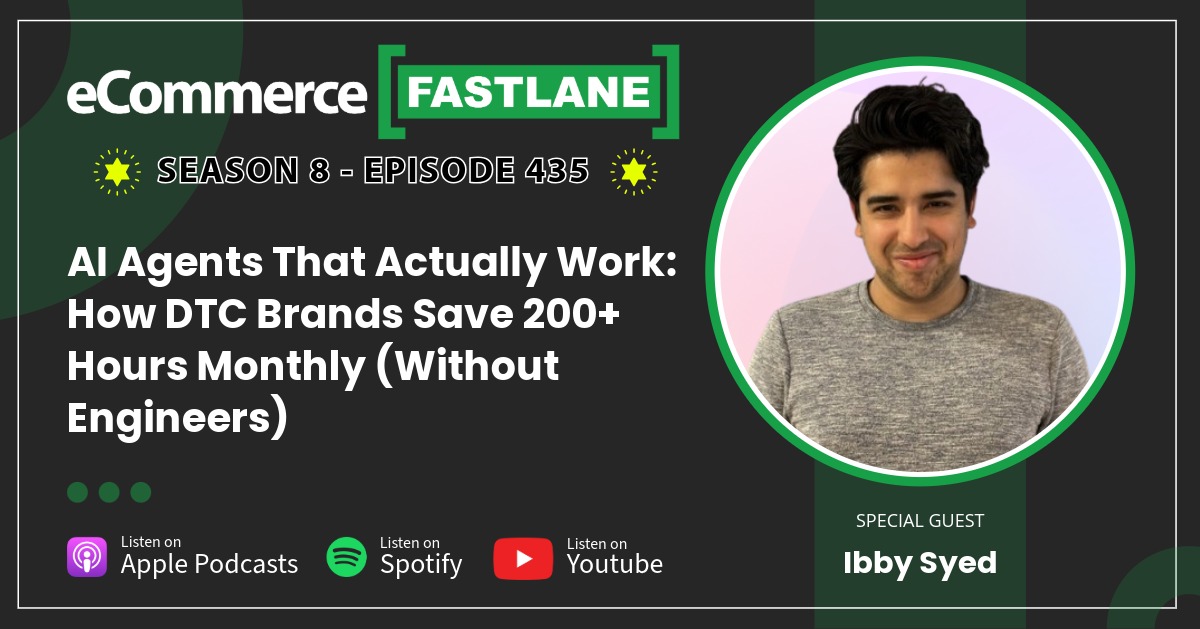
The AI conversation in ecommerce has gotten noisy, with everyone slapping an “AI-powered” badge on their tool. But there’s a massive gap between AI hype and AI that actually does meaningful autonomous work without constant hand-holding. Ibby Syed built his career at the center of that gap as one of the first data scientists at Peloton during their explosive growth phase. He watched DTC brands scale rapidly while their customer data scattered across dozens of disconnected tools, and he saw the painful disconnect between what marketers needed—actionable insights, now—and what data scientists delivered: complex models five months later.
That experience led him to co-found Cotera, an AI platform that builds truly autonomous agents—not chatbots requiring constant prompting, but agents that work like having a team of interns who execute the exact process you’d give a human team member. Whether you’re manually reviewing support tickets, identifying customers about to churn, or figuring out which top spenders could become brand ambassadors, this conversation breaks down how autonomous agents can handle the repetitive work currently consuming your day.
Let’s dive in.
What You’ll Learn
✅ Why the traditional data science workflow is broken for marketers — and how the five-to-six-month gap between “I need a churn prediction model” and “here’s a file full of technical details” creates a disconnect that keeps brands from acting on customer data in real time.
✅ The difference between chatbots and truly autonomous agents — understanding why tools that require constant prompting and manual stitching are fundamentally different from agents that execute complex workflows independently once you’ve defined the process, just like delegating to a well-trained team member.
✅ How to turn high-value customers into brand ambassadors systematically — the exact workflow one D2C fitness brand used to have AI agents research their top 5% of spenders on Instagram and Google, identify those with engaged followings, and automatically flag them for influencer outreach—work that would take human interns months to complete manually.
✅ The three-part framework for building effective AI agents — starting with defining your process in plain language (like writing an email to an intern), giving the agent access to the right tools (Instagram, Google, your ESP), and ensuring clean data inputs so the agent can execute without garbage-in, garbage-out failures.
✅ Where humans add value in an AI-augmented operation — why the real opportunity isn’t about replacing jobs but elevating teams from repetitive grunt work to high-leverage strategic decisions, creative problem-solving, and the customer experience “magic” that AI can’t replicate.
✅ Why AGI isn’t coming anytime soon — a reality check from someone spending hours daily getting AI agents to execute basic tasks properly, and why the current state of AI technology means humans will remain essential for strategic thinking, nuanced judgment calls, and adaptive decision-making for the foreseeable future.
Episode Sponsor: Littledata

The Data Layer for Shopify.
Powering acquisition, retention and analytics with conversion tracking you can trust.
Littledata gives you a reliable data infrastructure that connects your Shopify store with the marketing tools you already use, including:
- Google and Meta Ads for a stronger signal and attribution
- Klaviyo and Attentive for enriched customer flows
- Google Analytics for accurate revenue and event tracking
- Recharge for complete customer lifecycle visibility
Fast to set up. Effortless to maintain. Built to scale with your brand.
Join 2,000+ Shopify brands using Littledata as their foundation for growth.
Episode Summary
Steve welcomes Ibby Syed, Co-Founder of Cotera, for a conversation about the gap between AI hype and AI that’s actually doing autonomous work for ecommerce operations. Ibby brings a unique perspective as one of Peloton’s first data scientists, where he watched DTC brands scale rapidly while their teams drowned in manual work analyzing scattered customer data across disconnected tools. That experience showed him exactly where the traditional data science workflow breaks down—marketers ask for actionable insights they can implement in Klaviyo or Braze, but data scientists disappear for five to six months and return with complex model files nobody knows how to action.
The conversation centers on what makes autonomous agents fundamentally different from chatbots or query-based AI tools. Ibby breaks down the framework: instead of constantly prompting a tool or duct-taping together multiple platforms, you define a process in plain language (exactly like writing instructions to an intern), give the agent access to relevant tools (Instagram, Google, your customer data), and let it execute independently. He shares a compelling example—a D2C fitness brand wanted to identify which of their top 5% spenders could become brand ambassadors. The traditional approach would require a team of interns manually researching each customer on Instagram, checking their follower counts and fitness content, then reaching out individually—work that would take months. With Cotera’s autonomous agent, they defined the process once, gave it access to Instagram and Google, fed it their high-value customer list, and the agent completed months of research work in five minutes.
Ibby explains why the human role shifts rather than disappears in an AI-augmented operation. The repetitive work—analyzing support tickets, categorizing returns, segmenting customers based on purchase patterns—gets automated, but humans elevate to high-leverage strategic decisions, creative problem-solving, and building the memorable customer experiences that drive long-term loyalty. He uses the ATM analogy effectively: when ATMs were invented, people predicted massive job losses in banking, but what actually happened was humans got liberated from counting cash and moved into more valuable advisory and relationship roles. The banking sector employs more people today than before ATMs existed because the efficiency gains funded business growth and created new opportunities.
The conversation closes with a reality check on AGI (artificial general intelligence). Despite the hype suggesting AI will soon replace human strategic thinking entirely, Ibby spends his days wrestling with getting AI agents to execute basic tasks correctly. Current AI technology augments human capabilities powerfully for defined, repeatable workflows, but nuanced judgment, adaptive problem-solving, and strategic creativity remain firmly in human territory. This isn’t a story about AI replacing your team—it’s a blueprint for multiplying what your team can accomplish by automating the grind and elevating everyone to higher-value work.
Strategic Takeaways
👉 Define your AI agent workflows exactly like you’d delegate to a human team member. Write out the process in plain language as if you’re sending an email to an intern—step by step, with clear decision points and expected outcomes. The breakthrough with autonomous agents isn’t technical complexity; it’s being able to articulate your business logic clearly enough that an agent can execute it independently without constant supervision.
👉 Focus AI automation on high-frequency, low-complexity tasks first. Don’t start by trying to automate your most strategic decisions. Instead, identify the repetitive work your team does daily—analyzing support tickets for common issues, categorizing return reasons, segmenting customers based on purchase patterns—and build agents for those workflows. These are the tasks where saving 3-4 hours daily compounds into massive efficiency gains without requiring perfect accuracy on every decision.
👉 Give your AI agents the right tools, not just the right data. An agent analyzing customer churn needs access to your ESP for engagement data, your support platform for ticket history, and your Shopify store for purchase patterns. Think about what a human would need to do the job properly, then ensure your agents have those same integrations. Half-connected agents produce half-useful results, regardless of how sophisticated the underlying AI model is.
👉 Shift your team’s mindset from task execution to process design. The marketers who’ll thrive in AI-augmented operations aren’t the ones protecting their current workflows—they’re the ones who get comfortable defining processes, testing agent outputs, and iterating on automation. Start using these tools now, even imperfectly, because the skill isn’t in doing the work anymore; it’s in orchestrating the systems that do the work at scale.
👉 Measure AI ROI in time saved, then reinvest that time strategically. If your team saves 15-20 hours weekly by automating ticket analysis, returns categorization, and customer research, that’s not a license to reduce headcount—it’s fuel for growth. Redeploy those hours into strategic initiatives: launching new customer segments, testing creative campaign concepts, building deeper customer relationships. Companies that use AI savings to fund growth will outpace those that use it purely for cost reduction.
👉 Set realistic expectations about what current AI can and can’t do. Despite the hype, AGI isn’t around the corner. Current AI agents excel at executing defined, repeatable workflows but struggle with nuanced judgment calls, adaptive problem-solving, and strategic creativity. Don’t wait for perfect AI that replaces human thinking—deploy good-enough AI that handles repetitive work today, freeing your humans to do the strategic work that actually differentiates your brand.
Guest Spotlight
Ibby Syed
Co-Founder, Cotera
Ibby Syed co-founded Cotera after serving as one of Peloton’s first data scientists during the company’s explosive growth phase. Watching DTC brands scale rapidly through the COVID-era surge, he saw a pattern repeat itself: marketing teams would request a churn prediction model or customer segmentation tool, data scientists would disappear for five to six months building the “perfect” solution, and they’d return with complex technical files that nobody knew how to actually implement in Klaviyo or Braze. The disconnect wasn’t about capability—it was about translation.
That gap became Cotera’s founding insight. Ibby realized marketers already knew the business logic they needed—they just lacked a way to execute it at scale without hiring engineering teams or waiting months for custom models. His vision was simple: what if you could write instructions to an AI agent exactly like you’d delegate to an intern, give it access to the right tools, and let it execute complex workflows autonomously? No PhDs required. No five-month build cycles. Just clear process definition and smart automation.
Cotera launched with a mission to save humanity billions of hours currently wasted on repetitive operational work. The platform has already saved over 80 million hours of manual labor, with a goal to reach 5 billion hours in the next few years. But Ibby’s philosophy isn’t about replacing humans—it’s about elevation. He believes the future of work isn’t “AI versus humans” but rather “humans freed from grunt work to focus on strategy, creativity, and the customer experience magic that builds lasting brands.” His daily reality wrestling with AI agents to execute basic tasks properly keeps him grounded: AGI isn’t coming anytime soon, which means the real opportunity is augmentation, not replacement.
Connect with Ibby:
LinkedIn | Cotera Website
Links & Resources
Connect with Ibby & Cotera:
- Cotera — AI platform for building autonomous agents for ecommerce operations
- Ibby Syed on LinkedIn
Platforms & Tools Mentioned:
- Shopify — Ecommerce platform for DTC brands
- Klaviyo — Email and SMS marketing platform
- Braze — Customer engagement platform
- ChatGPT — AI tool for testing automation workflows
- Claude — AI assistant mentioned for marketing tasks
- Perplexity — AI search tool for research and competitor analysis
- Google Gemini — AI platform mentioned as an alternative tool
Brands Referenced:
- Coterie Baby — DTC baby product brand (acquired by Mammoth Brands) that uses Cotera for brand monitoring and customer experience
Thanks for Supporting the Pod!
Over the past eight seasons, I’ve been incredibly lucky to chat with some of the brightest founders in ecommerce building remarkable Shopify brands and partners shaping the app and marketing ecosystem. Honestly, every conversation has taught me something new, and I’m grateful for the chance to learn alongside you.
What matters most is that this podcast helps you solve real challenges and unlock new growth for your business. Your support, feedback, and stories have made this journey truly special. Thanks for tuning in, sharing your wins and losses, and being part of the eCommerce Fastlane community.
- Leave an Honest Rating/Review: Share your thoughts on Apple Podcasts or Spotify.
- Follow & Subscribe on YouTube: Get notified about new episodes on YouTube.
Contact Steve
