




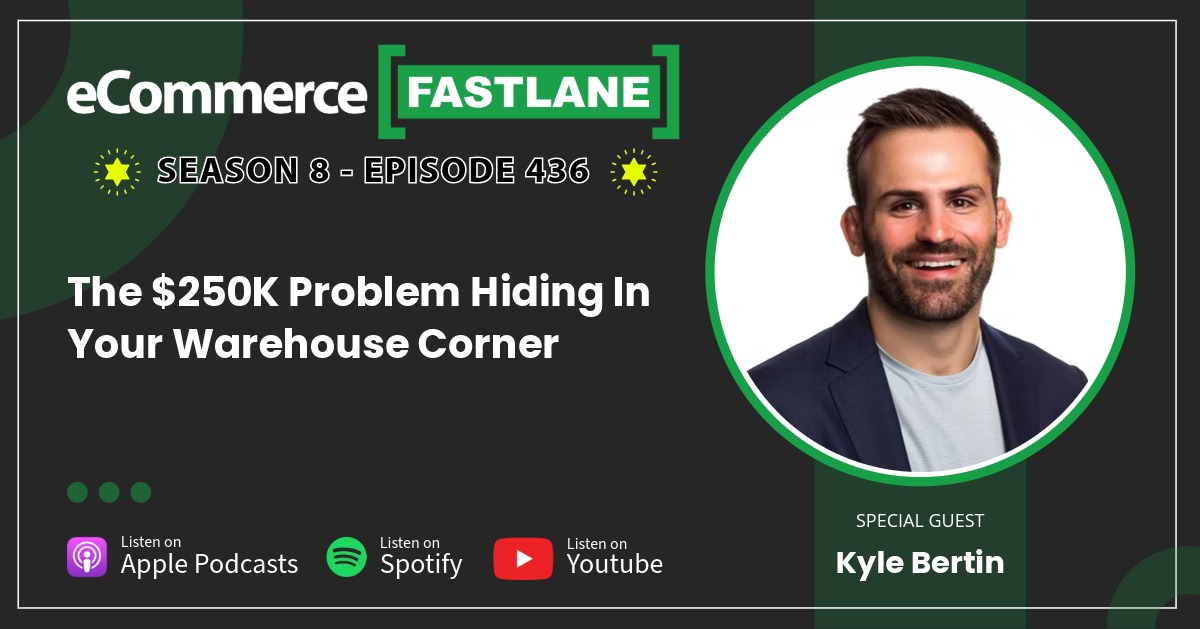
Here’s what most founders don’t realize until they’re deep into scaling: for every million dollars in sales you do, roughly $250,000 of that product is coming back to your warehouse.
And while you’re laser-focused on conversion rates, CAC, and ROAS, there’s an entire chaos corner in your fulfillment center where margins go to die.
Kyle Bertin discovered this problem the hard way—not as a merchant, but while touring fulfillment centers across North America for Outrider, an autonomous vehicle company. The pattern was impossible to miss: 90% of these massive facilities were pristine operations with robotics, automation, and gamified productivity systems. Then he’d turn the corner—always the corner—and find the returns section. Messy, manual, and staffed by visibly unhappy workers armed with nothing but Google Sheets trying to make split-second decisions about whether items were resellable, damaged, or fraudulent returns.
After the fifth or sixth warehouse tour showing the exact same dysfunction, Kyle realized even the most well-funded enterprise logistics companies couldn’t solve this problem. That realization led him to co-found Two Boxes, a return processing platform that uses AI and machine learning to automate the decisions that most brands are still making manually—if they’re making them at all. With Q4 volume hitting warehouses and January-February being what Kyle calls “the Super Bowl for returns” (brands see 50-500% spikes in return volume), this conversation couldn’t be more timely.
Let’s dive in.
What You’ll Learn
✅ The hidden margin killers in your return flow — beyond shipping and processing fees, you’re bleeding profitability through inventory tied up in transit, items incorrectly condition-graded, delayed restocking that costs you sales, and fraud you’re not detecting because warehouse workers are making snap judgments with zero data.
✅ Why your fulfillment team dreads the “returns corner” — while forward fulfillment is gamified and optimized with technology, returns processing feels like stepping back 30 years—opening mystery boxes, trying to determine if items are Grade A or damaged, logging everything in Excel, all while customers want instant refunds and your inventory sits in limbo.
✅ How Two Boxes uses AI to make the resellability decision in real-time — their platform integrates with your Shopify store in five minutes (seriously—five minutes), pulls order history and return patterns, and gives warehouse workers clear AI-powered guidance on whether items should be restocked, sent to liquidation, flagged as fraud, or routed for exchanges.
✅ The post-BFCM returns tsunami nobody prepares for — January and February see 50-500% increases in return volume as holiday purchases flood back to warehouses, and brands that don’t have systems in place are about to learn expensive lessons about why return processing isn’t just a customer service issue—it’s a P&L issue.
✅ Why returns are actually inventory opportunities, not just costs — processed correctly, returns reveal product quality issues, fraud patterns, and exchange opportunities that can save the sale, but most brands treat them as an afterthought instead of a strategic revenue recovery channel that deserves the same technology investment as forward fulfillment.
✅ The 25% rule and what it means for your P&L — with online sales seeing 17-25% return rates ($800-900 billion annually), every founder needs to understand the true cost structure: RMA software, shipping both ways, warehouse labor, delayed restocking, fraud losses, and the customer experience impacts of sending damaged goods because returns weren’t properly condition-graded the first time.
Episode Sponsor: Littledata

The Data Layer for Shopify.
Powering acquisition, retention and analytics with conversion tracking you can trust.
Littledata gives you a reliable data infrastructure that connects your Shopify store with the marketing tools you already use, including:
- Google and Meta Ads for a stronger signal and attribution
- Klaviyo and Attentive for enriched customer flows
- Google Analytics for accurate revenue and event tracking
- Recharge for complete customer lifecycle visibility
Fast to set up. Effortless to maintain. Built to scale with your brand.
Join 2,000+ Shopify brands using Littledata as their foundation for growth.
Episode Summary
Steve welcomes Kyle Bertin, Co-Founder and CEO of Two Boxes, for a conversation about the reverse logistics problem that most Shopify brands are completely overlooking—what actually happens after a return hits your warehouse. With returns representing 17-25% of online sales (an $800-900 billion market annually), the math is brutal: for every million dollars in sales, roughly $250,000 worth of product is flowing back through your fulfillment center, and how you process those returns directly impacts your margins, customer experience, and bottom line.
Kyle’s origin story is fascinating. While working at Outrider, a company building autonomous yard trucks for logistics facilities, he spent months touring fulfillment centers across North America. The pattern was impossible to ignore: these massive, sophisticated operations with state-of-the-art robotics and automation would have one consistent weak spot—the returns section, always tucked in a corner, where technology disappeared and chaos reigned. Workers armed with nothing but Google Sheets were making split-second decisions about whether items were resellable or damaged, all while dealing with messy, sometimes worn or stained products that customers had returned. By the fifth or sixth facility—including some of the largest and best-funded logistics operations on the planet—Kyle realized this was a massive unsolved problem worth tackling.
The conversation digs into the hidden costs most brands miss. Yes, you’re paying for RMA software, return shipping, and warehouse processing fees—those are your first-order costs. But the real margin killers are the second-order effects: inventory tied up in transit that can’t be sold, items condition-graded incorrectly (either marked damaged when they’re sellable, or worse—restocked when they’re damaged, leading to customers receiving defective goods), fraud that goes undetected because workers have no data to verify returns, and the opportunity cost of delayed restocking during peak selling periods. Kyle shares how one apparel company he visited in California had an entire 40-foot container arriving every few days filled with returns, with dedicated staff using steamers and manual inspection processes just to triage what could be resold.
Two Boxes solves this with AI-powered decision support that integrates directly with Shopify stores in what Kyle claims is a five-minute setup process. The platform pulls order history, return patterns, and product data to give warehouse workers real-time guidance on how to process each return—whether it should go back to stock, get routed for exchange, be sent to liquidation, or be flagged as potential fraud. January and February are “the Super Bowl for returns,” with most merchants seeing 50-500% increases in return volume as holiday purchases flood back. Kyle’s team onboarded 25 brands last December alone, proving it’s not too late to get systems in place before the post-BFCM wave hits.
The bigger opportunity? Returns are inventory intelligence most brands ignore. Properly processed returns reveal product quality issues, help detect fraud patterns, and create chances for exchanges that save the sale instead of losing the customer entirely. But most brands treat returns as an afterthought, dedicating massive technology investments to forward fulfillment while leaving reverse logistics stuck in spreadsheet hell.
Strategic Takeaways
👉 Treat returns as a P&L line item, not just a customer service problem. If 20-25% of your sales are coming back, that’s a material impact on profitability. The brands that win measure first-order costs (shipping, processing fees) alongside second-order impacts (inventory delays, fraud losses, incorrect condition grading). Run the math: what does $250K in returned product actually cost you in direct expenses and opportunity cost from delayed restocking?
👉 The post-BFCM returns tsunami is predictable—prepare now. January and February consistently see 50-500% spikes in return volume as holiday purchases flood back. If your returns process is already manual and chaotic during normal months, it’s about to become unmanageable. Brands that win install proper systems in December (Two Boxes does it in five minutes for Shopify stores) rather than firefighting through Q1 with overwhelmed warehouse staff and mounting customer complaints.
👉 Manual processing with Google Sheets is bleeding margin. When warehouse workers make snap decisions without access to order history, return patterns, or fraud indicators, errors cascade through your operation. Items get marked damaged when they’re fine (lost revenue). Items get restocked when they’re defective (angry customers). Fraud goes undetected because there’s no systematic flagging. Technology exists to solve this—use it.
👉 Your fulfillment team’s happiness directly impacts returns quality. The “returns corner” is universally dreaded—messy manual work with used products while forward fulfillment gets gamification and automation. Unhappy workers making rushed decisions with poor tools make more errors. Investing in better returns processing technology creates systems that help your team make better decisions under pressure.
👉 Returns reveal patterns that forward-looking metrics miss. A properly instrumented returns system shows you which products have quality issues (high return rates for specific SKUs), which customer segments are return-prone, and which returns look fraudulent (wrong items returned, excessive frequency). This intelligence feeds product development, marketing targeting, and fraud prevention—but only if you’re capturing the data instead of just processing boxes.
👉 The exchange opportunity is massive and most brands miss it. When a customer initiates a return, that’s not automatically a lost sale—it’s a chance to save the transaction through exchange. But you need systems that make exchanges easy for warehouse staff to process and for customers to request. Brands that treat returns strategically turn potential losses into retained revenue through proactive exchange programs and better customer experience.
Guest Spotlight
Kyle Bertin
Co-Founder & CEO, Two Boxes
Kyle Bertin co-founded Two Boxes after an unexpected discovery while working at Outrider, where he helped integrate autonomous vehicle solutions into logistics operations. His job required touring fulfillment centers across North America—a role that exposed him to one of e-commerce’s most persistent problems.
The pattern was impossible to miss: sophisticated operations with cutting-edge robotics and automation consistently had one dysfunctional weak spot—the returns section. Tucked in corners, staffed by unhappy workers armed with Google Sheets, and completely devoid of the technology powering the rest of the facility, these “returns corners” represented a massive opportunity. If even the largest enterprise 3PLs and retailers couldn’t solve this, Kyle saw real demand for a solution.
He dove deep into understanding why returns processing remained so broken. The answer was a perfect storm: returns are unpredictable (you don’t know what condition items arrive in), they require human judgment (is this resellable or damaged?), and brands treat them as an afterthought despite returns representing 17-25% of online sales—an $800-900 billion annual market. Two Boxes emerged as Kyle’s answer: an AI-powered platform that integrates with Shopify stores and gives warehouse workers real-time decision support on how to process each return.
What makes Kyle’s perspective valuable isn’t just the technology—it’s his genuine commitment to merchant success. He emphasizes that even if Two Boxes isn’t the right fit, founders should still be thinking strategically about returns as a P&L issue, not just a customer service inconvenience. His offer to provide advice via LinkedIn regardless of whether brands become customers reflects the “raise all boats” mentality the best operators bring to the ecosystem.
Links & Resources
Connect with Kyle & Two Boxes:
Two Boxes — AI-powered return processing platform for Shopify brands
Kyle on LinkedIn
Two Boxes on LinkedIn
Tools & Platforms:
Shopify
Slotted — 3PL matchmaking platform (Two Boxes partner)
Companies Referenced:
Narvar — Returns merchandise authorization (RMA) provider
Loop Returns — Returns management platform
Happy Returns — Returns solution provider
Thanks for Supporting the Pod!
Over the past eight seasons, I’ve been incredibly lucky to chat with some of the brightest founders in ecommerce building remarkable Shopify brands and partners shaping the app and marketing ecosystem. Honestly, every conversation has taught me something new, and I’m grateful for the chance to learn alongside you.
What matters most is that this podcast helps you solve real challenges and unlock new growth for your business. Your support, feedback, and stories have made this journey truly special. Thanks for tuning in, sharing your wins and losses, and being part of the eCommerce Fastlane community.
- Leave an Honest Rating/Review: Share your thoughts on Apple Podcasts or Spotify.
- Follow & Subscribe on YouTube: Get notified about new episodes on YouTube.
Contact Steve
Like Reading? Here’s the Full Episode Transcript
Steve Hutt:
Welcome back to eCommerce Fastlane. I am your host, Steve Hutt. Today, something that I believe a lot of founders don’t really think about, and you really should because we’re in this Q4 BFCM time right now. If you’re running a growing DTC brand, let’s say for every million dollars in sales you do, maybe a quarter of that, $250,000, is likely being returned back to your warehouse. You refund the customer immediately, I guess, and I believe that’s probably the easy part. But what really happens to that returned inventory? I have a small story I’m going to tell later on in this podcast about a fashion apparel company. I went to their warehouse in California. They run five or six retail locations and have their own warehouse. I was shocked at the dedicated amount of staffing they had. Literally, a 40-foot container truck would show up every few days full of all of their returns. The labor, the costs, the repackaging, they had these steamers out, it’s just a whole crazy story. I guarantee you my guest is going to know a lot about this, and that’s kind of the problem that he solved. What’s interesting, though, is that once this inventory is returned, it kind of sits in the 3PL, wherever your warehouse is. Then you have associates kind of flipping through some kind of manual trying to figure out, for example, if you have some boots, are they resellable? Are they A-grade, like perfect, or are they damaged? Is the return legitimate or is it fraud? I think that goes down a whole ugly path that I want to talk about today. My guest is Kyle Bertin. He’s the co-founder and CEO of a company called Two Boxes. They’re at twoboxes.com. They are a return processing platform, and what they do is tackle this reverse logistics challenge that a lot of brands are completely overlooking, like what actually happens after the return hits the warehouse. It’s really interesting. There are a lot of case studies out right now. I know that the returns market right now is like $800 or $900 billion last year. It’s 17 to 25% of online sales actually being returned. Now, returns aren’t necessarily a bad thing. I think that actually shows that people are actually willing to try the product out. But on the flip side, though, I think there are lots of margin losses with things that aren’t managed correctly, and I think that’s where Two Boxes fits into the equation. Hi, Kyle. Welcome to eCommerce Fastlane.
Kyle Bertin:
Thanks, Steve. Thanks for having me.
Steve Hutt:
My pleasure. So you have a storied background. It’s quite interesting. I did a little creeping on your LinkedIn profile before recording today. One of the companies you used to work for is called Outrider. When you were there, when did you kind of realize that maybe there was this unsolved problem in the market? When you’re seeing these warehouses, when did you figure out that something was broken kind of after a product gets into the warehouse?
Kyle Bertin:
Sure. No, it’s a great question, and I tell the story a lot when I meet new customers or partners or investors. Outrider has nothing to do with returns.
Steve Hutt:
I know.
Kyle Bertin:
They make what are called autonomous yard trucks, vehicles that can move trailers or containers in logistics yards. My job when I was there was flying all around the country and North America in general, touring different logistics facilities and understanding how could we make an Outrider autonomous vehicle work there. I was spending a lot of time in fulfillment centers. To be honest, I didn’t know anything about fulfillment or returns until about five years ago. I kept going into these fulfillment centers and I kept having the same experience, no matter whose logo was on the door, big enterprise 3PLs or retailers. The experience was, okay, well, it’s a million-square-foot building and 80, 90% of it is amazing. If you’re a logistics nerd like me, it’s incredible. There’s a ton of technology, automation, robotics, metrics for everything, gamified systems to make Steve pack faster, right? Then you turn the corner, and it’s always in the corner, by the way, in the warehouse, and it was like you stepped back in time 30 years. It was messy and everybody seemed a little unhappy. I kept asking, what is that? And they go, oh, that’s the return section. It’s scary and we don’t want to go over there. After maybe about the fifth or sixth time that that happened, I just felt like there must be something here. If these companies can’t do this well, then who can, right? Why is this such a problem even for some of the most well-funded and largest enterprise logistics organizations on the face of the planet? That kind of began maybe a little bit of an obsession of learning as much as I could about the state of returns and why the problem existed.
Steve Hutt:
Yeah, it’s funny because that brand I mentioned, I’ll keep them confidential for now. We’ll talk offline about it because it could be a good prospect for you guys. But it’s interesting. The people that were walking around doing fulfillment, actually picking orders and doing that, I was watching the process while I was there. When you actually go to this kind of chaos corner or whatever you want to call it, it’s so interesting. They didn’t seem as happy and it felt almost evasive because to a certain degree when you’re packing brand new fresh garments and things like that, they’re already in their own cellophane. They pick the right size, it goes into a certain tote and they kind of work their way around the warehouse picking orders. But then when you’re coming into the warehouse in that corner with this container, it’s just like they have to open them up. Someone’s worn it likely already. A lot of times they’re stained, they’re wrinkled, they’re not usable. Just trying to figure out, well, what do we do next? You have to make some really intelligent decisions about, well, who makes the decision about is this sellable? Is it grade A, is it grade B? Does it need to go to another division? Do we sell this wholesale off to somebody else? It gets really crazy. I’ve seen this firsthand, so it’s really interesting that you’re assisting to solve that problem. One thing that I think about is there are kind of other hidden costs, maybe even invisible costs that go along with all of these returns. Let’s say 20, 25% of returns are happening for a brand. Can you talk about maybe some of these other cost buckets that you believe maybe some of these founders or marketers are not thinking about once the return hits their warehouse?
Kyle Bertin:
Oh sure. So the way I like to frame this is that there’s sort of the first-order effect of the return cost. If you’re a merchant and Steve comes to your store and buys something and for whatever reason doesn’t meet his expectations and he sends it back, typically you’re using what’s called a returns merchandise authorization provider or an RMA provider. These are companies like Narvar, Loop, Happy Returns, many more. They will charge you to effectively create the customer experience for Steve to go to the website, have a great experience to create a return or exchange, get a shipping label or a drop-off location and get it back. Then you’re paying for the transportation to get the item back. Then once it hits the warehouse, you’re going to pay either your own team or you’re going to pay a 3PL, typically a variable rate, to process that inventory. Now processing that inventory, what that really means is you’ve got to open every individual box or package. You have to confirm, did Steve send back the right item? You have to condition grade it, then you have to decide what to do with it. Typically, in almost every scenario, you have to log the information about what happened in some way. Most of that information is logged, frankly, in Google Sheets, in my experience, or locally saved Excel files. So there are real costs of paying your warehouse labor. Your inventory is tied up in transit. You’re paying to move that product, you’re paying to initiate the return. Those are sort of your first-order costs. Where I think a lot of brands really miss the boat, in my opinion, the real opportunity in returns is that returns are inventory, right? First and foremost, managing your inventory is critically important to the profitability of a brand. Let’s say that a unit of inventory comes in and it’s processed too late to be restocked, or somebody makes the wrong decision and puts the item in the donation bin instead of returning it to stock. Or even worse, actually in a lot of cases, somebody puts an item back to stock that should not have been, and then Steve gets a damaged item, right? Think about the costs involved of having to repurchase inventory that was mistakenly thrown away or donated. Think about the costs of paying tariffs on that inbound inventory. Think about the cost of sending Steve a damaged item, and now Steve is going to create a return and potentially never buy from your brand again. You’re going to pay outbound shipping and all those inbound return costs that we just talked about. Having a bad returns process can drive a significant impact on margin. We tend to see that a lot of brands can increase margin somewhere in the range of 5 to 10 percentage points just by adding a better returns processing operation. Then really the sort of, if you’re still in second order but maybe we’ve jumped to third-order impacts, I think some of the most sophisticated brands that I meet with nowadays are thinking about the data from this process and how they can use that data to again drive more margin. Some of the most common examples are things like most brands today will refund Steve the moment the item has been dropped off or marked as delivered to the warehouse. However, about 15% of returns in the U.S. are fraudulent. Having the right data and tooling to refund the good customers and not refund the bad customers can save an incredible amount of money, because imagine you’ve incurred all those costs and you send a refund to Steve. That’s a big problem.
Steve Hutt:
Yeah.
Kyle Bertin:
Now the second thing on that is a lot of folks are understanding that returns data from the actual product helps you understand who are your best customers, who are your worst customers. Do you have things like systemic quality issues with your suppliers that people are returning products because it’s, frankly, damaged? Then the third, and this is where I think some people are getting very savvy, is if you’re able to understand your good customers and your bad customers through return inventory data, you can then think about how you incentivize your best customers and disincentivize your worst customers. Things like, do I target Steve with advertising and marketing spend if I know he’s a bad returner? Probably don’t want to.
Steve Hutt:
No, 100%.
Kyle Bertin:
Do I offer Steve a free return when I know he’s a bad returner, or do I say, hey, Steve, it’s final sale? These are the things that I think are going to happen in this post-free-returns era, is that brands are really starting to think about, hey, I’ve got 25% of my inventory coming back. I’ve got to get better about managing that inventory and understanding the customer profile.
Steve Hutt:
Yeah. It’s interesting too. You made a comment about the customer experience that could happen by misclassifying a return to being, you know, charity. That actually is a fine thing. But the worst is getting a product that’s opened or used. I’ve seen it even on Amazon and you see reviews, then all of a sudden the customer experience goes down. The negative reviews usually are, hey, I got this product, clearly it was used by somebody else. Then it goes down a really ugly path, which really, if there was a process that would have just worked, right? If you had the right process in place, that wouldn’t have happened.
Kyle Bertin:
100%. I mean, it’s funny enough, there’s a story I tell pretty often about the importance of this. I like to think of it through the lens of a statistical kind of analogy. There are type 1 and type 2 errors in statistics. In returns, I think there are type 1 and type 2 errors. A type 1 error is you dispose of a product that you could have restocked. Just to help the audience understand, about 50% of returns in the market are disposed. It’s a significant portion of inventory that gets disposed. A lot of it shouldn’t be, in my opinion. The second is type 2 error, which is I don’t dispose of a product or I don’t recycle a product that should have been disposed or recycled. I see in most of our merchants, I’d say we help them get more inventory back to stock, right, avoid these type 1 errors. Most customers on Two Boxes get somewhere in the range of 80 to 90% or more of their returned inventory restocked. One of our biggest customers, though, came to us and they had a 95% restock rate. After they launched on Two Boxes, it dropped down to about 88, 89%, something like that. I remember having a call with the VP of operations there, who’s an extremely intelligent guy, used to work at big retailers and other really large brands. I was panicking coming into the call and thinking to myself, man, this is a bad situation, right? We launched on Two Boxes and 7% of their inventory, or 7 percentage points more of inventory, is going back into donation. He goes, no, this is a great outcome. He said, because we didn’t have a good feedback loop between our 3PL and our team on product quality, and we couldn’t help them understand good versus bad and implement that in an easy-to-understand methodology in the facility, we were putting way too much inventory back to stock that we would never want to send to a customer. That’s a huge problem, and it sparks massive reviews of, hey, I bought a $350 pair of footwear and it was damaged. It’s a terrible experience. So it’s a very difficult thing to do well if you don’t have the right tools. But if you have the right tools, you can create a wonderful returns experience for your customers, for your 3PL, for your internal staff as well.
Steve Hutt:
Wow, that’s amazing. You know, I was doing more research too, and I noticed you have this series called Shit People Return. I think it’s hilarious. I think there’s some really interesting stuff. I watched a couple of videos. There are some pretty wild fraud cases. I want to talk about this. Empty boxes, I think somebody shipped a brick. There’s even counterfeit swaps and things and damaged goods, all kinds of stuff. Can you talk a bit about that show itself and was anything surprising that kind of revealed itself by this series? That’s kind of part one of that question. Then I’m curious about this feature you have called the shipback feature and how brands, I guess, are combating a lot of this unfortunate fraud that’s happening.
Kyle Bertin:
Sure. You know, fraud’s something that when we started the company, we didn’t even know that much about. I mean, again, I’m the first to admit that my co-founder Evan and I, we didn’t know really anything about returns, if we’re being honest, before we started the company. But he’s the best product person I’ve ever worked with by far, and lucky to have him as a co-founder. We both learned pretty quickly, and so we identified pretty quickly that fraud was a massive problem. I’d say, in terms of things that have surprised us, I think it’s surprising to me just the creative ways that people come up with to defraud brands. Then I think the other thing that’s very surprising to me is I think there’s a perception in the market that fraud is sort of a onesie-twosie issue, right? That it’s a lot of bad apples, that Steve just buys and returns a lot. He does this individually just to get free clothes or rent clothes. Actually, I think the problem is much larger than that from our perspective and the data that we see. This is actually organized individuals and groups that are effectively running businesses by stealing inventory from brands and selling it through infinite marketplaces or channels that exist today.
Steve Hutt:
Even to add to that, I’ve had a lot of these fraud people on, as far as the payment gateways are concerned. It’s so interesting. Even the porch pirates, there’s organized crime around that. Hundreds of millions of dollars are stolen. You wonder if there’s organized crime through DHL and through FedEx and whatnot. I mean, I don’t want to throw people under the bus. But it’s so interesting where something gets dropped off and all of a sudden a buddy of his knows that and tips them off. It’s time to swoop by and pick up the package. We’ve seen even in our own neighborhood, late at night, a guy go by with a bike and a trailer on the back and just kind of sees if there’s anything on anybody’s porch that was delivered at night and throws it in the back of his bike and just continues on.
Kyle Bertin:
Yeah. So I think the fraud problem is pervasive. It’s pervasive because, I mean, I could go on a whole diatribe of reasons why I think it is pervasive, but I’ll spare everybody. But I think the good news, the silver lining in all this, in my opinion, is that it’s actually not that hard to combat. What I mean by that is, okay, fraud, just to put it in perspective, returns fraud is growing four times faster right now than eCommerce sales, just to show the audience how fast this is growing. It’s an over $100 billion problem a year in the United States alone. The good news is that most brands are so bad at preventing themselves from being defrauded that once a fraudster identifies you as a brand that’s not a super easy target, they move on, because there’s plenty of other fish in the sea. So that’s one of the biggest things I would say to brands. First off, most merchants, when I meet them, they say, we don’t have a fraud problem. I go, are you sure? I think pretty quickly you can tease out with most merchants that somewhere in the range of low 2 to 3 percentage points of your returns are fraudulent or abusive, to 10 to 15% or more, especially when you get into higher value, higher price point, more branded merchandise. That’s where people go after it because it’s more desirable. So if you’re a merchant listening, I would say whether you know it or not, probably somewhere between 2 and 15% of your returns you should not be refunding the customer for. The good news is that there are lots of different ways to deal with this. You can change your refunding methodology. When do you refund that customer? You can change your refund policies. You can work really closely with your 3PL to make sure that they understand what to be on the lookout for. There are lots of telltale signs about fraud that we can coach merchants and 3PLs on. So you don’t have to totally boil the ocean and come up with crazy software-driven approaches. There are lots of different great tools out there that can help you with this, including Two Boxes. But honestly, sometimes just a little bit of focus on the problem can go a long way.
Steve Hutt:
What’s interesting is you bring up a good point there. What sort of questions do you think a brand should ask their 3PL maybe during this whole vetting process to kind of understand? Because I feel that most 3PLs are more optimized for outbound fulfillment, not necessarily returns. I know you mentioned Happy Returns and Loop and Narvar and whatever. These are all great kind of customer experience, front-end things. The process is all there. But you kind of more solve the okay, now it’s landed in the warehouse. Let’s analyze this with data and make some decisions about what to do. I know there are some policy changes that can happen with returns. I appreciate that part of it, but what questions can somebody ask their 3PL so that it’s maybe managed better with either other tools or with Two Boxes?
Kyle Bertin:
Sure. So I’m a big believer that a lot of the finger pointing between 3PLs and brands, because I think it’s a pretty common trope in the industry of brands saying I’ve never found a 3PL that I liked, I think a lot of it is just number one, misalignment of expectations.
Steve Hutt:
Okay.
Kyle Bertin:
3PLs, I’m a big, you know, we serve 3PLs mostly. We do serve merchants directly as well. But in 90% of cases, the 3PLs are our paying customer. I’m maybe a little biased, but I think 3PLs show up to work every day trying to do a good job. I think the hard thing is if you as a brand aren’t giving them very specific instruction and expectations, they’re not going to meet it. I think the reasons that they’re not going to meet it are, number one, they’re very focused on outbound, right? They want to make sure they get your orders out on time, in full, of high quality. So, you know, they don’t focus just definitionally by volume as much on returns. The second thing is returns are just hard. When we started the company, I tell this not to pat myself on the back, but just to make a point. We started the company, my co-founder and I actually processed returns by hand in real warehouses to learn. It’s a hard job. I mean, it’s super vague. There’s not a lot of great instruction. There’s not great tooling. You’re usually in some hot warehouse and it’s just not a really fun job. So most people are just going to default to making the best decision that they can. So the number one thing that I would tell brands is give 3PLs an honest set of expectations. How much volume do you think you’re going to have returned? If you can forecast growth in those volumes, as much as possible, that’s super helpful. Give them clear expectations on what you want to have happen to your merchandise. If you don’t have a documented SOP with your 3PL, they will not follow it. Even if you do, they probably still won’t follow it 100% to the letter of the law all the time.
Steve Hutt:
Right, right, right.
Kyle Bertin:
I think what’s really important is I see a lot of SOPs, and this is not to point a finger at brands, I see a lot of SOPs written by people who work at brands that frankly know nothing about how warehouses work. That’s totally to be expected, right? When you start a new brand, there’s probably five, 10 people in the brand. When you get to some real product-market fit, you don’t know that much about operations because you’re a brand builder. But I would say a really important thing I tell people all the time is go into the facility, right? See the instruction that you’re giving them, see what it makes them do, because I see a lot of people at brands write SOPs for returns where they say, oh, it’d be really awesome if they could do X, Y, Z. They don’t realize the strain and the cost that it puts on the warehouse for, in a lot of cases, pretty limited upside. So I think put yourself in the operator’s shoes, see what you’re asking them to do and be a partner in the solution. I think you’ll have a much better relationship and better outcomes.
Steve Hutt:
What’s interesting right now, we’re kind of in this busy period, this busy season right now, this Q4, depending on when this is being released. Maybe we’re kind of post-BFCM right now, but we’re still in the holiday times right now. It’s an interesting time right now. I understand that you have partnered with a company called Slotted, and that’s S-L-O-T-T-E-D, slotted.com. What’s interesting about them, and maybe you can tell me the story behind what they do. I know they have a very large database of a couple of thousand 3PLs, but you’re kind of aligned with them. Can you talk a bit about who Slotted is? Because I think there are people that are listening right now that maybe they’re shipping out of their garage or they’re unhappy with their current fulfillment partner and they’re looking to maybe find a better solution. We’re not going to do it at this exact second, but could they do it in January once the rush is over? The answer is yes. Is Slotted a great place, and just talk about your alignment with them.
Kyle Bertin:
Sure. So Slotted is a great company we partner with. Put it short, they really help merchants find 3PLs that are going to be a good fit for them and then make those connections. There are, depending on what numbers you look at, thousands to tens of thousands of 3PLs in North America alone. I’m stealing this from one of our advisors who says this, but finding the right 3PL is like finding the right partner in your life, right? Your husband or wife or partner or whatever it might be. I think a lot of brands, they sort of just rush into these relationships that really are meant to be long term, or particularly for the 3PL to make any money. That’s one of the things 3PLs won’t tell you. If you churn quickly, the 3PL’s going to lose a lot of money. They have a vested interest in making a long-term relationship. I think a lot of 3PLs are looking for brands that are different for them, and brands are always just looking for a good 3PL that’s a good fit for their product. So Slotted is a great place where you can go and understand who are 3PLs that might be a good fit for you. The partnership with Slotted that we went into this year is really more of helping brands search for providers that run Two Boxes, so that they can understand, hey, I have a high volume of returns. Let me look for somebody as a 3PL who’s invested in providing a fantastic return service and has the right tools and technology.
Steve Hutt:
Yeah, I could see that. That definitely does make sense. So then you’re saying that they’re kind of returns-ready fulfillment partners. They’re kind of ready for that. Even though maybe on the front end we’re still using all the basic either the Narvar and Loop or Happy Returns or whatever, that’s still the customer experience side. It still gets into the 3PL and then what’s happening kind of once it lands inside. So that’s what Slotted is doing. Then they’re kind of pre-vetted and they can and are potentially Two Boxes customers also. So you get that baked-in extra technology and data, correct?
Kyle Bertin:
Yeah, it’s just, it’s all sort of if you went to Airbnb and you’re like, hey, I want to find a place that has a fireplace and is pet-friendly, they have a selector for Two Boxes. I think, you know, we’re obviously biased, but we believe the 3PLs that have invested in tools like Two Boxes, they’re really prioritizing returns as a service offering. They’re also really, one of the great things about our tech is it makes it really easy for a merchant to get live. You know, a fun fact, year to date, we’ve launched on average one merchant per working day on Two Boxes. When a 3PL lands a new customer that has a lot of returns or they sign with Two Boxes and they want to expand from a few customers where they’re trialing Two Boxes to rolling it across their whole network, we make it really easy to natively integrate with the tech that the merchants are using. So one of the most common questions I get from merchants is, oh, well, shoot, do you guys compete with Narvar or Loop? Do I have to rip out and replace Loop? It’s like no, not at all. We just integrate really cleanly into that, into your Shopify storefront or whatever else it might be, really easily into the 3PL tech stack. So it just works and you can get live really soon. I mean, I actually had a fun fact. One of our 3PLs that runs us messaged me yesterday saying they met a brand last Thursday and they processed their first return yesterday because the brand was like, hey, I really need help with returns, can you help me? They said, yeah, sure, how quickly do you want to go? They’re like, can you start Monday? He was like, yeah, sure, no problem.
Steve Hutt:
That’s amazing. So it sounds like your ICP, your ideal customer profile for you really are the 3PLs that are out there. I think that’s where maybe one of the benefits I see with Slotted and what they’ve done is that you’ve aligned yourself with them and they have access to these 3PLs anyways. They’re pre-vetted and they have access to the Two Boxes solution. So it seems like that’s a good starting point, maybe, because I guess people listening right now, even in the mid-market to enterprise people, they wouldn’t necessarily reach out to you directly. Or is that a possibility to reach out to you directly and then maybe make warm introductions to an appropriate 3PL that could utilize your software?
Kyle Bertin:
Sure. Great question, Steve. I get it a lot. I tell customers, please reach out to me. I should say merchants, please reach out. We tend to serve 3PLs, and the reason that we tend to serve 3PLs is frankly that just economically we find that it can be a really advantageous model for everybody involved. For example, we serve coming up on about 60 3PLs globally, and those 3PLs all serve lots of brands. If I enter into an agreement with a 3PL to buy our software at a higher volume, they’re going to get a better rate per unit basis than a merchant who’s lower volume. So 3PLs can kind of buy it in bulk and pass along the service and the savings. Mostly, 3PLs don’t really charge what we do. They just, it saves them a lot of money and so they offer it up as a free service to their brands. But generally speaking, the way a lot of software pricing works, if you buy more volume, you get better pricing. That’s kind of how we’ve gone to market predominantly. However, we do have several merchants who license Two Boxes directly, typically in one of two cases. The first is they run their own facility. They don’t use a 3PL. That’s a fantastic use case. We have several customers like that. The other use case, increasingly, as we get into larger and larger brands, are brands that are running what are called, depending on what industry lingo you prefer, contract or dedicated facilities. Meaning, hey, I’m a big enough brand that I work with one of the big enterprise players and I have an entire warehouse or warehouses dedicated to my products. In those cases, this gets into too much 3PL lingo that we don’t need to worry about, but in most cases, it actually can economically make a lot of sense for the merchant to license the software. So I say, hey, if you’re a merchant and you want to run on Two Boxes, just reach out to me. Worst case scenario, I’ll ask you to introduce me to your 3PL. I tell people this all the time, I sincerely mean it. I obviously want Two Boxes to do well, but I really want to help merchants at the end of the day because I think if merchants don’t win, then nobody in the industry wins. So if you just have questions or concerns or want advice, always feel free to reach out to me on LinkedIn and I’m happy to connect.
Steve Hutt:
Yeah, that’s amazing. So what I’ll do is I’ll make sure I put all those details in the show notes about next steps. Certainly you can go to twoboxes.com directly. How should people get ahold of you directly? Is there an email or through a contact form on the website?
Kyle Bertin:
Sure. So a few different ways to do it. I’m pretty active on LinkedIn, so feel free to reach out to me there. My email is not hard to find. It’s actually in my LinkedIn profile if you look hard enough. But it’s [email protected]. Then yes, we do have a lead form on the website. So if you want to come in, give us some information, that always helps us to route your request internally. But, you know, if nothing else, just reach out to me. It might take me a few days to respond, but I try to respond to everybody who reaches out.
Steve Hutt:
Yeah, that’s amazing. I think one thing I’m thinking about, some of my takeaways right now that I’m thinking, and maybe you and I agree on this, is that we are in Q4 right now. I think there’s going to be a lot of post-mortems that are going to happen with brands. After listening to this episode, I’m hoping that it stirs and opens up some conversation around, okay, well, what happened? Because a lot of times, notoriously, there are lots of sales because everyone, everybody wants to get share of wallet. I mean, this is pre-BFCM right now, and you see so many sales and promotions and early Black Friday deals that are going on right now, and it’s still nine days out as of this recording for Black Friday. Everybody’s trying to get share of wallet, but I think in the end it’s like, okay, sales are up, margin is going to be down for sure because of the CAC and all other things that are going on in the marketplace right now and just the competition that’s out there. But I guess some of the takeaways I’m getting is that once the dust settles a bit and we kind of start rolling into January, I think that’s where conversation with Two Boxes is very interesting. Because then if you can actually look at the P&L and go, okay, what actually happened in December? Let’s talk about this. Then if you can bucket the returns and then, you know, discarded product or B-grade, where it goes, customer experience, I think that’s where your team kind of fits in and you fit into this mix. It’s just you have the data points from the business based on the busiest time of the season and then you’re able to say, no, no, no, here’s how we could have saved you money. Let’s not have this happen again. Am I right to frame it that way?
Kyle Bertin:
Oh, I think absolutely. We see most merchants on Two Boxes see somewhere in the range of about a 50% to 500% increase in return volume during January and February.
Steve Hutt:
Wow.
Kyle Bertin:
Yeah. I like to say that January, February are the Super Bowl for returns. So it’s very seasonal in most brands. Some brands are kind of countercyclical. They have a lot of sales in the summer versus the winter. But yeah, I think it’s a great exercise if you’re a merchant to go through and do your best to understand what happened with your returns and kind of think of it through a P&L lens. I’m happy to give advice if people want to run that exercise. We also, last year I think we onboarded about 25 brands during the month of December. So it’s actually not too late to start. I mean, it’s a very easy install process for us, especially if you’re running on Shopify. With all sincerity, we could launch you on Two Boxes from a software perspective in about five minutes.
Steve Hutt:
Oh, wow.
Kyle Bertin:
It’s not hard. It doesn’t take really any team effort. It’s one of the things that, it doesn’t have any negative impacts on your site performance or anything like that. I think I spend a lot of time convincing people that that’s true. But sincerely, it is true. So a lot of merchants who are listening to this and you’re like, hey, I’m getting, I’m heads down getting through BFCM, but maybe you’ve got a week in December that you want to think about return processing, reach out and we’ll get you prepared to launch immediately or sometime in Q1.
Steve Hutt:
Yeah. Okay. This is lovely. All right, Kyle, thank you so much, number one, for being flexible for recording today.
Kyle Bertin:
Of course. I really appreciate it.
Steve Hutt:
Every time is precious, and I really appreciate that. I want to wish you continued success. Thank you for solving a very unique challenge. It’s a glaring challenge that maybe some people know about and others don’t. That’s kind of the reason why I had you on the show today. I want to make sure that we’ve educated people that there is a significant customer experience and margin loss, but then there’s the upside through your software and through the associated 3PLs that you partner with. So I want to wish you continued success, and thanks again for recording today.
Kyle Bertin:
Thanks so much, Steve. Really appreciate you having me.
