




Here’s what most brands miss about Black Friday Cyber Monday: generating the orders is only half the battle.
The real test starts the moment customers hit ‘buy’—because if those orders don’t ship fast and accurately, your record-breaking weekend becomes a fulfillment disaster that kills repeat purchases and drowns you in support tickets.
This year’s BFCM was massive. Shopify merchants hit over $14 billion in sales, up 27% year-over-year, with more than 94,000 merchants having their best day ever. But the brands crushing it right now aren’t just the ones who drove the most traffic—they’re the ones who positioned inventory strategically, timed inbound shipments correctly, and built operations that can handle surge without breaking.
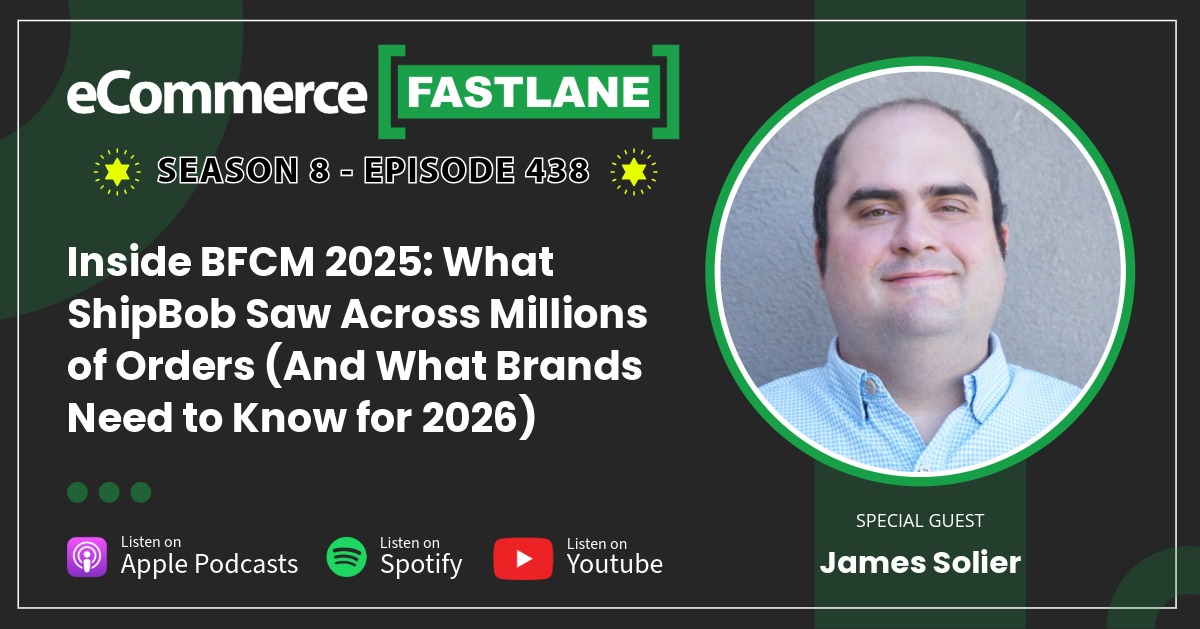
Today’s guest has direct visibility into what’s actually working. James Solier is the Senior Vice President of Central Operations at ShipBob, and his team just published a BFCM postmortem revealing which categories grew 40% year-over-year, how top brands managed inventory differently this year, and what separates winners from brands that plateau. Whether you’re doing $50K or $5M months, this breaks down what you need to know about fulfillment, expansion, and positioning for 2026.
Let’s dive in.
What You’ll Learn
✅ Why inventory timing beat inventory volume this year — How winning brands elevated inbound starting in September (not the usual pre-BFCM rush) to maintain 22 weeks of cover while optimizing cash and capturing 20-40% YoY growth
✅ Which categories are actually crushing it — Apparel, beauty, toys, and health all grew 20%+ across ShipBob’s network, with standout brands hitting 40% growth while maintaining operational excellence
✅ The real cost of self-fulfillment — Why the $1-5M revenue range is where warehouse operations start costing more than outsourcing, and how 3PLs free you to focus on growth instead of boxes
✅ How FTZ warehouses solve tariff pressure — The cash flow advantage of deferring duties until products ship, especially critical for China-sourced inventory in 2025-2026
✅ International expansion without the complexity — Whether you’re deploying inventory globally or using DDP/DDU solutions, how to tap untapped markets without overcomplicating operations
✅ What the 2026 playbook looks like — Why 8-10% is baseline growth but 30%+ brands exist, and how to position your inventory and fulfillment strategy to be one of them
Episode Sponsor: Littledata

The Data Layer for Shopify.
Powering acquisition, retention and analytics with conversion tracking you can trust.
Littledata gives you a reliable data infrastructure that connects your Shopify store with the marketing tools you already use, including:
- Google and Meta Ads for a stronger signal and attribution
- Klaviyo and Attentive for enriched customer flows
- Google Analytics for accurate revenue and event tracking
- Recharge for complete customer lifecycle visibility
Fast to set up. Effortless to maintain. Built to scale with your brand.
Join 2,000+ Shopify brands using Littledata as their foundation for growth.
Episode Summary
Steve welcomes James Solier, Senior Vice President of Central Operations at ShipBob, for a data-driven breakdown of what actually happened during BFCM 2025—and what brands can learn from the operational realities that separated winners from the rest.
The headline numbers were massive: Shopify’s $14+ billion weekend, 27% year-over-year growth, sales peaking at $5.1 million per minute. But James reframes what those numbers miss—generating orders is one thing, getting them out the door accurately and quickly is where brands actually win or lose. ShipBob’s network saw apparel, toys, beauty, and health all grow 20%+ year-over-year, with individual brands hitting 40% growth while maintaining operational excellence.
Here’s what winning brands did differently: Instead of the typical pattern of rushing inbound shipments two weeks before BFCM, the smartest brands kept inbound elevated and steady starting in September. Their peak inbound week came later than usual, showing sophisticated cash optimization—timing inventory buys to minimize working capital impact while maintaining healthy stock levels throughout peak.
James breaks down international expansion as a major 2026 opportunity, explaining how brands can deploy inventory globally or use DDP/DDU cross-border shipping. He covers the trade-offs between speed and complexity, and why international markets often mean lower acquisition costs and less competition.
You’ll also hear practical solutions for tariff and cash flow challenges: ShipBob’s Foreign Trade Zone warehouses that let you defer duties until products ship, and their co-branded lending program for working capital. James’s prediction for 2026? Overall ecommerce growth around 8-10%, but standout brands that nail operations will keep growing at 30%+ annually.
This is a strategic conversation about the operational realities that determine whether your BFCM success becomes sustainable growth or gets eaten by fulfillment bottlenecks.
Strategic Takeaways
👉 Stop treating fulfillment as an afterthought—it’s where your BFCM success actually gets realized or lost. You can drive record orders all weekend, but if those shipments are delayed, inaccurate, or inconsistent, you’re torching your repeat purchase rate and LTV. The brands James sees winning aren’t just the ones with the best marketing—they’re the ones who positioned inventory correctly, maintained healthy in-stock rates, and built fulfillment operations that can handle 2x October demand without breaking. That operational excellence is what separates sustainable growth from one-time spikes.
👉 Time your inventory inbound strategically instead of panic-buying two weeks before peak. This year’s winners elevated their inbound shipments starting in September and maintained steady flow instead of the usual pre-BFCM rush. This isn’t just about avoiding stockouts—it’s sophisticated cash flow management that minimizes working capital impact while keeping you in stock. When your peak inbound week is one week later than prior year, you’re optimizing for both inventory availability and balance sheet health. Think about your sourcing timeline now, not in October.
👉 Recognize when self-fulfillment becomes more expensive than outsourcing. The $1-5M revenue range is typically where the math flips—your time packing boxes and managing warehouse operations costs more than what you’d pay a 3PL, plus you’re limited by physical space and can’t scale quickly. James makes the point that transitioning to fulfillment partners doesn’t mean losing control; it means deploying your time on what actually grows the business (product development, marketing, customer experience) instead of operational tasks that someone else can handle better.
👉 Use Foreign Trade Zone warehouses to defer tariff payments and improve cash flow. If you’re sourcing from China (like most Shopify brands), FTZ facilities let you bring inventory into the US without paying duties upfront—you only pay when products actually ship. That’s massive for working capital, especially when you’re managing large inventory buys amid tariff uncertainty. ShipBob’s FTZ warehouses on both coasts give you strategic flexibility to position inventory domestically while managing the cash impact of duties and taxes.
👉 Look at international expansion as your next growth lever, not a distant future goal. The brands James works with are finding meaningful revenue in markets outside the US where customer acquisition costs are lower and competition is less saturated. You don’t need to overcomplicate it—start by shipping internationally from your US warehouses using DDP or DDU solutions, then deploy inventory globally once you’ve proven demand. The infrastructure exists; the question is whether you’re willing to test new markets or stay focused only on domestic growth.
👉 Audit which categories and products are actually driving your growth right now. Apparel, toys and hobbies, beauty, and health all grew 20%+ year-over-year in aggregate, but within those categories, specific brands hit 40% growth. That variance tells you something important: it’s not just about being in the right category—it’s about product-market fit, marketing execution, and operational excellence combined. Look at which of your SKUs are driving repeat purchases and new customer acquisition, then double down on those instead of spreading resources thin across your entire catalog.
Guest Spotlight
James Solier
Senior Vice President of Central Operations, ShipBob
James Solier oversees central operations at ShipBob, one of the leading fulfillment platforms for Shopify and direct-to-consumer brands. With direct visibility into thousands of ecommerce brands across ShipBob’s 60+ warehouse global network, James has a unique perspective on what actually works at scale.
He and his team recently published a comprehensive BFCM postmortem analyzing order volume, inventory positioning, category performance, and fulfillment metrics across ShipBob’s entire network. That transparency—publicly sharing what worked, what didn’t, and what brands can learn—reflects his approach to helping merchants make smarter operational decisions.
What makes James’s insights valuable is his understanding that fulfillment is a strategic growth lever, not just a cost center. He sees patterns across every segment from bootstrapped startups to eight-figure brands, understanding how operational decisions compound over time. Whether it’s timing inventory to optimize cash flow, leveraging Foreign Trade Zone warehouses to manage tariffs, or expanding internationally, James brings practical frameworks that help brands scale without operational bottlenecks.
Links & Resources
Connect with James & ShipBob:
Featured in This Episode:
- ShipBob BFCM 2025 Data Report — Post-Black Friday Cyber Monday insights and metrics
Solutions Mentioned:
- ShipBob Foreign Trade Zone (FTZ) Warehouses — Defer tariff payments until products ship
- ShipBob Co-Branded Lending Program — Working capital support for merchants
- ShipBob WMS (Warehouse Management System) — Self-fulfillment solution for brands running their own warehouses
- DDP (Delivered Duty Paid) & DDU (Delivered Duty Unpaid) — International shipping solutions
Data Sources Referenced:
- Shopify BFCM 2025 public data (over $14 billion in merchant sales)
- Adobe annual BFCM report ($44.2 billion total ecommerce, 8% YoY growth)
- ShipBob internal fulfillment network data
Thanks for Supporting the Pod!
Over the past eight seasons, I’ve been incredibly lucky to chat with some of the brightest founders in ecommerce building remarkable Shopify brands and partners shaping the app and marketing ecosystem. Honestly, every conversation has taught me something new, and I’m grateful for the chance to learn alongside you.
What matters most is that this podcast helps you solve real challenges and unlock new growth for your business. Your support, feedback, and stories have made this journey truly special. Thanks for tuning in, sharing your wins and losses, and being part of the eCommerce Fastlane community.
- Leave an Honest Rating/Review: Share your thoughts on Apple Podcasts or Spotify.
- Follow & Subscribe on YouTube: Get notified about new episodes on YouTube.
Contact Steve
Like Reading? Here’s the Full Episode Transcript
Steve Hutt
Welcome back to Ecommerce Fastlane. I am your host, Steve Hutt. We’re still in what I’d call the peak busy times right now—the post-BFCM rush—and I want to acknowledge just how massive this year’s Black Friday Cyber Monday was for Shopify brands.
Steve Hutt
Shopify publicly announced that merchants generated over $14 billion in sales over the weekend, up about 27% year-over-year. Sales peaked at $5.1 million per minute on Black Friday, and more than 94,000 merchants had their highest-selling day ever on the platform. It’s pretty amazing. It looks like everybody’s winning, and those numbers are incredible. But generating orders is only one part of the equation. A lot of the heavy lifting actually starts right now.
Steve Hutt
Customer expectations are sky-high. They want quick delivery, accurate orders, and a seamless post-purchase experience. The only way to have a truly great Black Friday for your brand is to make sure those orders get out on time. That’s one of the reasons I have my guest on the show today. It’s James Solier, Senior Vice President of Central Operations at ShipBob. We know and love ShipBob—they’ve sponsored the show quite a few times. They recently put together a fantastic blog post packed with data points and insights.
Steve Hutt
It’s essentially a BFCM postmortem—what happened after Black Friday. They even hosted a webinar around it. What’s interesting is how openly they’re sharing what’s actually going on in the network and the key takeaways brands can learn from. Whether you’re doing 50 orders a day or 5,000, there’s a lot here for you.
Steve Hutt
My hope today is that James will unpack some of the operational realities behind the scenes—what worked, what didn’t, what broke—and what brands can learn from BFCM as they move into the rest of the holiday period. There’s still a lot of revenue to capture in this season. So, James, welcome to the show.
James Solier
Steve, super happy to be here. Thank you, sir.
Steve Hutt
Yeah, my pleasure. Let’s talk about the big picture for BFCM, because this year felt a little different. There was a lot of uncertainty. Merchants were thinking about tariffs, changes to de minimis rules and clearing under $800, and a shorter holiday window. But your data, in this blog post, tells a very different story. Can you walk us through what you actually saw over that weekend?
James Solier
Yeah, from an outbound or demand-based standpoint, there were no signs of weakening. In addition to the Shopify data points, Adobe published their annual report showing about 8% growth in total revenue over Black Friday Cyber Monday—industry-wide, about $44.2 billion. I stay in close contact with friends at other very large marketplaces who reported around 8% year-over-year order growth and about 10% growth in units. So holistically, things are trending in the right direction. The story is merchant by merchant, and I’d say the biggest winners here are absolutely brands.
James Solier
While these numbers speak to averages across all volume and all orders, we had more than our fair share of standouts going into Black Friday Cyber Monday. A lot of the metrics in that blog post speak to how much these segments peaked—more than doubling of demand coming out of October. Compared to last year, merchants did a far better job of maintaining healthy in-stock positions going into peak.
James Solier
Usually, brands sourcing from China with long vendor lead times keep about 22 weeks of cover worth of inventory. As we go into Black Friday Cyber Monday, it drains considerably—by about half. The inbound pipeline also tends to peak around two weeks prior to Black Friday and then slows back down. What we saw this year, which was really interesting, was that inbound has been elevated and steady since September. Our peak inbound week this year was actually one week later than prior year. That’s a sign of real cash optimization—deferring those bigger buys until just the right moment.
James Solier
On the demand side, holy smokes—doubling since October. But more to the point, comparing those 7% or 8% year-over-year figures, in aggregate we saw apparel, toys and hobbies, beauty, and health all grow more than 20% year-over-year, with some brands going as high as 40%. The way I’d think about it is these averages do a very good job of illustrating that ecommerce and DTC is very healthy. But there are absolutely some brands out there that are just continuing to crush it—already well into the millions of GMV and still finding their stride in growth. We’re very proud to support them and very excited to see very strong demand coming out of these channels.
Steve Hutt
Yeah, it’s amazing. The category performance—beauty, health and wellness, apparel—those are typically the big ones, but it’s nice to see that confirmed. When I was at Shopify, one of the running jokes was that half of the Shopify brands on the network are in fashion. So clearly it’s a massive market.
Steve Hutt
But one of the things I found interesting was the geographic surprise. When I was reading this blog post, seeing how Canada spiked almost 400% and Australia 250%—those aren’t incremental jumps. Can you talk about these international markets and what’s going on there?
James Solier
Absolutely. It’s brands that usually started in the US finding extremely strong footholds internationally. There were more than a few ShipBob customers that have recently expanded into our Canadian operations—spread between the Greater Toronto area and Vancouver—as well as using ShipBob for our Australian operation, which is growing extremely rapidly. What you see there is relationships we’ve built with brands that have reached a level of growth and penetration where, from a sourcing standpoint, from an execution standpoint, from a cost of acquisition standpoint, they’re ready to go into new geos. ShipBob is right behind them as part of that fulfillment journey, and they’re finding success.
Steve Hutt
Yeah, this is amazing. Let’s talk a little about the technology behind the curtain. Part of the blog post talked about 100% uptime—Shopify had a little hiccup on Cyber Monday for a few hours, but it didn’t affect the overall business of merchants. You had 100% uptime, millions of API calls, and some technical metrics. Can you talk about what it means when things aren’t breaking? How do you maintain a network like this and plan and forecast when these floods of orders are coming in?
James Solier
That’s a really great point. Part of it is forecasting, and part of it is infrastructure. I’ll answer that in two parts. From the forecasting side, this is a place where I’d say no one is phenomenal, but we absolutely need to help everyone get better. It’s funny—coming from Amazon, I remember having an organization stacked with some of the sharpest PhDs in the world, and even in those instances it was hard to maintain plus or minus 10% accuracy because you never know what consumer sentiment will be. It’s hard to keep a pulse on what products are hot or not.
James Solier
Translating that to some of the smaller brands we work with, I was just doing an analysis earlier this week. Except for food, drink, and health, there wasn’t a single category where the majority of merchants weren’t off forecast—either heavy or light—by more than 10 to 15%. That’s not to say they’re bad at demand planning. It just goes to show how hard that problem is. The way ShipBob handles that is we’re extremely proactive. We partner closely. We want to understand what growth looks like. These are conversations we have weekly and reinforce at the executive level in quarterly business reviews.
James Solier
By the time peak comes around, we’ve already got a pretty good sense of what we’d call a P20 scenario—your median expectation, your best peak ever, and your worst peak ever. What does that triangle look like? From there, we make sure the fleet and our technology can scale to the best peak ever for all parties. That comes through load testing, volume signals, and simulating the transactions we might have in the system multiple times between the middle of the year and year-end. So when certain brands come into a given building and they’re double forecast, we want to celebrate that with them. That local node is absolutely ready to handle it.
James Solier
From a technical integration side, it’s constant stress testing of the ecosystem. This is a space that’s growing a lot. Our brands are growing a lot. Some of our established brands are organically managing double-digit growth still. So we’re building for this. There are places where we’re continuing to internalize certain solutions where maybe other providers would be going externally—things like label calls or order management. We’re very much in the process of internalizing or pre-processing to the best extent possible. So when those big volume days come, it’s almost unnoticeable on the FC floor or on the merchant dashboard. There are always still hiccups, and we work through them collectively. But I think ShipBob has an extremely robust and best-in-class sense of where we’re going with our tech stack, and we’ve made huge strides toward that just over the last year. This is a place where we’re going to continue to surprise and delight, not just in terms of scalability but in terms of functionality. I can assure you it’s a place where our heads have been for most of this year.
Steve Hutt
Yeah, it’s amazing. So what’s this hub-and-spoke distribution strategy you have? It’s so interesting to me—zone skipping, sort centers—can you break down exactly what this means for a merchant? Let’s say you’re doing five grand a month and trying to decide between storing everything in one warehouse or distributing inventory across multiple warehouses. I’m curious about this whole technology and mindset around hub-and-spoke.
James Solier
Oh, phenomenal. The hub-and-spoke is a means to an end. At the end of the day, anything you see in the operation is a means to an end. On the inventory placement side, I’ll start there first. The reason why a merchant might want to think through whether they want to be in more than one region comes down to a couple of quick things. One, can it be a conversion driver? We’re very much of the mindset that the supply chain is your P&L. If you place inventory closer to your demand epicenters—or centroids, depending on how sciency you want to sound—the lower your distances are, the faster your transit times are. At checkout, it’s been proven time and time again across most selection: shorter promises convert more. That’s the first thing I’d think through.
James Solier
The second thing is that with regional placement, it opens you up to a lot more carrier options in those larger cities. If you look at some of the regional carriers that have come up to date and the amount of growth and evolution in that space—the ones I’ve been really happy with, like Uni and Seko—they’re really making their presence known. They don’t always have full connectivity, or they’re in the process of expanding it. But the second that product is in those high population centers where they’re already running routes, it gives you access to more carriers, often with phenomenal service at better cost points. So not only do you have the benefit of shipping shorter distances, but you also see the benefits of broader carrier selection.
James Solier
All these are good outputs. The way ShipBob thinks about it is first understanding the catalog and what you’re trying to sell and what you convert on. If you’re less speed-sensitive in terms of your conversion metrics and you have a very dense catalog with lots of different order permutations—we have a few merchants that fit that bill, oftentimes in apparel where you have size mixes or color mixes—it makes it extremely hard to identify what your head or tail SKUs are. In those instances, you probably want to consolidate your inventory in one place, and you want your fulfillment location to probably be more middle of the country so that you hit both coasts effectively.
James Solier
What we’ve found, and I think a lot of even smaller merchants are surprised by, is that for most segments, your head selection—those SKUs that generate the majority of your orders and the components of those most popular orders—is pretty common. That signals an opportunity to say, hey, based on what your customers buy, it’s extremely predictable. It feels safe to buy into. Your demand patterns are probably pretty stable. And that becomes a great recipe for regional inventory plays. That further reinforces speed, further brings down your cost structure, and some of the risks that could come with the larger inventory position tied to being in more than one place is really mitigated because you’re very confident in your demand patterns.
James Solier
For those times where you still don’t want to split an order because there’s that one or two tail SKUs being added in, one of the concepts ShipBob has is a hero site. There’s always one building that has all of your selection in it, so it doesn’t become a split shipment driver. It’s purely a tailwind to help those orders containing your most fast-turning selection just come to customers from shorter distances.
Steve Hutt
So I want to talk about social selling for a minute because I think TikTok Shop has been massive this year. I’m seeing more and more brands selling through multiple channels—their Shopify store, their Amazon store, their TikTok Shop, maybe even wholesale. From a fulfillment perspective, what’s happening differently with managing inventory? If you’re selling on TikTok versus a traditional D2C site, does anything change about how you think about where your inventory sits, or does ShipBob have the processes in place to fully fulfill the omnichannel experience?
James Solier
Oh, that’s a great point. Yeah, I think omnichannel holistically—I’m of the opinion that demand is what ends up shaping how you think about inventory placement. Omnichannel is more about how many capabilities you have once you’re in a given building. From a ShipBob perspective, we think it absolutely helps merchants and their inbound cost structure and their inventory management holistically to be able to do that kitting, prep, and freight-type movements out of the same origin where we do D2C volume. This is a strategy we’ve used successfully for multiple brands.
James Solier
For brands thinking about channel expansion into those marketplaces, I’d say first and foremost, don’t think that you need to replicate or completely replace your inventory pools. That’s exactly why 3PLs like ShipBob are really focused on omnichannel. There’s a way to test those waters without duplicating your fulfillment network. And to the second piece, our experience thus far is that some of the marketplace challenges we see tie back more to integration and quality management—are you comfortable that your shipper can provide the correct shipping and delivery SLAs to maintain the performance ratings you need to sell on platforms like TikTok or Amazon Seller Fulfilled Prime?
James Solier
From a ShipBob approach, we’ve done a very good job of ensuring that we can run B2B, D2C, the whole kit and caboodle on one inventory position in larger facilities for merchants trying to expand everywhere. So again, merchants out there, don’t think you need to have multiple partners and multiple inventory duplicated for a solution like this. As a follow-on thought, just make sure that wherever you’re going has their finger on the pulse of how those marketplaces are evaluating your performance. More often than not, the challenges we see with small brands or brands that have come to us tie back to, “Hey, my legacy partner did not ship this in time, and now I’m threatened with being delisted on a platform because my delivery experience is so poor.” That’s a place where we’re really leading.
Steve Hutt
I see. So here we are—we’re still in Q4 right now. Obviously BFCM is done. I wrote a blog post on this recently about the fact that if someone has $800 as their budget for the holidays, stats have proven that $400 of it has already been spent on Black Friday Cyber Monday. That still means there’s 50% more business opportunity available for the remainder of Q4. What do you think about that? And is there anything that a merchant should be doing now? We’re in the thick of Q4, and we want to maximize what we have. It’s not a one-and-done BFCM—it’s now, what do we do with the remainder of Q4? And how does that momentum help Q1 of next year?
James Solier
That’s a perfect question. We’re about to enter what I’d refer to as the second peak—maybe a bit more of a bump—but this is the time where people are shopping more broadly. To your point, just looking at our order curve last year, it’s safe to assume that our merchants are only about 55% done with their volume between now and Christmas.
Steve Hutt
Okay.
James Solier
From a cutoff standpoint, that’s where I’d start. Be cognizant of how long it takes your product to get to customers. That will shorten your window. Mentioning some of the inventory placement before, some of our more well-placed merchants actually have more pre-Christmas buying days just as an extension of having closer product. But I’d start there—just understanding what your time window is. I think the next evaluation—it’s interesting, peak is really about doing the same thing you always do, just executing it the best you can. So I’d start with really understanding the fundamentals of your D2C platform.
James Solier
What does your traffic look like? What are your conversion drivers? I’d look at your current inventory position and start looking at what stuff is not turning. I’d refer to that as deadwood, where you can leverage that as a more effective way of getting your fixed costs down and freeing up cash on your balance sheet just by discounting that product, instead of finding some other more expensive or less beneficial long-term liquidation channel. The sense I give is that there are still going to be a lot of people on the hunt for Christmas presents for the coming weeks. They’re going to be coming into your website. Be thoughtful about how much time you have to fulfill an order without having to upgrade to a more expensive shipment type, like putting it on a plane.
James Solier
Just leverage it to the best extent you can. Make sure you understand where you’re converting, and if there are instances where you’re currently spending too much on storage and products that aren’t turning at the rate you thought they would, now is a phenomenal time to contemplate discount adjustments or bundling or other behaviors to help get that out the door and keep your balance sheet in a great position.
Steve Hutt
So what about those listening who are in the early stages of their business—early startup mode, maybe mid-market? I get this question asked a lot from brands: When should I be doing fulfillment myself, or when should I start working with a 3PL like ShipBob? How do you start asking the right questions to figure out what are the signs that you need to move from your own warehouse or out of your garage? When do they find that it’s a better approach to actually have ShipBob or whomever they choose as their fulfillment partner?
James Solier
That’s a great question. I’d say the way ShipBob would approach that is we’re here to support you on day zero. Now, the type of solutions we might offer will absolutely evolve with your volume, your demand, how your business grows, how your catalog expands, or how your channels change. But at the very beginning, I imagine as a new brand owner, you just want to make sure that your product has clear market fit, your customers are jazzed about it and celebrating, and you’re thinking holistically about growth. The enablement of that growth is 100% your supply chain. But that’s where you’d think to yourself: What’s an evening better spent—packing boxes in your garage or thinking through how you’re going to grow either your addressable market or existing top line by another 50%? I’d argue packing boxes might feel more therapeutic.
James Solier
But as you think about where you are, the spot you’re in, it’s because you’re solving a problem for a customer and you found some unique value or perspective in what you’re doing. That’s your comparative advantage, and that’s where you should lean in hard. ShipBob exists so that you have someone who really cares about what a great supply chain looks like and will hold itself accountable. Many of the brands that started extremely small—single building footprints with us—are now well-known household names. We expect to take that journey with you. As we notice your demand patterns, we’re the type of organization that might reach out proactively and say, “Holy smokes, congratulations on the success. Maybe it’s time to think about more than one building, or maybe it’s time to think about international expansion.”
James Solier
I’d err on the side of growing your revenue and relying on a company like ShipBob to make sure there’s someone just crushing it on the fulfillment side for you. And that can be at nearly any size. That transparency is also important because we know those early stages—you want to make sure your customers have a seamless experience from checkout to delivery. We’re pretty transparent on that. I think you can make that transition without feeling any real loss of control.
Steve Hutt
Yeah, that’s amazing. So what about for the remainder, getting into 2026? Is there anything that the data is showing that brands can think about now? I think a lot of people maybe aren’t paying as much attention to the data as they should. I’m trying to figure out if there are any takeaways based on this blog post, the success so far, and how we’re going to continue with that momentum as we bleed into 2026. I just want to make sure we’re thinking about—you brought it up already—global expansion opportunities. What does ShipBob think about how 2026 should play out and how brands can position themselves successfully?
James Solier
I think for 2026, it’s mostly us helping brands think through what’s the best way to manage their balance sheets and continue to grow the way they need to. Again, most of the volume that we do here at ShipBob originates from an inventory perspective from Asia, and a lot of that’s from China. We know the tariff picture has put cash pressure on a lot of our partners, and they’re looking at strategies like FTZ, or again, as we saw this peak, really timing their inbound in a way to not have too much of a working capital impact. I’d say that we at ShipBob have spent a lot of this year thinking about that. We launched our own ShipBob co-branded lending program to help merchants out. We’ve launched an FTZ on the West Coast and have one ready to go in the East.
James Solier
So we’re building solutions to help merchants manage the cash positions and pressures they’ve seen this year. But aside from that, I’d expect that if we were to talk again a year from now, Steve, it would be the same thing. It would be another gangbusters year for ecommerce growth. It would be a story that says the American consumer is spending 8 to 10% more. But there are some brands out there that have just hit the nail on the head and are continuing to grow at 30-plus percent CAGRs. For them, it’ll just be more of the same—how far are you penetrated now? Do you think you’re ready for international expansion? Do you have the right people to talk to? As you think about that, is it deploying inventory or is it shipping internationally using a DDP or DDU-type solution?
James Solier
That’s where I’d err on the side of finding a partner that is highly transparent, that you can trust to help navigate those conversations. And all you need to do is continue to do what you are doing—making your product great, finding the addressable market, bringing people’s attention to it—and let an organization like ShipBob just empower you the whole way.
Steve Hutt
So what do you say for those merchants listening right now who want to learn more about ShipBob—whether it’s your 3PL solution or even your WMS solution if they want to run it out of their own warehouse? I just want to understand how your network could really help them scale. What do you believe are the next steps? What’s the best way to explore learning more about ShipBob?
James Solier
I think we have an extremely robust website that includes case studies and things along those lines. By all means, that’s an absolutely great place to start. It’s also a great place to submit your inquiry if you want to learn more. We do a very good job of reviewing those questions and inquiries, and people that come into that funnel—merchant size can be anywhere from SMB to larger mid-market. I’d absolutely suggest starting there. And then we have a phenomenal marketing and sales team that’ll understand what your problem statements are. Heck, you might even get a chance to speak with me depending on how complicated a solution we need to provide.
Steve Hutt
Great. This has been really eye-opening. I have to thank you and the team for putting together this blog post. I think it really opened my mind. It’s always nice to have—I think Rachel was the one who actually wrote it. But it’s interesting because it kind of peels back the curtain, peels the onion a bit, and says, “Hey, here’s what’s actually going on right now.” I’ll make sure this is in the show notes so you can get full details of what happened over that weekend. And with this blog post and having you on the show right now, I think it opens our minds that there is massive opportunity still available, and implementing some of the things and some of the successes of these bigger brands.
Steve Hutt
The internationalization is blowing my mind, and Shopify is helping with a lot of that. I think even Shopify today—at least as of this recording—I guess every six months they release their Editions, and I think the Winter Editions came out today. And I think you guys were doing some webinars and talking about some of the fulfillment-related things you’re working together on. It’s so interesting. I think the opportunity is just so massive right now. So just thank you, James, for coming on the show and being so transparent and sharing. I wish ShipBob continued success in helping Shopify brands continue to scale up.
James Solier
Steve, thank you for having me. And yes, all power to the brands. I wish for their success going forward.
Steve Hutt
Absolutely. All right, have yourself a great afternoon. Cheers.
James Solier
You too. Bye.
Steve Hutt
All right, take care. Well, that’s it for today’s episode. I’d like to thank you personally for being a loyal listener of Ecommerce Fastlane. It’s my hope that this podcast is offering you a ton of value through growth strategies, tactics, and exclusive insider tips on the best Shopify apps and marketing platforms, all with my personal goal to help you build, manage, grow, and scale a successful and thriving company powered by Shopify. Thanks for investing some time today and listening to the show. I’m so proud and excited that you have a growth mindset and are a constant learner. I truly appreciate you and your entrepreneurial journey. Enjoy the rest of the week and keep thriving with Shopify.
