





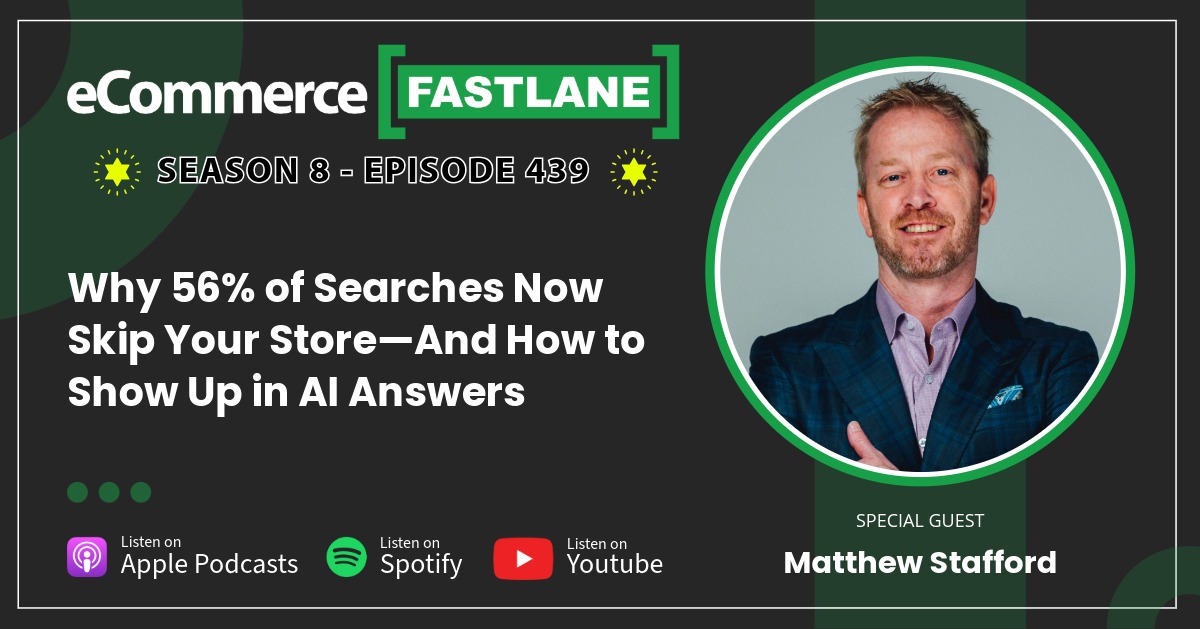
Here’s what most Shopify brands don’t realize until it’s too late: when someone asks ChatGPT, Perplexity, or Gemini “What’s the best moisturizer for dry skin?” or “Which Shopify app handles subscriptions?”—the AI generates one answer.
If your brand isn’t in that response, you’ve been erased from the customer journey. There’s no second page, no way to optimize your way back in, and no do-overs.
This shift from traditional SEO to what Matt Stafford calls Answer Engine Optimization (AEO) is already reshaping commerce. The numbers tell the story: organic Google traffic has dropped 30% over 12-18 months, 56% of searches now end in zero clicks, and conversions from AI recommendations are converting at five times the rate of traditional Google traffic. People treat these AI assistants as trusted advisors, not search engines—fundamentally changing how discovery works.
Matt Stafford returns to the show as Managing Director of Build Grow Scale, where he’s helped hundreds of DTC brands scale past seven and eight figures over the past decade. His core philosophy cuts through the noise: traffic isn’t your problem, optimization is.
This conversation bridges revenue optimization fundamentals with future-proofing strategies you need right now to stay discoverable in an AI-first world. Whether you’re launching your first store or managing eight-figure operations, this episode breaks down how to optimize for both human buyers and the machines recommending you.
What You’ll Learn
✅ Why Answer Engine Optimization is replacing traditional SEO — With 56% of Google searches ending in zero clicks and organic traffic down 30% in the past year, you’re either being cited by AI systems like ChatGPT, Perplexity, and Gemini, or you’re invisible in the customer journey.
✅ The revenue optimization framework that actually drives profit — Conversion rate alone is a vanity metric. Matt breaks down the funnel stages that matter: add to cart rate, proceed to checkout rate, and completion rate, showing exactly where you’re losing money before blaming traffic.
✅ How to convert the 97% of visitors who leave without buying — The average ecommerce site converts 2-3%, meaning you’re only capturing a fraction of your traffic. Converting just two or three more people per 100 visitors doubles your sales and lets you outspend competitors for customer acquisition.
✅ The structured data strategy that makes AI recommend your brand — From FAQ schema answering buyer-intent questions to comparison content and progressive disclosure, you’ll learn how to train large language models to understand and cite your products with confidence.
✅ Why AI recommendations convert 5x better than Google clicks — Users treat ChatGPT as a trusted advisor with memory of their preferences, not a search engine. These personalized recommendations fundamentally change purchase decisions and make showing up in AI answers non-negotiable.
✅ The lean team structure winning in 2025 — Matt shares why three to four high-quality specialists operating in their zones of genius outperform massive in-house teams, especially when the pace of change makes it impossible to maintain cutting-edge expertise across every discipline.
Episode Sponsor: Littledata

The Data Layer for Shopify.
Powering acquisition, retention and analytics with conversion tracking you can trust.
Littledata gives you a reliable data infrastructure that connects your Shopify store with the marketing tools you already use, including:
- Google and Meta Ads for a stronger signal and attribution
- Klaviyo and Attentive for enriched customer flows
- Google Analytics for accurate revenue and event tracking
- Recharge for complete customer lifecycle visibility
Fast to set up. Effortless to maintain. Built to scale with your brand.
Join 2,000+ Shopify brands using Littledata as their foundation for growth.
Episode Summary
Steve welcomes back Matt Stafford, Managing Director of Build Grow Scale, for a conversation about how AI is fundamentally reshaping customer discovery. The data is stark: 30% of organic traffic has disappeared over the past 12-18 months, and 56% of Google searches now end in zero clicks. When users ask ChatGPT, Perplexity, or Gemini for product recommendations, they get one answer. If your brand isn’t mentioned, you’ve been erased from the customer journey.
Matt bridges foundational revenue optimization with Answer Engine Optimization strategy. He starts by dismantling the traffic obsession most founders have—when the average ecommerce site converts 2-3%, you have 97 out of 100 visitors leaving without buying. His framework focuses on funnel metrics that actually matter: add to cart rate, proceed to checkout rate, and completion rate. One brand discovered a 60% bounce rate was eating their traffic—they paid for 100 visitors but only 40 people actually saw the site. A 10% improvement in bounce rate suddenly delivers 20% more visitors without spending another dollar on ads.
The conversation then pivots to Answer Engine Optimization. AI-powered recommendations convert five times better than traditional Google clicks because users view large language models as trusted advisors with memory of their preferences. To show up in these answers, you need structured data like FAQ schema and product schema, comprehensive content that establishes authority, and clear signals that tell AI who you are and what you’re known for. Shopify’s Winter 2026 Editions included Sidekick, an AI co-worker that makes this optimization more accessible to smaller teams.
Matt addresses the practical reality of staying current when change happens this fast. His philosophy: work with three to four high-quality specialists in their zones of genius rather than building massive internal teams that can’t keep pace with monthly platform updates. Whether you’re just starting out and need to nail Google Analytics tagging, or you’re scaling and need competitive advantages through AI optimization, this episode delivers the roadmap.
Strategic Takeaways
👉 Stop chasing more traffic and start converting the visitors you already have. When your site converts at 2-3% like most ecommerce stores, 97 people out of every 100 leave without buying. Your competitors burn cash fighting for more eyeballs—you can dominate by converting just two or three more of those 97 people, doubling your sales per hundred visits. That lets you outspend competitors to acquire customers and buy market share. He who can afford to spend the most to acquire a customer wins.
👉 Break down conversion rate into funnel stages that reveal where you’re actually losing money. Overall conversion rate is a vanity metric. Track add to cart rate, proceed to checkout rate, and completion rate separately. If people add to cart but don’t check out, you have a trust or friction problem. If they browse but never add to cart, your product pages or offer needs work. Fix the specific broken stage instead of guessing.
👉 Audit your bounce rate immediately—you might be paying for traffic that never sees your store. One brand had a 60% bounce rate from slow load times. They paid for 100 visitors but only 40 stayed long enough to see products. A 10% bounce rate reduction delivers 20% more effective visitors without spending another dollar on ads. If your bounce rate exceeds 40-50%, you’re losing money before the customer journey starts.
👉 Treat Answer Engine Optimization as non-negotiable. AI-powered recommendations from ChatGPT, Perplexity, and Gemini convert five times better than Google clicks because users view them as trusted advisors with memory. If your brand doesn’t show up when someone asks “What’s the best [your product category]?”—you don’t exist. There’s no second page, no paid placement. The machine decided you’re not worth recommending, and that decision cost you the sale.
👉 Implement structured data foundations: FAQ schema, product schema, and clear positioning. Large language models need signals to understand who you are. FAQ schema that answers buyer-intent questions, comprehensive content that establishes authority, and clear positioning give AI the context to recommend you confidently. Shopify’s Winter 2026 Editions made this more accessible, but deliberate implementation matters.
👉 Build a lean team of specialists instead of expensive internal operations. Ecommerce evolves too fast for generalists or massive teams to keep current. Work with three to four specialists in their zones of genius—conversion optimization, AEO, email/SMS, creative. These experts stay current in their disciplines while you focus on product and strategy. Trying to master everything yourself means spending all your time learning instead of executing.
Guest Spotlight
Matt Stafford
Managing Director, Build Grow Scale
Matt Stafford is the Managing Director of Build Grow Scale, where he’s spent over a decade helping hundreds of DTC and Shopify brands scale profitably past seven and eight figures. His philosophy cuts against conventional wisdom: traffic isn’t your problem, optimization is your problem. Over the past 10-11 years, Matt and his team have optimized carts processing over a billion dollars in revenue, giving him pattern recognition most operators can’t match.
Matt’s approach combines data-driven funnel analysis with what he calls “revenue optimization”—focusing on profit, not vanity metrics like conversion rate alone. He’s known for asking: “Would you rather do $1 million in revenue that costs $990,000 to generate, or $1 million that only costs $250,000?” That mindset shift from chasing growth at any cost to optimizing for profitable, sustainable scaling has made him a trusted advisor for mid-market and enterprise brands navigating increasingly complex ecommerce operations.
What makes Matt’s perspective especially valuable right now is his position on the front lines of Answer Engine Optimization. While most brands are still figuring out traditional SEO, Matt’s team is actively testing and implementing AEO strategies that keep clients discoverable as AI-powered search reshapes customer behavior. His willingness to share real data—like the 30% drop in organic traffic and 5x conversion lift from AI recommendations—gives operators the clarity they need to make strategic decisions instead of reacting to hype. This is his second appearance on eCommerce Fastlane, and based on how fast the AI landscape is evolving, he’ll likely be back every six months with updated playbooks.
If what Matt shared resonates with you and you’re ready to turn more of your existing traffic into actual customers, book a strategy call with the Build Grow Scale team. No pressure—just real insights into what’s holding your store back and what to fix first.
Links & Resources
Featured in This Episode:
- Build Grow Scale — Revenue optimization and AEO agency for DTC brands
- Shopify Winter 2026 Editions — Latest platform updates, including AI functionality
AI Tools & Platforms Mentioned:
- ChatGPT — AI-powered search and recommendations
- Perplexity — AI search engine
- Gemini — Google’s AI platform
- Sidekick — Shopify’s AI co-worker (Winter 2026 Edition)
Thanks for Supporting the Pod!
Over the past eight seasons, I’ve been incredibly lucky to chat with some of the brightest founders in ecommerce building remarkable Shopify brands and partners shaping the app and marketing ecosystem. Honestly, every conversation has taught me something new, and I’m grateful for the chance to learn alongside you.
What matters most is that this podcast helps you solve real challenges and unlock new growth for your business. Your support, feedback, and stories have made this journey truly special. Thanks for tuning in, sharing your wins and losses, and being part of the eCommerce Fastlane community.
- Leave an Honest Rating/Review: Share your thoughts on Apple Podcasts or Spotify.
- Follow & Subscribe on YouTube: Get notified about new episodes on YouTube.
Contact Steve
Like Reading? Here’s the Full Episode Transcript
Steve Hutt:
Welcome back to eCommerce Fastlane. I’m your host, Steve Hutt. Today we’re going to talk about something that I believe is quietly reshaping the whole customer journey right now. I’d argue that most operators are completely missing it, and I know that because I get DMs asking, “Hey, how come I’m not showing up in ChatGPT?” A lot of people are asking questions either to Google directly or to ChatGPT, Perplexity, or Gemini—questions like “best moisturizer for dry skin” or “what’s the best Shopify app to handle subscriptions?” And the AI is now generating one answer. Sometimes there are citations on the right, but a lot of times a brand really isn’t being mentioned in that answer. If that’s the case, then you’re clearly not very visible. There really is no second page and there’s really no way to go back in. It just is what it is. I think this whole concept is called Answer Engine Optimization—the short form is AEO. I believe it’s bridging between traditional SEO, search engine optimization, and this AI-driven future that we’re in right now. You’re either getting cited and trusted by these sources, or you literally don’t exist in the customer journey, which is terrible. That’s why my guest is on today. He’s been on before, but Matt’s fantastic. Matt Stafford is the Managing Director of a company called Build Grow Scale, and they’re at buildgrowscale.com. Matt’s been helping hundreds of DTC brands, tons of Shopify brands, scale past seven and in some cases even eight figures. He has a very interesting philosophy which we’re going to dig into in this show. His philosophy is that traffic isn’t your problem, optimization is your problem. He’s combining data-driven work with founders, the psychology around the founder, and how to figure out and future-proof your brand both for human buyers, which I think is really important, and making sure that the machine understands your brand. That’s where the AEO fits in. Matt, welcome to the show.
Matt Stafford:
Hello. Excited to be here and looking forward to the conversation. Just to add to what you were saying, what we’re also noticing is that those recommendations are very personal to people because the language model that they use on a regular basis has memory now. It’s actually tailoring the suggestions to them based on their own personal circumstances. When we’re looking at the data and actually talking to the consumers that have purchased through the large language models, they view them more like a trusted advisor. The conversions from the language models—all the data is showing that it’s about five times more valuable or five times more likely to convert than a Google click. I think you alluded to it in the intro: the Google clicks are going down. We’re seeing about 30% of our organic traffic disappearing over the last 12 to 18 months. We know that about 56% of Google searches result in zero clicks. This isn’t something that you can avoid for very much longer. It’s already happening whether you like it or not.
Steve Hutt:
Yeah, it’s interesting, but the sky is not falling. I believe that there are a lot of processes and tools for those that are interested. I think that’s why we’re here today—just to learn more about what is available and what can I do as a solo operator or if you’re firmly entrenched in the mid-market. There’s lots of opportunity out there. I think we should probably talk about the whole revenue leak situation because I really feel if we get a foundation first about your methodology, that’ll set the stage as to why AI optimization is an important strategy. You’re clearly seeing a lot of revenue leaks, but I think you coined it more like revenue optimization. Can you talk about what that means in practice before we jump into the AI?
Matt Stafford:
Yes. You can tell what level of skill people are playing at by how they label things. We call it revenue optimization because personally I don’t care if your store does a million dollars and it costs you $990,000 to do that million dollars of revenue, or if your store does $1 million and it only costs you $250,000 to do that revenue. I would take the second store that’s doing the same amount of revenue but is a lot more profitable. We’re not consumed with the vanity metrics of just conversion rate or just revenue. We want to know how much we take home. As a business owner, we’re not doing this as a charity. We’re doing this to make money. Profit is not a dirty word.
Steve Hutt:
Yeah, 100%. I’ve also learned through you, I think in a previous episode, about the fact that traffic typically is not a brand’s problem. A lot of founders still to this day believe that they just need more eyeballs. So how do you reframe that mindset to focus more on the right levers, not just traffic?
Matt Stafford:
Yeah, this comes from running our own brand. Through the data over the last 10 or 11 years, we’ve had probably over a billion dollars go through carts that we’ve optimized. We’re looking at all different areas. The average ecommerce site converts around 2 to 3%. When I was buying traffic for my store, I was like, “Okay, I’m getting 100 visitors from Facebook, I’m converting this much, it costs me X amount per click,” and I was trying to do the metrics. But then I was wondering why we weren’t making money. We started looking into the analytics and saw, “Oh, our load time is too long, so we have a 60% bounce rate.” Essentially, for every 100 visitors that I’m getting, 60 of them are leaving. I’m really spending the ad spend to get 100, but I’m actually only getting 40 people to my site. That’s the accurate number that you need to use to make your projections, or you need to fix the site so that the bounce rate goes down. A 10% reduction in your bounce rate can give you 20% more visitors, and that changes your metrics very fast. To go back to the original point: 2 to 3% convert. That means for every 100 visitors that raised their hand and came to your site, only two or three bought. Like you said, most owners think, “I need more, more, more visitors.” I use Dan Kennedy’s statement: “He who can afford to spend the most to acquire the customer wins.” So I’m like, “How can we afford to acquire more?” Well, if I can convert two or three more of those 97 people that left, now I have six sales for every 100 visits. My competitors have two or three sales for every 100 visits. I can now spend more money to acquire customers and I can buy market share and dominate my market.
Steve Hutt:
Yeah, 100%. I’m all in on that. Even yesterday, I had another fellow on and we were talking about the funnel itself. I think the whole conversion rate just as a number is pretty much a vanity metric overall. He talks about breaking it down like, what is your product page to add-to-cart rate and then what’s your cart completion rate? He went through these four different steps and it’s so interesting because that’s more metric-based driven. If people are going to the product page and they’re adding to cart and not buying, then that’s a different signal problem than if they’re not even coming to the site or they’re just looking around and never add it to cart.
Matt Stafford:
100%. That’s how we reverse engineer what area to work on. First you have the add-to-cart, the proceed to checkout, and then the completion of the sale.
Steve Hutt:
Right. And there’s strategy around all of that. This is a whole other episode, but I’ll put it in the show notes and link to that because it’s very interesting having the funnel organized in that fashion and thinking about the metrics in each one of those stages of a successful transaction.
Matt Stafford:
100%. Yeah. We have what we would consider best practices based on your average order value, what your add-to-cart should be, and then what the drop-off is from each step. Because no matter what you do, there’s going to be some drop-off, and then how you mitigate that as you improve it. And then at the end you get better at recalling your abandoned carts, abandoned checkout through email or SMS, or just actually content marketing rather than just “buy my stuff, buy my stuff.”
Steve Hutt:
Yeah, exactly. So I want to pivot over to Shopify for just a quick moment because I want to call out that every six months they release what they call Editions. This was the Winter Editions 2026 that came out, and the reason I’m calling this out right now is because they’ve clearly put their flag in the AI sand. You can tell by a number of employees that have been let go over the last 18 months just because of AI and some consolidation. They’re definitely an AI-first company now. They’ve been very clear about that. But what they’ve enhanced, which I think you know a lot about—I think internally you guys have been talking about Sidekick as this new AI coworker thing that’s going on and even some internal testing. What’s your initial thought—I know it’s in the early days, it just came out a couple days ago—but what’s your initial thought about Sidekick as this AI companion or coworker?
Matt Stafford:
Yeah. So we have our own team of developers and what we’ve noticed is our project managers are able to use these tools that are in the Shopify toolbelt now and get a lot of work done that we don’t even need to send to the developer. Our development team has been scaled down a little bit or we have them focus on the harder problems only. A lot of these simple things, the store owner now can take care of. What I would say is the speed to implementation for a small team can match that of a very large team. We have almost 30 employees, so someone using these AI tools can really run side by side with a bigger team and do it for a lot less money, which is pretty incredible and actually very exciting because I think there’s not a lot of times that happens where the little guy can compete with these big leverage things. It’s also happening even in the way that the language models are affecting search. There are two or three levers that have come out in the last 12 months that are leveling the playing field again for the small mom-and-pop guys or the smaller stores to actually compete and do well.
Steve Hutt:
Yeah, it’s amazing. They even had this thing, I think it’s called Sim Gym, where they’re allowing for testing before you deploy. It’s pretty neat.
Matt Stafford:
Yeah. Yeah. It’s a simulated A/B test to be able to release something that has a much better chance of winning, which in any playbook, I would always love to have the most successful plays before I play them.
Steve Hutt:
Yeah. So okay, this is basically what’s going on inside Shopify with the business. But I think we should probably now talk about what happens outside of the platform. I think that’s the core of our conversation today—this whole Answer Engine Optimization as a strategy. Why do you believe that even matters right now? Shopify has these AI features, fair enough. But having this Answer Engine Optimization strategy now, why do we need it? And then what does that look like?
Matt Stafford:
Yeah, so I would say the hardest part of owning an ecommerce company is how expensive ads have gotten in order to drive traffic to your site. That’s the hardest hurdle for the business owner to overcome. And now you have an ability to—well, let me step back a second so we give some context around the content. Essentially back in 2004 when SEO really started becoming a thing, it created this upward spiral of if you ranked well, you would get a bunch of organic traffic which would convert, which would give you more sales, which would give you a higher ranking, which would make more sales. The people that dominated the SEO won on traffic. Well now the new search that was never planned for with SEO that’s happening in the AEO is essentially leveling the playing field again. Everybody is starting from zero and it’s harder to game it because you can type in a million different queries because it’s a lot more personal than when you just go type a keyword phrase into Google search. We also know that now about 56% of Google searches result in zero clicks, which means the experience that Google is serving through SEO is no longer working the way that it did. So all of that traffic doesn’t disappear, it just goes somewhere else. And the advantage to that is the old SEO, the legacy companies that dominated that, that you couldn’t compete with because they have years and years of content out there, you can now go get that AEO traffic just as easy as they can. And that traffic is proving to convert much higher than a Google click. So you would need about five Google clicks for every one sent from an LLM to convert the same amount. When you reverse engineer that math when almost 60% of them result in zero clicks, now you need 10 Google clicks to equal the same amount as one AEO click.
Steve Hutt:
Right. So I guess the next question then—I mean I totally agree with you—but the next question is around are there any signals or any structures that can be implemented for a brand? So you’re helping these AI engines understand who you are or what you sell or what you stand for. I guess I’m just—it’s so hard and I don’t personally have the answer to it. That’s why I have you on today.
Matt Stafford:
Yeah, I’m part of a community that literally has five full-time people and the community is free to join. I’ll give you the link for the show notes where they are studying what’s working and figuring that out in real time and sharing that with people so that they can jump on this trend now while it’s early. I truly believe just because of the scale and how fast it’s being adopted that it’s probably the biggest swing that I’ve seen in ecommerce in the last 11 years. Doing this full time and selling millions of dollars worth of consulting per year, I literally believe that this is the biggest swing in ecommerce that I’ve seen since I’ve started.
Steve Hutt:
Yeah, yeah. Well, even in the early days when I was at Shopify, one of the things I always talked about was getting a blog going and thinking about SEO as the best ROI possible because you put in the early work, but then you just own the top spot and you get all this free traffic and your acquisition costs are next to zero. A lot of that has completely changed. Now you’ve mentioned already about the traffic going down. A lot of brands, people having to diversify into different channels to make up for the difference. But part of it is, well, let’s play the game along with where these tools actually are—if it’s AI overviews or ChatGPT or whatever, right?
Matt Stafford:
So yeah, I believe in the next three or four years, most websites will probably not even be visited. They’ll probably look more like a Notion doc that these large language models can read in markup language and then they’ll make the recommendation inside the large language model. People will buy and check out right there and never even visit your website.
Steve Hutt:
Yeah, that’s insane, right? And all of these connections now that Shopify is making with ChatGPT, with Etsy, with a lot of other players now where you can physically buy from within the app. And you’re right, you don’t even have to go to the Shopify store. You can buy within ChatGPT and you can check out with Shop Pay and boom, you’re done.
Matt Stafford:
100%. And I think that’s going to get more and more prolific. It’s going to change the face of ecommerce over the next 24 to 36 months.
Steve Hutt:
Wow. It’s crazy. I’ve also been looking at different tools out there and I’m not here to pitch any one tool over another because it’s clearly your own research, but I’ve been looking at some enterprise tools like Profound, Air Ops, even Searchable.com. A lot of these are tracking brand visibility and citations across these search engines. I even have Ahrefs and stuff like that. I’m seeing I’m being cited, and so are some of the ecommerce brands that I’m part of right now. But is there any insider tips you can share about—I know you’re saying you’re in this group—but is there anything that a brand can do today to more than likely have that trust and authority and expertise that these models are wanting to cite these businesses in these answers?
Matt Stafford:
Yeah, there is. And I mean that could be a four-hour podcast, no doubt.
Steve Hutt:
A four-hour podcast, no doubt.
Matt Stafford:
And to be really honest, I would say that I tend to default to saying that I’m not the expert in it because anybody that claims that they are is lying or they’re trying to sell you something because it’s changing. What was working six months ago doesn’t work now. Something new is working because these language models are updating things so fast and what they’re considering to be a better signal—they’re learning and growing just like Google did over the years. I think it’s going to take another six to 12 months for it to really settle in and then plant their flag on what they’re using in order to make these recommendations. And I think the good thing about that right now is if you’re willing to invest a little bit and work on it now, by the time that the flag is planted, you’re going to be way farther ahead of everyone else that’s just saying, “Well, I’ll wait until we figure it out because I don’t want to waste any money.” And then they’re going to automatically be behind by that six to 12 months.
Steve Hutt:
I’ve also learned a little bit along the way about schema—on key pages you think about like product schema and FAQ schema and stuff like that. I think that’s interesting because if the data is built into the post or the product page, the AI engines can actually parse that data correctly and structure it correctly so it’s machine-readable. And I think that really helps.
Matt Stafford:
It does a lot. Schema does matter. Yeah. And actually buyer-intent FAQs, we’re seeing that has a lot to do with it. The way that the FAQs are laid out and the way that it actually answers specific types of questions rather than like “when are you shipping my stuff?”—that’s really not buyer intent. A lot of times people are using that FAQ to be a sales page instead of actually answering technical questions. So the FAQs that answer the technical questions is actually what the LLMs are weighting. They’re putting more weight towards that in order to give a response.
Steve Hutt:
The other thing I’ve learned too, and I know we’re doing some show-and-tell here, but I also learned about creating comparison content—like your brand versus a competitor. I think the AI engines really are pulling from a lot of this comparison content right now. So “hey, what’s the difference between X and Y?” Even though some brands feel a little uncomfortable wanting to do that, I think if you own the comparison content, it means you control the narrative a bit.
Matt Stafford:
Yeah, yeah. And the truth of the matter is your buyers do comparisons, and so I think the people that are the most transparent and share that information provide the most trust. If you’re openly sharing who else you’re competing with, the person is going to naturally think, “Well, they’re not trying to hide anything.”
Steve Hutt:
I see. And what about—I noticed in Google too that sometimes on the right sidebar when you type something, there is the AI overviews but there’s also sometimes, not always, but it comes up “People Also Asked.” And I found it interesting that that box is there around similar core topics. Is that another way of potentially optimizing a brand saying, “Well, people maybe ask things you never even thought of,” and should you learn from what’s in that “People Also Ask” section to figure out content or product pages that need to be updated?
Matt Stafford:
I think that’s a great point. I hadn’t honestly thought about it, and so you saying that, you seeded my brain to go look into that. So I appreciate that.
Steve Hutt:
Yeah, my pleasure. So let’s talk a bit about your company because I really want to understand. I’ve looked and, once again, we’re not here to pitch your company, but I really feel that you’re firmly entrenched in the mid-market. I think $5 to $20 million brands—so not for everybody—but you really I think are all about incrementality. You really are there to help people when it comes to these AI engines now. Talk a little bit about how you’re a different kind of agency and why you’re more focused on the profit side and how overall you’re able to help because you have a whole list of incredible brands that you work with currently.
Matt Stafford:
So yeah, what we care about is the data and analytics. We don’t go by our gut feel. We certainly have best practices that we know over years of doing this, how people interact with your website. But sites are very contextual and they’re getting more and more contextual, so not everybody wants the same experience. When your site is built off of the data and analytics and we adjust it according to that, we get more people to add to cart. And when the cart is laid out in a way that we know—a lot of people think, “Oh, well, I want a bunch of upsells in my cart.” Well, we know that when you put a bunch of upsells in there based on which ones you put in there, many times it actually hurts your conversions because now the person’s like, “Oh, do I need that too?” And then they go look and they search, and you’ve taken them out of the buying cycle and put them back into the browsing cycle. So there’s certainly good things to do and poor things to do that are going to affect how many people become customers that then you can market to. Our goal is to get more customers, and then you do a good job of marketing to them and you sell a good product so that they’ll come back and use you again and again. It’s not the latest trick or hack that will get somebody to buy from you and then you send them something junky and then they’ll never come back.
Steve Hutt:
Right. Yeah, it’s crazy. What about fresh content? Because I feel that—I mean, I’m not sure this is actually true or not—but it seems that cited content in a lot of these AI engines right now, it seems that they give more value towards fresher, newer content. I just wonder how a Shopify brand should be thinking about the freshness factor when it comes to that.
Matt Stafford:
I agree. And the way that we’re accomplishing that is through what we would call progressive disclosure. Meaning you could put a tab or you could put a section that would have like a “See More” button and there’s a whole bunch of content in there that the language models or Google can crawl, and that information gets updated based on what’s going on now. And it doesn’t hurt the user experience. The only people that will see it are the ones that want to see it. And other than that, you’re just feeding the algorithm in order to share your site as the recommended way for them to solve their problem.
Steve Hutt:
I see. So what do you say to listeners that clearly are—a lot of people are wearing a lot of hats in their business. They’re doing paid media, they’re doing email, they’re probably dabbling in some CRO things like that. And now we have to add on this AEO opportunity on top of everything else. So how do you recommend prioritizing so that what they’re actually working on is compounding, maybe instead of chasing a shiny object, so to speak?
Matt Stafford:
Yeah, for sure. I would say that you need to schedule thinking time, not just busy work. Most of us default to certainty over opportunity because we know that, “Oh, if I answer these emails and I spend this much on traffic, I’m going to make this amount of sales.” And what happens is over time it starts not working as well and it gets harder and harder. So you need to take some time and figure out what’s sustainable and what are the metrics. This month I’m going to spend my time in this area of my business, and next month I will spend my focus time in this area of the business. So three or four months down the road, your entire business has got an overhaul of what’s effective, and then you just keep doing that circle every three to four months and your business stays relevant rather than essentially dying on the vine.
Steve Hutt:
Yeah. So what about a brand story? I just always feel warm and fuzzy when I hear about—because you clearly do have done-for-you services where you’re helping a business in this regard. Like is there any—I don’t know if you have to call out the brand publicly or not—but maybe anecdotally, maybe a brand was achieving a certain level of success and then they came on board with Build Grow Scale. You executed some of your processes, and then what does great look like for them after the engagement with you?
Matt Stafford:
Yeah, that certainly varies based on the maturity level of the different businesses. We’ve had businesses that have 4Xed or 5Xed in a year. We have ones that have doubled. We have ones that have grown 30%. It’s really—a lot of times you can create enough sales that you can break your supply. There’s just a whole lot of things that matter. We love the brands that have a great product. They understand how to buy traffic. Because once you have those two things, all the things that we work on—I always say small hinges swing big doors. So you’re not necessarily looking for these big things. It’s actually many times removing a lot of the stuff that you have on your site that doesn’t get any attention or they’re not clicking on it, they’re not using it, so that your message becomes a lot more clear. I think that clarity always will trump persuasion. A lot of times people are trying to do too much and that confuses the buyer. So the buyer has this paradox of choice and ends up not buying or coming back at another time, or they leave for now. And then the AEO search engine recommends a brand that wasn’t yours. So you paid to get them to come to your brand, educated them, they left, and then bought from the other competitor. So it really—I think less is more. And you’re going to find that that 80/20 rule is very applicable. About 20% of your products are going to do about 80% of your sales. And it’s just such a hard concept for the owner to buy into that they want to eliminate a whole bunch of things that have made a few sales. They think that matters. When success leaves clues and the easier you make it to buy the things that you sell the most, your conversions always go up.
Steve Hutt:
Interesting. I’d love to dabble into the conversion question again because it’s been coming up a lot. Brands have been mentioning this to me and I’m sure you’ll have an opinion on this because I know I do. But in America, when someone visits a website and you said maybe let’s call an average conversion rate of 2%, maybe on the high end 3% depending on the product, but let’s just call it 2% for sake of argument. So knowing that 98 of 100 are leaving, many have not opted in or don’t even know that there’s an offer or a deal or a newsletter or a VIP promotional loyalty thing—they don’t even know about it and off they go. And as we know, there are tools out there like Retention.com and OpenSend and a few others that are unhashing the unknown site visitor into an email address. And there’s a full address—they’ve probably previously opted in for marketing materials somewhere else on the web, and because of that, this data now becomes publicly available. And my last little comment is that I think in America we’re more of an opt-out legislation for email, meaning you literally can send an email to anybody at any time as long as you have a legal opt-out. And so knowing that, I mean maybe that’s some of the reasons why some of these tools are doing so well in DTC—you show up to the website, you didn’t sign up for anything, and then you get a welcome sequence or “thanks for visiting” sequence. I just want to hear your mindset around do you know anybody currently doing that? Is that something that you recommend, or are there risk factors that go along with sending an email to someone who didn’t legally opt in?
Matt Stafford:
Yeah, so we definitely do that. I encourage every single one of the brands that we work with to do it. We have tested every tool out there and they are not all equal. We have ones that ruin your sending score and we have ones where the people opt in when they land on the site. And those ones tend to not create that negative effect on your email sends. Your email and SMS are going to be your largest generated revenue. So anything that you do that hurts that is going to have a downstream effect that’s going to cause the business to suffer in one form or another. So I would say yes, we absolutely do it, and yes, we have figured out ways to do it that don’t hurt the brand—that actually help. We have one brand that gets about 20,000 people added to their list every single month and they have less than a 1% unsubscribe from those people because essentially what happens is out of their 100,000 visitors, they’ll get about 60,000 that will click “accept cookies” and then from there we resolve about 20%, 20 to 30%. So you’re still getting about 20,000 people. But those people are essentially what I would consider at that point warm traffic, and they stay in the sequences and they’re buying.
Steve Hutt:
Yeah. That’s amazing. Yeah, so I was just curious on that. I’ve had a few of them on—I’ve had the Retention people on and OpenSend has been on before, and I think Wonderment wants to get on. There’s a few others out there. I think there’s some even ecommerce-focused competitors out there too that I think get involved with cart abandonment and all that. And I think those are the ones they unhash because you’re abandoning cart. So instead of just leaving or retargeting, but actually knowing what was in cart is a really amazing intel to have. Yeah.
Matt Stafford:
And it converts high and generates a lot of revenue. So it makes sense to do that.
Steve Hutt:
Yeah, it’s amazing. So what do you think our next steps are? I mean there are people that are listening today that are like, “Hey, this is all great information.” If someone’s in their early stages right now, is there any one or two things you say, “Hey, if you’re in your early days trying to get traction and product-market fit, but you don’t want to be behind the eight ball of this AI thing that’s happening right now, what do you say to those people?”
Matt Stafford:
I would say the number one thing that you need to do is understand your Google Analytics and how to have your site tagged in a way that you can look at the data, because the people who are using the data are winning and it’s predictable.
Steve Hutt:
Yeah, okay, I agree. And then how about people in the mid-market to enterprise side that are looking for that incrementality or trying to create that almost competitive moat, so to speak, from an AI perspective?
Matt Stafford:
Yeah. Again, I would say the brands that we work with are the ones that are the most successful because they don’t try to be all things to everybody and they don’t try to do it all themselves. They find high-quality partners because the face of business is changing so fast. In order to keep up with all of it, you could spend all your time learning and no time doing. So I really think that ecommerce is evolving to the point where it requires a team of three or four different specialists that each operate in their own zone of genius that create these brands that are working much more than having a big, large team that you’re responsible for when it goes up and down.
Steve Hutt:
Yeah, I totally get it. So how can people get ahold of you? What’s the best way to contact you or learn more about Build Grow Scale?
Matt Stafford:
Yeah, just buildgrowscale.com is the website, and go there. If you like what you heard or you want us to take a look at your site and maybe give you some suggestions, you could book a call with me. That’s very easy to do right on the site, and I’ll jump on and see if we can provide some value. And if not, we can certainly send you in a direction with someone that could.
Steve Hutt:
Yeah, it’s amazing. So almost like a little roadmap, so to speak, or some next steps. People could figure out what might be working or not working—almost like a business partner, little freebie just to get some clarity, I guess, around their site. So yeah, I’ll make sure that goes in the show notes. That’s a really good callout. All right, Matt. Well, once again, thank you for coming on the show. Thanks for sharing all this. I think this sounds like this needs to be a recurring recording because you’re obviously in that group right now and really on the front lines of what’s working to become discoverable in AI tools and stuff. And I think knowing that, it sounds like we need to be on a call every six months again. “Well, what’s new now?”
Matt Stafford:
Yeah, let’s do it. I love it, and you always have an amazing podcast, and I appreciate listening to it even when I’m not the guest.
Steve Hutt:
All right, sounds good. Thank you so much for that. All right, have yourself a great afternoon.
Matt Stafford:
Thanks. You too.
Steve Hutt:
All right, take care. Well, that’s it for today’s episode. I’d like to thank you personally for being a loyal listener of eCommerce Fastlane. It’s my hope that this podcast is offering you a ton of value through growth strategies, tactics, and exclusive insider tips on the best Shopify apps and marketing platforms, all with my personal goal to help you build, manage, grow, and scale a successful and thriving company powered by Shopify. Thanks for investing some time today and listening to the show. I’m so proud and excited that you have a growth mindset and are a constant learner. I truly appreciate you and your entrepreneurial journey. Enjoy the rest of the week and keep thriving with Shopify.
